High-resolution original files are available from the 1899art Archive.
Original scans have a minimum resolution of 6,000 × 9,000 pixels.
Depending on the original source medium, original master scans of up to 15,000 × 20,000 pixels are available.
Only the low-resolution images displayed on the 1899art website may be linked, shared, or embedded on external websites, and only in their original, unmanipulated form, provided that clear attribution to “1899art” is given and a clearly visible link to https://1899art.com is included.
Any use, distribution, or publication of high-resolution files, whether obtained intentionally or inadvertently, is strictly prohibited.
Any modification, alteration, recomposition, recoloring, AI processing, or commercial reuse beyond simple linking and sharing is not permitted without prior written consent of the
1899art Archive
YOKOHAMA SCHOOL BACK TO MAIN PAGE
Album 1 – 48 Motifs of the Yokohama School. All photographs are carefully reconstructed and described based on extensive research. We strive for the highest possible accuracy in all attributions and contextual information. If you believe any information is incorrect, please contact us and include your source.
Japan · c. 1895–1910 · Hand-colored photograph
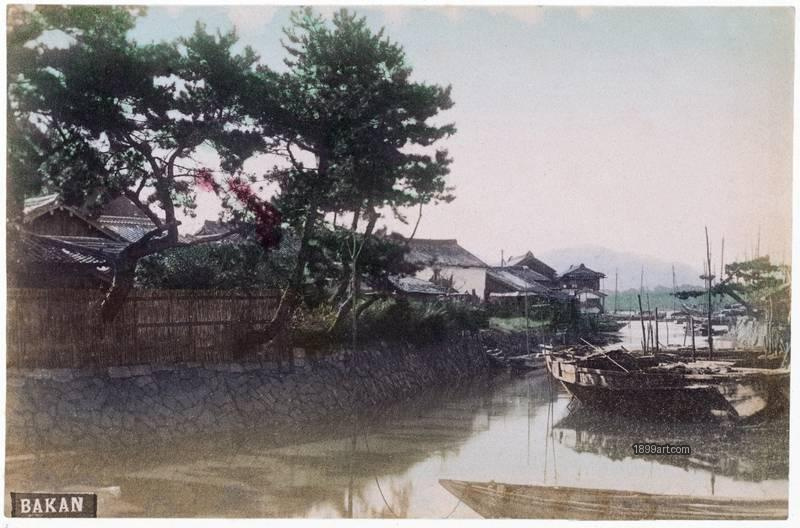
1899art Japan, Bakan (Shimonoseki) – Canal View, c. 1890 Handcolored 1900s 1899art
From the 1899art Archive: This hand-colored photograph shows a tranquil canal in Bakan, the historical name of present-day Shimonoseki, around 1890. A narrow waterway bordered by stone embankments, traditional wooden houses, and pine trees leads the eye into the distance. Moored flat-bottomed boats on the right reflect in the calm water, emphasizing the canal’s role in local trade and everyday life.
The composition is carefully balanced, with the canal forming a gentle diagonal and rooftops and trees creating a quiet rhythm of lines. Subtle hand coloring in restrained greens, browns, and soft blues enhances depth and material clarity without overpowering the photographic image.
Created during the Meiji period, the photograph documents a transitional moment in Japanese urban life, when waterways remained central to transportation and commerce despite rapid modernization. The caption “BAKAN” reflects contemporary Western usage and indicates production for an international audience. The image stands as a serene visual record of a traditional canal landscape on the threshold of modern change.
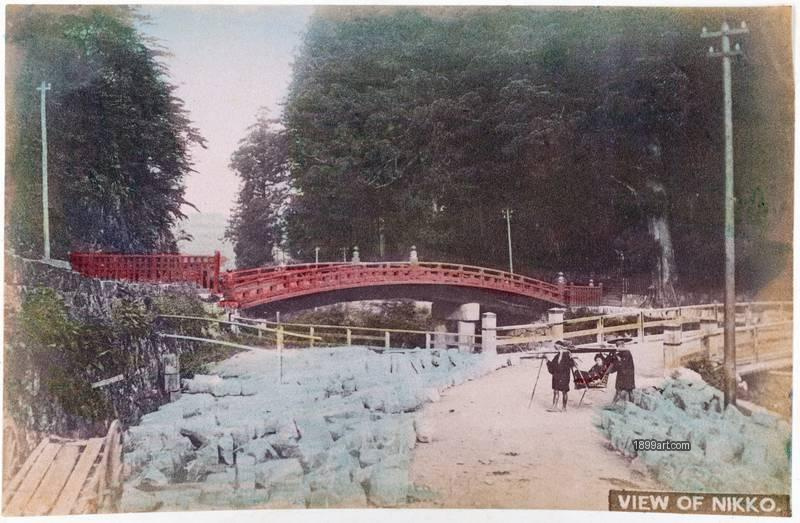
From the 1899art Archive: This hand-colored albumen photograph shows the Shinkyō Bridge, the sacred vermilion bridge marking the ceremonial entrance to the shrine precincts of Nikko. The original English caption “VIEW OF NIKKO.”, directly on the image, reflects contemporary export titling practices and confirms that the photograph was intended as a general topographical view rather than a narrowly architectural study.
In the foreground, two kago bearers are transporting a seated woman in a palanquin along the approach road, clearly situating the scene in everyday use rather than ritual isolation. The bridge visible here corresponds to the late Meiji-period structure, prior to its destruction by flooding and reconstruction in 1904. The photograph therefore documents Nikko as a lived landscape at the end of the 19th century, combining sacred architecture, infrastructure, and social movement within a single, coherent view.
Japan · c. 1895–1910 · Hand-colored photograph
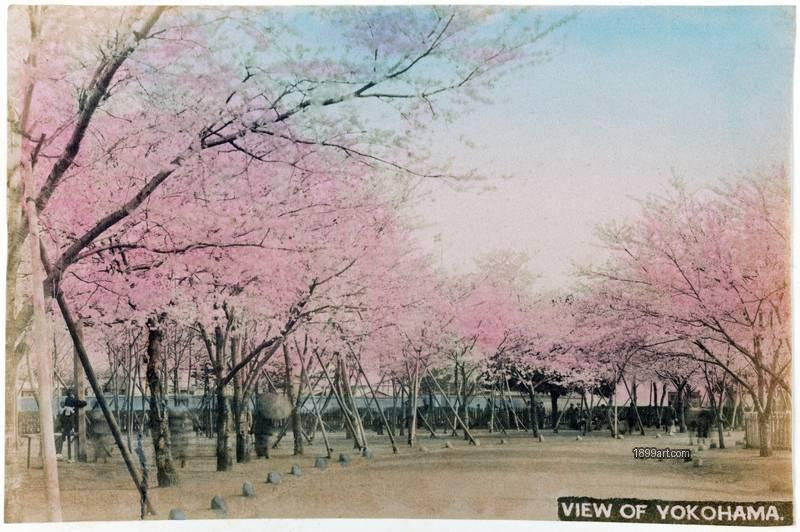
1899art Japan View of Yokohama – Cherry Blossom Park, c. 1890 Handcolored 1899art
From the 1899art Archive: This hand-colored albumen photograph presents a wide park landscape in Yokohama during the cherry blossom season. Rows of blooming sakura trees stretch across an open, level ground, their branches supported by wooden braces, a common feature of early urban park plantings in Meiji-era Japan. The scene emphasizes space, light, and seasonal atmosphere rather than architectural landmarks, with the soft pink blossoms forming a delicate canopy over the orderly park layout.
The image bears the original embedded caption “VIEW OF YOKOHAMA.” at the lower right, confirming its function as a general city view intended for the export market. Such views typically depicted accessible, centrally located public spaces rather than specific monuments. The photograph was originally produced as a monochrome albumen print and later carefully hand-colored, consistent with Yokohama School practices around 1890–1900, offering Western audiences an idealized yet documentary impression of modern Yokohama’s public landscape.
Japan · c. 1895–1910 · Hand-colored photograph
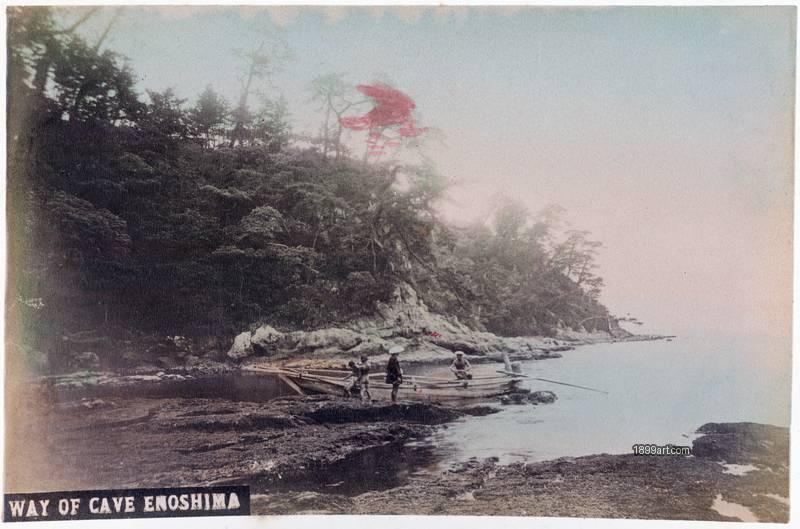
1899art Japan Way of Cave, Enoshima, c. 1890 Handcolored 1899art
From the 1899art Archive: This hand-colored albumen photograph depicts a rocky shoreline on Enoshima, showing a small group of fishermen working at the water’s edge. Wooden boats are pulled close to shore, while figures stand ankle-deep in shallow water, engaged in everyday coastal activity. The composition is defined by the contrast between the dark, tree-covered rock formations on the left and the open, calm sea extending to the right, creating a balanced and expansive coastal view.
The image bears the original embedded caption “WAY OF CAVE ENOSHIMA.” at the lower left, identifying the location as the coastal path leading toward the island’s well-known sea caves. The photograph was originally produced as a monochrome albumen print and later carefully hand-colored, in keeping with late 19th-century Japanese export photography. Rather than presenting a staged scene, the image emphasizes local maritime life and landscape, offering a documentary view of Enoshima’s shoreline as it was experienced around 1890.
Japan · c. 1895–1910 · Hand-colored photograph
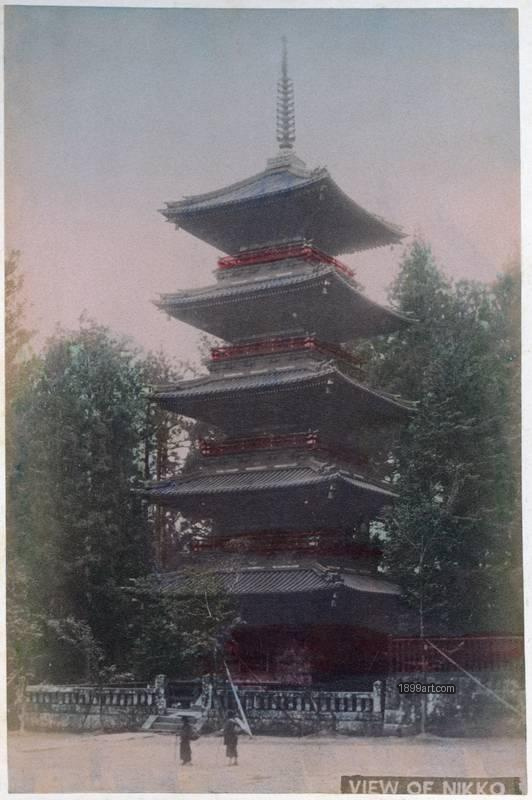
1899art Japan View of Nikko – Five-Story Pagoda, c. 1890 Handcolored 1899art
From the 1899art Archive: This hand-colored albumen photograph shows a five-story pagoda in Nikko, rising prominently among tall cedar trees. The pagoda’s layered wooden roofs and central spire dominate the composition, while two small figures at the base provide a clear sense of scale. The scene emphasizes verticality and calm symmetry, characteristic of temple architecture in Nikko during the late Meiji period.
The original embedded caption “VIEW OF NIKKO.” is visible on the image, identifying the location rather than a specific temple name, consistent with export photographs intended for foreign audiences. The photograph was originally produced as a monochrome albumen print and later carefully hand-colored. Rather than focusing on ritual activity, the image presents the pagoda as a landmark within its natural setting, reflecting Nikko’s role as a sacred landscape and major destination for travelers around 1890.
Japan · c. 1895–1910 · Hand-colored photograph
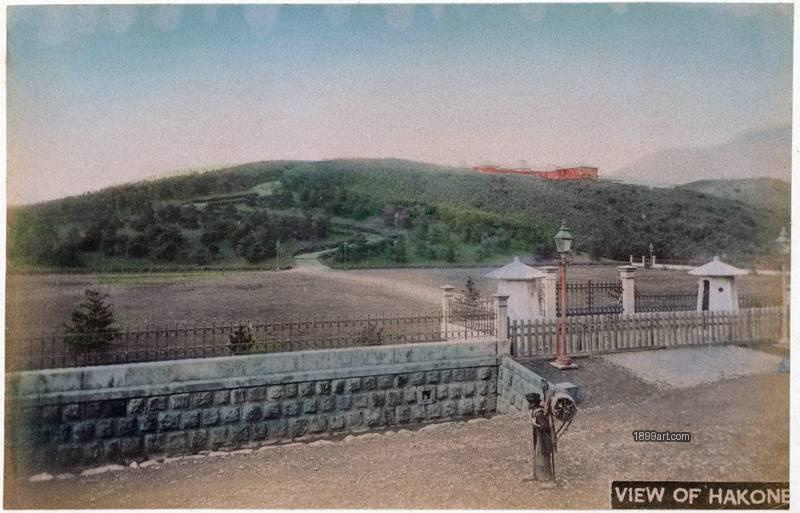
1899art Japan View of Hakone – Former Hakone Imperial Villa (Kyū Hakone Rikyū), c. 1890 Handcolored 1899art
From the 1899art Archive: This hand-colored albumen photograph shows the grounds of the former Hakone Imperial Villa (Kyū Hakone Rikyū) in Hakone, Japan. Built in 1886 as a summer retreat for the imperial family, the villa occupied a prominent position on a peninsula extending into Lake Ashi. The image presents a landscaped approach with stone walls, iron fencing, and a gate structure in the foreground, while gently rising hills and villa-related buildings appear in the background, reflecting the carefully planned setting of an elite imperial estate.
The original embedded caption “VIEW OF HAKONE.” appears on the photograph, providing a general geographic label typical of Meiji-period export photography, while the architecture and layout clearly correspond to the Hakone Imperial Villa complex. Originally produced as a monochrome albumen print, the photograph was later hand-colored to enhance depth and atmosphere. Following earthquake damage, the villa was dismantled, and the site was converted in 1945 into what is now Onshi-Hakone Park, preserving the historic landscape and viewpoints once reserved exclusively for the imperial household.
Japan · c. 1895–1910 · Hand-colored photograph
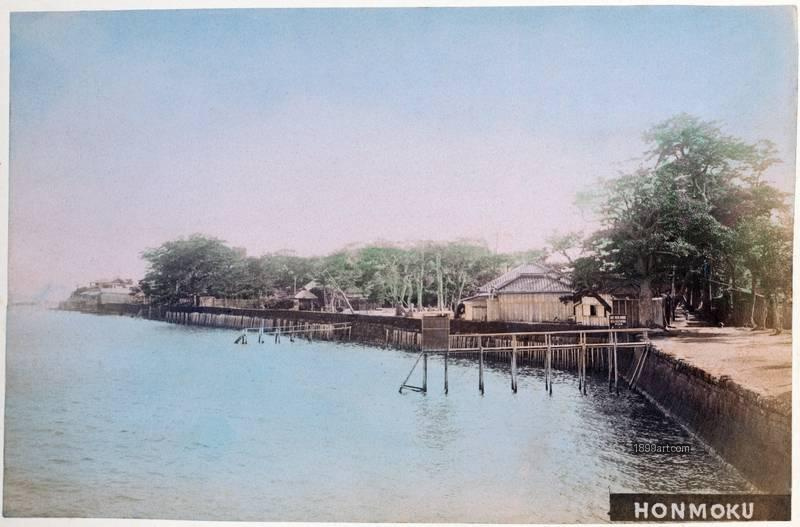
1899art Japan Honmoku – Coastal View, Yokohama, c. 1890 Handcolored 1899art
From the 1899art Archive: This hand-colored albumen photograph depicts the coastal shoreline of Honmoku, a waterfront area of Yokohama during the Meiji period. Traditional wooden buildings line the shore behind a stone embankment, while simple wooden piers and stakes extend into the shallow coastal waters. The scene reflects the semi-rural, maritime character of Honmoku before large-scale industrial development transformed the Yokohama coastline.
The original caption “HONMOKU” is clearly embedded in the image, serving as a direct location identifier rather than a descriptive title. Originally produced as a monochrome albumen print, the photograph was later carefully hand-colored in keeping with late 19th-century Japanese export photography practices. The image documents everyday coastal infrastructure and architecture in Honmoku, an area known at the time for its open shoreline, residences, and its proximity to the foreign settlement and port of Yokohama.
Japan · c. 1895–1910 · Hand-colored photograph
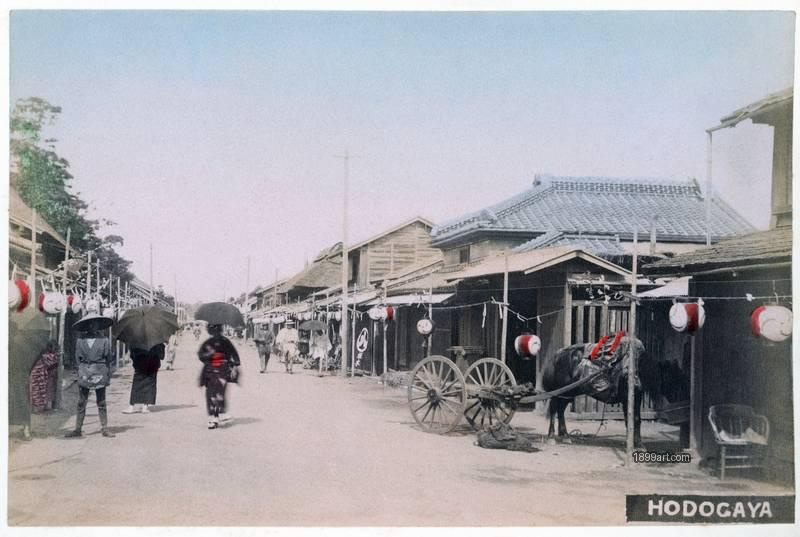
1899art Japan Hodogaya – Street View, Tōkaidō Road, c. 1890 Handcolored 1899art
From the 1899art Archive: This hand-colored albumen photograph shows a street scene in Hodogaya, a historic post town (shukuba) on the Tōkaidō Road connecting Edo (Tokyo) and Kyoto. Wooden shopfronts and inns line the wide unpaved road, while pedestrians move through the scene carrying umbrellas and wearing traditional clothing. On the right, a horse-drawn cart stands beside the street, emphasizing Hodogaya’s role as a service and transport hub for travelers.
The original caption “HODOGAYA” is clearly embedded in the image and functions as a direct geographic identifier rather than a narrative title. Originally produced as a monochrome albumen print, the photograph was later carefully hand-colored in accordance with Meiji-period export photography practices. The image documents everyday life along one of Japan’s most important historic highways, capturing Hodogaya’s transitional character at a time when Edo-period travel culture still shaped the landscape, even as modern influences were beginning to appear.
Japan · c. 1895–1910 · Hand-colored photograph
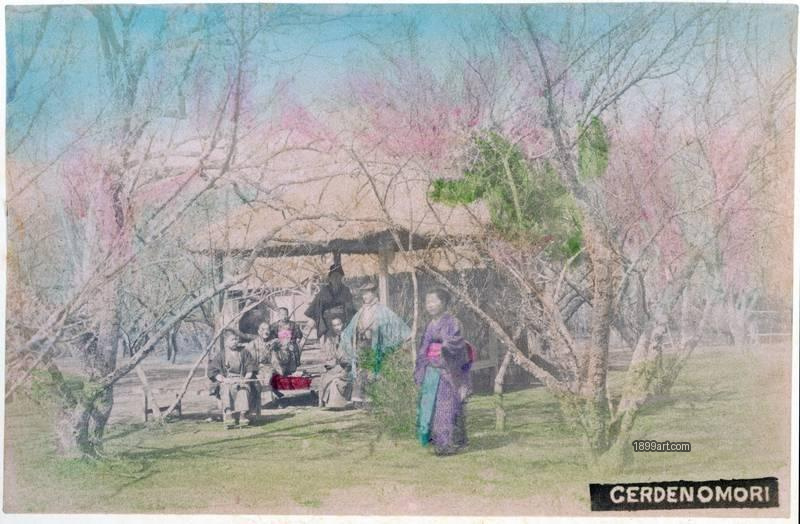
1899art Japan Japanese Tea Pavilion Gathering Handcolored 1900s 1899art
From the 1899art Archive: This hand-colored albumen photograph shows a small group resting beneath blossoming trees in a landscaped garden setting during the late Meiji period. The composition combines natural elements—bare branches, early blossoms, trimmed grass—with a simple wooden shelter, suggesting a leisure or excursion site rather than a private residence. Figures are arranged informally, some seated, others standing, conveying a calm, observational moment rather than a staged portrait.
The caption “GERDENOMORI”, directly inscribed in the image, reflects a period Western romanization rather than standardized Japanese spelling. It is most plausibly a phonetic rendering of “Garden no Mori” (“garden grove” or “garden woodland”), a descriptive term used for park-like environments intended for visitors. Such non-standard spellings are characteristic of late 19th-century export photography and were often designed to be legible and evocative for foreign audiences rather than linguistically precise.
Japan · c. 1895–1910 · Hand-colored photograph
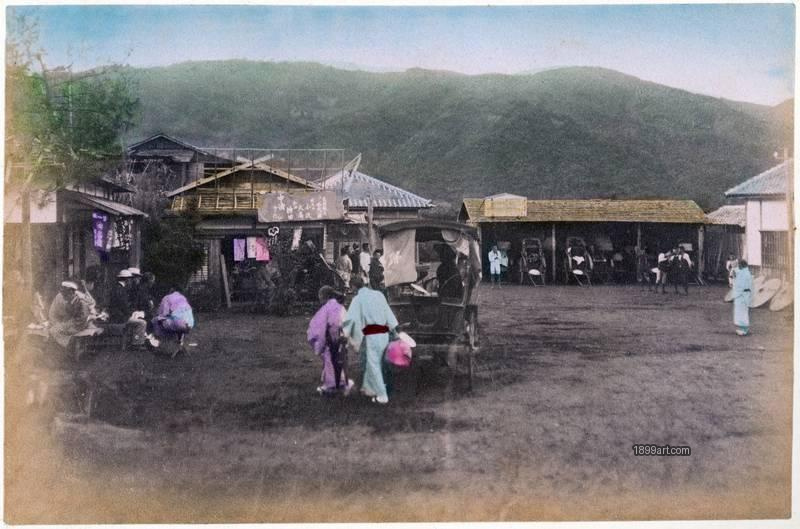
1899art Rural Rickshaw Stand and Street Life, Late Meiji Japan Handcolored 1900s 1899art
From the 1899art Archive: This hand-colored albumen photograph presents an open, unpaved square within a rural Japanese settlement during the late Meiji period. Low wooden buildings with simple shopfronts and fabric curtains border the space, while the broad clearing functions as a point of circulation rather than a commercial market. In the foreground, a jinrikisha is stationed at rest, and additional rickshaws are visible nearby, indicating the presence of a local transport stand. Figures dressed in everyday kimono move through the scene, some carrying small bundles, others pausing or conversing along the edges of the square.
The composition conveys a moment of routine activity rather than deliberate staging. Individuals appear to be waiting, passing through, or resting, suggesting the site’s role as a practical roadside node within the local transport network. Enclosing the settlement are low, wooded hills, emphasizing its provincial setting and separation from major urban centers.
Originally produced as a monochrome albumen print, the photograph was later carefully hand-colored, with color applied sparingly to garments and select architectural details. While similar images from late nineteenth-century souvenir albums are sometimes loosely associated with rural areas near Nagasaki, Yokohama, or Karuizawa, no specific location is identified on the photograph itself. The image is therefore best understood as a representative view of rural mobility and everyday street life in Meiji-period Japan, rather than as a depiction of a precisely documented place.
Japan · c. 1895–1910 · Hand-colored photograph
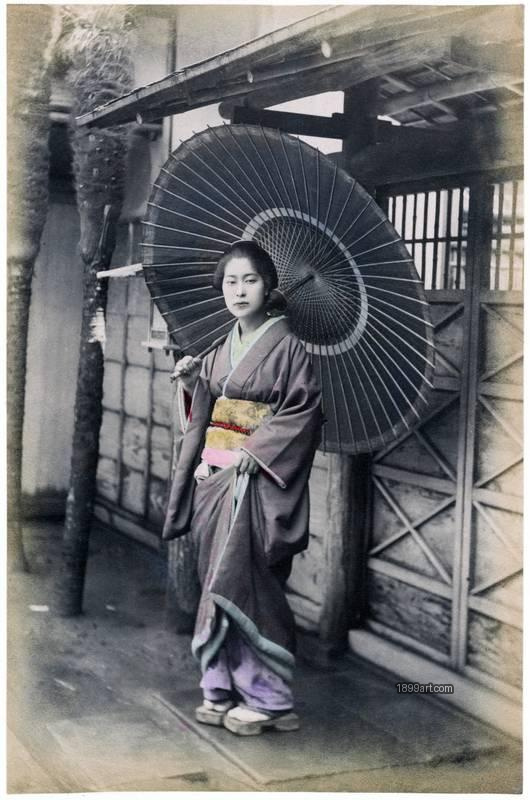
1899art Japan Woman with Paper Parasol in a Narrow Street Handcolored 1900s Enami 1899art
From the 1899art Archive: This hand-colored albumen photograph shows a woman standing in a narrow street or courtyard, holding a large wagasa (traditional Japanese paper parasol) over her shoulder. She is dressed in a subdued kimono with a carefully tied obi, her posture calm and self-contained. The parasol dominates the composition, its circular form contrasting with the angular wooden architecture behind her. The ground appears wet, suggesting recent rain or a damp urban environment.
The background consists of wooden gates, plastered walls, and simple roof structures, typical of residential or semi-commercial areas in late 19th-century Japan. The image was originally produced as a monochrome albumen print and later selectively hand-colored, with restrained emphasis on garments and accessories. No identifying caption or location is visible on the photograph itself, and the scene should be understood as a representative street portrait rather than a depiction of a specific landmark or named setting.
Japan · c. 1895–1910 · Hand-colored photograph
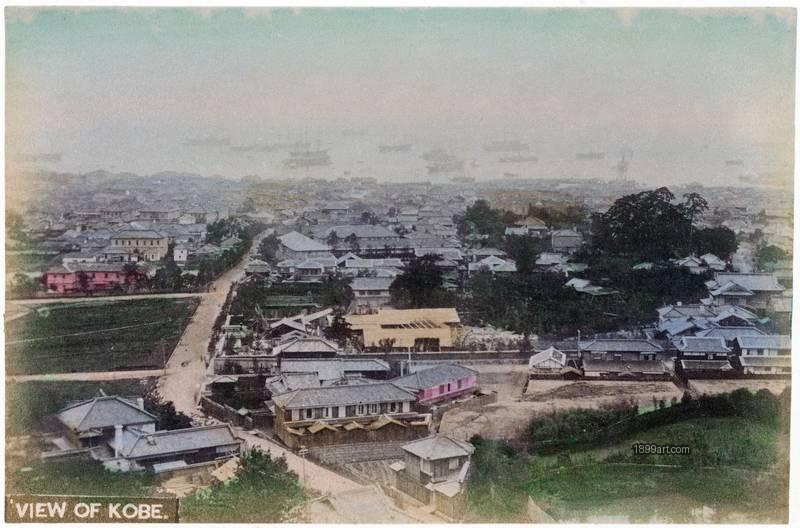
1899art Japan "270B. KOBE" — Panoramic View over Kobe and Harbor Handcolored 1900s 1899art
From the 1899art Archive: This hand-colored albumen photograph presents a wide panoramic view over the city of Kobe, looking down from an elevated vantage point toward the harbor. The composition is structured around a straight road cutting through fields and residential quarters, leading the eye toward the densely built town and the bay beyond. Numerous anchored sailing ships and steamships fill the harbor, emphasizing Kobe’s role as an international port during the late Meiji period. The photograph captures the coexistence of agricultural land, traditional Japanese architecture, and modern maritime traffic within a single coherent urban landscape.
The image corresponds directly to catalog entry “270B. KOBE” in T. Enami’s published view series. An identical photograph—matching viewpoint, composition, and numbering—appears in Enami’s catalog under this designation, confirming the attribution. Variants of this view are known with slight differences in cropping and hand-coloring, consistent with Enami’s export production practice. The catalog number, subject matter, and visual structure together establish this photograph securely within Enami’s documented body of work.
Japan · c. 1895–1910 · Hand-colored photograph
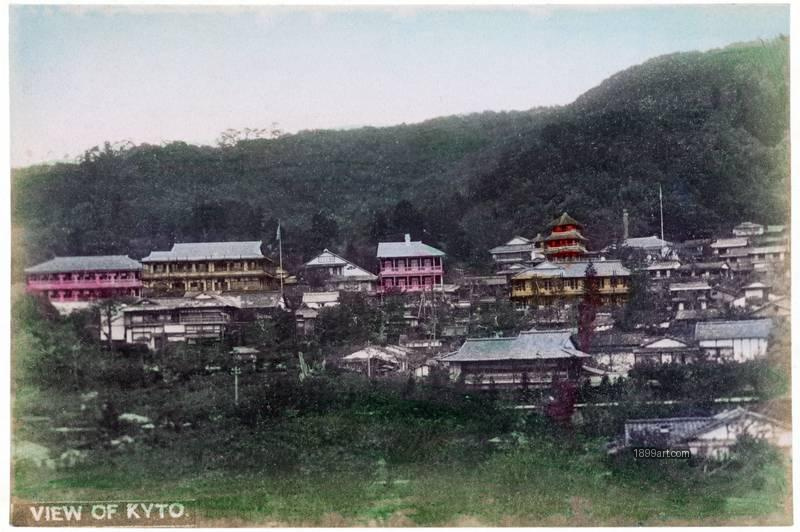
1899art Japan View of Kyoto (Maruyama District), c. 1890 Handcolored 1899art
From the 1899art Archive: This hand-colored albumen photograph presents an elevated panoramic view of the Maruyama district in Kyoto, looking across a dense cluster of temples, residences, and traditional buildings set against the wooded foothills of the eastern mountains. Prominent rooflines and a multi-storey pagoda rise above the surrounding architecture, creating a layered composition that reflects Kyoto’s urban and religious landscape in the late Meiji period.
Originally produced as a monochrome albumen print and later carefully hand-colored for the export market, the image exemplifies the Yokohama School’s approach to city views: broad perspective, architectural clarity, and restrained coloration. The caption “VIEW OF KYOTO”, visible within the image, identifies the location and situates the photograph within a larger series of regional views. Closely related views of the same area are known under separate catalogue numbers, indicating multiple negatives made from slightly different positions rather than a single cropped source image.
Japan · c. 1895–1910 · Hand-colored photograph
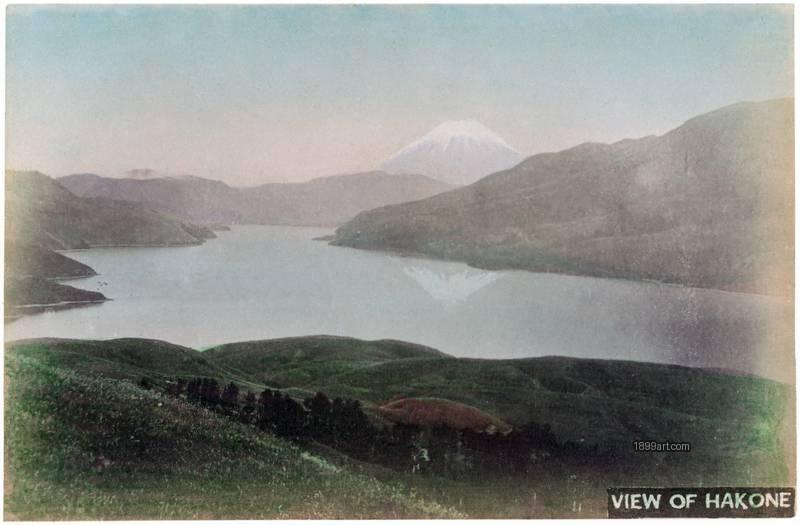
1899art Japan View of Hakone (Lake Ashi and Mount Fuji), c. 1890 Handcolored 1899art
From the 1899art Archive: This hand-colored albumen photograph presents a wide panoramic view across Hakone, looking over Lake Ashi toward the distant, snow-capped summit of Mount Fuji. The lake is framed by gently sloping hills in the foreground and darker mountain ridges on either side, creating a balanced, symmetrical composition that draws the eye toward Fuji rising at the center of the horizon.
The photograph was originally produced as a monochrome albumen print and later carefully hand-colored, with restrained tones used to differentiate water, vegetation, and sky while preserving the atmospheric depth of the landscape. Such views were popular subjects within late 19th-century Japanese export photography, presenting Hakone as a scenic resort area known for its natural beauty and vistas toward Mount Fuji.
The caption “VIEW OF HAKONE”, visible within the image, identifies the location and situates the photograph within a broader series of regional landscape views produced for foreign visitors during the Meiji period.
Japan · c. 1895–1910 · Hand-colored photograph
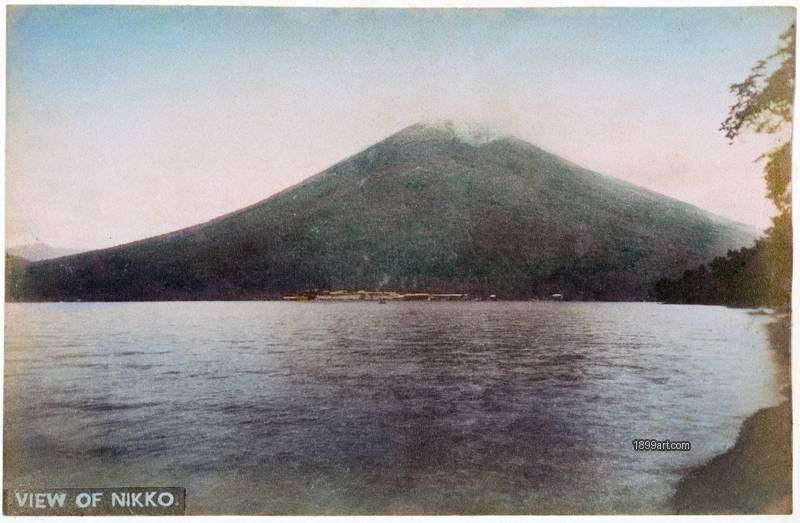
1899art Japan View of Nikko (Mount Nantai and Lake Chūzenji), c. 1890 Handcolored 1899art
From the 1899art Archive: Hand-colored albumen photograph depicting Lake Chūzenji near Nikko, with Mount Nantai dominating the background. The broad expanse of water and the gently rising volcanic slopes create a calm, balanced landscape composition characteristic of late Meiji-era scenic photography. The still surface of the lake emphasizes the mass and symmetry of the mountain, conveying both scale and quiet atmosphere.
This photograph is known to exist in identical visual form with different in-image captions.
In addition to versions bearing the short caption “VIEW OF NIKKO”, the same motif also appears with the longer and more specific designation “LAKE CHUZENJI NIKKO”, confirming that both prints derive from the same original negative. Such extended captions were commonly used in Yokohama School photography to provide foreign audiences with clearer geographic context, while shorter captions functioned as more general scenic labels.
The photograph was originally produced as a monochrome albumen print and subsequently hand-colored, a typical practice of Japanese export photography around 1900, intended to enhance visual appeal without altering the documentary structure of the scene.
Japan · c. 1895–1910 · Hand-colored photograph
1899art Japan View of Hakone — Forest Path and Mountain Outlook Handcolored 1900s 1899art
From the 1899art Archive:Hand-colored albumen photograph showing a wooded hillside in Hakone, framed by tall pine trees and dense undergrowth. In the foreground, a narrow path runs along the slope, with a small resting area and wooden elements suggesting a scenic viewpoint or roadside stop. Through the trees, distant mountain forms are faintly visible, creating depth and a layered landscape composition.
The image bears the original in-image caption “VIEW OF HAKONE.”, identifying the location in the generalized manner typical of Yokohama School export photography. Rather than documenting a specific landmark, the photograph presents Hakone as a cultivated natural environment—valued for its forests, mountain air, and picturesque walking routes.
Originally produced as a monochrome albumen print, the photograph was later carefully hand-colored. The restrained application of color emphasizes foliage and atmospheric depth while preserving the documentary structure of the scene, consistent with late 19th-century Japanese export photographs intended for Western audiences.
Japan · c. 1895–1910 · Hand-colored photograph
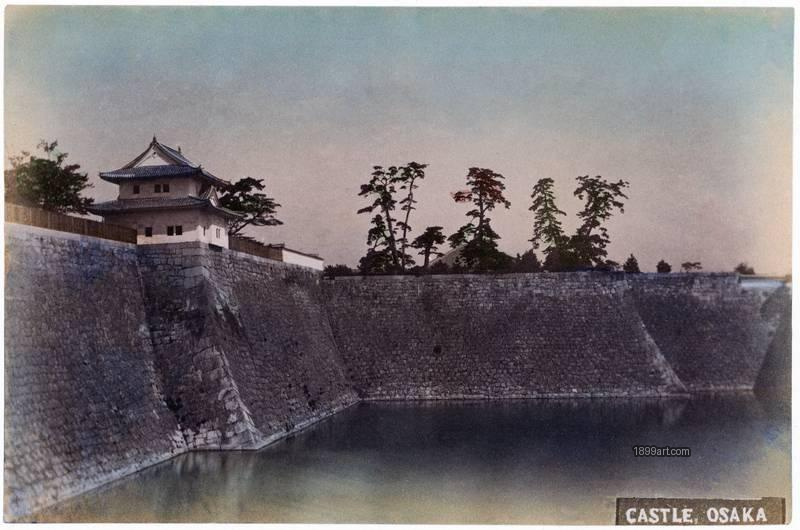
1899art Japan Castle Osaka — Outer Moat and Stone Ramparts Handcolored 1900s 1899art
From the 1899art Archive: Hand-colored albumen photograph depicting the outer defensive works of Osaka Castle. The image shows the massive sloped stone ramparts descending into a still moat, their carefully fitted blocks emphasizing the scale and engineering of early modern Japanese fortification. At the upper left stands a corner turret (yagura), its tiled roof and white plaster walls contrasting with the dark stone base.
A line of pine trees crowns the walls, adding a natural rhythm to the otherwise monumental geometry and reflecting the traditional integration of landscape and military architecture in Japanese castle design. The calm water of the moat mirrors the ramparts, reinforcing the balanced, almost austere composition.
The original in-image caption “CASTLE OSAKA.” is visible, identifying the site in the concise, place-oriented manner typical of Yokohama School export photography. The photograph was originally produced as a monochrome albumen print and later hand-colored, with restrained tones used to enhance atmosphere rather than narrative detail—consistent with late 19th-century views made for foreign visitors documenting Japan’s historic landmarks.
Japan · c. 1895–1910 · Hand-colored photograph
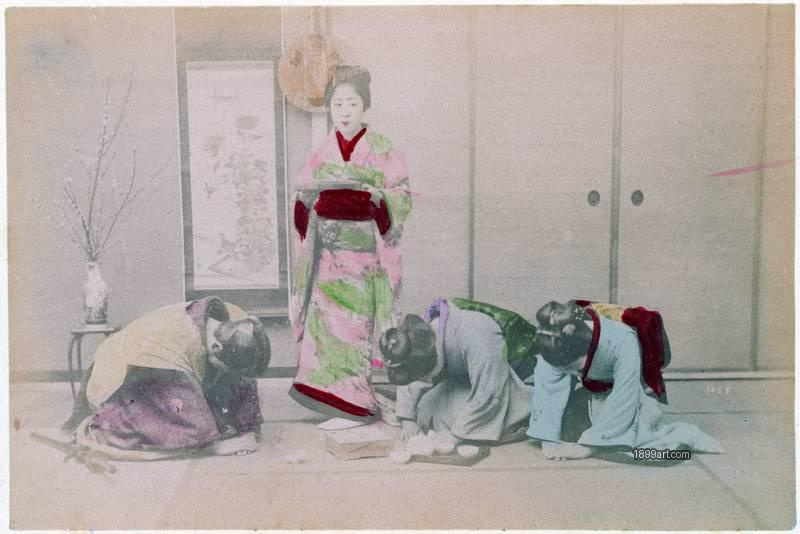
1899art Man and Meiko Making a Deep Bow to a Tea Server Woman Handcolored 1880s 1899art
From the 1899art Archive: This hand-colored albumen print (1880) is a formally staged interior scene by Kusakabe Kinbei (1841–1934), one of the leading photographers of the Yokohama School. The image is constructed as a legible code of hierarchy and etiquette for export audiences: a standing woman, centered and elevated by posture, carries a serving tray, while a man and two meiko kneel before her in an exaggerated deep bow—an emphatic performance of deference rather than a documentary domestic moment.
A decisive detail makes the intended reading explicit: a long sword (katana) lies on the tatami beside the kneeling man, functioning as a clear samurai signifier in the visual vocabulary of late 19th-century studio photography. The sword does not introduce action or threat; instead, its placement—set down, inactive, outside the body—intensifies the theme of disciplined self-control and submission to ritual order. The man is therefore staged not merely as “a male figure with a weapon,” but as a samurai-coded subject, rendered immediately recognizable to Western viewers through the most iconic attribute of the warrior class.
The sparse interior—tatami flooring, sliding fusuma doors, and minimal decoration—serves as a neutral stage that focuses attention on gesture, spacing, and controlled posture. Selective hand-coloring highlights garments and key accents while leaving the surrounding space subdued, a characteristic Yokohama School strategy that guides the eye toward role and ritual rather than toward narrative realism.
Japan · c. 1895–1910 · Hand-colored photograph
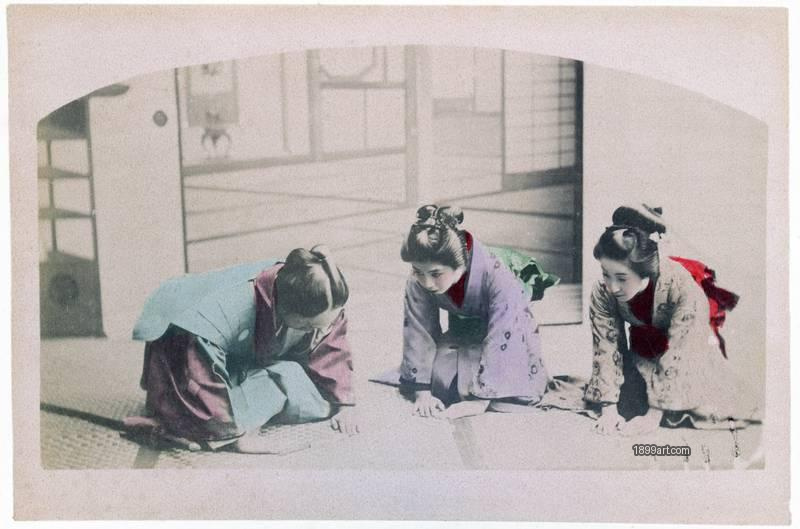
1899art Japan Meiko Bowing No. 80 – Visiting Ceremonials (Formal Bowing), c. 1880 Handcolore Kimbei 1899art
From the 1899art Archive: Printed with the catalogue number “80” and the English caption “Visiting Ceremonials,” this hand-colored albumen photograph (c. 1880) by Kusakabe Kimbei (1841–1934) stages etiquette as a teachable form rather than a lived moment. On tatami mats in a sparse interior, a kneeling man at left and two maiko at right perform a synchronized deep bow whose exaggerated forward lean and precise hand placement signal choreographed protocol.
A decisive prop anchors the intended reading: a single long sword (katana) lies on the tatami beside the man, marking him as samurai-coded—not as a claim about legal status in 1880, but as an instantly legible role-type within Yokohama School “manners and customs” imagery. Crucially, the sword is set down and inactive; its function is not threat but rank, restraint, and authority expressed through controlled posture.
The scene also contains a subtle cue that this is instruction, not merely submission: one of the kneeling meiko bows while glancing toward the swordsman rather than down to the mat, as if calibrating her movement against his demonstration. In that detail the photograph becomes a small lesson in form—an export-friendly codification of “how to bow correctly”—built from choreography, costume, and the deliberate placement of a single sign: the katana.
Japan · c. 1895–1910 · Hand-colored photograph
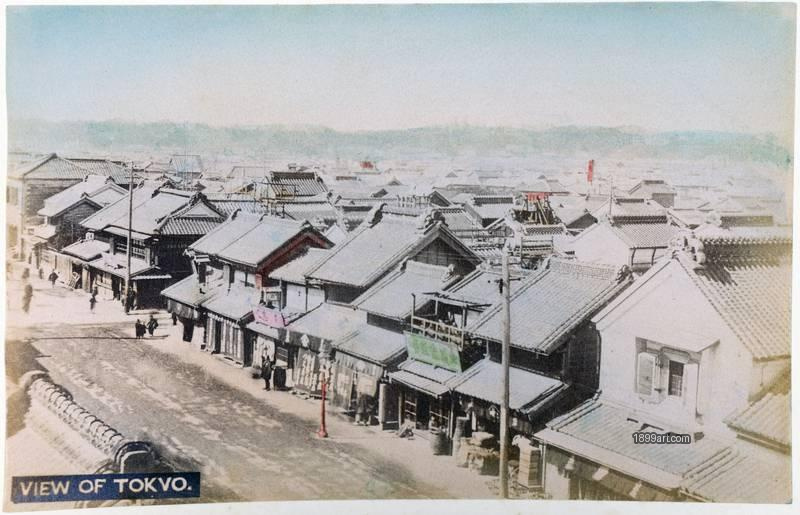
1899art View of Tokyo – Traditional Townscape with Tiled Roofs, c. 1890 Handcolored 1899art
From the 1899art Archive: This hand-colored albumen photograph presents an elevated street view of Tokyo during the late 19th century, looking across a dense expanse of traditional wooden townhouses with tiled roofs. The composition emphasizes the repetitive geometry of rooflines, narrow streets, and shopfronts, conveying the scale and texture of urban life in the Meiji period before large-scale modernization reshaped the city.
The image was originally produced as a monochrome albumen print and later carefully hand-colored for the export market. Subtle washes of color accent architectural details, shop signs, and selected garments, while the overall tonality remains restrained. The embedded caption “VIEW OF TOKYO.”, visible within the image itself, reflects the standardized naming conventions used by Yokohama School photographers for foreign audiences, prioritizing clear geographic identification over specific neighborhood attribution.
Rather than depicting monuments or ceremonial scenes, the photograph documents everyday urban structure: commercial facades, utility poles, and pedestrian activity along a gently curving street. As such, it offers a valuable visual record of Tokyo’s pre-industrial cityscape at a moment of transition, balancing traditional building forms with the early signs of infrastructural change.
Japan · c. 1895–1910 · Hand-colored photograph
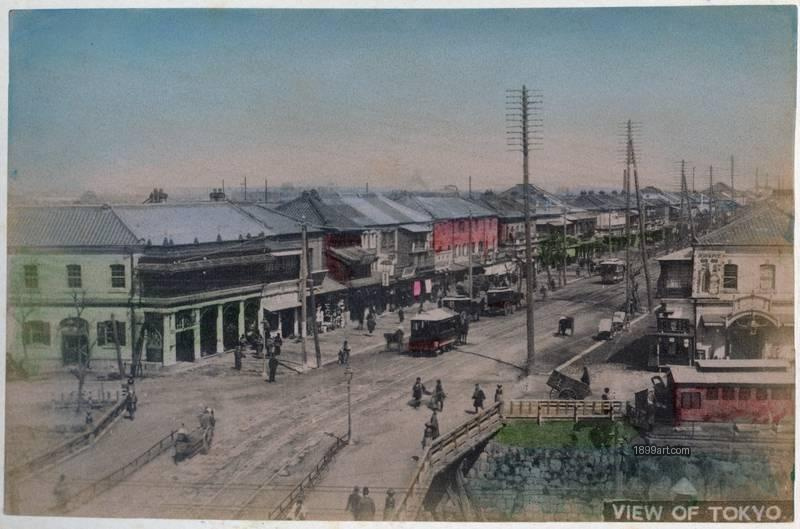
1899art Japan View of Tokyo – Main Street with Tramlines and Telegraph Poles, c. 1890 Handcolored 1899art
From the 1899art Archive: This hand-colored albumen photograph depicts a broad urban street in Tokyo during the late Meiji period, capturing a moment of transition between traditional city life and emerging modern infrastructure. Wooden and masonry shop buildings line both sides of the road, while pedestrians, carts, and early street traffic animate the scene. The presence of telegraph poles, overhead wiring, and tram tracks embedded in the street surface signals the rapid technological transformation of the capital at the turn of the century.
Originally produced as a monochrome albumen print, the photograph was later hand-colored for the export market. Color accents are selectively applied to façades, shop signs, vehicles, and clothing, while the street and sky retain a muted tonality. This restrained coloring enhances legibility without obscuring architectural detail. The elevated viewpoint allows a clear view down the street axis, emphasizing depth, circulation, and the rhythm of urban movement.
The caption “VIEW OF TOKYO.”, visibly embedded within the image, follows the standardized labeling practice of Yokohama School photography, offering a general geographic identification rather than a specific street name. The image functions less as a picturesque city view and more as a documentary record of everyday metropolitan structure, illustrating how traditional wooden architecture, commercial activity, and new transport and communication systems coexisted in Tokyo around 1890.
Japan · c. 1895–1910 · Hand-colored photograph
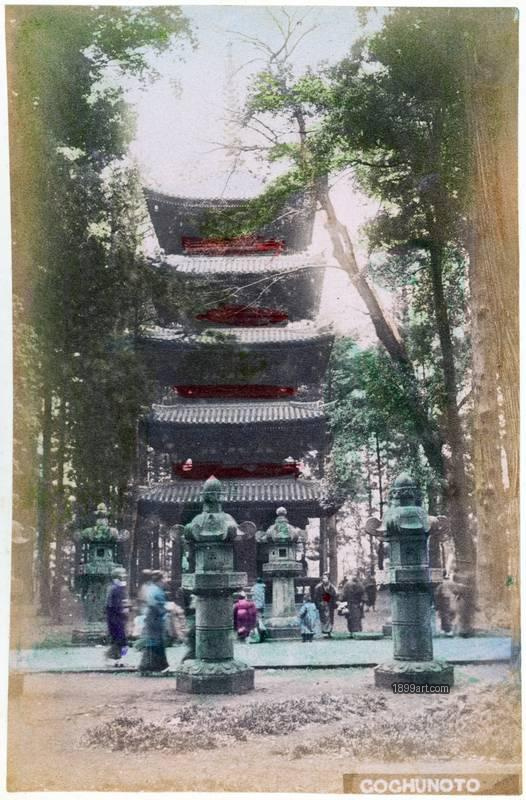
1899art Japan Five-Storied Pagoda at Mount Haguro, Yamagata Prefecture, c. 1890 Pagoda Handcolored 1899art
From the 1899art Archive: This hand-colored albumen photograph shows the five-storied pagoda (Gojū-no-tō) at the foot of Mount Haguro in Yamagata Prefecture, one of the most important sacred sites of the Dewa Sanzan mountain complex. Rising from a dense cedar forest, the pagoda is framed by tall, straight trees that emphasize its verticality and spiritual presence. In the foreground, traditional stone lanterns mark the ritual approach to the structure.
The Haguro pagoda, originally built in the 14th century, is a designated Important Cultural Property of Japan and has long served as a focal point for Shugendō mountain worship. The photograph captures the site not as an isolated monument but as part of a living religious landscape, with visitors visible near the base of the pagoda, providing scale and indicating ongoing devotional use.
Selective hand-coloring was applied after printing, with restrained red accents highlighting architectural details of the pagoda while preserving the subdued tonal balance of the surrounding forest. The caption “GOCHUNOTO”, visibly embedded in the image, uses a romanized descriptive term meaning five-storied pagoda, a common Yokohama School convention that names the architectural type rather than the exact location. Despite this generic labeling, the composition and setting clearly correspond to the pagoda at Mount Haguro.
Japan · c. 1895–1910 · Hand-colored photograph
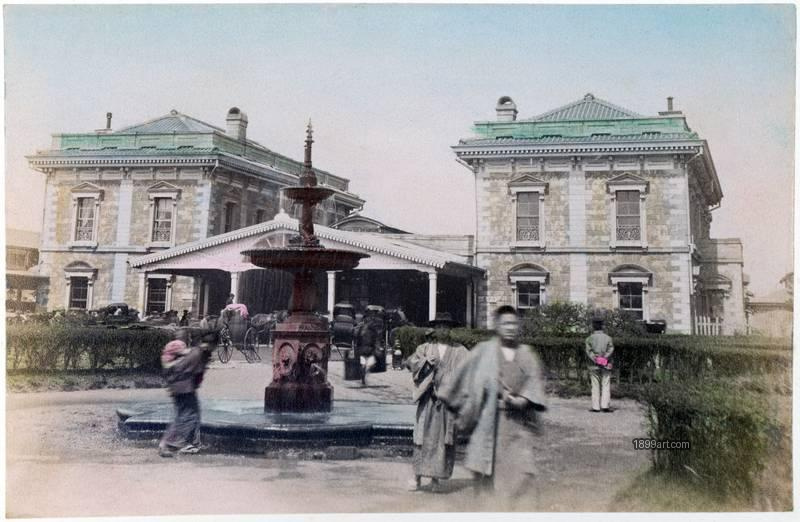
1899art Yokohama Railway Station, c. 1890 with Fountain Handcolored 1899art
From the 1899art Archive: This hand-colored albumen photograph depicts Yokohama Railway Station in the late Meiji period. The image shows the station complex with its characteristic symmetrical Western-style buildings, a central entrance structure, and a prominent fountain in the forecourt, a feature frequently visible in period views of major railway stations intended for international travelers.
The architecture reflects early Japanese railway design influenced by European institutional models, introduced following the opening of Yokohama as Japan’s principal treaty port. The station served as a key gateway between Yokohama and Tokyo and played a central role in the modernization of transport and commerce in eastern Japan.
In the foreground, people dressed in traditional Japanese clothing move through the station grounds, some captured in motion, while horse-drawn carriages and bicycles are visible near the entrance. These elements underscore the transitional character of the era, where modern infrastructure coexisted with everyday Meiji-period urban life.
The photograph was originally produced as a monochrome albumen print and later carefully hand-colored, using restrained tones for stone façades, roofing, and garments. The image documents Yokohama Station as both a functional transport hub and a symbolic site of modernization, marking the city’s role as Japan’s primary point of contact with the outside world.
Japan · c. 1895–1910 · Hand-colored photograph
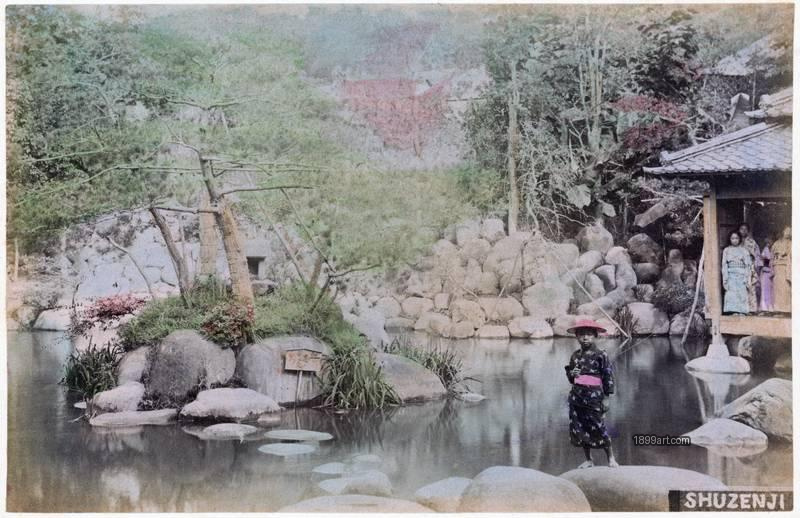
1899art Japan Scene in Shuzenji, a historic hot spring town (onsen) on the Izu Peninsula. Handcolored 1900s 1899art
From the 1899art Archive: This hand-colored albumen photograph depicts a garden scene in Shuzenji, a historic hot spring town on the Izu Peninsula. In the foreground, a young boy in traditional clothing stands on stepping stones at the edge of a pond, forming the visual focal point of the composition. In the background, several women in kimono are visible standing inside a pavilion or veranda of a wooden structure, observing the garden scene. The carefully arranged rocks, still water, and surrounding vegetation reflect the principles of Japanese garden design, emphasizing harmony between architecture and nature. The photograph was originally produced as a monochrome albumen print and later hand-colored for the export market, with restrained coloring applied to clothing and selected details while preserving the calm, balanced atmosphere.
Japan · c. 1895–1910 · Hand-colored photograph
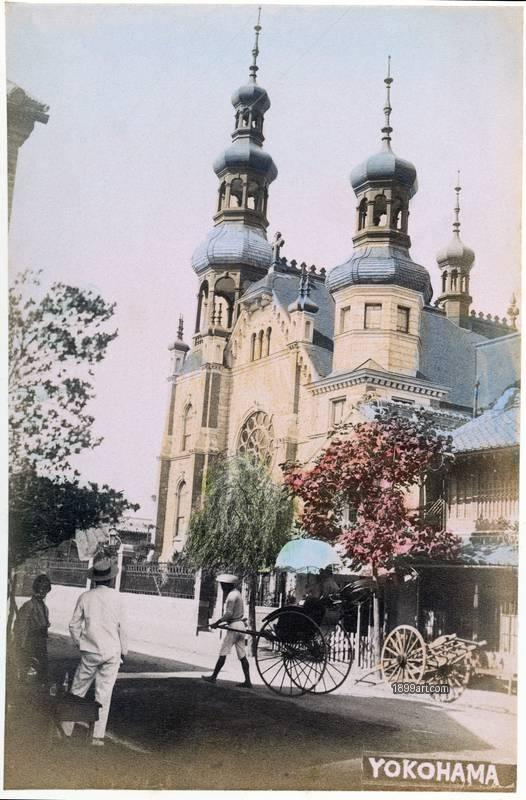
1899art Japan Yokohama – Sacred Heart Cathedral (Yamate), c. 1900 Handcolored 1899art
From the 1899art Archive:This hand-colored albumen photograph shows the Sacred Heart Cathedral of Yokohama (Yamate Tenshūdō), one of the most prominent Western-style religious buildings in Yokohama at the turn of the 20th century. The Neo-Gothic structure with its distinctive twin towers dominates the street scene, while pedestrians and a jinrikisha in the foreground situate the architecture within everyday urban life. The cathedral, completed in 1901, served the growing foreign and Catholic community of Yokohama following the opening of the port during the Meiji period.
The location “YOKOHAMA” is printed directly on the image, confirming the site. Originally produced as a monochrome albumen print and later carefully hand-colored, the photograph reflects the Yokohama School’s interest in documenting modern architecture and the visual presence of Western institutions in Japan. Rather than isolating the building as a monument, the composition integrates it into the lived streetscape, emphasizing Yokohama’s role as a contact zone between Japanese society and international influence around 1900.
Japan · c. 1895–1910 · Hand-colored photograph
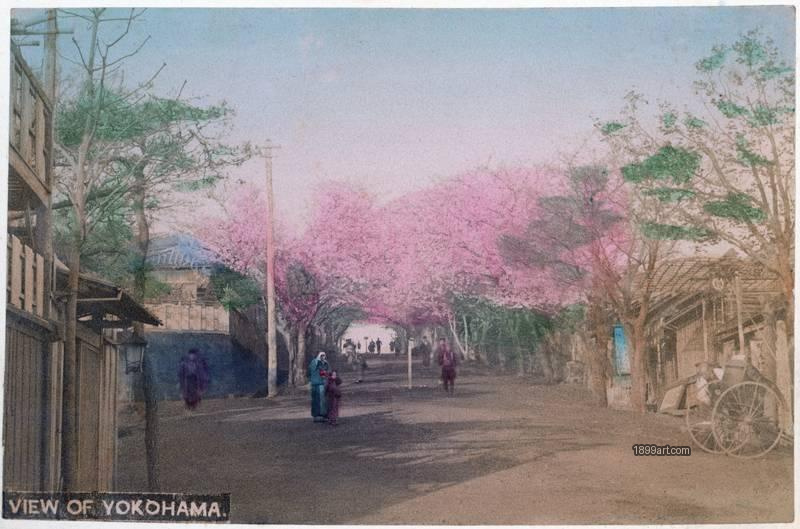
1899art Japan View of Yokohama – Cherry Blossom Street, c. 1900 Handcolored 1899art
From the 1899art Archive: This hand-colored albumen photograph depicts a quiet street in Yokohama during the cherry blossom season. A row of flowering sakura trees forms a soft canopy along the road, while a small number of pedestrians and a rickshaw at the roadside introduce scale and everyday movement. Wooden buildings line the street, creating a balanced composition that combines seasonal atmosphere with urban structure.
The caption “VIEW OF YOKOHAMA” is printed directly on the image, confirming the location as intended for the original audience. Produced as a monochrome albumen print and later carefully hand-colored, the photograph reflects the Yokohama School’s approach to street views: not as dramatic events, but as calm, legible scenes that emphasize place, season, and lived urban space in Yokohama around the turn of the 20th century.
Japan · c. 1895–1910 · Hand-colored photograph
1899art Japan Fishermen with Boat on a Riverbank, c. 1900 Handcolored 1899art
From the 1899art Archive: This hand-colored albumen photograph shows three fishermen standing on and beside a working boat at the edge of a calm river or inlet. The vessel is loaded with nets and gear, and a long pole is used to steady or maneuver the boat at the shallow shoreline. The water’s surface reflects the hull and figures, emphasizing the stillness of the scene and the functional nature of the setting.
Originally produced as a monochrome albumen print and later carefully hand-colored, the photograph belongs to the tradition of late 19th-century Japanese export photography documenting everyday labor. Rather than dramatizing the activity, the image presents fishing as routine work embedded in the landscape, with the wide waterway and low horizon reinforcing a sense of openness and quiet continuity.
Japan · c. 1895–1910 · Hand-colored photograph
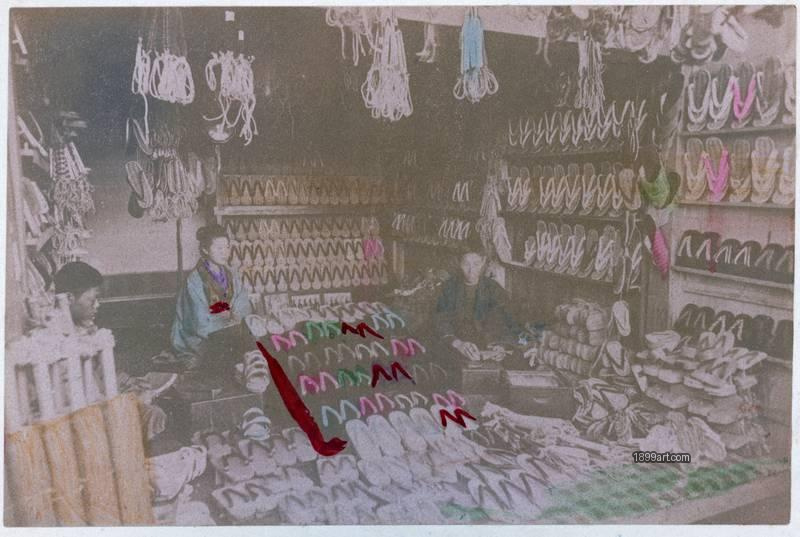
1899art Japan Sandal Shop Interior with Zōri and Geta, c. 1900 Handcolored 1899art
From the 1899art Archive: This hand-colored albumen photograph shows the interior of a traditional footwear shop, densely filled with zōri and geta sandals arranged on shelves, hanging from beams, and stacked across the floor. Several figures are seated inside the shop, engaged in quiet work or waiting, surrounded by rows of finished sandals and bundled materials.
The image was originally produced as a monochrome albumen print and later selectively hand-colored, with particular emphasis on individual straps and garments. Rather than staging a commercial scene for effect, the photograph documents the spatial reality of a small retail and craft environment, where production, storage, and sale coexist in a single room. The tightly packed composition reflects the material culture of everyday urban life in late 19th-century Japan, focusing on function, repetition, and craft rather than narrative action.
Japan · c. 1895–1910 · Hand-colored photograph
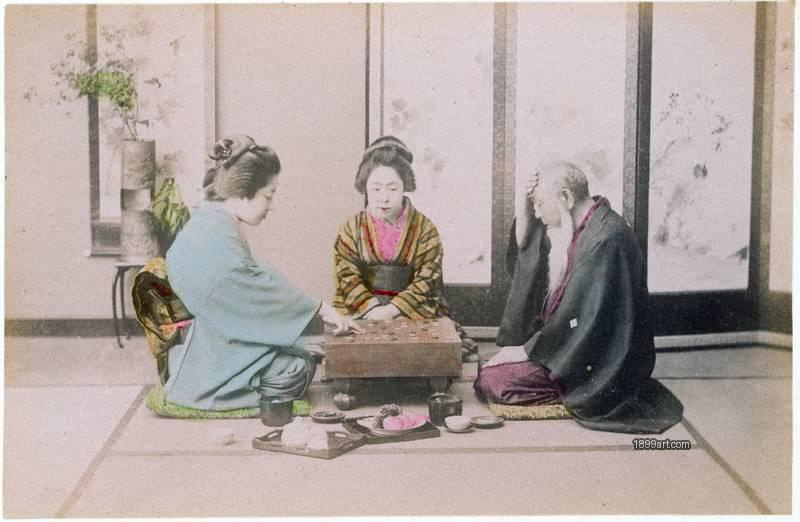
1899art Japan Playing at Go (Indoor Scene), No. B 88, c. 1890–1900 Handcolored 1899art
From the 1899art Archive: This hand-colored albumen photograph shows three figures seated on tatami mats around a low wooden go board inside a formal Japanese interior. Two women in kimono are actively engaged in the game, while an elderly man sits to the right, observing the position with a contemplative gesture, his hand resting on his head.
The setting is defined by sliding paper doors (shōji) and a painted folding screen in the background, decorated with birds and flowering plants. A tokonoma alcove with a simple flower arrangement is visible to the left, reinforcing the formal and domestic character of the room. In the foreground, lacquered trays with tea bowls and small sweets are arranged neatly on the tatami, indicating a pause within a longer social encounter.
Originally produced as a monochrome albumen print, the photograph was subsequently hand-colored with restraint, emphasizing garments, cushions, and small objects while leaving architectural elements largely neutral. The image documents a quiet moment of leisure and intellectual pastime, combining staged composition with everyday domestic ritual, characteristic of late 19th-century Japanese studio photography intended for both local and foreign audiences.
The printed caption “B 88 – Playing at Go Draught” identifies the image as part of a numbered commercial series, suggesting standardized distribution within a larger photographic catalog.
Japan · c. 1895–1910 · Hand-colored photograph
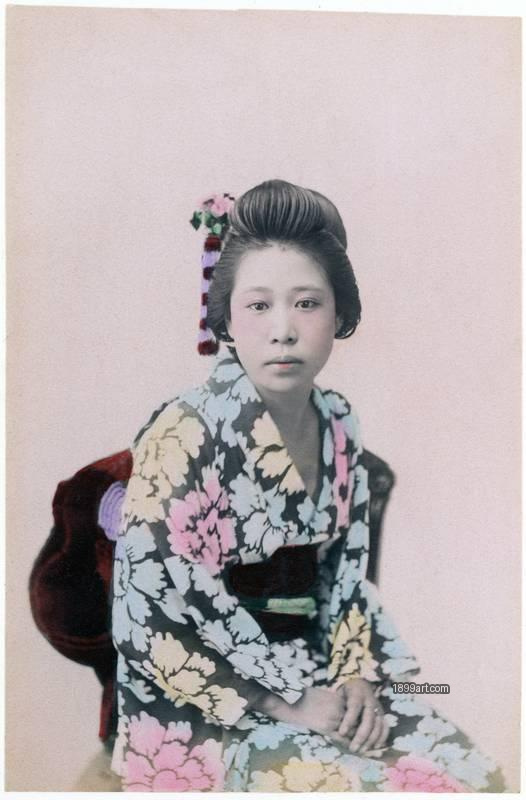
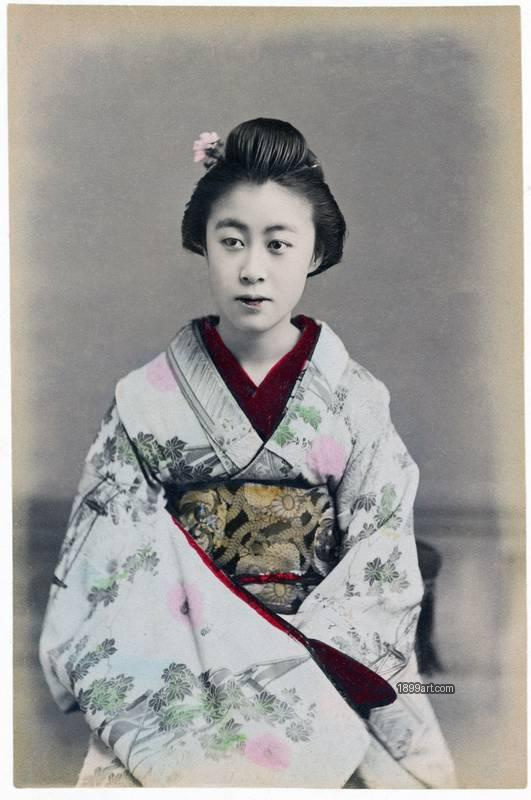
1899art Japan Young Woman in Floral Kimono (Studio Portrait), c. 1890–1900 Handcolored 1899art
From the 1899art Archive:This hand-colored studio portrait depicts a young Japanese woman seated against a plain, softly tinted background. She wears a richly patterned kimono decorated with large floral motifs, rendered in restrained pastel tones with selective hand-coloring applied to the garment and hair ornaments. Her posture is composed and reserved, with hands folded gently in her lap, conveying quiet self-possession rather than overt display.
The woman’s hairstyle is arranged in a formal style typical of the late Meiji period, with decorative cords and floral elements placed discreetly at the back of the coiffure. Her facial expression is neutral and direct, neither smiling nor theatrical, suggesting an intention to present dignity and calm rather than emotion. The absence of props or architectural context places full emphasis on the sitter herself, a common strategy in studio portraiture intended for both documentation and export.
Originally produced as a monochrome albumen print, the photograph was subsequently hand-colored with particular attention to textile patterns and subtle skin tones, while the background remains intentionally minimal. The image exemplifies late 19th-century Japanese studio photography’s balance between idealized representation and individual presence, offering a timeless, intimate view of personal appearance and cultural aesthetics of the period.
Japan · c. 1895–1910 · Hand-colored photograph
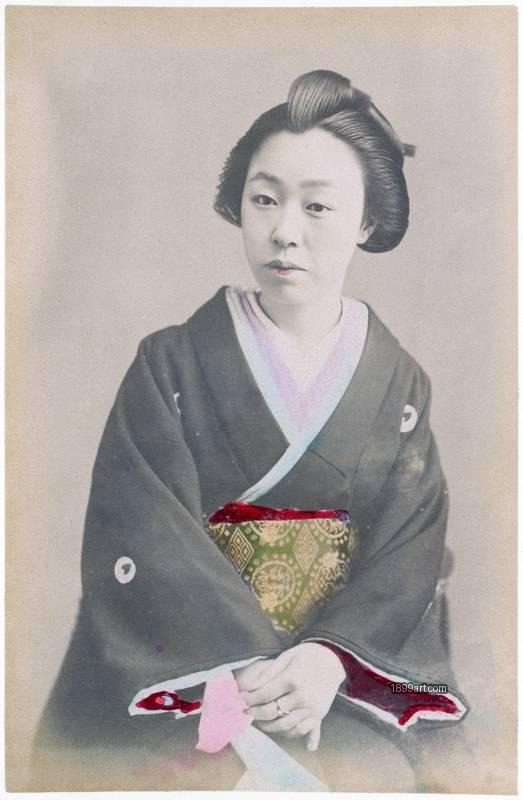
1899art Studio Portrait of a Japanese Woman in Formal Kimono Handcolored 1900s 2 1899art
From the 1899art Archive: This hand-colored studio portrait depicts an adult Japanese woman posed calmly against a neutral backdrop. Her hairstyle, kimono, and obi clearly correspond to the attire of a mature civilian woman of the late Meiji period and do not indicate a maiko or geisha. In particular, the closed nihongami hairstyle, the restrained kimono pattern, and the traditionally tied obi distinguish the sitter from women of the licensed entertainment districts.
The kimono bears subtle family crests (kamon), suggesting a formal or representational context rather than a commercial studio fantasy. The sitter’s composed posture and direct gaze reflect the visual language of Meiji-era studio photography, which emphasized dignity, restraint, and social identity.
Hand-coloring is applied sparingly and with precision, primarily accenting the obi and inner garments. Rather than theatrical enhancement, the coloring serves to clarify material and form. This photograph exemplifies an important but often overlooked aspect of Yokohama School photography: the documentation of civilian identity alongside travel views and genre scenes produced for both domestic and foreign audiences.
Japan · c. 1895–1910 · Hand-colored photograph
1899art Japan Maiko Portrait in Formal Attire Handcolored 1900s 1899art
From the 1899art Archive: This hand-colored studio portrait shows a maiko, identifiable by her formal kimono, long furisode sleeves, richly patterned obi, and traditional maiko hairstyle.
Within the conventions of Yokohama School photography, figures depicted wearing maiko garments and hairstyle are understood to represent actual maiko, not generalized models or symbolic types.
The image reflects the refined visual language of late 19th-century Japanese studio photography, where dress, hairstyle, and posture function as precise social identifiers.
Rather than theatrical staging, the photograph presents a composed and dignified portrayal of a young maiko, emphasizing apprenticeship, youth, and cultural continuity.
The restrained hand-coloring highlights textile patterns and facial features while preserving the photographic structure of the original albumen print.
Japan · c. 1895–1910 · Hand-colored photograph
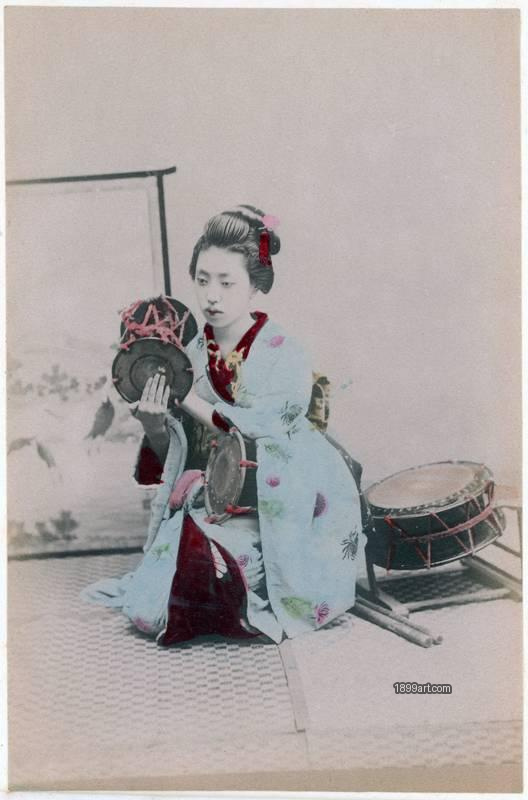
1899art Japan Maiko Performing with Tsuzumi and Taiko Handcolored 1900s 1899art
From the 1899art Archive: This hand-colored studio photograph depicts a maiko kneeling in formal performance posture, holding a tsuzumi hand drum, with a taiko placed beside her. Her distinctive maiko hairstyle, long-sleeved furisode kimono, and ornamental hairpins clearly identify her as a maiko in training.
The identical image is documented in Japanese institutional archives under the descriptive title “Singing Girl (Tsuzumi, Taiko)”, where the term refers to the depicted activity rather than the social role of the subject.
Archival reference:
International Research Center for Japanese Studies (Nichibunken), Web OPEC
Photo title: SINGING GIRL (TSUZUMI, TAIKO)
Photo ID: YA081023
GID: G0204584
Source publication: YA081
Within the Yokohama School context, such generic English captions were routinely used for export and cataloguing purposes. Visual identifiers take precedence over catalog titles. The hairstyle, kimono construction, and performance setting unequivocally indicate a maiko engaged in musical training, consistent with documented maiko education practices of the late 19th century.
This photograph should therefore be understood as a documentary studio image of a maiko in performance training, not as a generic portrayal of an anonymous “singing girl.”
Japan · c. 1895–1910 · Hand-colored photograph
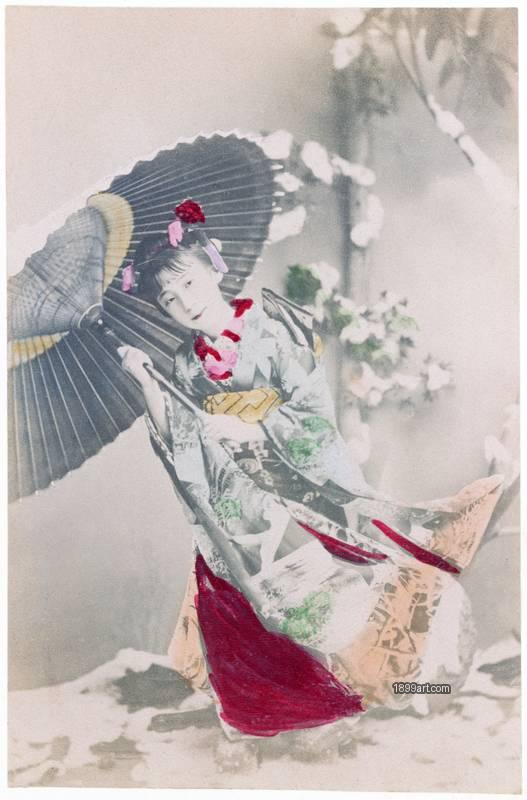
1899art Beauty in Snow – Young Maiko with Parasol Japan, c. 1890–1900 1899art
From the 1899art Archive: This hand-colored albumen photograph depicts a young maiko standing in falling snow, holding a traditional paper parasol. The subject wears a formal maiko kimono with a long-sleeved silhouette and an elaborate wareshinobu-style hairstyle, clearly identifying her as an apprentice geisha rather than a general female sitter. The seasonal setting, parasol, and stylized posture reflect a carefully composed studio scene typical of Yokohama School photography intended for the late Meiji export market.
The image corresponds to a documented museum-held work and is recorded in the collection of the Tokyo Photographic Art Museum (Work No. 87727). Comparable examples of this motif appear in institutional and commercial catalogues associated with Kusakabe Kimbei, including related snow-themed portraits and genre studies of maiko.
The photograph exemplifies the Yokohama School convention of combining staged studio photography with seasonal symbolism and selective hand-coloring, emphasizing elegance, youth, and refined cultural identity rather than narrative realism.
Japan · c. 1895–1910 · Hand-colored photograph
1899art Maiko with Parasol – Studio Garden Scene Japan, c. 1890–1900 Handcolored 1900s 1899art
From the 1899art Archive: This hand-colored albumen photograph depicts a young maiko posed outdoors in a staged garden setting, holding a traditional paper parasol. The identification as maiko is supported by the formal apprentice hairstyle, the long-sleeved kimono, and the overall styling consistent with late Meiji-period maiko iconography as represented in Yokohama School photography.
The pose suggests controlled movement rather than portrait stillness, with the body inclined and the kimono slightly lifted, creating a dynamic yet composed silhouette. The parasol functions both as a cultural attribute and a compositional device, balancing the figure against the lightly suggested garden background. As typical for export-oriented Yokohama School images, the scene is not documentary but carefully staged, combining studio control with the visual suggestion of an outdoor environment.
Selective hand-coloring emphasizes the kimono, obi, and footwear, while the background remains subdued, directing attention to the figure’s role, costume, and gesture. The photograph belongs to a broader group of Yokohama School maiko studies that focus on elegance, youth, and formalized movement rather than narrative context.
Japan · c. 1895–1910 · Hand-colored photograph
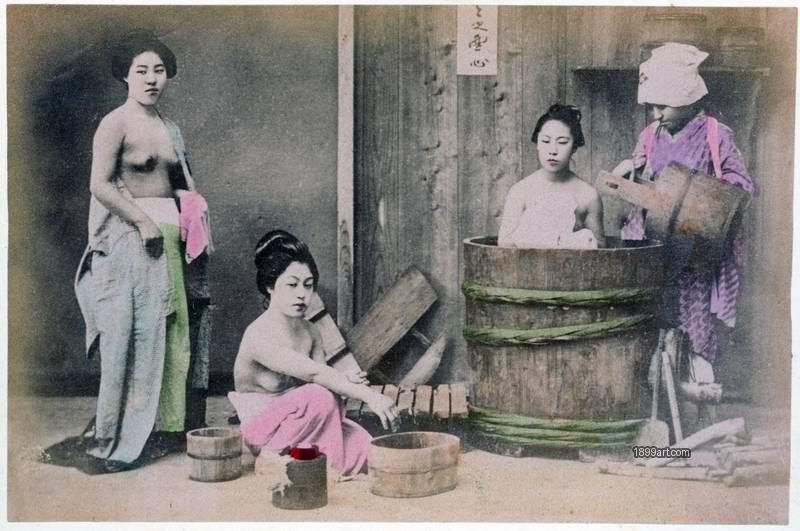
1899art Home Bathing (B 1098) Three Japanese Women Bathing Handcolored 1900s Kimbei 1899art
From the 1899art Archive: This hand-colored albumen photograph depicts three Japanese women engaged in a domestic bathing scene, arranged around wooden tubs, buckets, and washing implements. One woman is seated inside a large barrel bath while the others assist with washing and preparation, forming a carefully composed but activity-focused tableau.
The scene is staged within a studio setting, using wooden walls, vessels, and tools that closely mirror everyday bathing practices of the late Meiji period. While partially undressed, the figures are presented in a task-oriented, non-theatrical manner, emphasizing routine hygiene rather than narrative or erotic intent.
This photograph is securely documented in museum collections. An identical print is held by the Münchner Stadtmuseum (Von Parish Kostümbibliothek) under the title “Drei Japanerinnen beim Baden”, inventory number VPK-2017/209.100, bearing the original studio caption “B 1098 HOME BATHING”. The museum dates the work to circa 1890 and attributes it to Kusakabe Kimbei, confirming both authorship and subject classification.
Bathing scenes such as this were a recurring genre within late 19th-century Yokohama School photography, positioned between ethnographic illustration and commercial studio production. The image reflects contemporary Western interest in Japanese domestic customs while maintaining a composed, observational structure consistent with Kimbei’s cataloged studio work.
Japan · c. 1895–1910 · Hand-colored photograph
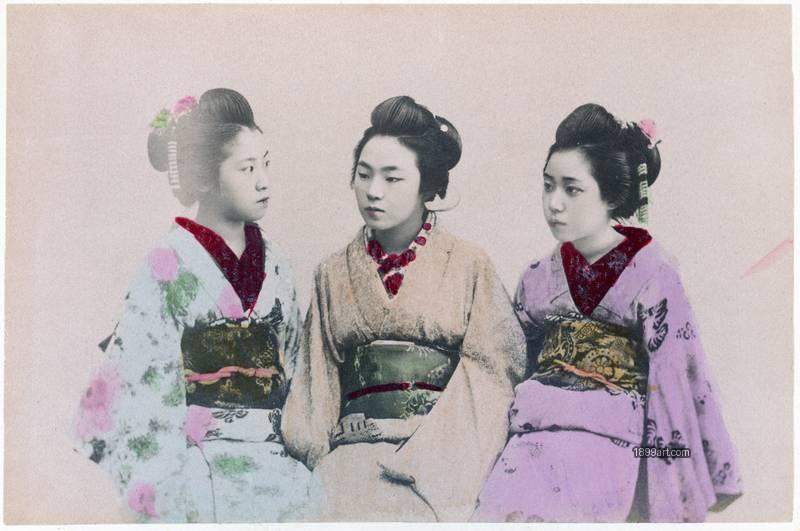
1899art Japan Three Maiko in Conversation Handcolored 1900s 1899art
From the 1899art Archive: This hand-colored albumen photograph depicts three maiko seated closely together, captured in a quiet moment of shared attention and subtle interaction. Their distinctive maiko hairstyles, including the elaborate coiffure with floral hair ornaments, combined with formal long-sleeved kimono and wide obi, clearly identify them as maiko (apprentice geisha) rather than generic female models.
The composition emphasizes relationship and hierarchy: the central figure appears slightly more composed and inward-facing, while the two flanking maiko turn toward her, creating a triangular structure typical of late 19th-century Yokohama School studio portraits. The restrained poses and neutral background direct focus toward costume, posture, and expression, not narrative action.
Such images were produced for the export market but rely on accurate professional markers rather than theatrical role-play. In the context of Yokohama School practice, figures wearing correct maiko dress and hairstyle are understood to represent maiko as such, not generic women in costume.
The photograph exemplifies the studio tradition of controlled realism: carefully staged, yet grounded in authentic visual codes of the Kyoto entertainment world during the Meiji period.
Japan · c. 1895–1910 · Hand-colored photograph
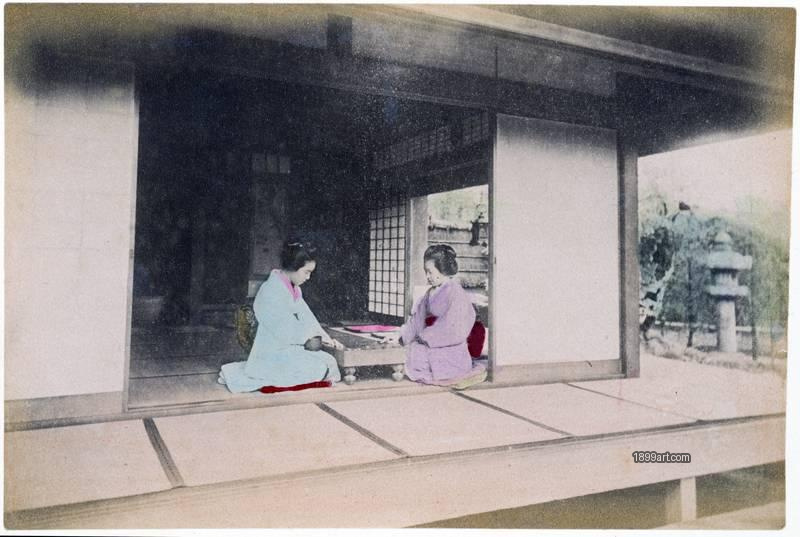
1899art B 277 – Two Maiko Playing Go at Okano Garden, Meguro, Tokyo Handcolored 1900s 1899art
From the 1899art Archive: This hand-colored albumen print, labeled on the mount as “B 277 OKANO GARDEN MEGURO TOKYO”, shows two maiko playing the board game Go on a low table in a traditional interior with sliding doors and garden view. The figures wear formal apprentice geisha attire, confirming their professional status. The original studio annotation provides the only firm catalog identifier currently available for this motif.
Produced around the late Meiji period as part of the Yokohama School photographic tradition, the scene combines staged composition with authentic visual codes of costume and setting. The label B 277 functions as the producer’s own catalog reference.
Japan · c. 1895–1910 · Hand-colored photograph
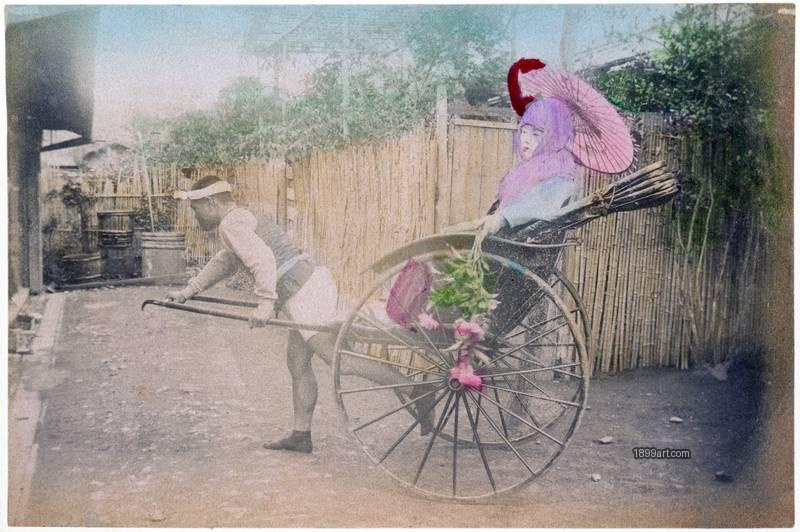
1899art Woman in a Rickshaw with Parasol, Japan (Yokohama School), c. 1890–1900 Handcolored 1899art
From the 1899art Archive: This hand-colored albumen photograph depicts a woman seated in a traditional jinrikisha (rickshaw), drawn by a rickshaw runner along an unpaved street. The passenger holds a paper parasol and wears a formal kimono, while the puller is dressed in typical working attire with headband and short trousers. A bamboo fence and simple wooden structures line the roadside, situating the scene in an everyday urban environment.
The image belongs to the visual repertoire of the Yokohama School, where such scenes were produced for both documentary and export purposes. The composition combines a staged clarity with authentic social roles: the rickshaw runner shown explicitly as laborer, the female passenger as a client in transit. Hand-applied color highlights the parasol, clothing, and floral accents, emphasizing contrast between motion, status, and setting.
Rickshaw scenes like this were a recurring subject in late Meiji-period photography, reflecting modern urban mobility while preserving traditional forms of transport. The photograph illustrates not performance or disguise, but a real, contemporary social interaction rendered in a controlled photographic setting.
Japan · c. 1895–1910 · Hand-colored photograph
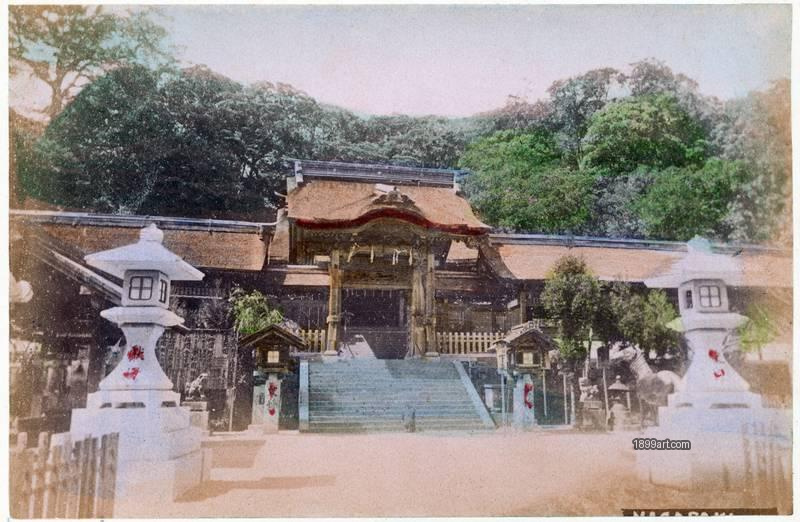
1899art Osuwa Shrine (Osuwa-Ten), Nagasaki — Shrine Entrance with Stone Lanterns, c. 1890–1900 Handcolored 1899art
From the 1899art Archive: This albumen photograph shows the formal entrance of Osuwa Shrine (Osuwa-Ten) in Nagasaki, clearly identified by the original negative caption “B 224 OSUWA-TEMPLE, NAGASAKI” visible in the print.
The composition centers on a broad stone stairway leading to the shrine’s main gate, framed symmetrically by large stone lanterns (ishidōrō) in the foreground and smaller lantern structures closer to the steps. A shimenawa rope beneath the gate roof confirms the site as Shinto, while guardian figures and wooden fencing further define the sacred precinct.
Set against a wooded hillside, the shrine complex illustrates the close integration of Shinto architecture and natural landscape. Such views were frequently produced by Yokohama School studios as both documentary records and export images, with standardized numbering systems (here B 224) used for international distribution.
Japan · c. 1895–1910 · Hand-colored photograph
1899art Japan Three Women in Kimono Seated Indoors Handcolored 1900s 1899art
From the 1899art Archive: This hand-colored albumen photograph shows three Japanese women seated on tatami mats in an interior setting. The women wear everyday kimono of differing patterns and subdued colors, their hair styled in contemporary late-Meiji fashions. In front of them are small tea bowls and utensils, suggesting a moment of quiet domestic activity or a simplified tea-serving scene rather than a formal tea ceremony.
The restrained poses, neutral studio backdrop, and carefully arranged interior elements reflect the visual language of Yokohama School photography, where scenes of daily life were composed for both documentary and commercial purposes. The image does not depict geisha or maiko; instead, it presents women in ordinary kimono, emphasizing that kimono were standard attire across Japanese society, not exclusive to entertainment professions.
Likely produced in Yokohama around the turn of the 20th century, the photograph belongs to the broader genre of genre studies that introduced Western audiences to Japanese domestic interiors and social customs.
Japan · c. 1895–1910 · Hand-colored photograph
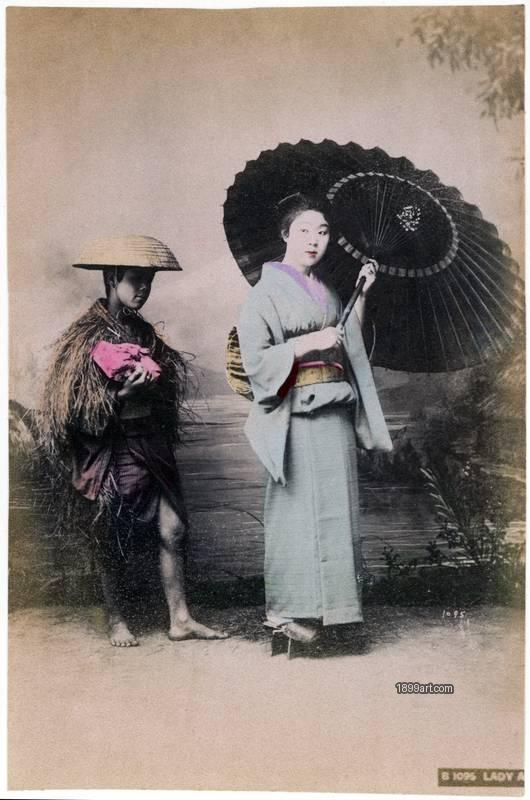
1899art Japan B 1095 — “Lady and Boy” (Woman with Parasol and Boy), hand-colored albumen print 1899art
From the 1899art Archive: Hand-colored albumen photograph (Yokohama School), studio composition. An adult Japanese woman stands in three-quarter pose holding a large paper parasol; she wears a formal-but-non-professional kimono with a modest obi and an adult hairstyle (no Meiko markers). To her left stands a barefoot boy in rustic attire, including a woven hat and a straw/rain cape (mino), holding a cloth bundle. The background is a painted landscape backdrop typical of export-oriented Meiji-period studio work, using staged social contrast (urban femininity vs. rural youth) as an illustrative motif rather than documenting an identifiable event.
Catalog reference / concordance: The identical composition is documented in the International Research Center for Japanese Studies (Nichibunken), Web OPEC / Sekiei image database, where it is catalogued as “LADY AND BOY”, B 1095 (image reference as provided by the user: sekiei.nichibun.ac.jp, thumbnail view). This external catalog entry confirms the standard title and numbering used for this motif.
Japan · c. 1895–1910 · Hand-colored photograph
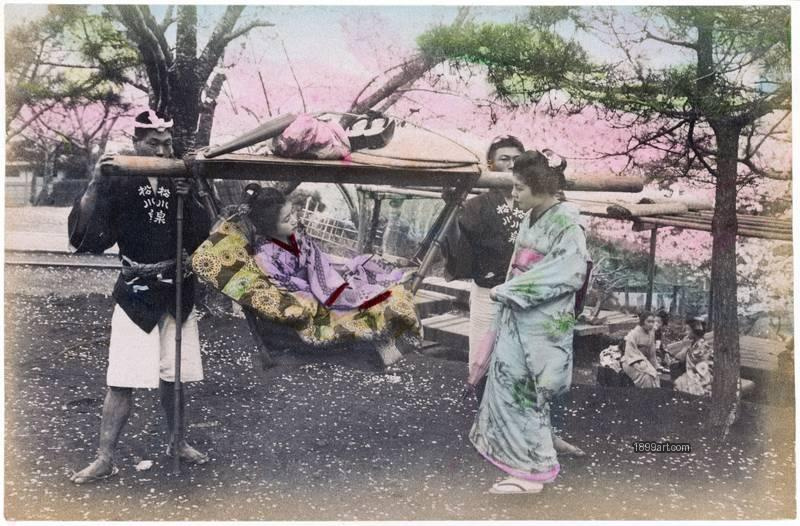
1899art Japanese Woman Reclining in a Rickshaw under Cherry Blossoms Handcolored 1900s 1899art
From the 1899art Archive: Hand-colored albumen photograph, Yokohama School, Meiji period. The image shows a Japanese woman reclining in a rickshaw (jinrikisha) beneath blooming cherry trees. She wears a formal kimono with an elaborate obi and refined hairstyle; however, no definitive Geisha or Meiko markers (such as long swinging darari-obi) are present. She is therefore identified as a woman, not a Geisha or Meiko.
The rickshaw is carried by two male pullers dressed in traditional work attire, while another woman in a patterned kimono stands beside the vehicle, engaging with the seated figure. The background features cherry blossoms in full bloom, a recurring seasonal motif in Yokohama School studio and semi-outdoor compositions intended for the export market.
The scene represents a staged leisure motif, combining transportation, seasonal scenery, and gendered social roles rather than documenting a specific event. The photograph exemplifies the Yokohama School’s practice of presenting idealized, culturally legible tableaux for Western audiences while employing real occupational roles (rickshaw pullers) and authentic dress.
Japan · c. 1895–1910 · Hand-colored photograph
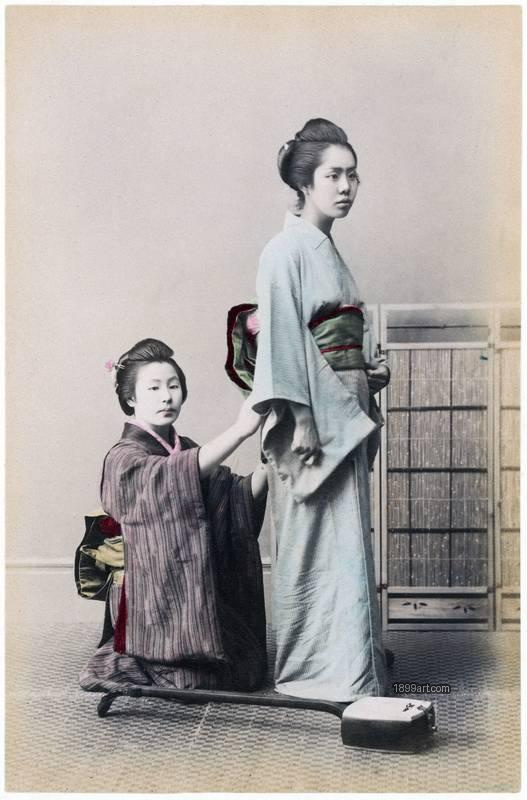
1899art Preparatory Moment of a Geisha Musician (Seiren), c. 1895–1905 Handcolored 1899art
From the 1899art Archive: This hand-colored albumen photograph depicts a young Japanese woman (Seiren) being dressed by an assistant in a studio setting during the late Meiji period. The scene records a moment of preparation rather than performance: the central figure stands calmly while her garment and obi are adjusted, conveying routine and professional familiarity rather than ceremony. A musical instrument placed beside her identifies her role as a trained performer and situates the image within the artistic practices of the geisha world.
Unlike common Yokohama School motifs that emphasize theatricality or stylized genre scenes—such as geisha toilette or bathing compositions—this photograph adopts a restrained, almost documentary tone. The woman’s controlled posture, compact obi, and reduced hairstyle indicate a fully trained geisha (geigi) rather than a maiko in apprenticeship. The absence of a darari-obi or youthful hair styling further supports this classification.
The repeated appearance of the same woman with the same musical instrument across related photographs suggests an identifiable individual rather than a generic studio model, pointing to a deliberate portrayal of a professional artist. As such, the image offers a rare studio view of a geisha musician in a transitional, preparatory moment, emphasizing disciplined practice and everyday professionalism over performance or spectacle.
Japan · c. 1895–1910 · Hand-colored photograph
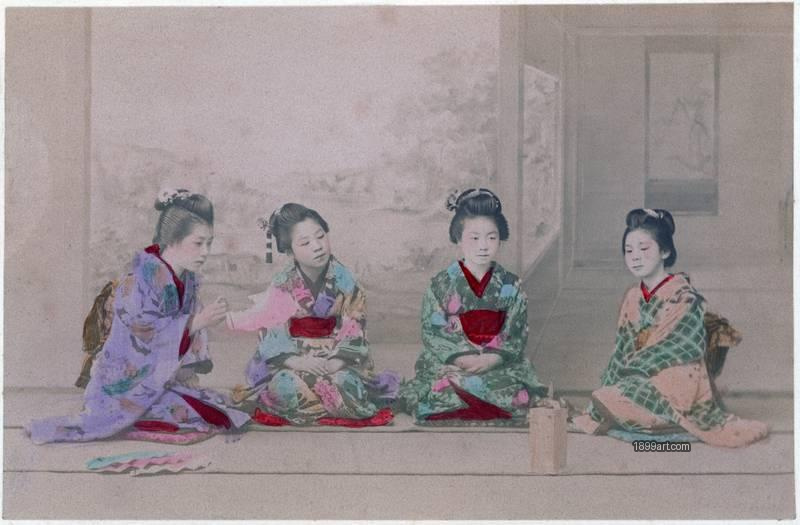
1899art Group of Four Maiko Seated Indoors Japan, c. 1890s Handcolored 1899art
From the 1899art Archive: Hand-colored albumen photograph depicting four maiko (apprentice geisha) seated indoors in a formal interior setting. The young women wear brightly patterned kimonos with high-set obi and traditional maiko hairstyles, clearly distinguishing them from adult women or fully trained geisha.
The scene does not represent a performance or ritual, but rather a quiet moment of waiting or instruction within the hanamachi training environment. The absence of props associated with tea ceremony, music, or dance suggests an everyday moment within the structured routine of apprenticeship.
Such group portraits emphasize the collective aspect of maiko training and are characteristic of Yokohama School studio photography aimed at documenting recognizable cultural types rather than individual identities.
Japan · c. 1895–1910 · Hand-colored photograph
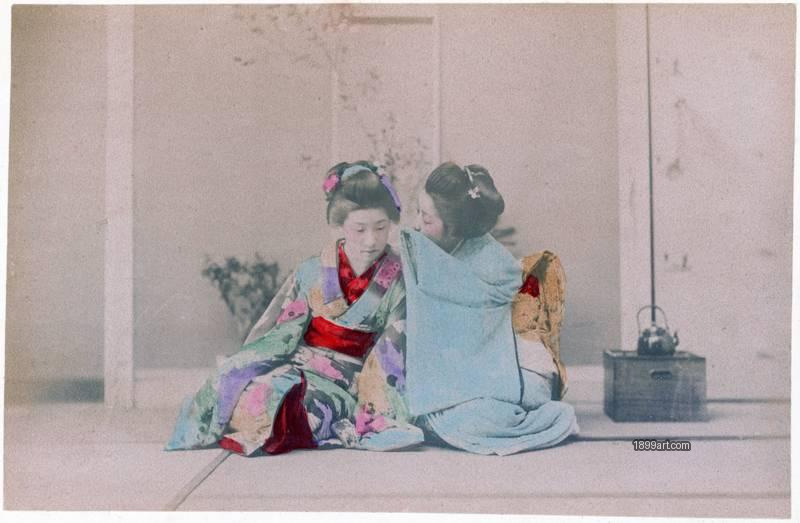
1899art Two Maiko Sharing a Private Moment Japan, c. 1890s Indoors Handcolored 1899art
From the 1899art Archive: Hand-colored albumen photograph showing two maiko of similar age seated closely together, engaged in a private exchange. One maiko leans toward the other, shielding her mouth with her sleeve while whispering, a gesture commonly associated with discretion and intimacy rather than instruction.
Both figures display the characteristic attire and hairstyles of maiko, including ornate kanzashi and vividly patterned kimono, indicating equal status within the apprenticeship system. The absence of any active dressing or corrective gesture suggests that the moment captured is social rather than pedagogical.
Such images are rare within Yokohama School photography, which typically presents maiko as composed cultural figures. Here, the photographer records a fleeting, human interaction—a moment of companionship, humor, or shared secrecy—offering an unusually candid view into the interpersonal world of maiko life.
Japan · c. 1895–1910 · Hand-colored photograph
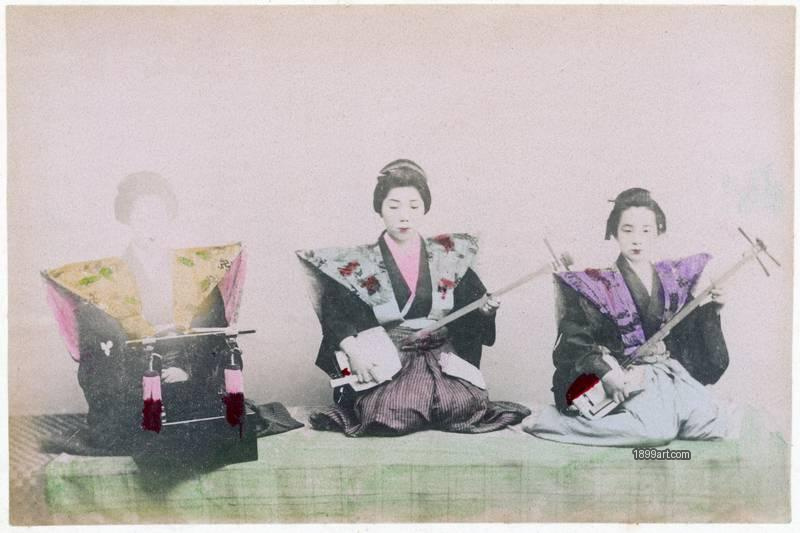
1899art Three Maiko Playing the Shamisen Japan, c. 1890s Handcolored 1899art
From the 1899art Archive: Hand-colored albumen photograph depicting three maiko seated in a formal arrangement, each holding and playing a shamisen, the traditional three-stringed Japanese lute. Their coordinated posture, ceremonial garments, and performance attire indicate a musical ensemble setting, likely staged in a studio environment characteristic of Yokohama School photography.
The maiko wear elaborate kimono with reinforced shoulder panels commonly associated with musical performance, along with traditional hairstyles and kanzashi ornaments. The absence of an audience and the neutral background suggest that the image was intended to document musical roles within the maiko tradition, rather than a specific event.
Such photographs emphasize the importance of music as a core discipline in maiko training, presenting the performers not as generic “women in kimono,” but as apprentice artists engaged in formal musical practice.
Japan · c. 1895–1910 · Hand-colored photograph
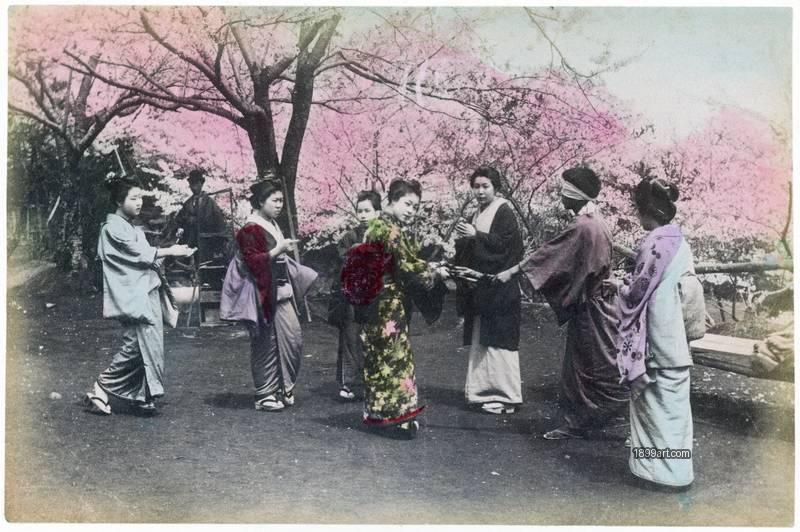
1899art Japan A 248 – Oni-gokko (Blind Man’s Buff) with Maiko, Hill of Nogé, Yokohama Handcolored 1900s 1899art
From the 1899art Archive: Hand-colored albumen photograph depicting a group of maiko engaged in a staged game of oni-gokko (目隠し鬼, “blind oni”), a traditional Japanese children’s and youth game comparable to blind man’s buff.
A blindfolded young man, identified as the oni (chaser), stands at the center of the composition while the maiko form a loose circle around him, holding slender branches or sticks to maintain distance and provoke movement.
The scene is set beneath blooming cherry trees on the Hill of Nogé, Yokohama, a location frequently used by Yokohama School photographers for outdoor genre scenes. The cherry blossoms function as a seasonal marker, emphasizing spring, youth, and playful vitality.
This photograph is carefully staged rather than documentary. The balanced spatial arrangement, controlled gestures, and coordinated attire indicate a studio-directed outdoor composition intended for the export market. Within Yokohama School imagery, such scenes served to present idealized representations of Japanese leisure activities and traditional customs rather than everyday social reality.
The image bears the printed catalogue number “A 248 – Hill of Nogé Yokohama”, consistent with standardized numbering systems used by commercial studios of the Yokohama School in the late Meiji period.
Contact & Credits
Purpose of this site
YokohamaSchool.org is intended as a reference and context resource for the history and surviving works of the Yokohama School of hand-colored photography.
It does not claim to be complete and will be expanded over time.
Focus
Historical research, visual analysis, digital preservation and curated examples of original works from the period c. 1860–1920.
This website is currently in its early phase. Further sections on sources, studios and bibliography will follow.
YokohamaSchool.org is part of the wider 1899art project:
www.1899art.com.
Usage Rights & Legal Notice – 1899art Archive
All images published on 1899art.com originate from the 1899art Archive and are provided for cultural, educational, and historical reference purposes only.
Permitted use
Images may be linked, embedded, or shared on external websites and platforms exclusively in their original, unmanipulated form, provided that:
– the source is clearly credited as “1899art”, and
– a visible and clickable link to https://1899art.com accompanies the image.
Prohibited use
Any form of modification, including but not limited to cropping, retouching, recoloring, compositing, filtering, AI-based processing, or the creation of derivative works, is strictly prohibited without prior written permission.
Commercial use, resale, redistribution as standalone files, or inclusion in third-party archives or databases is also not permitted without explicit authorization.
Rights status
While the original photographs may be in the public domain due to age, the digital reproductions, curatorial selection, restoration decisions, metadata, and contextual presentation are the intellectual property of the 1899art Archive.
By using images from this website, you agree to respect these conditions. Automated downloading, scraping, or use of images for machine learning or AI training purposes is expressly prohibited.
EU / International Copyright Notice
All images published by the 1899art Archive are protected under European and international copyright law.
Any reproduction, redistribution, modification, AI-based processing, or commercial use beyond the explicitly permitted low-resolution web sharing is prohibited without prior written consent of the 1899art Archive.
This applies equally to high-resolution files obtained through unauthorized access, third-party leaks, or archival reproductions.
DMCA Copyright Notice & Protection
All images and digital files published by the 1899art Archive are protected by international copyright law and the Digital Millennium Copyright Act (DMCA).
Unauthorized reproduction, distribution, modification, AI processing, or commercial use of any image or high-resolution file from the 1899art Archive is strictly prohibited.
The unauthorized possession or dissemination of high-resolution files does not constitute a license and does not grant any rights of use.
Any infringement will result in DMCA takedown notices, platform removal requests, and, where applicable, legal action.