High-resolution original files are available from the 1899art Archive.
Original scans have a minimum resolution of 6,000 × 9,000 pixels.
Depending on the original source medium, original master scans of up to 15,000 × 20,000 pixels are available.
Only the low-resolution images displayed on the 1899art website may be linked, shared, or embedded on external websites, and only in their original, unmanipulated form, provided that clear attribution to “1899art” is given and a clearly visible link to https://1899art.com is included.
Any use, distribution, or publication of high-resolution files, whether obtained intentionally or inadvertently, is strictly prohibited.
Any modification, alteration, recomposition, recoloring, AI processing, or commercial reuse beyond simple linking and sharing is not permitted without prior written consent of the
1899art Archive.
YOKOHAMA SCHOOL BACK TO MAIN PAGE
Album 2 – 51 Motifs of the Yokohama School. All photographs are carefully reconstructed and described based on extensive research. We strive for the highest possible accuracy in all attributions and contextual information. If you believe any information is incorrect, please contact us and include your source.
Japan · c. 1895–1910 · Hand-colored photograph
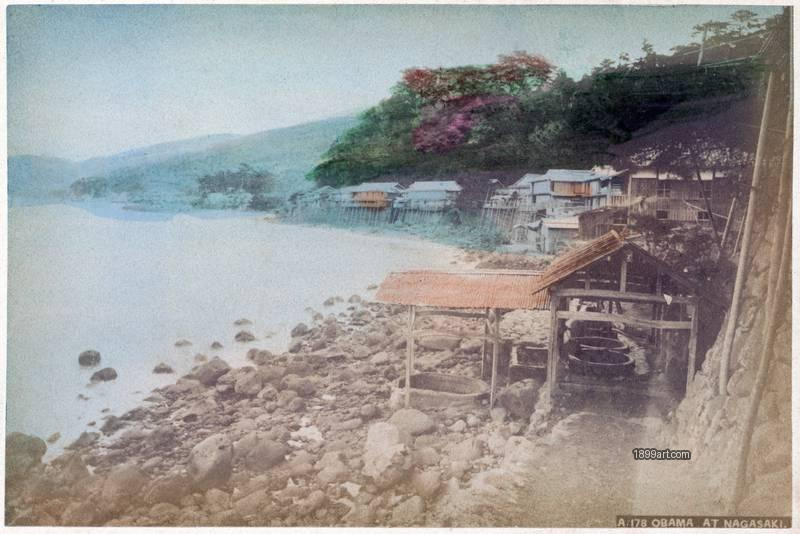
1899art Japan Obama Onsen – Coastal View, c. 1890 Handcolored 1899art
From the 1899art Archive: Hand-colored albumen photograph showing a coastal view of Obama Onsen (小浜温泉), a hot spring town located on the western coast of the Shimabara Peninsula in Nagasaki Prefecture. The original caption “A178 OBAMA AT NAGASAKI”, printed within the image, securely identifies the location.
The photograph depicts modest wooden structures built directly along a rocky shoreline, with simple sheds and vats in the foreground and small houses extending along the bay. The proximity of buildings to the sea reflects the dual character of Obama as both a fishing settlement and a hot spring resort, where geothermal activity shaped everyday life and local infrastructure.
The hot springs of Obama emerge from geothermal sources connected to the volcanic system of Mount Unzen, whose foothills dominate the surrounding landscape. Produced as a monochrome albumen print and later hand-colored, the image belongs to a topographical series intended for the export market, emphasizing regional character, coastal geography, and utilitarian architecture rather than staged studio scenes.
Japan · c. 1895–1910 · Hand-colored photograph
1899art Japan Itsukushima Shrine – Floating Torii Gate, c. 1890 Handcolored 1899art
From the 1899art Archive: Hand-colored albumen photograph depicting the floating torii gate (ōtorii) of Itsukushima Shrine, standing in the shallow waters of the Seto Inland Sea off the island of Miyajima. The massive wooden gate rises directly from the sea, supported by multiple pillars, while a small sailing boat passes nearby, emphasizing scale and distance. Low wooded hills and a softly tinted sky form the background, creating a calm and balanced coastal composition.
Originally produced as a monochrome albumen print and later hand-colored, the image belongs to a widely distributed topographical series of iconic Japanese views for the export market. The torii of Itsukushima, considered one of the most celebrated Shinto landmarks in Japan, symbolically marks the boundary between the sacred space of the shrine and the surrounding sea. This exact photograph has been reproduced in modern publications, including the TASCHEN volume Japan 1900, confirming its status as a canonical image of late 19th-century Japanese photography.
Japan · c. 1895–1910 · Hand-colored photograph
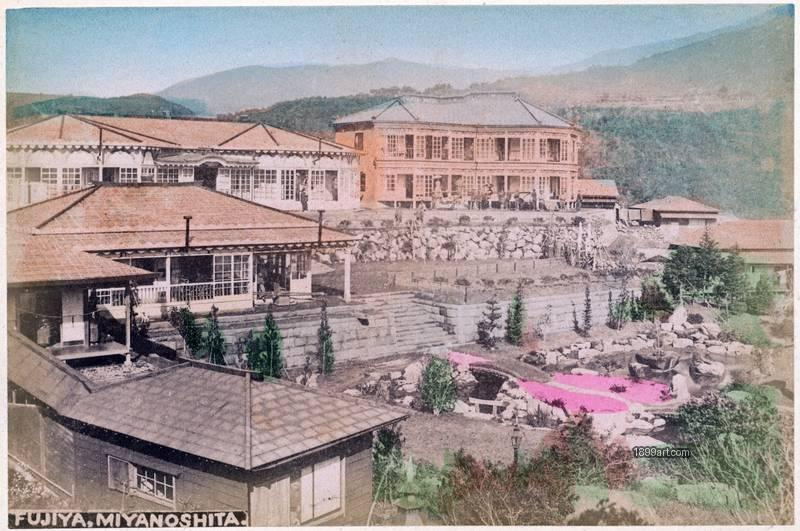
1899art Japan Fujiya Hotel, Miyanoshita, c. 1890 Handcolored 1899art
From the 1899art Archive: Hand-colored albumen photograph showing the Fujiya Hotel at Miyanoshita, a prominent Western-style resort hotel in the Hakone area. The view presents a cluster of wooden hotel buildings arranged on terraced ground, with verandas, large windows, and tiled roofs reflecting a hybrid architectural style developed for foreign visitors in Meiji-period Japan. Stone retaining walls, landscaped paths, and small planted areas structure the foreground, while wooded hills and distant mountains form the backdrop.
Originally produced as a monochrome albumen print and later hand-colored, the photograph belongs to a topographical series documenting places frequented by international travelers. Founded in 1878, the Fujiya Hotel quickly became one of Japan’s most famous hotels, serving diplomats, merchants, and tourists traveling the Tōkaidō route. Images of the hotel were widely circulated as souvenirs, symbolizing the emergence of modern hospitality and cross-cultural exchange in late 19th-century Japan.
Japan · c. 1895–1910 · Hand-colored photograph
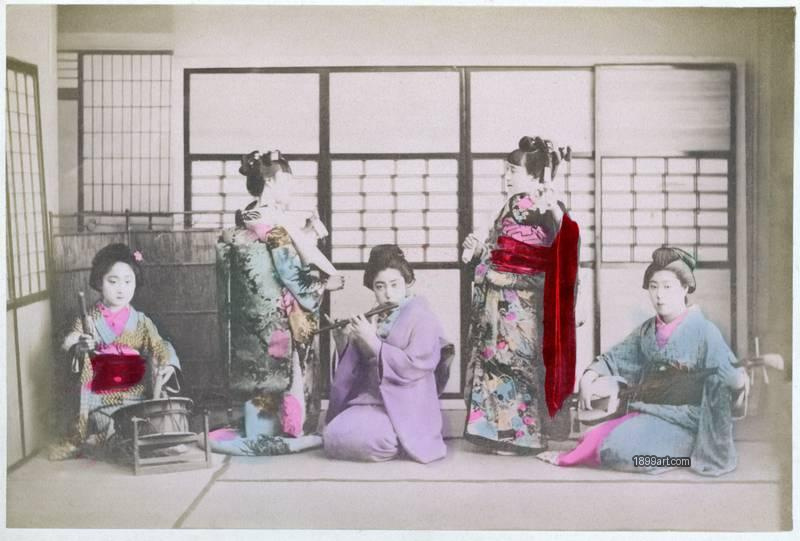
1899art Japan Group of Maiko Musicians in a Tatami Interior Handcolored 1900s 1899art
From the 1899art Archive: This hand-colored albumen photograph depicts a group of young maiko (apprentice geisha) performing traditional music in a studio interior with tatami mats and shoji screens. The vivid kimono colors, long decorative obi, elaborate hairstyles with kanzashi ornaments, and the youthful appearance of the performers clearly identify them as maiko rather than fully trained geisha (geiko).
Such carefully staged scenes were widely produced by Yokohama School studios around 1890–1905 for the Western export market, presenting an idealized and aesthetically curated image of Japanese performing arts and feminine refinement.
Japan · c. 1895–1910 · Hand-colored photograph
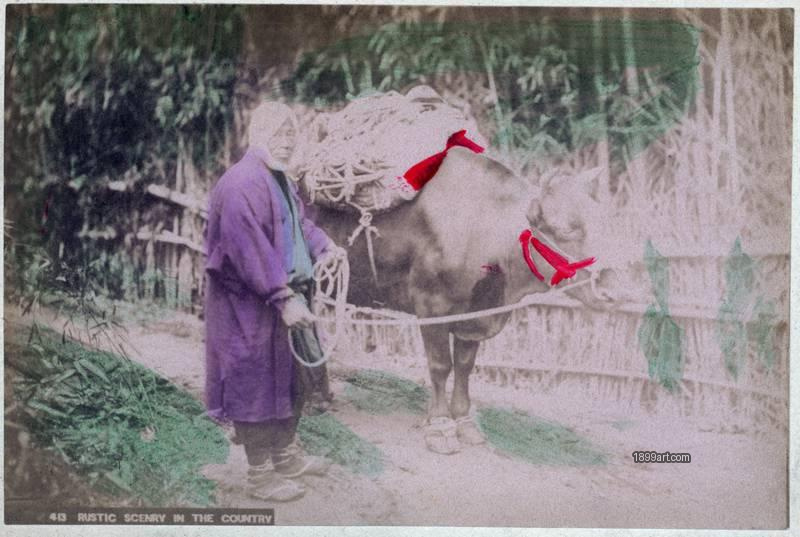
1899art Japanese Farmer Leading a Pack Ox on a Country Path, Japan, c. 1895–1905 Handcolored 1899art
From the 1899art Archive: Hand-colored albumen photograph showing a rural scene in Japan: an elderly farmer walking along a country path while leading a pack ox laden with bundles of straw secured by rope. The man wears practical working clothing, and the setting is defined by a bamboo fence and dense vegetation, indicating an agrarian landscape. Selective hand-coloring emphasizes elements such as the ox’s harness and details of the clothing, following common Yokohama photography conventions of the late 19th century.
The photograph is part of a numbered souvenir series produced for the international tourist market during the late Meiji period. In the original series, the image carried the generic caption “413 RUSTIC SCENERY IN THE COUNTRY” a title that reflects the romanticized pastoral image of Japan marketed to Western audiences. Today, the photograph can be read as a carefully staged yet valuable visual record of rural labor imagery circulating at the intersection of photography, commerce, and early tourism.
Japan · c. 1895–1910 · Hand-colored photograph
1899art Japan Shintō Shrine Buildings with Red Railings, Japan, c. 1895–1905 Handcolored 1899art
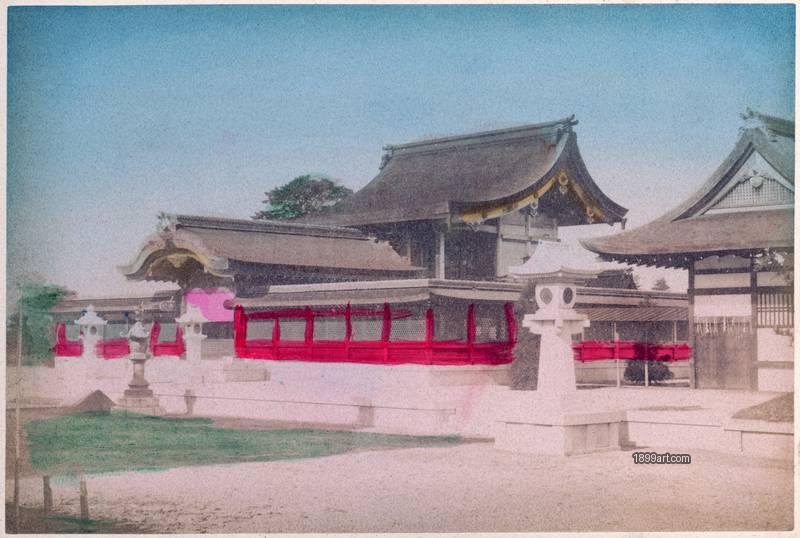
From the 1899art Archive: Hand-colored albumen photograph depicting a group of traditional Shintō shrine buildings arranged around a raised courtyard. The architecture is defined by gently curved tiled roofs, wooden structures, and prominently red-painted railings enclosing an elevated walkway. Two distinctive entrance pillars with circular openings mark the access to the inner precinct, while stone lanterns are positioned symmetrically in the foreground. Gravel paths and open space emphasize the formal and ceremonial layout of the shrine complex.
The photograph was produced during the late Meiji period as part of the Yokohama souvenir photography tradition for an international market. Selective hand-coloring highlights culturally symbolic elements, particularly the red architectural features, enhancing visual clarity rather than providing precise architectural documentation. In the absence of definitive comparative material, the shrine cannot be identified with certainty; the image is therefore best understood as an idealized representation of Shintō sacred architecture as it was presented to Western audiences around 1900..
Japan · c. 1895–1910 · Hand-colored photograph
1899art Festival Lanterns on a Street in Yokohama, Japan, c. 1895–1905 Handcolored 1899art
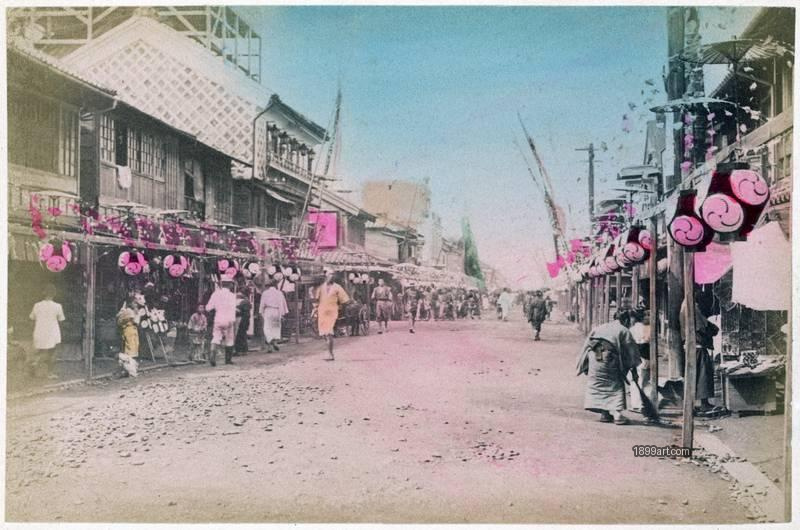
From the 1899art Archive: Hand-colored albumen photograph depicting a wide street in Yokohama decorated with rows of paper lanterns suspended along the shopfronts. Numerous pedestrians move through the scene, while merchants and customers gather in front of wooden buildings lining both sides of the unpaved road. The repetition of lanterns and the strong linear perspective draw the viewer’s eye toward the distant vanishing point, emphasizing the scale and liveliness of the urban setting during a festive occasion.
The image belongs to a numbered souvenir series distributed for the international tourist market in the late Meiji period. An uncolored version of the same photograph bears the caption “A 563 Festival Lanterns at Yokohama,” confirming that multiple editions were produced from the same negative. The selective hand-coloring in this version accentuates the lanterns and architectural details, enhancing visual appeal rather than documentary precision. While the photograph is stylistically consistent with the output of major Yokohama studios such as Kusakabe Kimbei and Tamamura Enami, no definitive studio attribution can currently be established, and the image is therefore best understood as part of the broader Yokohama School production.
Japan · c. 1895–1910 · Hand-colored photograph
1899art Women Manufacturing Thread Indoors, Japan, c. 1895–1905 Handcolored Enami 1899art
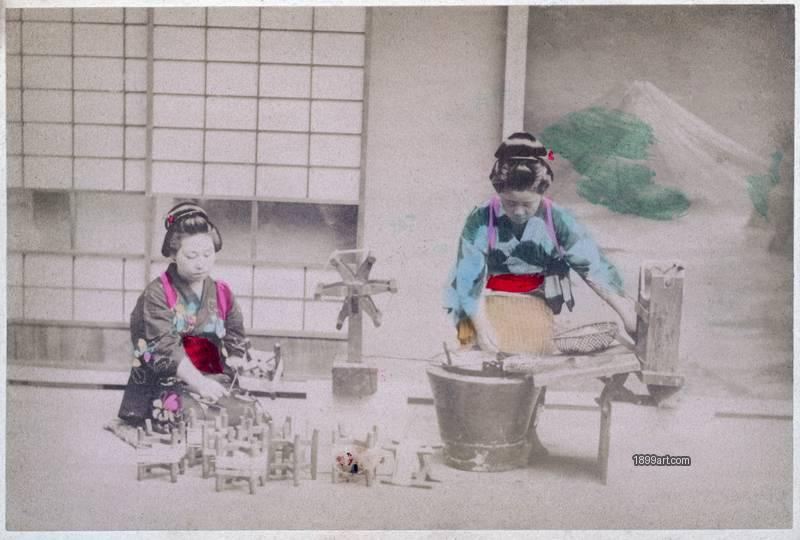
From the 1899art Archive: Hand-colored albumen photograph depicting two young women engaged in textile production inside a traditional Japanese interior. One woman operates a small hand-driven reel or winding device, while the other prepares silk fibers using a low wooden frame and a basin. A painted backdrop featuring Mount Fuji and sliding paper screens (shōji) forms the background, clearly indicating a studio setting rather than a purely documentary interior. The tools and gestures emphasize stages of silk preparation and thread production.
The photograph is part of a numbered Yokohama souvenir series distributed for the international tourist market during the late Meiji period. The original caption, “K.14. Manufacturing Silk,” reflects the export-oriented framing of traditional labor as a picturesque and orderly craft. Like many images of this genre, the scene combines authentic tools with staged composition and selective hand-coloring to present an idealized vision of pre-industrial Japanese industry at a time when silk production was a key component of Japan’s global economic presence.
Japan · c. 1895–1910 · Hand-colored photograph
1899art Harbour of Nagasaki Seen from an Elevated Viewpoint, Japan, c. 1895–1905 Handcolored 1899art
From the 1899art Archive: Hand-colored albumen photograph showing a panoramic view of Nagasaki harbour taken from an elevated hillside. In the foreground, upright stone grave markers indicate that the viewpoint is located at or near a hillside cemetery overlooking the city. Below, clusters of wooden buildings extend toward the shoreline, while the calm waters of the harbour open into the distance. Layered hills and mountains frame the background, creating a sense of depth and emphasizing the natural setting of the port.
The photograph belongs to a numbered Yokohama souvenir series produced for international travelers during the late Meiji period. Under the original caption “Y.32. The Harbour of Nagasaki,” the image presents Nagasaki as a scenic maritime city shaped by both geography and long-standing international connections. The selective hand-coloring enhances atmospheric effects rather than providing precise topographical detail, offering an idealized impression of the harbour as it was perceived by Western visitors around 1900.
Japan · c. 1895–1910 · Hand-colored photograph
1899art Rickshaw with Two Female Passengers and Puller, Japan, c. 1895–1905 Handcolored 1899art
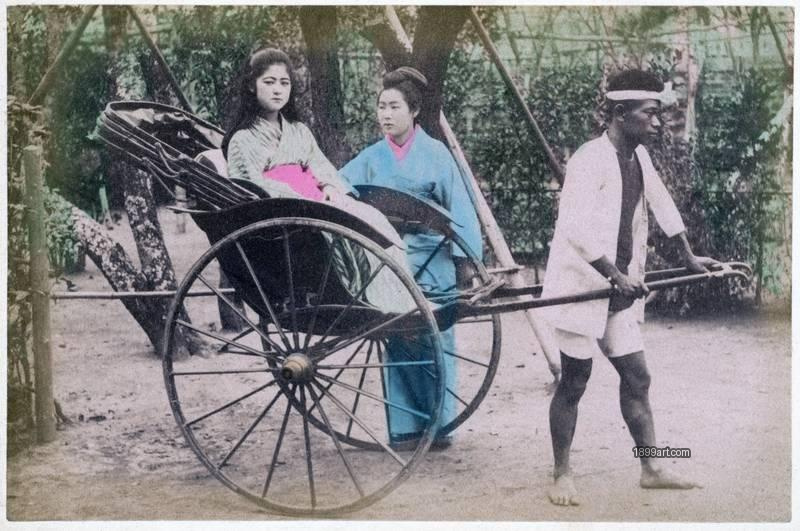
From the 1899art Archive:Hand-colored albumen photograph depicting a rickshaw scene in a garden or park-like setting. A rickshaw puller, dressed in short working garments and a headband, draws a two-wheeled vehicle carrying two young women seated side by side. The passengers wear patterned kimono with contrasting obi, their posture composed and forward-facing. The large spoked wheel and curved body of the rickshaw dominate the center of the composition, emphasizing the vehicle as both means of transport and visual focal point.
The photograph belongs to the genre of Yokohama souvenir photography produced for Western audiences during the late Meiji period. Rickshaw scenes were among the most popular motifs, symbolizing mobility, urban leisure, and the encounter between tradition and modern transport. As with many such images, the scene appears carefully arranged rather than purely documentary, and selective hand-coloring highlights clothing and key details to enhance visual clarity and appeal for the export market.
Japan · c. 1895–1910 · Hand-colored photograph
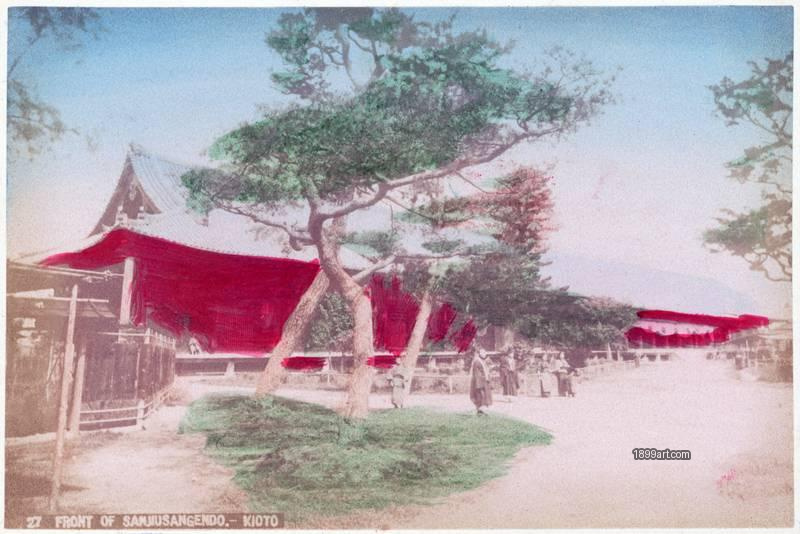
1899art Japan Front of Sanjūsangen-dō Temple, Kyoto Handcolored 1900s 1899art
From the 1899art Archive: This hand-colored photograph depicts the front view of Sanjūsangen-dō, one of Kyoto’s most significant Buddhist temples, photographed around 1900 for the international tourist market. The exceptionally long wooden hall is partially draped with red cloths, possibly indicating a ceremonial occasion, maintenance work, or temporary festival decoration. Pine trees line the open forecourt, emphasizing the horizontal scale and calm monumentality of the temple architecture.
The printed caption at the lower margin — “27 Front of Sanjusangendo – Kyoto” — follows the standardized numbering and titling system widely used in Yokohama School photography. Such numbered views were issued in series and distributed through studios including Kusakabe Kimbei, Adolfo Farsari, and related publishers. The motif appears consistently across late 19th-century albumin prints and travel albums, categorized as a classic temple view intended for Western collectors and travelers. The delicate hand-coloring reflects techniques inherited from Japanese woodblock print artisans and enhances the serene, timeless atmosphere of the scene.
Japan · c. 1895–1910 · Hand-colored photograph
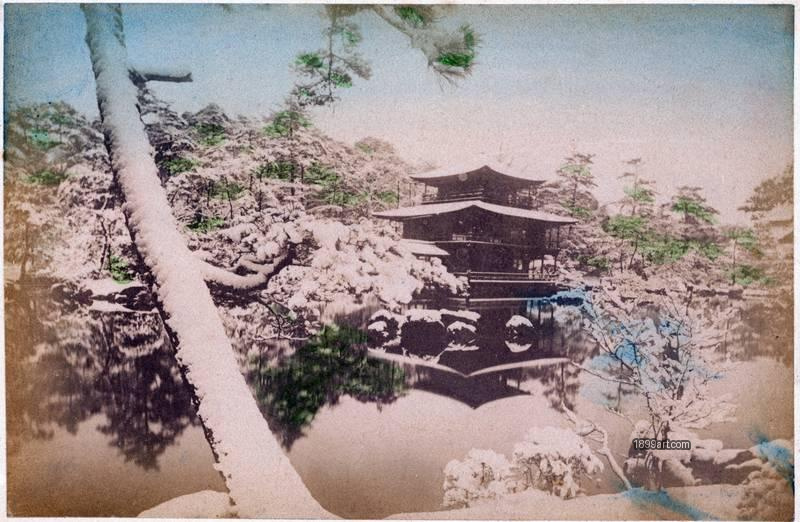
1899art Japan The Golden Pavilion (Kinkaku-ji) in Snow, Kyoto Handcolored 1900s 1899art
From the 1899art Archive: This photograph depicts Kinkaku-ji, the Golden Pavilion in Kyoto, shown in winter around 1900. The three-tiered Zen temple stands at the edge of its reflecting pond, framed by snow-covered pines and rocks. The still water mirrors the pavilion, creating a calm and formally balanced composition typical of views made for visiting foreign audiences.
Unlike high-quality Yokohama School examples, the hand coloring here is notably crude and schematic. Colors are applied hastily and without sensitivity to form, light, or material, flattening architectural detail and disrupting the natural tonal balance of the original photograph. Greens and blues are laid on mechanically, with little regard for atmospheric depth or seasonal nuance, indicating a low-cost production intended for mass-market tourist albums rather than discerning collectors.
Such images were commonly sold as souvenirs, where speed and quantity outweighed artistic refinement. In this context, the hand coloring functions not as an enhancement but as a superficial embellishment—an instructive example of how iconic motifs like Kinkaku-ji were sometimes reduced to decorative commodities for the late Meiji tourist trade.
Japan · c. 1895–1910 · Hand-colored photograph
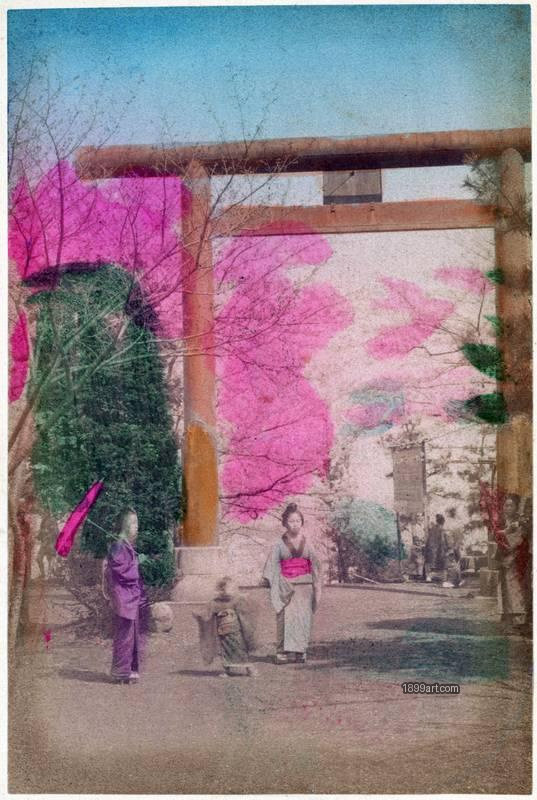
1899art Japan Torii Gate with Pagoda in the Background, Ueno Park, Tokyo Handcolored 1900s 1899art
From the 1899art Archive: This hand-colored photograph shows Meikos in front of a large wooden torii gate opening onto a shrine approach, framed by blossoming trees and figures in traditional dress. In the background, aligned through the torii, rises a tall stone pagoda, creating a strong axial composition typical of shrine and temple precincts in late-Meiji Tokyo.
The combination of the torii gate and the pagoda visible beyond strongly suggests Ueno Park, with the pagoda most likely belonging to Kan’ei‑ji, a major Tendai Buddhist complex whose pagoda was a well-known landmark already in the 19th century. The torii itself may be associated with Ueno Tōshō‑gū, whose entrance axis historically aligned with views toward temple structures within the park.
Such carefully composed views—often enhanced by vivid hand-applied color, especially pinks for cherry blossoms—were characteristic of Yokohama School production around 1900. They were intended for the foreign market and deliberately emphasized spatial harmony, ritual architecture, and seasonal atmosphere rather than precise documentary labeling.
Japan · c. 1895–1910 · Hand-colored photograph
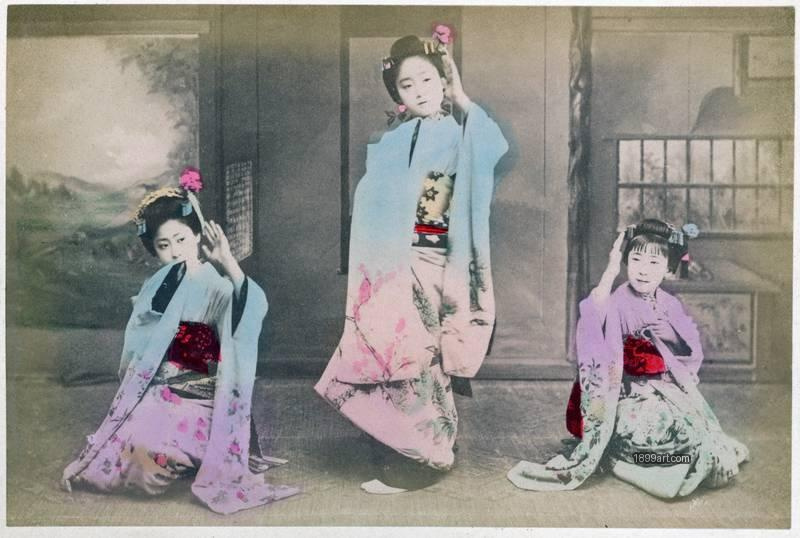
1899art Maiko Performing a Traditional Dance – Studio Scene, Japan, c. 1900 Handcolored 1900s 1899art
From the 1899art Archive: This hand-colored albumen photograph shows three young women performing a stylized traditional dance in a studio setting. Based on posture, balance, arm positioning, and the precise control of movement, the figures are best understood as actual maiko (apprentice geisha) rather than non-professional studio models. The embodied knowledge visible in their poses—especially the controlled transitions, asymmetrical stances, and refined hand gestures—reflects formal training that cannot be convincingly imitated.
While the scene itself is clearly studio-staged for the tourist market, the performers’ physical discipline and movement vocabulary point to authentic maiko education. Such photographs, produced by studios of the Yokohama School around 1900, combine real practitioners with constructed visual narratives, offering Western audiences an idealized yet physically truthful representation of Japanese performing arts. The image thus occupies a space between documentation and commercial staging: choreographed for the camera, but grounded in genuine lived practice.
Japan · c. 1895–1910 · Hand-colored photograph
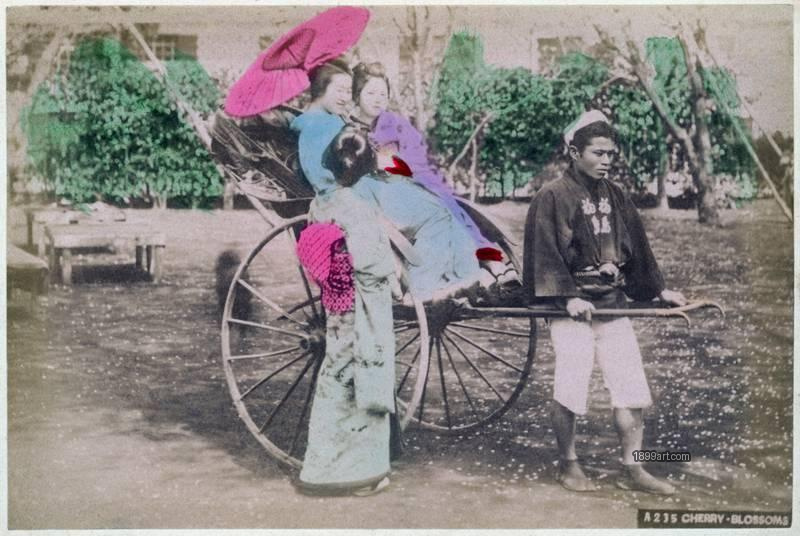
1899art Japan A235 – Rikisha with Young Women (Cherry Blossoms Series) Handcolored 1900s 1899art
From the 1899art Archive: This hand-colored studio photograph shows a rickshaw carrying two young women, accompanied by a third standing figure, while being pulled by a rickshaw runner. The women wear refined kimono with elaborate obi and traditional hairstyles consistent with maiko (apprentice geisha) or young women trained in the geisha arts. Their relaxed posture and familiarity with the vehicle suggest a staged studio or garden setting rather than a candid street scene.
Although the printed title on the photograph reads “A235 – Cherry Blossoms”, no cherry trees or visible blossoms appear in the image itself. This discrepancy is typical of Yokohama School commercial photography, where series titles often functioned as seasonal or thematic marketing labels rather than literal descriptions of the depicted scene. “Cherry Blossoms” likely refers to the springtime atmosphere and cultural association, not to a specific botanical element within the composition.
The numbered caption style (“A235”) and English title strongly correspond to late-19th-century Yokohama studio catalog systems used by photographers such as Adolfo Farsari and Kusakabe Kimbei. The image was produced for the tourist market and circulated widely in albumin prints and, more rarely, as glass transparencies for projection. The glass-based version preserves finer tonal transitions and color application, indicating a higher-quality production intended for visual presentation rather than mass souvenir sales.
Japan · c. 1895–1910 · Hand-colored photograph
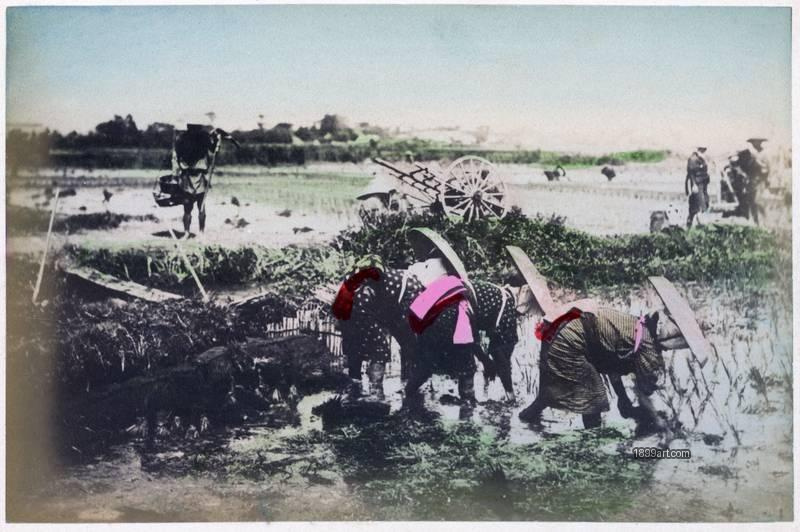
1899art Women Transplanting Rice Seedlings, Japan, c. 1890 Handcolored 1899art
From the 1899art Archive: This hand-coloured albumen print depicts women transplanting young rice seedlings in flooded paddy fields, a key stage in traditional rice cultivation in rural Japan. Bent forward in shallow water, the workers carefully place seedlings into the soft soil, while agricultural tools and carts appear in the background. The scene emphasizes coordinated manual labour and the physical demands of wet-rice agriculture, which formed the economic foundation of Japanese rural life.
The photograph dates to around 1890 and belongs to the Meiji-period genre of ethnographic and agricultural imagery produced for educational and international audiences. An identical print is preserved and exhibited by the Museo Oriental (Spain) under the title “Mujeres transplantando arroz”, where it is described as a hand-coloured albumen photograph illustrating the central role of rice cultivation in Japan’s agrarian economy. Such images were widely disseminated by Yokohama-based photographic studios and reflect a didactic visual tradition that presented agricultural labour as orderly, cyclical, and essential to national life.
Japan · c. 1895–1910 · Hand-colored photograph
1899art Yokohama Railway Station, Yokohama, Japan, c. 1890s Handcolored 1899art
From the 1899art Archive: This hand-coloured albumen photograph depicts the Yokohama railway station, one of the earliest and most important railway terminals in Japan. The image shows the station complex with its distinctive Western-style masonry buildings, symmetrical façades, and adjoining covered platforms. The open forecourt in front of the station is populated by small figures, emphasizing the scale of the architecture and the role of the station as a central node of movement and exchange in the treaty port city of Yokohama.
The Yokohama railway station played a crucial role in Japan’s modernization during the Meiji period, connecting the international port with Tokyo and the expanding national rail network. Images of the station were widely circulated by Yokohama photography studios and sold to foreign visitors as visual evidence of Japan’s rapid adoption of Western technology and infrastructure. This photograph belongs to a broader group of Meiji-era views documenting railways, stations, and modern public architecture, presenting Yokohama as the symbolic gateway through which Japan entered the industrial and globalized world.
Japan · c. 1895–1910 · Hand-colored photograph
1899art Dragon-Shaped Water Basin (Chōzubachi) at a Japanese Shrine, Japan, c. 1900 Handcolored 1899art
From the 1899art Archive: This hand-coloured albumen photograph shows a dragon-shaped water basin (chōzubachi or temizuya) used for ritual purification at a Japanese shrine or temple. Water flows from the open mouth of the sculpted dragon into a rectangular stone basin, where worshippers would cleanse their hands and mouth before approaching the sacred space. A metal ladle (hishaku) rests on the edge of the basin, emphasizing the ritual function of the structure rather than its decorative role alone.
Dragon fountains of this type were commonly installed at Shintō and Buddhist sites during the late Edo and Meiji periods, symbolizing water, protection, and spiritual power. Such motifs were especially appealing to foreign visitors, and images like this were frequently produced by Yokohama studios for the tourist market.
Japan · c. 1895–1910 · Hand-colored photograph
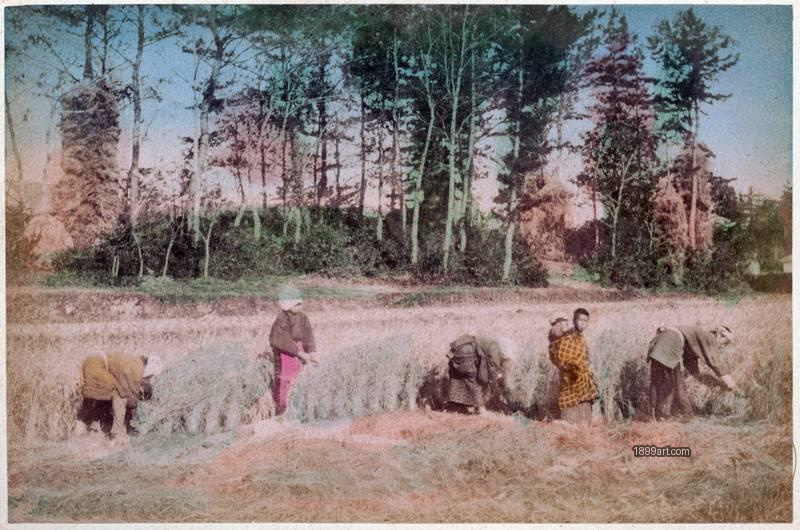
1899art Farm Workers Harvesting Rice in a Rural Landscape, Japan, c. 1890s–1900s Handcolored 1899art
From the 1899art Archive: This hand-coloured albumen photograph shows a group of rural agricultural workers harvesting rice in a flooded or recently drained paddy field. Several figures are bent forward in the characteristic working posture associated with rice cultivation, while others stand briefly upright, holding bundles of cut stalks. The scene is set against a tree-lined embankment, emphasizing the flat, carefully managed terrain required for wet-rice agriculture.
Rice cultivation formed the economic and social foundation of rural Japan during the late Edo and Meiji periods. Images like this were widely produced for the tourist market, presenting agricultural labour as a timeless and orderly activity rooted in tradition. At the same time, such photographs document real working practices, tools, and clothing, offering valuable visual evidence of seasonal labour, gendered work roles, and the physical demands of rice harvesting at the turn of the 20th century.
Japan · c. 1895–1910 · Hand-colored photograph
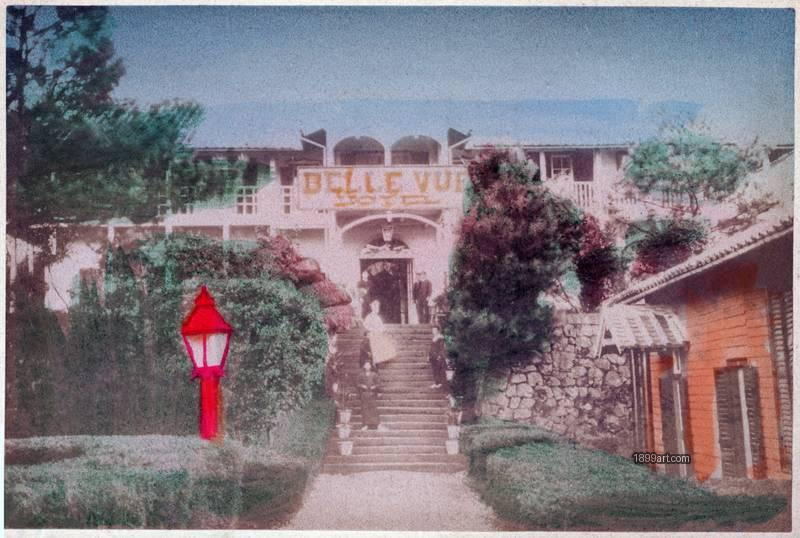
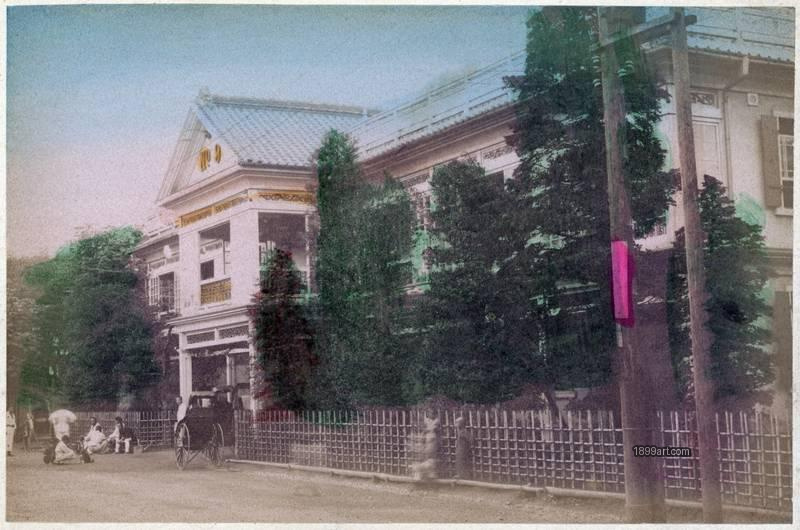
1899art Entrance of the “Belle Vue” Hotel, Yokohama, Japan, c. 1890s–1900s Handcolored 1899art
From the 1899art Archive: This hand-coloured albumen photograph shows the entrance of the “Belle Vue” Hotel in Yokohama, one of the best-known Western-style hotels serving foreign visitors in the treaty-port era. The image is dominated by a broad stone staircase leading up to the hotel façade, above which the name “BELLE VUE” is prominently displayed. Several figures stand or move on the steps, giving a sense of scale and everyday activity. A Western-style street lamp in the foreground further emphasizes the hybrid architectural and cultural environment of the port city.
Hotels such as the Belle Vue played a central role in Yokohama’s tourist and commercial infrastructure around 1900. They functioned not only as places of accommodation, but also as social hubs where foreign travelers encountered a carefully curated image of modern Japan. Photographs of hotel entrances were popular souvenir subjects, symbolizing comfort, accessibility, and Japan’s integration into global travel networks. This image fits squarely within the Yokohama studio tradition of documenting modern institutions alongside “traditional” scenes, presenting Japan as both exotic and reassuringly familiar to Western audiences.
Japan · c. 1895–1910 · Hand-colored photograph
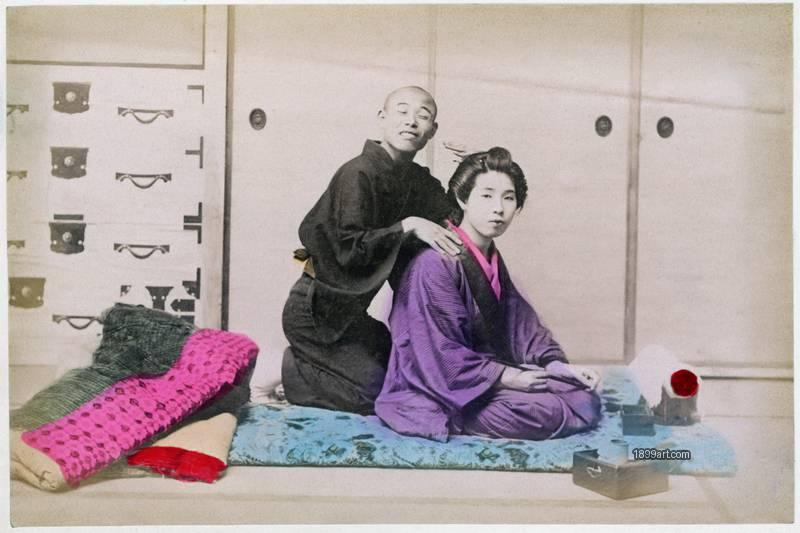
1899art B1022 – Blind Shampoorer, Japan, c. 1890s–1900s Handcolored 1899art
From the 1899art Archive: This hand-coloured albumen photograph is catalogued under the traditional Western title “Blind Shampoonier”. While the term may suggest hair washing to a modern reader, its historical meaning was considerably broader. In nineteenth-century English—shaped by colonial usage in South and East Asia—to shampoo originally referred to massage or bodily manipulation, particularly of the head, neck, and shoulders, rather than the washing of hair with water.
The scene depicted here clearly shows a traditional anma massage. A blind practitioner kneels behind a seated woman and applies pressure to her neck and shoulders, a posture and hand placement characteristic of professional massage rather than hair washing. The absence of water, basins, or washing implements further confirms that the activity shown is therapeutic massage, not hygiene or cosmetic care.
In late Edo and Meiji Japan, blind men were commonly employed as professional anma-shi (masseurs), a regulated and socially respected occupation. Western photographers and publishers lacked a precise equivalent for this profession and therefore adopted the familiar English term shampoorer to describe such figures for foreign audiences.
The image is a carefully staged studio composition typical of Yokohama School photography, produced for the export market. Its title reflects contemporary Western vocabulary rather than a literal description of the practice shown. Read in its historical context, “Blind Shampoonier” should thus be understood as blind masseur, illustrating how linguistic conventions shaped the interpretation of Japanese subjects for nineteenth-century viewers.
Japan · c. 1895–1910 · Hand-colored photograph
1899art Ōtenmon Gate, Heian Shrine, Kyoto, c. 1895–1905 Handcolored 1899art
From the 1899art Archive: This hand-coloured albumen photograph depicts the Ōtenmon, the monumental main gate of the Heian Shrine (Heian-jingū) in Kyoto. The two-storey vermilion gate with its wide tiled roof and symmetrical pillars is a faithful Meiji-period reconstruction of classical Heian-era imperial architecture. The open forecourt and the absence of crowds suggest an early photograph, taken shortly after the shrine’s completion in 1895, when it was still a relatively new landmark.
Heian Shrine was erected to commemorate the 1100th anniversary of Kyoto’s founding and to honor Emperor Kanmu. Images of the Ōtenmon quickly became popular motifs in Yokohama photography, as the gate visually condensed Japan’s architectural past into a single, highly legible symbol for foreign visitors. The intense red hand-colouring emphasizes ritual authority and continuity, while the clear frontal composition reflects the standardized, catalog-ready style used by studios such as Kimbei and Enami for the tourist market.
Japan · c. 1895–1910 · Hand-colored photograph
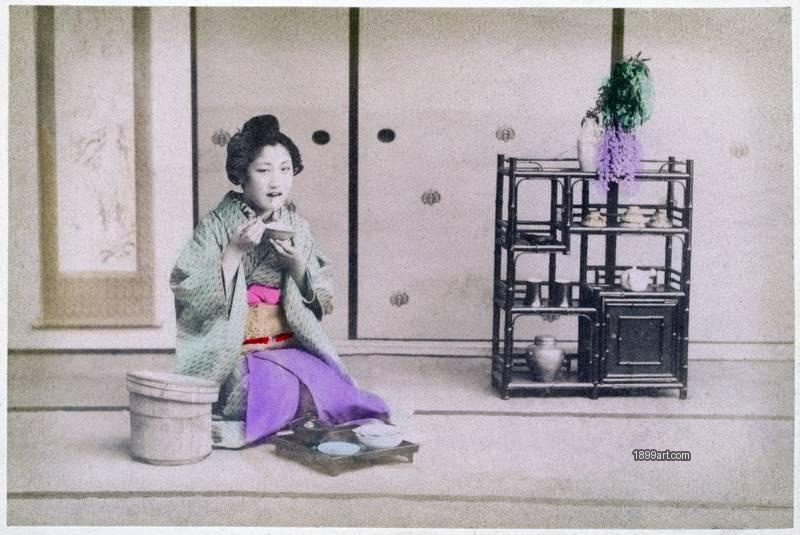
1899art Japan Maiko Eating in a Tatami Interior 1900s 1899art
From the 1899art Archive: This hand-colored studio photograph depicts a maiko (apprentice geisha) seated on tatami mats while eating with chopsticks from a small bowl. Her youthful facial features, long-sleeved furisode-style kimono, and formal hairstyle clearly identify her as a maiko rather than a fully trained geisha. The visible chopsticks in her right hand and the bowl held close to her body confirm that the scene shows an act of eating, not drinking.
The composition is carefully arranged, yet the gesture itself appears natural and unforced. The maiko’s posture reflects discipline and restraint within an everyday activity rather than a ceremonial performance. The interior setting—sliding fusuma doors and a lacquered shelving unit with arranged utensils—presents an idealized domestic environment typical of Yokohama School studio photography produced for export.
The hand coloring is applied in a broad, simplified manner, consistent with commercial tourist-album production rather than refined collector works. As such, the photograph offers insight into how ordinary aspects of maiko life were staged and commodified for foreign audiences at the turn of the 20th century, balancing authenticity of gesture with the conventions of studio presentation.
Japan · c. 1895–1910 · Hand-colored photograph
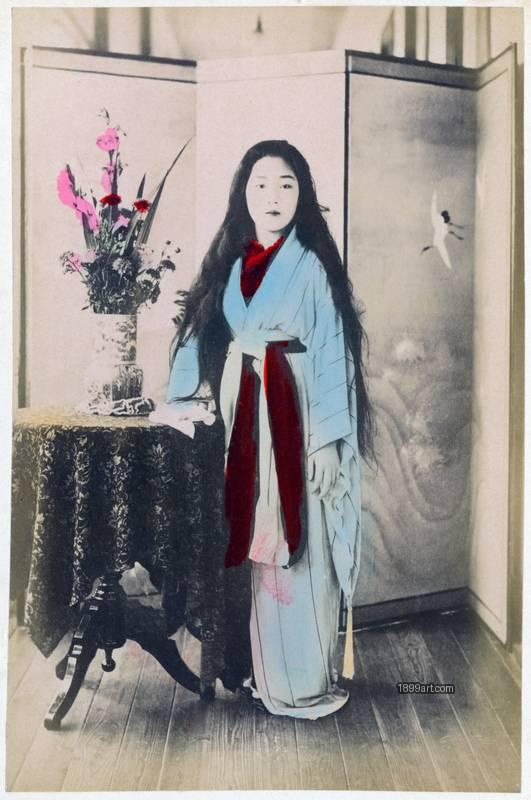
1899art Japan Standing Maiko in Studio Interior with Folding Screen and Floral Arrangement Handcolored 1900s 1899art
From the 1899art Archive: This hand-coloured studio photograph depicts a maiko standing in a formal interior setting. Her long, ungebundene Haartracht, youthful facial features, and the style of her kimono—worn with a relatively narrow obi and long sleeves—identify her as an apprentice geisha rather than a fully trained geisha. The posture is upright yet reserved, suggesting instruction and discipline rather than performance.
The scene is carefully composed: a small table with a floral arrangement stands beside the figure, while a painted folding screen (byōbu) forms the background, reinforcing the studio setting typical of Yokohama School photography. Such images were produced primarily for export and often employed real maiko as models, whose trained bodily presence and controlled stillness lent authenticity to the composition. The photograph reflects both the commercial staging of Meiji-era studio photography and the genuine corporeal knowledge embodied by the young performer.
Japan · c. 1895–1910 · Hand-colored photograph
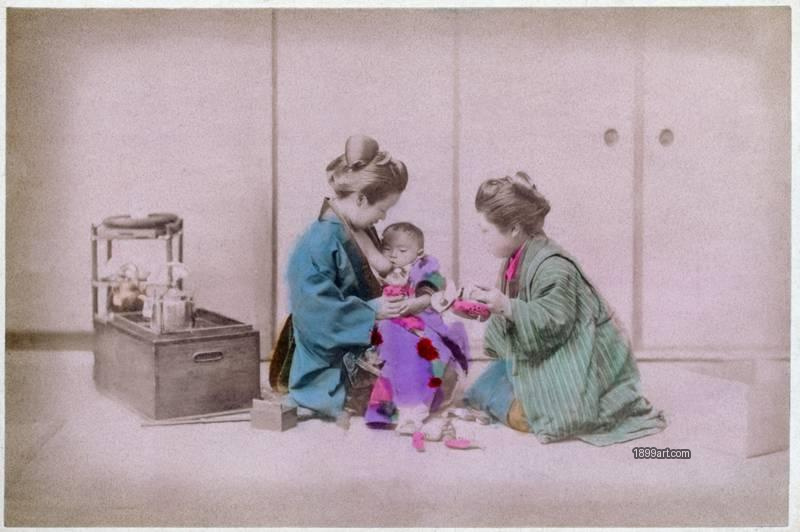
1899art Japanese Women and Baby B1180 – Nursing Child Handcolored 1900s 1899art
From the 1899art Archive: This studio photograph depicts a mother seated with her infant, attended by a younger female helper, possibly a household servant or adolescent attendant. The mother supports the child on her lap, while the younger girl kneels opposite, offering food or assisting in the care of the infant. The interaction suggests a moment of everyday domestic nursing rather than formal childcare.
The age difference, posture, and role distribution indicate that the second female figure is not the mother, but a subordinate helper — potentially a young household assistant and, in some cases within Yokohama studio practice, possibly a maiko or trainee model used to enact domestic roles. The setting is a constructed studio interior, with sliding doors and carefully arranged utensils, designed for export imagery. Such scenes were intended to present an idealized vision of Japanese family life, while relying on the bodily discipline and composure of real women and girls accustomed to formal kneeling postures and close caregiving roles.
Japan · c. 1895–1910 · Hand-colored photograph
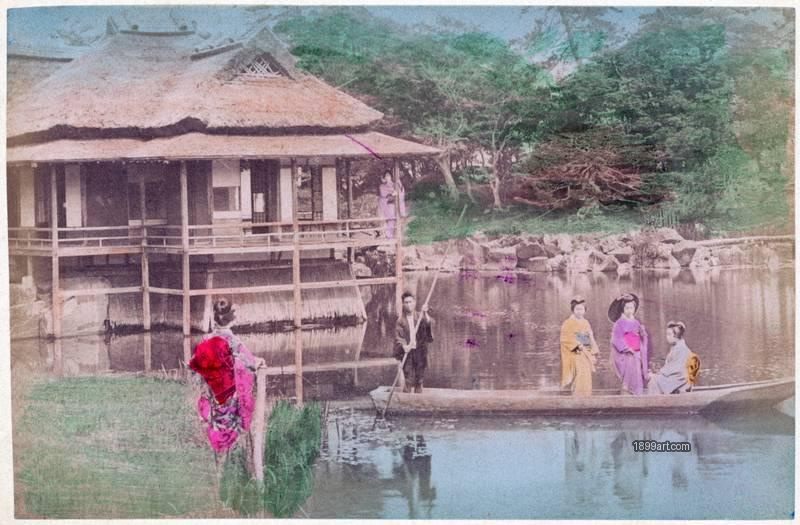
1899art Women in a Boat at Prince Hotta’s Garden, Tokyo, Japan. Handcolored 1900s 1899art
From the 1899art Archive: This hand-coloured albumen photograph shows a small wooden boat gliding across a landscaped garden pond, carrying several young women dressed in formal kimono. The figures are carefully arranged: two women seated in the boat, another standing near the shore, while a boatman propels the vessel with a pole. Their hairstyles, layered kimono, and composed postures strongly suggest maiko or young geisha, likely employed as studio models rather than captured in a purely spontaneous scene.
The setting can be identified with high confidence as Prince Hotta’s Garden, a well-known daimyo garden in Tokyo that appears repeatedly in Yokohama School photography. Characteristic elements include the irregular stone embankments, stone lanterns, gently curving shoreline, and the integration of human figures into the garden composition. The boat scene functions both as an evocation of refined leisure and as a picturesque stage designed to meet Western expectations of Japanese elegance around 1890–1900.
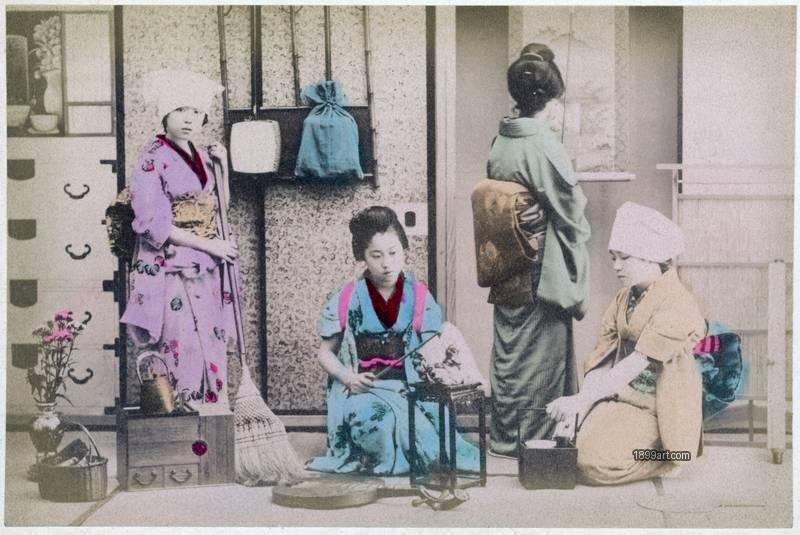
From the 1899art Archive: This hand-coloured albumen photograph shows a staged interior genre scene titled “Girls Dusting in Room”, identified by the original caption and number Y76. Four meiko are arranged in a traditional Japanese room and shown performing light domestic tasks. The studio set is carefully composed with props—broom, lantern, storage boxes, hanging cloth bundles, and small household items—creating a readable “everyday life” tableau for the tourist/export market.
Although the caption frames the scene as ordinary housekeeping, the hairstyles, kimono styling, obi tying, and highly controlled poses suggest these are professional studio models, very plausibly maiko (apprentice geisha) used across multiple Yokohama School genre images. The photograph therefore reads less as documentary observation and more as a choreographed studio construction: a theatrical, idealized domestic moment designed to be legible and appealing to Western buyers.
Japan · c. 1895–1910 · Hand-colored photograph
1899art Japan Three Maiko with Tobacco Pipe and Writing Box Handcolored 1900s 1899art
From the 1899art Archive: This hand-coloured albumen print depicts three young women seated on tatami mats around a low writing box and a tobacco set. One figure arranges or selects items from the box, while another smokes a kiseru pipe. The indoor setting, framed by plain sliding paper doors, is carefully staged; the objects and gestures suggest refined leisure rather than domestic labour.
Despite the everyday titles often applied to such images, the hairstyles, kimono construction with long sleeves, obi tying, and composed posture clearly identify the figures as maiko, deliberately employed as studio models. Such scenes were characteristic products of Yokohama School studios, where the same maiko were repeatedly photographed in varied roles—leisure scenes, interiors, and musical settings—tailored to the expectations of the foreign tourist market. The image presents an idealised, performative vision of Japanese interior life rather than a documentary record.
Japan · c. 1895–1910 · Hand-colored photograph
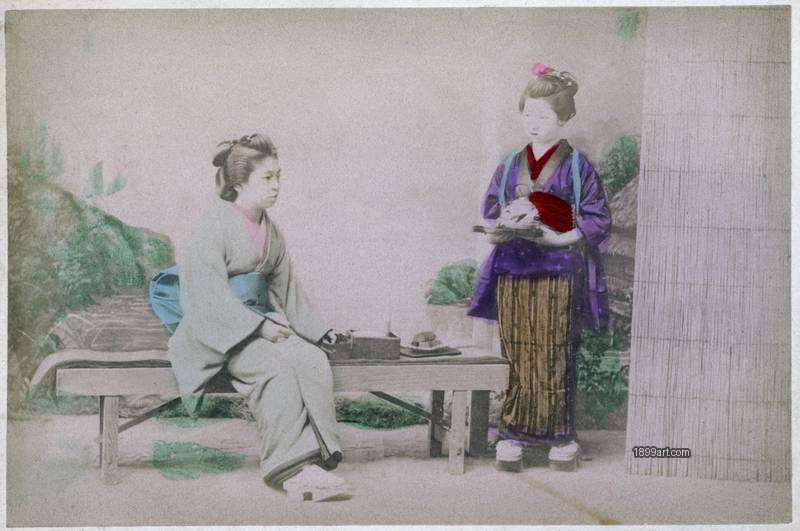
1899art Japan Young Maikos in a Tea House Scene Handcolored 1900s 1899art
From the 1899art Archive: This hand-coloured albumen print shows a staged roadside tea-house scene featuring real maikos employed as studio models by a Yokohama School photographer around the late 1890s–early 1900s. The standing figure is unmistakably a maiko, identifiable by her youthful facial features, distinctive hairstyle, red collar (eri), long-sleeved furisode-style kimono, and formal posture. These are not generic servants or actresses in costume, but trained apprentice geisha whose bodily discipline and movement could not be convincingly imitated by non-professionals.
The seated woman represents a customer resting at a roadside tea bench, while the maiko performs a ritualized act of service, holding a lacquered tray with tea utensils. The scene is constructed within a studio using a painted backdrop depicting Mount Fuji and an idealized landscape, combined with minimal props such as a bamboo screen and low bench. This deliberate staging reflects the Yokohama School’s practice of using authentic maikos to embody cultural refinement, while simultaneously removing the scene from real geography and social context.
Rather than documentary truth, the photograph offers a symbolic composition: youth, elegance, service, and tradition condensed into a single, export-oriented image. The repeated appearance of the same maikos across multiple tea-house, music, and domestic scenes strongly suggests that individual maikos were systematically reused across series, forming a recognizable visual vocabulary within the studios’ catalogues.
Japan · c. 1895–1910 · Hand-colored photograph
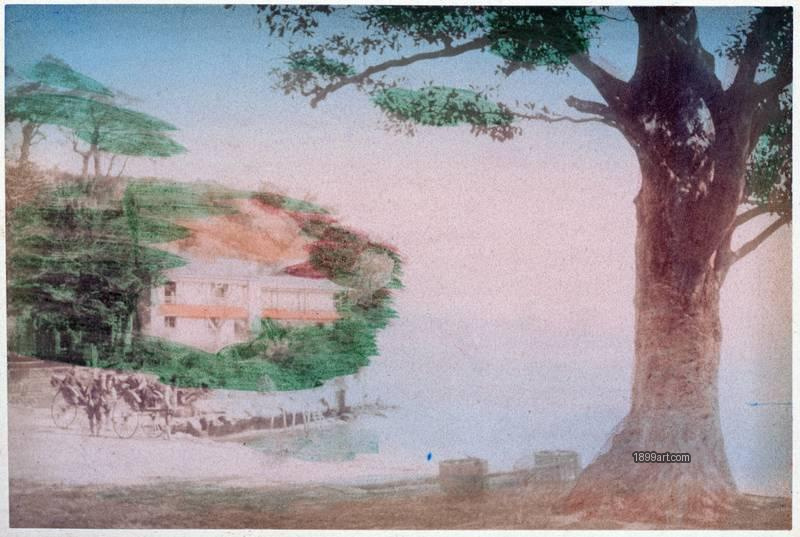
1899art Honmoku Coast, Yokohama — View with Tree and Carriages Handcolored 1900s 1899art
From the 1899art Archive: This hand-coloured photograph depicts a quiet coastal scene in Honmoku, an area south of Yokohama that was well known around 1900 for its elevated coastal bluffs, large trees, and proximity to the foreign settlement. The prominent tree in the foreground frames the view toward the shoreline and road, where horse-drawn carriages can be seen—an everyday mode of transport at the time.
Honmoku was a favoured subject within Yokohama photography because it combined natural scenery with signs of modern infrastructure and Western-influenced architecture. Views like this were produced primarily for travellers and collectors, presenting a calm, picturesque image of Yokohama’s outskirts at the turn of the century, during Japan’s transition into a modern, internationally connected society (c. 1890–1905).
Japan · c. 1895–1910 · Hand-colored photograph
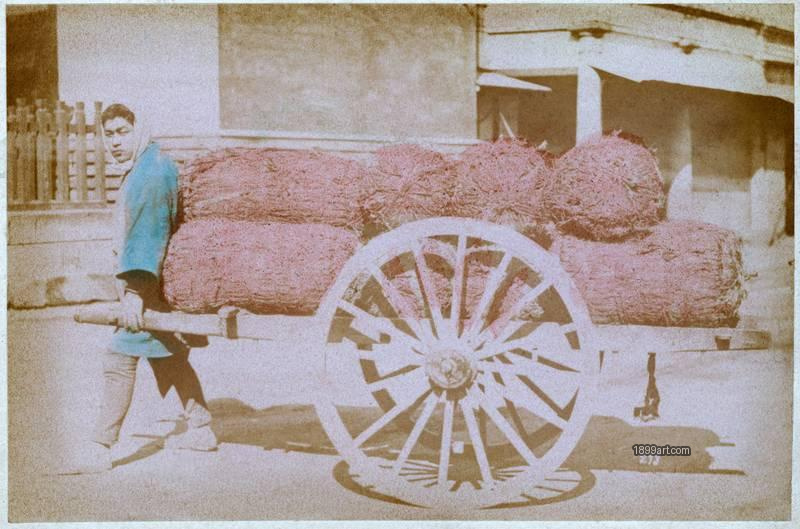
1899art Man Pulling a Handcart Loaded with Straw Bales, Japan Handcolored 1900s 1899art
From the 1899art Archive: This hand-coloured albumen photograph shows a working man pulling a traditional two-wheeled handcart (rikisha-style freight cart) heavily loaded with bundled straw or reeds. Such carts were a common sight in Japanese towns and cities around 1890–1905 and were used for transporting fuel, roofing material, animal fodder, or agricultural goods over short distances.
Images like this belong to the genre of everyday labor scenes produced by Yokohama-school studios for foreign visitors. Rather than depicting elites or ceremonial life, the photograph documents the physical reality of manual transport before mechanization became widespread. The carefully posed composition and later hand-colouring transform a scene of hard labor into a visually balanced, almost emblematic representation of working life in Meiji-era Japan.
Japan · c. 1895–1910 · Hand-colored photograph
1899art Handcart on a Coastal Road Below Steep Cliffs, Japan Handcolored 1900s 1899art
From the 1899art Archive: This hand-coloured albumen photograph depicts a solitary handcart on a winding road running beneath steep coastal cliffs. The cart, seen in profile against the open landscape, emphasizes the scale of the terrain and the effort required to move goods through Japan’s hilly coastal regions at the turn of the 20th century. Sparse vegetation, tall grasses, and the pale sky create a quiet, almost atmospheric composition.
Such images were typical of Yokohama-school landscape views, combining documentary observation with a carefully balanced pictorial style. The later hand-colouring softens contrasts and adds tonal depth, transforming a functional transport scene into a contemplative landscape that highlights both human presence and the surrounding natural environment in Meiji-era Japan.
Japan · c. 1895–1910 · Hand-colored photograph
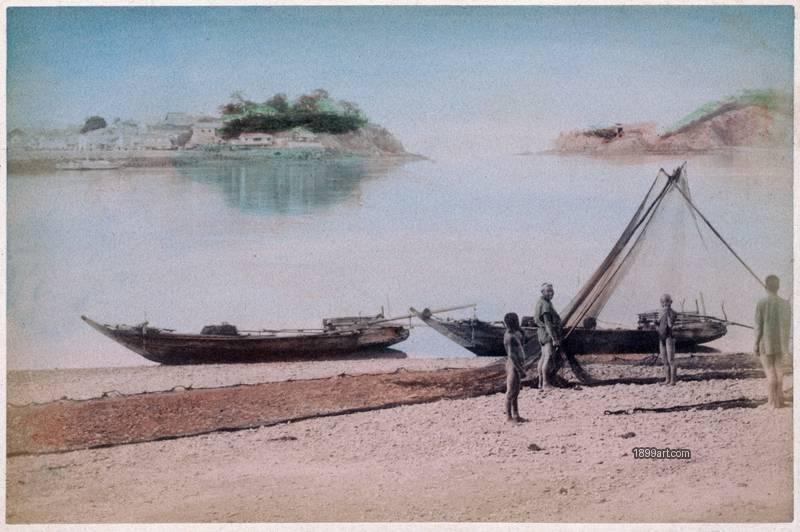
1899art Fishing Boats and Fishermen at Bingo, Japan Handcolored 1900s 1899art
From the 1899art Archive: This hand-coloured albumen photograph depicts fishermen and their boats along the shore of the Inland Sea at Bingo (modern-day Hiroshima Prefecture). Several wooden fishing vessels rest on the pebbled beach while fishermen stand beside their nets, preparing or repairing them after use. The calm water reflects the low hills and small settlements visible across the inlet, emphasizing the quiet, sheltered character of the Inland Sea.
Scenes of coastal labour such as this were commonly produced by Yokohama School studios in the late 19th century, combining documentary realism with a picturesque composition aimed at foreign audiences. The subtle hand-colouring enhances the natural tones of sea, land, and figures, lending the image a serene and timeless atmosphere typical of Meiji-period souvenir photography.
Japan · c. 1895–1910 · Hand-colored photograph
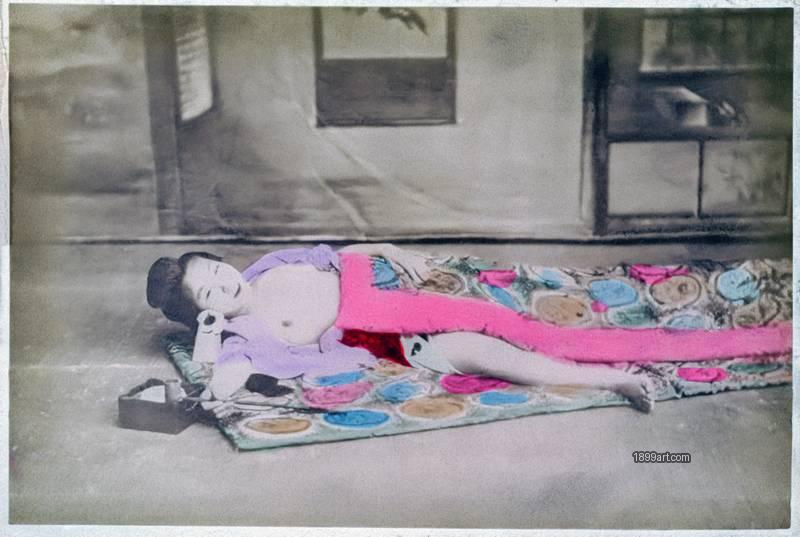
1899art Japan Reclining woman, studio genre scene for export market Handcolored 1900s 1899art
From the 1899art Archive: This hand-coloured albumen print depicts an adult woman reclining on a patterned floor mat inside a studio interior. She is shown in a relaxed, intimate pose, partially draped in a kimono that leaves her upper torso exposed. Her hairstyle and cosmetics follow late-19th-century conventions, yet her presentation clearly falls outside the strict visual and social codes associated with geishas. Images of this type were commonly created in Yokohama studios for Western clientele, reflecting exoticized expectations of private or intimate Japanese interiors. The woman is best described as a studio model or courtesan figure, posed deliberately to suggest leisure and sensuality, rather than any identifiable occupational or ceremonial role.
Japan · c. 1895–1910 · Hand-colored photograph
1899art Rock Formation off Awajishima Island, Hyōgo Prefecture Handcolored 1900s 1899art
From the 1899art Archive: This hand-coloured albumen print depicts a distinctive rocky islet rising from shallow coastal waters, crowned by wind-shaped pine trees. In the foreground, a traditional wooden coastal boat with a simple mast and rail structure is moored in calm water, emphasizing the intimate scale of inland-sea navigation.
Direct comparison with a documented early 20th-century photograph confirms that the rock formation shown here is identical to a well-known coastal outcrop off Awajishima. The unique silhouette of the cliff face, the stratified rock layers, and the placement of the pine trees leave no reasonable doubt as to the location.
Awajishima, situated at the eastern entrance to the Seto Inland Sea, was frequently photographed during the Meiji period for its dramatic coastal geology and tranquil maritime scenery. Such images were popular subjects within Yokohama School albums, combining recognizable landmarks with an idealized, serene vision of Japan’s natural landscape.
Japan · c. 1895–1910 · Hand-colored photograph
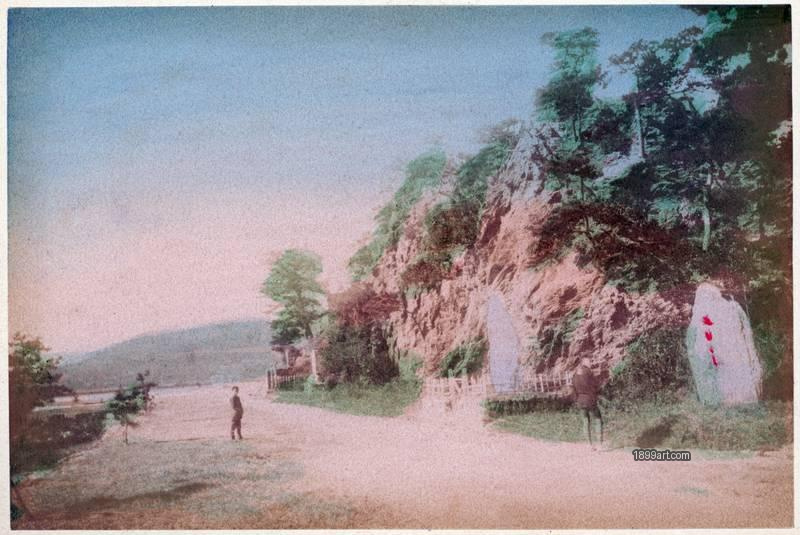
1899art Coastal Road with Stone Monuments, Awajishima Island (Seto Inland Sea), Japan Handcolored 1900s 1899art
From the 1899art Archive: Hand-coloured albumen photograph showing a rural coastal road running alongside a rocky hillside on Awajishima Island, Japan. The scene features prominent natural rock formations with sparse pine growth and several upright stone monuments positioned along the roadside, likely serving as traditional markers or memorial stones. A small number of figures are visible on the road, providing scale but not forming the central subject.
The photograph is characteristic of late Meiji-period landscape imagery from the Seto Inland Sea region, emphasizing topography, route infrastructure, and culturally significant stone markers rather than urban development. Comparable geological formations and road layouts are documented in other confirmed Awajishima views from the same period.
Japan · c. 1895–1910 · Hand-colored photograph
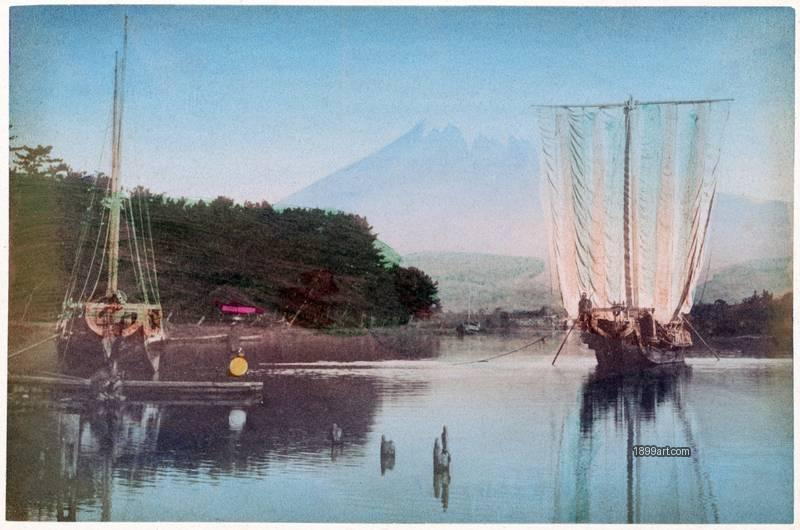
1899art Sailboats on Calm Water with Mount Fuji in the Distance Handcolored 1900s 1899art
From the 1899art Archive: Hand-coloured albumen photograph showing traditional Japanese sailboats on calm inland coastal waters at Tagonoura, in the former Suruga Province, with Mount Fuji rising prominently in the background. The still water and low shoreline indicate the sheltered coastal inlet of Tagonoura rather than an open-sea setting, a well-known viewpoint along the Tōkaidō route.
This composition belongs to a large and systematic series of Mount Fuji views produced for the export market in the late 19th century. The motif is documented in multiple institutional collections, including the Syracuse University Art Museum, under the designation "A528 – Fujiyama from Tagonoura, Suruga", and is characteristic of Kusakabe Kimbei’s Fuji-view catalog, which emphasized precise named viewpoints combined with idealized, hand-tinted scenic balance.
Japan · c. 1895–1910 · Hand-colored photograph
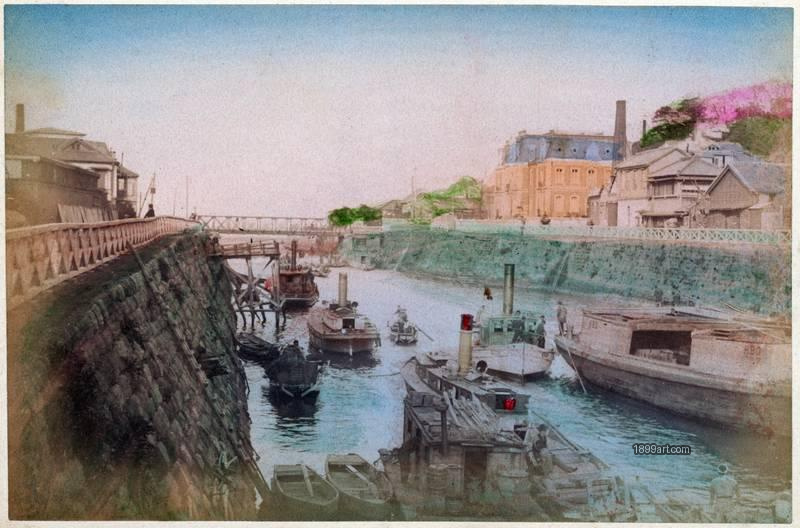
1899art Steam Boats in the Harbour of Yokohama. Handcolored 1900s 1899art
From the 1899art Archive: Hand-coloured albumen photograph showing a busy inner harbour scene in Yokohama, with several steam-powered vessels and small boats moored along a stone-lined canal or dock. The steep masonry embankment on the left and the iron bridge in the background reflect the rapid modernization of Yokohama’s port infrastructure during the late Meiji period.
The prominent Western-style brick building on the right is consistent with the former French Consulate in Yokohama, one of several foreign legations established near the waterfront after the opening of the treaty port. The photograph documents Yokohama’s role as Japan’s primary international gateway, where traditional boats and modern steam vessels coexisted in a highly industrialized harbour environment around 1890–1900.
Japan · c. 1895–1910 · Hand-colored photograph
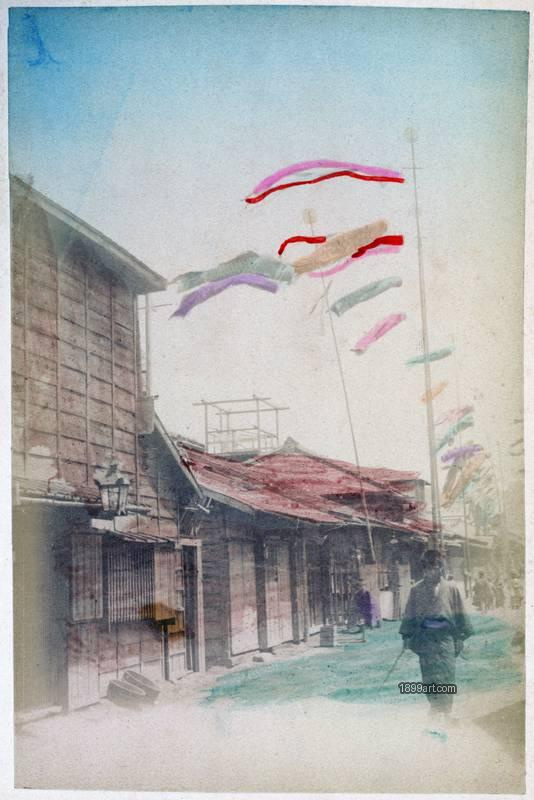
1899art Street Scene with Koinobori (Carp Streamers), Japan Handcolored 1900s 1899art
From the 1899art Archive: Hand-coloured albumen photograph showing a narrow Japanese street decorated with koinobori (carp-shaped windsocks) suspended on tall bamboo poles. These streamers are traditionally displayed during Boys’ Day (Tango no Sekku) in early May and symbolize strength, perseverance, and prosperity. The wooden townhouses lining the street, with tiled and corrugated roofs, reflect typical urban architecture of the late Meiji period.
The image captures a quiet everyday moment rather than a formal festival scene, emphasizing seasonal decoration integrated into daily life. Such street views were popular subjects among Yokohama School photographers, documenting local customs for both domestic memory and foreign audiences around 1890–1905.
Japan · c. 1895–1910 · Hand-colored photograph
1899art Jinpuro Brothel (“No. 9”), Yokohama, Japan Handcolored 1900s 1899art
From the 1899art Archive: Hand-coloured albumen photograph showing the Jinpuro Brothel, also known internationally as “No. 9” or “Nectarine”, one of the most famous establishments in Yokohama’s licensed pleasure district during the Meiji period (late 19th century). The large numeral 9 visible on the façade corresponds directly to the house’s well-documented designation and confirms the identification beyond architectural comparison.
The Jinpuro was originally opened in 1872 in Takashima-chō, Yokohama, and relocated in 1885. It was widely known among foreign residents, sailors, and visitors, and is explicitly mentioned by Rudyard Kipling, who visited Japan in 1889. The Western-style architecture reflects the hybrid urban culture of Yokohama’s international quarters, where entertainment, commerce, and foreign presence intersected visibly. Like much of historic Yokohama, the Jinpuro was destroyed during Allied firebombing in the Second World War.
Japan · c. 1895–1910 · Hand-colored photograph
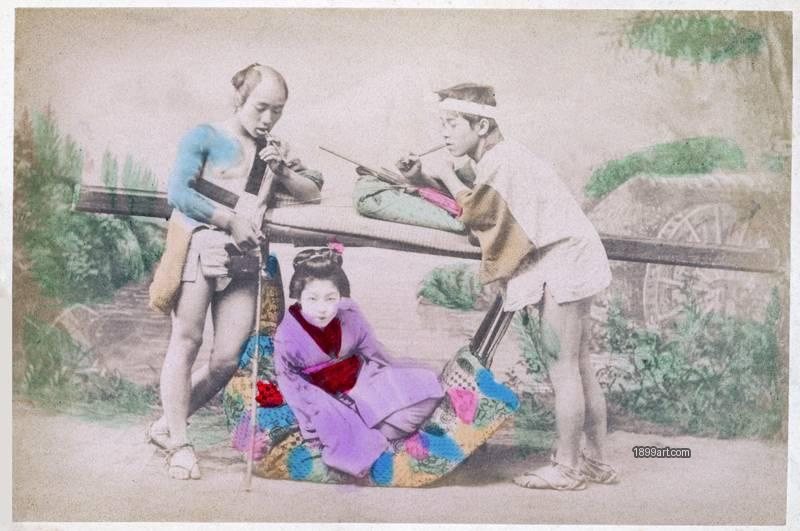
1899art B.1158 – Kago (Travelling Chair): Japanese Maiko Carried in a Sedan Chair with Attendants, circa 1890 Handcolored 1899art
From the 1899art Archive: This hand-coloured albumen photograph depicts a maiko (apprentice geisha) seated in a kago (sedan chair), carried by two male attendants. The scene is clearly staged: the maiko sits low within the woven carrier, her long-sleeved kimono, high obi, and youthful hairstyle emphasizing refinement, restraint, and status, while the bearers pause in a relaxed moment, smoking their pipes.
The visual contrast between the elaborately dressed young performer and the lightly clothed carriers establishes a hierarchy that would have been immediately legible to Western viewers of the late nineteenth century. A painted studio backdrop suggesting a rural landscape further identifies the image as a constructed tableau rather than a documentary street scene.
The photograph is attributed with high confidence to Kusakabe Kimbei and corresponds to his export catalogue series, identifiable by the number B.1158 printed on the image. Closely related variants of this motif are held in institutional collections, including the KITLV, supporting both attribution and a dating to around 1890. Produced for the foreign tourist market, such images presented traditional modes of transport and youthful performers as emblematic figures of “Old Japan” at a time when the country was undergoing rapid modernization.
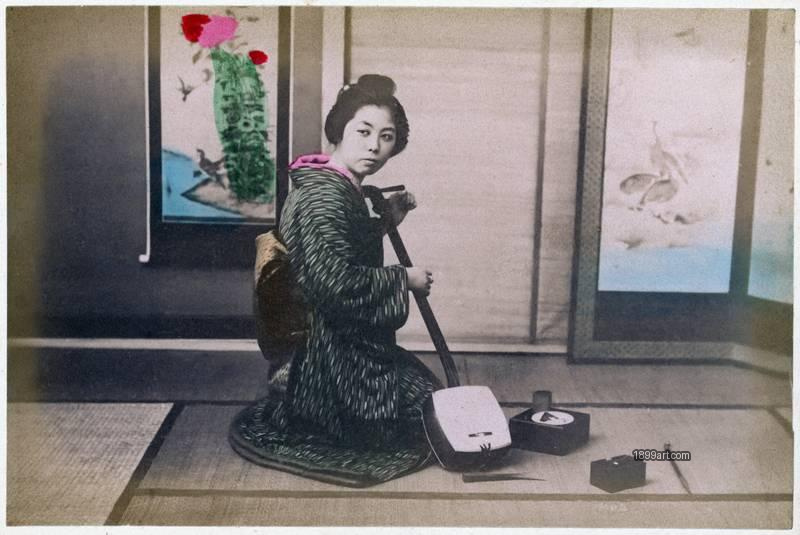
From the 1899art Archive: This hand-coloured albumen photograph depicts a young Japanese woman (Model “Seiren”) seated indoors, holding a shamisen. She is shown kneeling on tatami mats, her body slightly turned, looking directly toward the camera. The instrument rests diagonally across her body, suggesting a pause between performance and pose. The setting is a studio interior with painted folding screens (byōbu) in the background, decorated with birds and floral motifs, a common visual device used in Yokohama School studio photography.
The woman’s hairstyle, kimono, and posture are consistent with those of a maiko or young performer-in-training. The shamisen appears repeatedly with the same model across related photographs, indicating that the instrument may have belonged to her and was intentionally reused as a defining attribute. The negative number “1042” is incised directly into the image, confirming its position within a larger numbered studio series. While the photograph is often catalogued as anonymous, the combination of serial numbering, studio staging, and model continuity places it firmly within the commercial Yokohama photography tradition of the late 19th century.
Japan · c. 1895–1910 · Hand-colored photograph
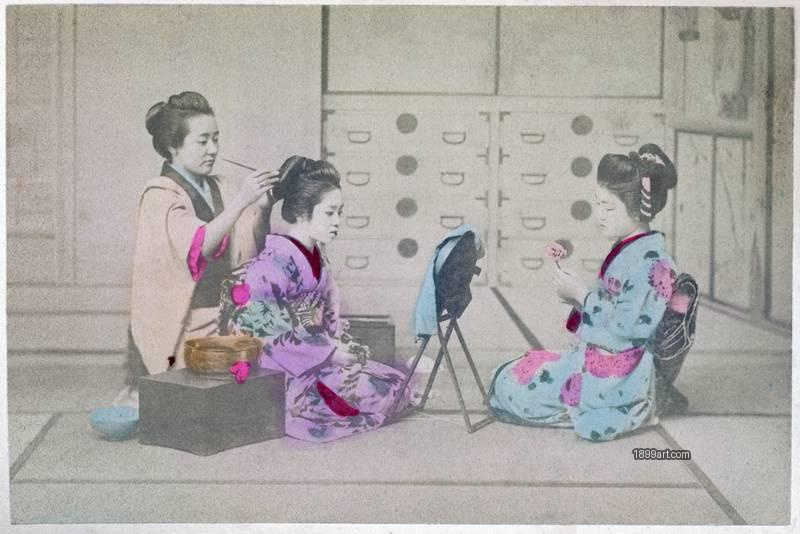
1899art Japan B 1218 – Tokoyama Dressing the Hair of Two Maiko (Girls Dressing Hair) Handcolored 1900s 1899art
From the 1899art Archive: This studio photograph shows a professional tokoyama (specialist hairdresser) carefully arranging the traditional hairstyle of a maiko, while a second maiko sits opposite, observing and preparing for the same process. The complexity of the coiffure, the tools present, and the calm, practiced posture of the hairdresser clearly identify this as a genuine hairdressing session rather than a staged imitation. Maiko hairstyles were highly specialized and could only be executed or adjusted by trained professionals; they were never arranged casually or by untrained women.
The two young women display consistent dress, comportment, and bearing typical of real maiko, a fact reinforced by their repeated appearance across Yokohama School photographs. The presence of a tokoyama is essential to the scene’s internal logic: such a hairstyle could not be risked or reconstructed without expert supervision. Although produced in a studio environment, the photograph documents authentic professional roles and practices of the Meiji period. The original caption “Girls Dressing Hair” reflects Western market terminology, where the term maiko was largely avoided for foreign audiences unfamiliar with the profession.
Japan · c. 1895–1910 · Hand-colored photograph
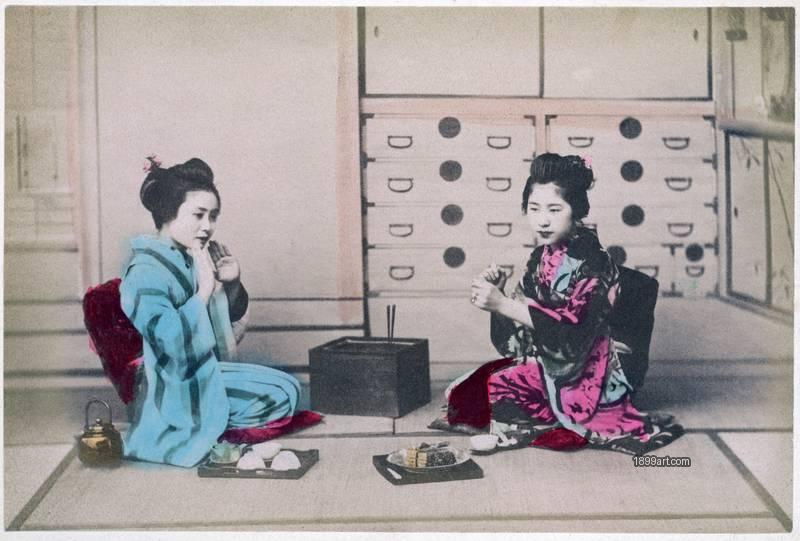
1899art Japan. B 1212 — “Girls Playing Ken (Game)” Handcolored 1900s 1899art
From the 1899art Archive: This studio photograph shows two geisha (very likely maiko/apprentices, based on hairstyle and demeanor) seated on tatami, engaged in the popular hand game ken. The women face each other with focused, playful concentration, hands poised to form the next gesture. Between them sits a square wooden incense box (or low container) with upright sticks, while individual trays hold wagashi (Japanese sweets) and tea utensils—props that frame the scene as a refined entertainment setting rather than a domestic moment.
Ken was a common pastime in the pleasure quarters and teahouse culture, often associated with geisha social performance—a mix of quick wit, rhythm, and ritualized play. Western-market captions frequently used “girls” as a simplified label for foreign customers, even when the sitters were clearly trained professionals.
Japan · c. 1895–1910 · Hand-colored photograph
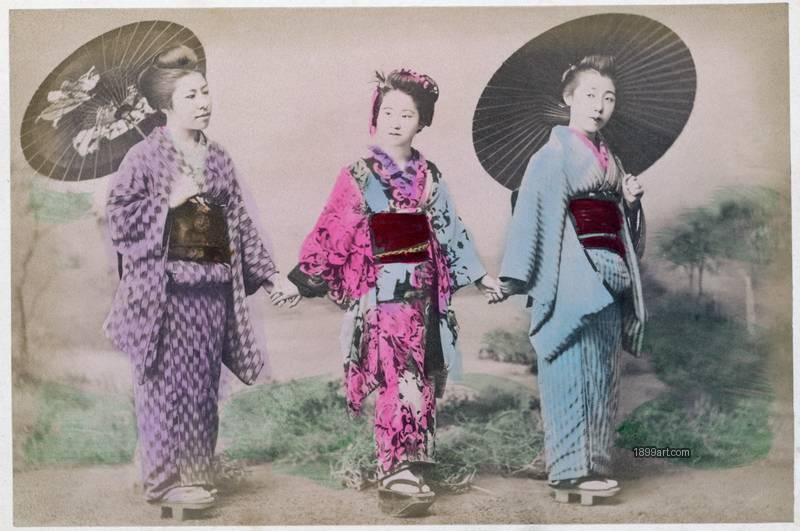
1899art Japan. Three Maiko Walking with Parasols Handcolored 1900s 1899art
From the 1899art Archive: This studio photograph depicts three maiko (apprentice geisha) walking hand in hand, two of them holding traditional wagasa (paper parasols). The figures are arranged in a gentle forward motion, suggesting a promenade rather than a static pose. Their hairstyles, kimono patterns, and especially the wide darari obi clearly identify them as maiko, not generic “girls” or models. The coordinated yet individual garments emphasize both professional identity and personal distinction within the group.
Although photographed in a studio setting for the export market, the scene is not theatrical role-play. Within the Yokohama School tradition, such images document real professional performers in controlled, readable compositions. The parasols function both as everyday accessories and as visual markers of elegance and training. Western captions often reduced such scenes to vague descriptions, but the visual evidence is explicit: these are maiko, presented as maiko, behaving as maiko—captured in a moment of composed movement that reflects their social and cultural role rather than an invented tableau.
Japan · c. 1895–1910 · Hand-colored photograph
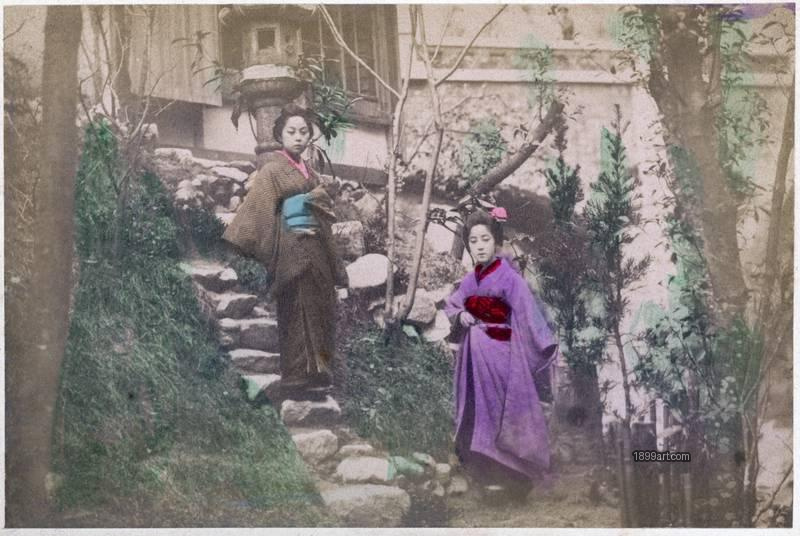
1899art Two Meiko descending in Garden. No. 468 – Ryoudo’s Garden at Nunobiki Falls, Kobe, Japan. Handcolored. 1900s 1899art
From the 1899art Archive: This photograph depicts two maiko descending a narrow stone path within Ryoudo’s Garden at Nunobiki Falls, Kobe, a well-known scenic and recreational site near the Nunobiki waterfalls. The original negative number 468 and title are visible within the image itself, confirming the historical identification of the location. The stone lantern, garden architecture, and terraced slope correspond closely to period views of the Nunobiki area, which was a popular destination for visitors in the late 19th century.
The figures are clearly identifiable as maiko by their darari obi, hairstyle, and posture. They are not posed as generic “girls,” but presented in their professional identity, moving naturally through a real garden environment rather than a theatrical setting. As characteristic of the Yokohama School, the scene is composed for visual clarity and export circulation, yet remains grounded in authentic place and role: maiko within a recognized leisure landscape, not as performers, but as participants in the social world the photograph documents.
Japan · c. 1895–1910 · Hand-colored photograph
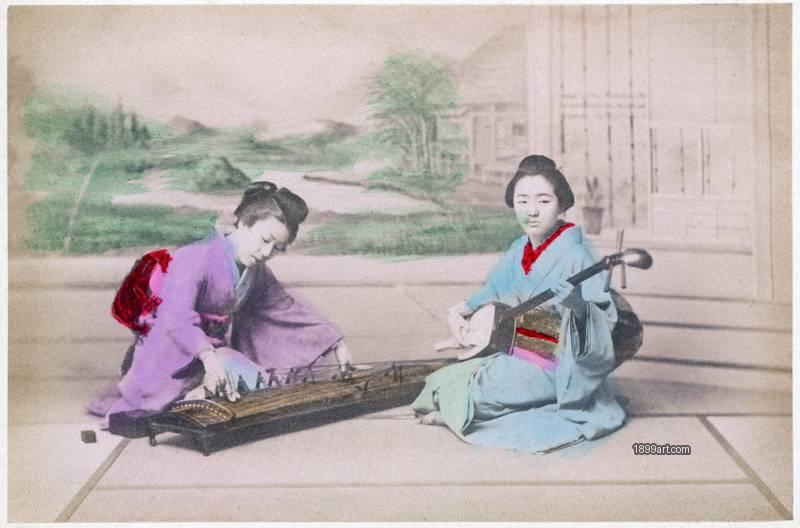
1899art Japan Maiko Musicians Performing Koto and Shamisen Handcolored 1900s 1899art
From the 1899art Archive: This photograph shows two maiko seated on tatami mats, performing traditional Japanese music with a koto (left) and a shamisen (right). Their hairstyles, kimono styling, and darari obi clearly identify them as professional maiko in training within the geisha world. The instruments are handled with correct posture and technique, indicating real musical practice rather than theatrical imitation.
The scene is arranged within a studio setting using a painted backdrop, a common practice of the Yokohama School, yet the roles depicted are authentic. Musical training was a central part of a maiko’s professional education, and the calm concentration of both performers reflects this discipline. The photograph documents maiko as skilled musicians, presenting their cultural role clearly and without caricature for an international audience.
Japan · c. 1895–1910 · Hand-colored photograph
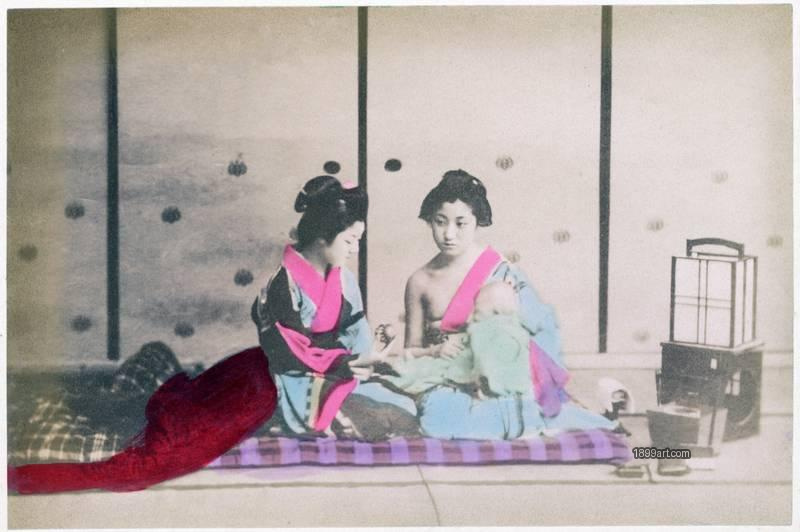
1899art Japan "No.1605. Mother and Baby on Japanese Bed" Handcolored 1900s 1899art
From the 1899art Archive: This hand-tinted albumen photograph shows a young Japanese mother seated on a traditional floor mattress (futon) with her infant, inside a tatami-lined interior with sliding fusuma doors. The mother holds the baby calmly in her lap, while another young woman—likely an attendant or helper—sits beside her, engaging gently with the child. A small wooden lantern and personal items placed to the right complete the domestic setting and emphasize the intimacy of everyday life.
Although the mother appears very young by modern standards, this reflects historical reality rather than staging: early motherhood was common in Meiji-period Japan. The scene is not theatrical but observational, consistent with Yokohama School practices that documented real social roles and domestic situations for a foreign audience, using neutral titles rather than culturally specific terminology.
Japan · c. 1895–1910 · Hand-colored photograph
1899art Japan Two Maiko with Doll in a Tatami Interior Handcolored 1900s 1899art
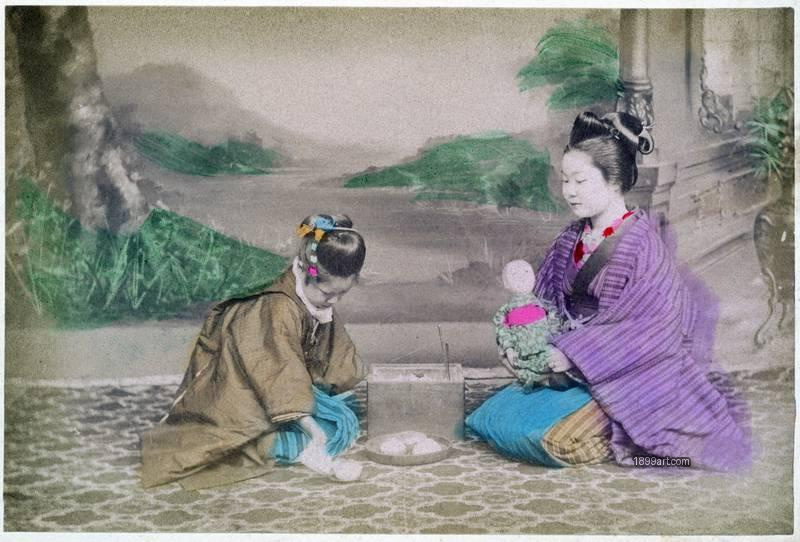
From the 1899art Archive: This hand-tinted albumen photograph shows two maiko seated on tatami mats in a studio interior arranged as a domestic space. The young woman on the right holds a doll, not a real infant—a detail made clear by the rigid posture, scale, and stylised appearance of the figure. The maiko on the left is engaged with a small tray of food or sweets placed between them, suggesting a quiet, everyday moment rather than a narrative scene.
Japan · c. 1895–1910 · Hand-colored photograph
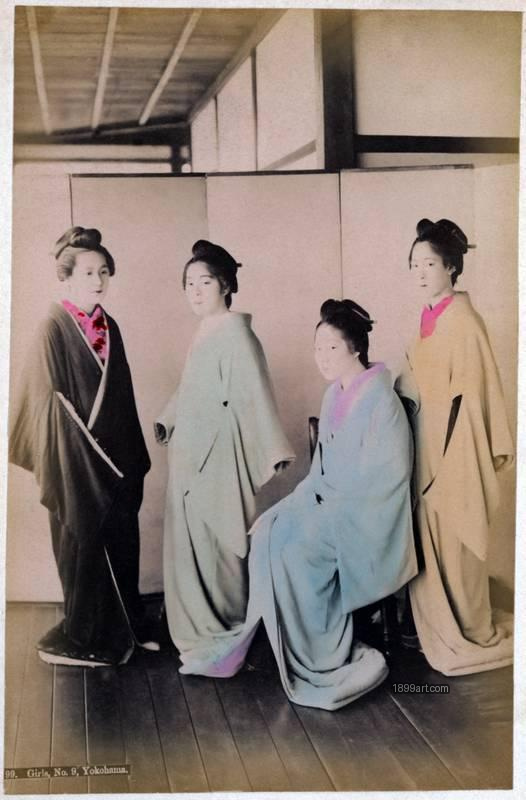
1899art "No. 99. Girls, No. 9, Yokohama" Four Girls in Brothel No. 9 in Yokohama, Japan. 1900s 1899art
From the 1899art Archive: This hand-colored albumen photograph depicts four women posed indoors, three standing and one seated, dressed in formal kimono and presented in a frontal studio arrangement typical of Yokohama souvenir photography. The original caption printed on the image reads “99. Girls No. 9, Yokohama.” The numbering and naming correspond to established commercial cataloguing practices used for export photographs in the late nineteenth century.
The designation “No. 9” refers to the well-known Jinpuro / Nectarine establishment in Yokohama, which functioned as a licensed brothel catering largely to foreign clientele. Contemporary photographs by Yokohama School photographers explicitly labeled women from this house as “prostitutes,” confirming the meaning of the reference. The term “girls” reflects period export language rather than social ambiguity. The photograph documents women associated with House No. 9, presented as such for an international market, without euphemism or later reinterpretation.
Contact & Credits
Purpose of this site
YokohamaSchool.org is intended as a reference and context resource for the history and surviving works of the Yokohama School of hand-colored photography.
It does not claim to be complete and will be expanded over time.
Focus
Historical research, visual analysis, digital preservation and curated examples of original works from the period c. 1860–1920.
This website is currently in its early phase. Further sections on sources, studios and bibliography will follow.
YokohamaSchool.org is part of the wider 1899art project:
www.1899art.com.
Usage Rights & Legal Notice – 1899art Archive
All images published on 1899art.com originate from the 1899art Archive and are provided for cultural, educational, and historical reference purposes only.
Permitted use
Images may be linked, embedded, or shared on external websites and platforms exclusively in their original, unmanipulated form, provided that:
– the source is clearly credited as “1899art”, and
– a visible and clickable link to https://1899art.com accompanies the image.
Prohibited use
Any form of modification, including but not limited to cropping, retouching, recoloring, compositing, filtering, AI-based processing, or the creation of derivative works, is strictly prohibited without prior written permission.
Commercial use, resale, redistribution as standalone files, or inclusion in third-party archives or databases is also not permitted without explicit authorization.
Rights status
While the original photographs may be in the public domain due to age, the digital reproductions, curatorial selection, restoration decisions, metadata, and contextual presentation are the intellectual property of the 1899art Archive.
By using images from this website, you agree to respect these conditions. Automated downloading, scraping, or use of images for machine learning or AI training purposes is expressly prohibited.
EU / International Copyright Notice
All images published by the 1899art Archive are protected under European and international copyright law.
Any reproduction, redistribution, modification, AI-based processing, or commercial use beyond the explicitly permitted low-resolution web sharing is prohibited without prior written consent of the 1899art Archive.
This applies equally to high-resolution files obtained through unauthorized access, third-party leaks, or archival reproductions.
DMCA Copyright Notice & Protection
All images and digital files published by the 1899art Archive are protected by international copyright law and the Digital Millennium Copyright Act (DMCA).
Unauthorized reproduction, distribution, modification, AI processing, or commercial use of any image or high-resolution file from the 1899art Archive is strictly prohibited.
The unauthorized possession or dissemination of high-resolution files does not constitute a license and does not grant any rights of use.
Any infringement will result in DMCA takedown notices, platform removal requests, and, where applicable, legal action.