High-resolution original files are available from the 1899art Archive.
Original scans have a minimum resolution of 6,000 × 9,000 pixels.
Depending on the original source medium, original master scans of up to 15,000 × 20,000 pixels are available.
Only the low-resolution images displayed on the 1899art website may be linked, shared, or embedded on external websites, and only in their original, unmanipulated form, provided that clear attribution to “1899art” is given and a clearly visible link to https://1899art.com is included.
Any use, distribution, or publication of high-resolution files, whether obtained intentionally or inadvertently, is strictly prohibited.
Any modification, alteration, recomposition, recoloring, AI processing, or commercial reuse beyond simple linking and sharing is not permitted without prior written consent of the
1899art Archive.
YOKOHAMA SCHOOL BACK TO MAIN PAGE
Album 3 – 24 Motifs of the Yokohama School. All photographs are carefully reconstructed and described based on extensive research. We strive for the highest possible accuracy in all attributions and contextual information. If you believe any information is incorrect, please contact us and include your source.
Japan · c. 1895–1910 · Hand-colored photograph
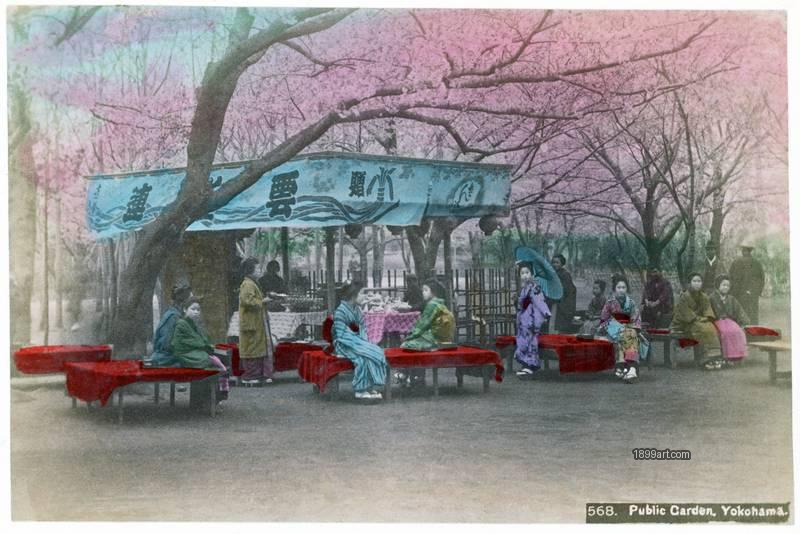
1899art Meiko in Public Garden, Yokohama, Japan (Nogeyama), c. 1890, Meiji period Handcolored 1899art
From the 1899art Archive: Hand-colored albumen photograph depicting a public garden scene in Yokohama during cherry blossom season. A group of geisha and maiko are seated and standing on red-covered benches beneath flowering cherry trees around a pavilion. The printed studio title reads “Public Garden, Yokohama.”
According to later art-historical references (e.g., TASCHEN / GEO), the scene is associated with the Nogeyama area, a well-known public garden district in Meiji-period Yokohama. The meiko are visually distinguished by their brightly colored kimono, elaborate hairstyles, and formal appearance, which contrasts with the more subdued dress of the surrounding men and women.
The presence of meiko in such a public setting was not unusual in late-19th-century urban Japan. They were socially recognized performers and cultural professionals, easily identifiable and accepted within the cityscape, particularly in or near entertainment districts. Their inclusion in the scene was likely intentional, serving both as a cultural marker and as a visual anchor within the composition.
Japan · c. 1895–1910 · Hand-colored photograph
1899art French Consulate, Yokohama, Japan – Western Architecture in the Foreign Settlement (c. 1899) 1899art
From the 1899art Archive: This hand-colored albumen photograph depicts the French Consulate in Yokohama, photographed around 1899. The building, completed in 1890, was located in the Yamashita-chō foreign settlement, an area specifically designated for diplomatic missions and foreign residents following the opening of the port in 1859.
The structure exemplifies Western architectural influence during the Meiji period, with its brick construction, symmetrical façade, and ornamental detailing distinctly contrasting with surrounding Japanese buildings. The stone embankment, stepped access to the water, and adjacent bridge situate the consulate directly within Yokohama’s modernized waterfront infrastructure.
The building was destroyed during the Great Kantō Earthquake of 1923, making photographs such as this important visual records of Yokohama’s diplomatic and architectural landscape before the catastrophe. The image belongs stylistically to the Yokohama School, combining documentary clarity with subtle hand-coloring intended for both historical documentation and the international souvenir market.
Japan · c. 1895–1910 · Hand-colored photograph
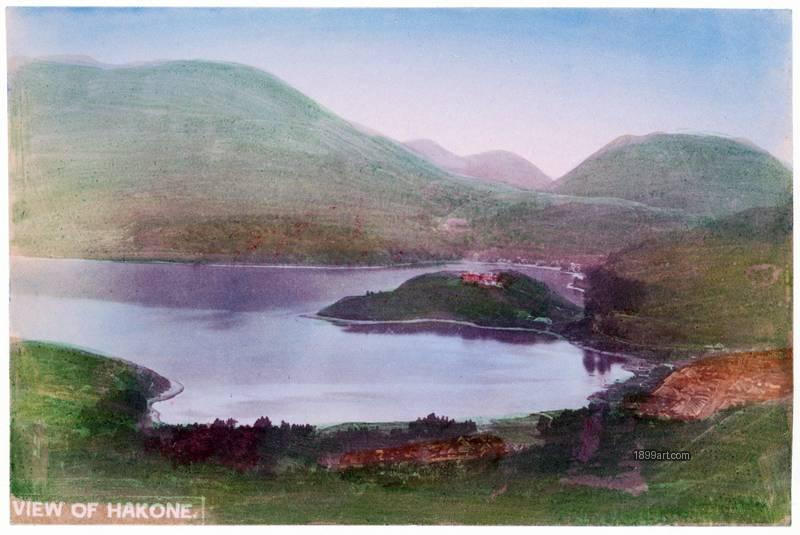
1899art Japan View of Hakone and Lake Ashi (Ashinoko), Meiji Period (c. 1890s) Handcolored 1900s 1899art
From the 1899art Archive: This hand-colored albumen photograph presents a panoramic view of Hakone, centered on Lake Ashi (Ashinoko), one of the most celebrated landscapes of Japan during the Meiji period. The calm crater lake is framed by softly contoured volcanic hills, characteristic of the Hakone area, long known for its geothermal activity, mountain scenery, and strategic position along the historic Tōkaidō route between Edo (Tokyo) and Kyoto.
The subtle, atmospheric hand-coloring emphasizes the lake’s reflective surface and the layered greens of the surrounding slopes, creating an image that balances topographical documentation with pictorial serenity. Such views were especially popular among foreign travelers, for whom Hakone represented both a natural retreat and a gateway to views of Mount Fuji on clear days.
Japan · c. 1895–1910 · Hand-colored photograph
1899art Ueno Tōshō-gū Shrine, Tokyo – Ceremonial Gate and Courtyard (Meiji Period, c. 1890s) Handcolored 1899art
From the 1899art Archive: This hand-colored albumen photograph depicts the Ueno Tōshō-gū Shrine in Tokyo during the late Meiji period, around the 1890s. The image shows the shrine’s ornate entrance gate with its richly detailed tiled roof and gilded elements, set within a broad gravel courtyard enclosed by red-painted shrine fences.
Ueno Tōshō-gū was originally founded in 1627 and is dedicated to Tokugawa Ieyasu, the founder of the Tokugawa shogunate. Unlike many shrines that were rebuilt or simplified during Japan’s modernization, Ueno Tōshō-gū retained much of its early architectural character, making it a prominent symbol of continuity between the Edo and Meiji eras.
The presence of ceremonial markers and open courtyard space reflects the shrine’s role not only as a place of worship but also as a site for ritual practice and formal observance. The careful hand-coloring emphasizes the vermilion structures and gold accents while leaving the surrounding space calm and uncluttered, creating a dignified and almost timeless atmosphere.
Japan · c. 1895–1910 · Hand-colored photograph
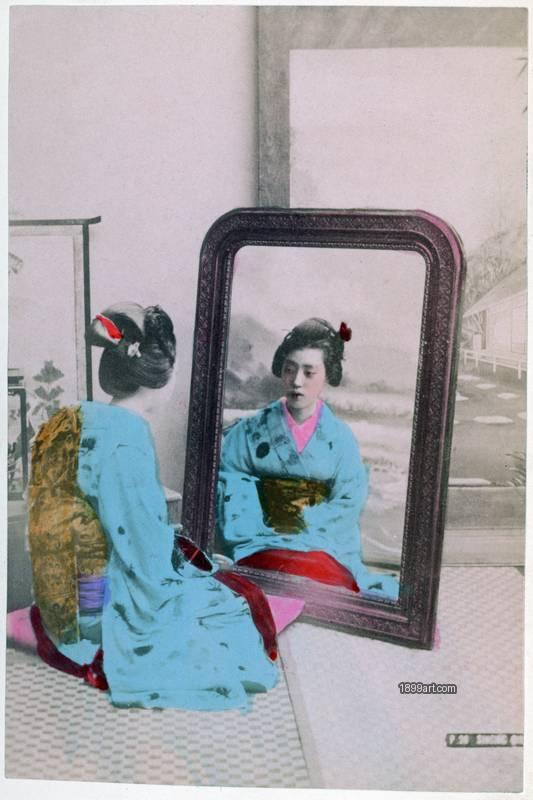
1899art Japan Young Geisha Seated Before a Mirror Handcolored 1900s Kimbei 1899art
From the 1899art Archive: This hand-colored albumen photograph shows a young Japanese woman seated in a formal studio setting, depicted in a calm, introspective pose. The image belongs to a systematically produced series of studio portraits created in Japan during the late Meiji period, most likely within the Yokohama School tradition.
A close examination of the original albumen print reveals a faint studio inscription reading “P28 – SITTING GIRL”, visible in the paper fibers of the original scan. The designation “P28” corresponds to an internal studio plate or picture number, while “SITTING GIRL” represents a neutral working title used for cataloging and production rather than a descriptive or social classification.
Such generic English titles were typical of Yokohama studios and indicate that the photograph was conceived as part of a reproducible series, intended for album assembly, hand-coloring, and export. The title does not specify the sitter’s social status; later interpretations identifying the figure as a geisha or maiko reflect subsequent cultural readings rather than the original studio intent.
An identical or closely related print is preserved in the Musée Guimet (Paris), Dubois Collection, Album 143, confirming the wide distribution of this motif and reinforcing its attribution to a professional studio operating on an international market.
Japan · c. 1895–1910 · Hand-colored photograph
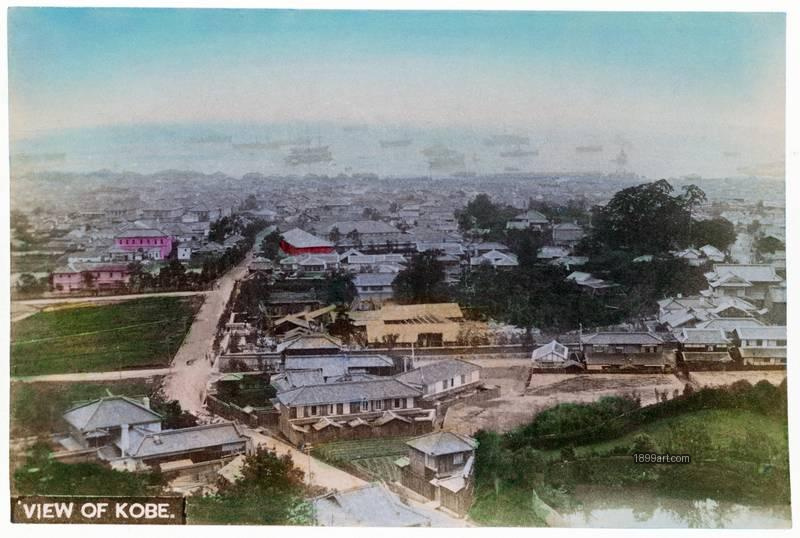
1899art Japan View of Kobe – Panoramic City and Harbor, c. 1895 Handcolored 1900s 1899art
From the 1899art Archive: Hand-colored albumen photograph depicting a panoramic view over the city of Kobe, seen from an elevated vantage point. In the foreground, traditional Japanese residential buildings with tiled roofs line unpaved roads and small cultivated areas. The urban fabric appears low and densely arranged, reflecting the architectural character of Kobe during the late Meiji period.
In the distance, the harbor of Kobe is visible with numerous ships anchored offshore, emphasizing the city’s role as an international treaty port. The photograph was originally produced as a monochrome albumen print and later carefully hand-colored, a common practice within Yokohama-shashin export photography intended for the Western tourist market in the late 19th century.
Japan · c. 1895–1910 · Hand-colored photograph
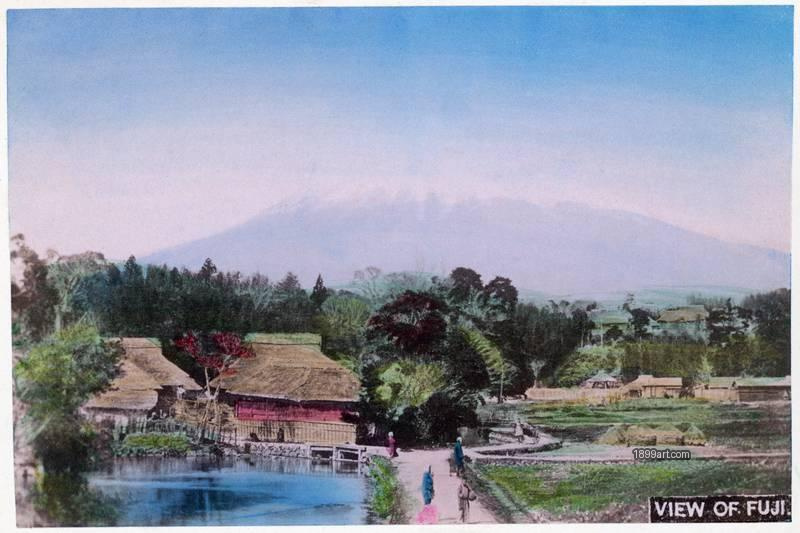
1899art Japan View of Mount Fuji from Yoshida, c. 1890 Handcolored 1900s 1899art
From the 1899art Archive: Hand-colored albumen photograph depicting a panoramic view over the city of Kobe, seen from an elevated vantage point. In the foreground, traditional Japanese residential buildings with tiled roofs line unpaved roads and small cultivated areas. The urban fabric appears low and densely arranged, reflecting the architectural character of Kobe during the late Meiji period.
In the distance, the harbor of Kobe is visible with numerous ships anchored offshore, emphasizing the city’s role as an international treaty port. The photograph was originally produced as a monochrome albumen print and later carefully hand-colored, a common practice within Yokohama-shashin export photography intended for the Western tourist market in the late 19th century.
Japan · c. 1895–1910 · Hand-colored photograph
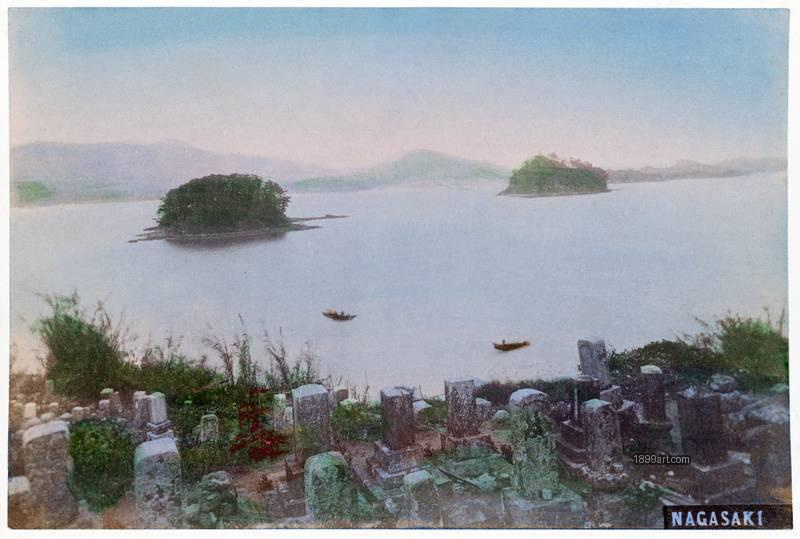
1899art Japan Nagasaki – Coastal View with Cemetery, c. 1890 Handcolored 1899art
From the 1899art Archive: Hand-colored albumen photograph depicting a tranquil coastal view of Nagasaki, seen from an elevated vantage point overlooking a hillside cemetery in the foreground. Stone grave markers and monuments are arranged irregularly among grass and shrubs, leading the eye toward the calm waters of the bay. Several small boats float on the surface, while tree-covered islets emerge gently from the sea.
The photograph was originally produced as a monochrome albumen print and later carefully hand-colored, following the established practices of late 19th-century Japanese export photography. The soft tonal transitions of sky, water, and distant hills reflect the aesthetic conventions of Yokohama-shashin imagery, created for the Western tourist market and emphasizing atmosphere, serenity, and Japan’s coastal landscape rather than urban activity.
Japan · c. 1895–1910 · Hand-colored photograph
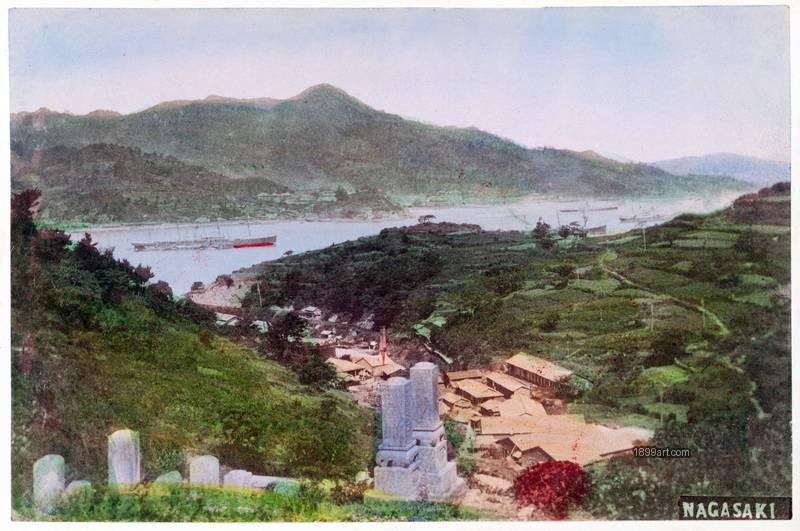
1899art Japan Nagasaki – Panoramic Harbor View from the Hills, c. 1890 Handcolored 1899art
From the 1899art Archive: Hand-colored albumen photograph showing a wide panoramic view over the harbor of Nagasaki, taken from an elevated hillside position. In the foreground, stone grave markers of a hillside cemetery stand among grass and vegetation, overlooking a small settlement with wooden houses below. Terraced fields and rolling green hills extend across the landscape, guiding the view toward the calm waters of the bay.
In the middle and far distance, ships and boats are visible in the harbor, emphasizing Nagasaki’s long-standing role as a maritime and trading port. The photograph was originally produced as a monochrome albumen print and later carefully hand-colored, following the conventions of late 19th-century Japanese export photography. The restrained color palette and layered composition reflect the Yokohama-shashin aesthetic, designed to convey atmosphere, scale, and the harmonious integration of settlement, landscape, and sea.
Japan · c. 1895–1910 · Hand-colored photograph
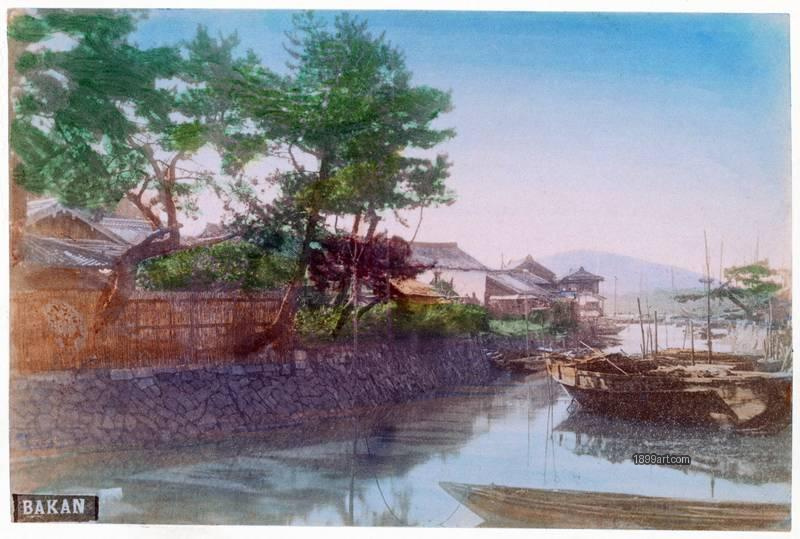
1899art Japan Bakan (Shimonoseki) – Canal View, c. 1890 Handcolored 1900s 1899art
From the 1899art Archive: Hand-colored albumen photograph showing a quiet canal scene in Bakan (present-day Shimonoseki). Traditional wooden houses with tiled roofs line the waterway, bordered by stone embankments and shaded by pine trees. Small boats are moored along the canal, and the calm water reflects the buildings and vegetation, creating a balanced and intimate composition.
The photograph was originally produced as a monochrome albumen print and later carefully hand-colored, in keeping with late 19th-century Japanese export photography. The label “BAKAN” visible on the image confirms the location. While canal views in Japan were sometimes romantically described for Western audiences as the “Venice of Japan,” this image specifically represents Bakan/Shimonoseki and not Uchikawa or Imizu. The scene reflects a regional port town environment rather than a major canal city, emphasizing everyday maritime life and atmosphere.
Japan · c. 1895–1910 · Hand-colored photograph
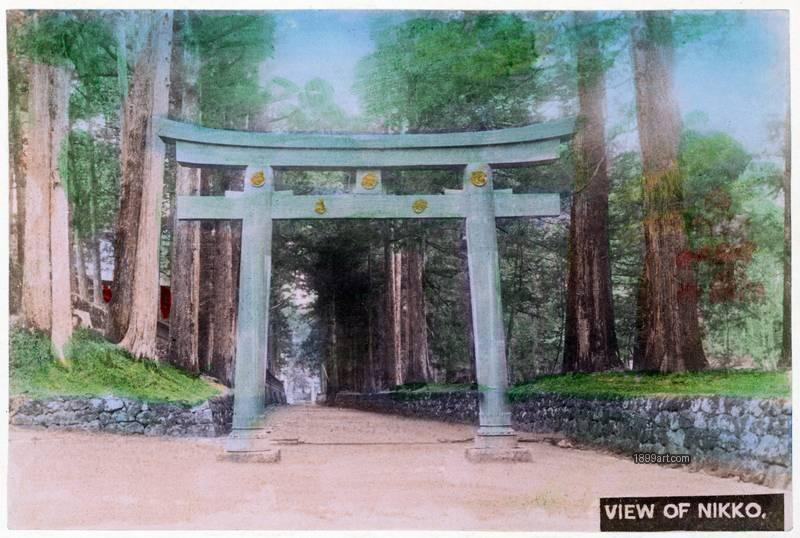
1899art Japan Nikkō – Torii Gate in the Cedar Forest, c. 1890 Handcolored 1900s 1899art
From the 1899art Archive: Hand-colored albumen photograph depicting a large torii gate standing along the forest approach in Nikkō. The gate marks the entrance to a sacred Shintō space and is set within a dense avenue of tall Japanese cedar trees (sugi). A wide, unpaved path leads beneath the torii, flanked by low stone embankments and towering trunks that emphasize depth, symmetry, and stillness.
The photograph was originally produced as a monochrome albumen print and later carefully hand-colored, following the conventions of late 19th-century Japanese export photography. Such images of Nikkō were popular among Western visitors, documenting the ritual landscape surrounding the shrine complexes rather than specific ceremonial events. While Nikkō is closely associated with the Tōshō-gū Shrine, this image represents the broader sacred environment of the cedar-lined approaches rather than a detailed view of an individual shrine structure.
Japan · c. 1895–1910 · Hand-colored photograph
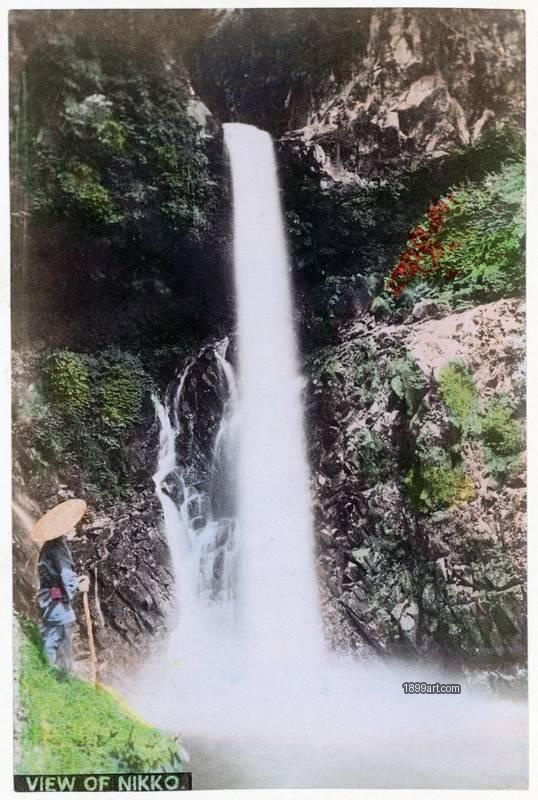
1899art Japan Nikkō – 根尾の滝 (Neo Falls), c. 1890 Handcolored 1900s Enami 1899art
From the 1899art Archive: Hand-colored albumen photograph showing a tall, narrow waterfall plunging vertically down a rocky cliff in the mountainous landscape of Nikkō. Dense vegetation clings to the surrounding rock faces, while the falling water forms a bright, continuous column that contrasts strongly with the dark stone. At the lower left, a solitary figure wearing traditional clothing and a straw hat stands near the base of the falls, providing a sense of scale.
The photograph was originally produced as a monochrome albumen print and later carefully hand-colored, in accordance with late 19th-century Japanese export photography practices. Waterfalls around Nikkō were popular motifs for Western visitors, valued for their dramatic natural forms and spiritual associations within the sacred mountain landscape. Rather than documenting a specific named site, the image emphasizes verticality, isolation, and the relationship between human presence and nature.
Japan · c. 1895–1910 · Hand-colored photograph
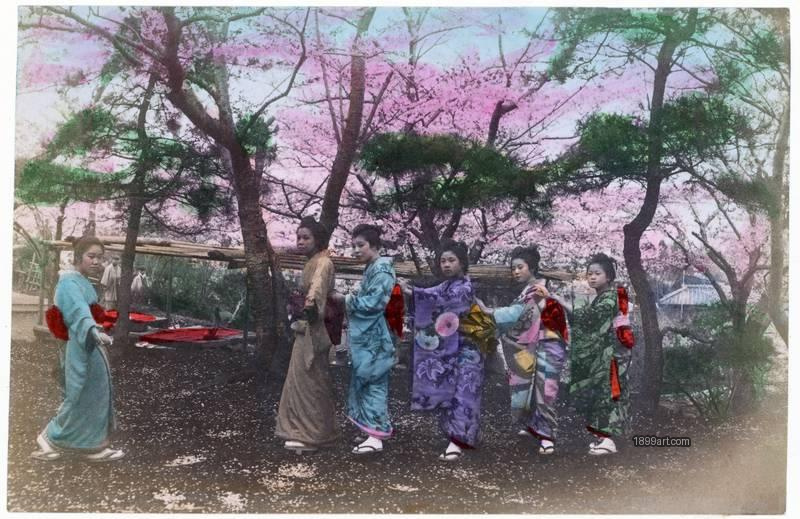
1899art Japan, Yokohama – Geisha and Maiko beneath Cherry Blossoms, Noge Hill, c. 1890 Handcolored 1899art
From the 1899art Archive: Hand-colored albumen photograph depicting a staged outdoor scene of geisha and maiko arranged in a loose circle beneath blooming cherry trees at Noge Hill, Yokohama. The figures wear formal kimono with wide obi and carefully styled coiffures; several display the distinctive youthful appearance and dress associated with maiko, while others appear as fully trained geisha. The women engage in a choreographed hand-passing gesture, suggesting a stylized seasonal performance rather than an informal gathering. The photograph was originally produced as a monochrome albumen print and later carefully hand-colored, following the conventions of late 19th-century Yokohama-shashin export photography. Such images were created for the Western market and present an idealized view of geisha culture, combining springtime symbolism (cherry blossoms) with carefully posed figures, selective color accents, and a constructed garden setting. The scene is known in multiple variant prints, indicating distribution from a commercially circulated negative.
Japan · c. 1895–1910 · Hand-colored photograph
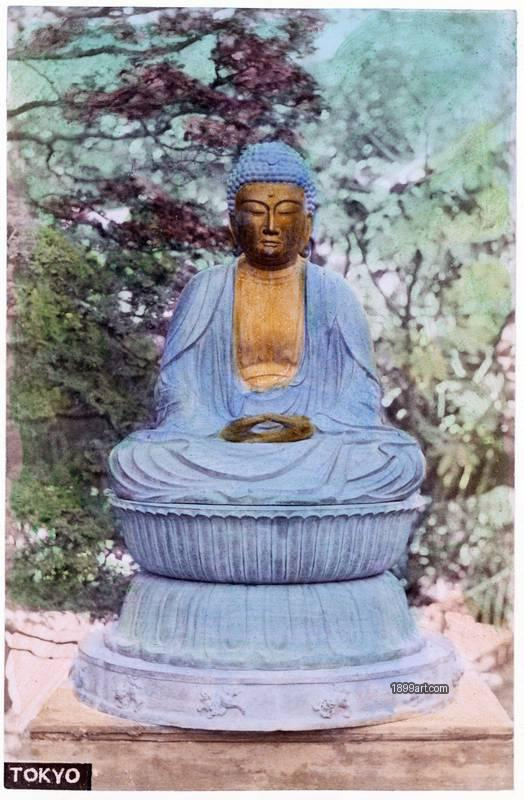
1899art Japan, Tokyo – Amida Buddha Statue, c. 1890Handcolored 1900s 1899art
From the 1899art Archive: Hand-colored albumen photograph depicting a seated Amida Buddha statue shown frontally on a stone pedestal, positioned outdoors within a temple garden setting. The Buddha is represented in a meditative posture with hands resting in the lap (dhyāna mudrā), eyes gently lowered, and a calm, idealized facial expression. The sculpted robe falls in symmetrical folds, and the figure is framed by softly rendered foliage in the background.
Japan · c. 1895–1910 · Hand-colored photograph
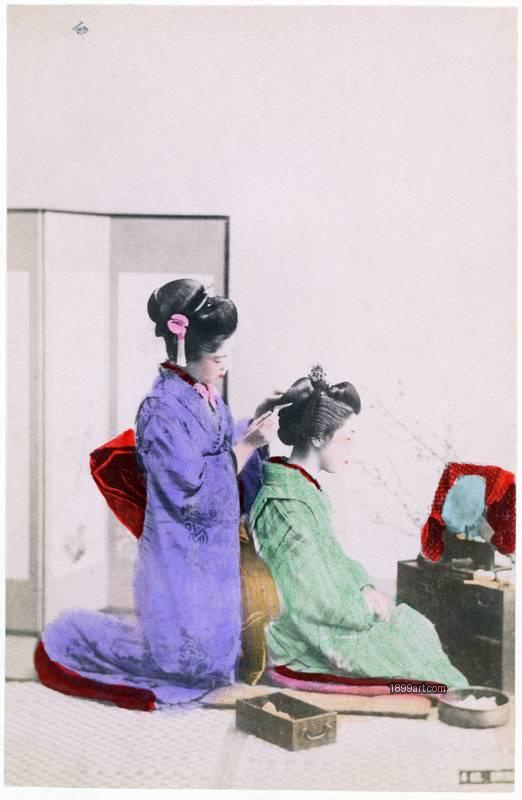
1899art Japan – Maiko Attending a Geisha’s Hairstyle, c. 1890 Handcolored 1900s 1899art
From the 1899art Archive: Hand-colored albumen photograph depicting an indoor scene in which a maiko kneels behind a seated geisha, carefully arranging her elaborate coiffure. The geisha sits formally on a cushion in front of a small mirror placed on a low stand, while cosmetic boxes and grooming implements are arranged on the floor. Both figures wear formal kimono: the standing maiko in a richly colored robe with a prominent obi, the seated geisha in a more subdued yet elegant garment, reflecting differences in age, status, and training.
Japan · c. 1895–1910 · Hand-colored photograph
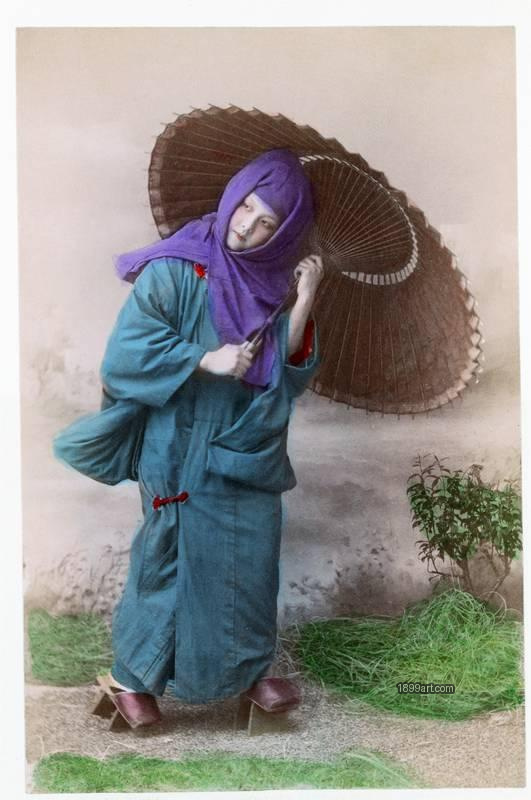
1899art Japan Girl in Winter Clothing with Paper Umbrella, Japan, c. 1890 Handcolored 1899art
From the 1899art Archive: Hand-colored albumen photograph depicting a young girl dressed in winter clothing, standing and holding a large paper umbrella (wagasa). She wears layered garments suitable for cold weather, including a loose outer robe and a headscarf wrapped around the head and neck for warmth and protection against wind or snow. Her posture is slightly inclined, with the umbrella angled behind her head, creating a gentle diagonal that emphasizes balance and movement.
Japan · c. 1895–1910 · Hand-colored photograph
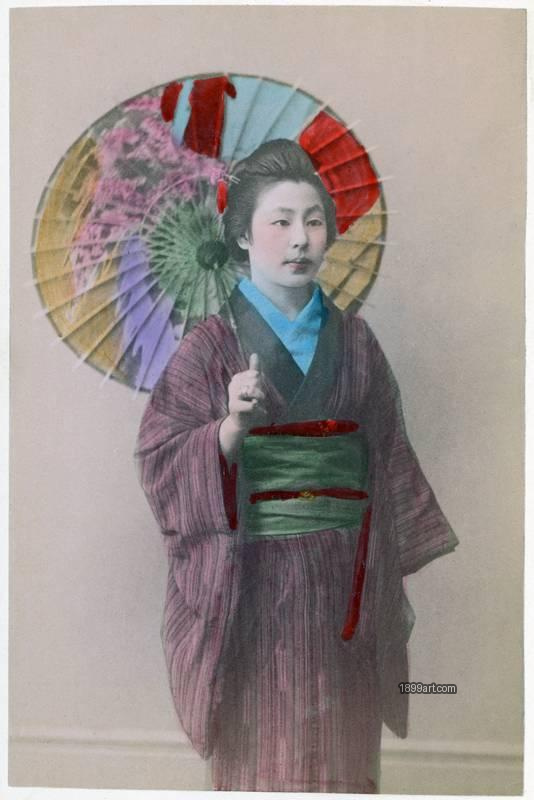
1899art Japan – Geisha with Paper Umbrella, c. 1890 Handcolored 1899art
From the 1899art Archive: Hand-colored albumen photograph depicting a geisha standing frontally and holding a paper umbrella (wagasa) behind her head. She wears a formal kimono in muted plum tones with a contrasting green obi, while selective red accents are applied to the umbrella and garment details. Her coiffure is carefully styled in a mature geisha fashion, and her expression is calm and composed. The circular form of the open umbrella frames her head, creating a strong visual focus and a balanced, iconic composition.
Japan · c. 1895–1910 · Hand-colored photograph
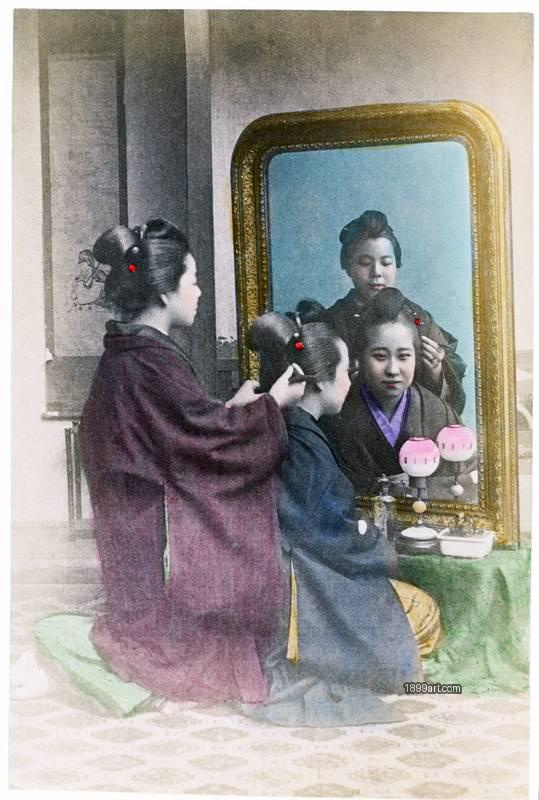
1899art Japan – Geisha Grooming before a Mirror, c. 1890 Handcolored 1899art
From the 1899art Archive: Hand-colored albumen photograph depicting an indoor grooming scene in which a geisha is seated in front of a tall framed mirror while her hairstyle is carefully adjusted by an attendant, likely a maiko. The seated geisha wears a subdued kimono and looks calmly toward the mirror, while cosmetic containers, brushes, and small grooming implements are arranged neatly on a low table covered with cloth. The attendant kneels behind her, focused on arranging the elaborate coiffure, emphasizing the ritualized nature of preparation.
Japan · c. 1895–1910 · Hand-colored photograph
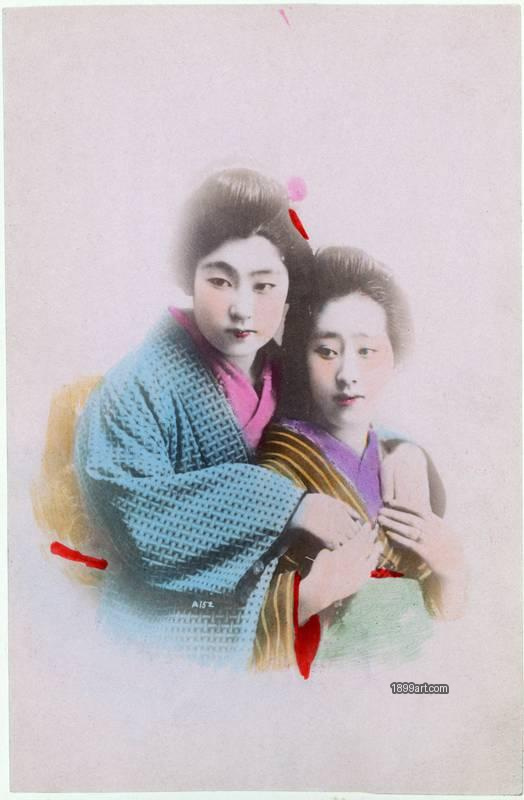
1899art Ponta and Oen, c. 1895 Photograph by Kajima Seibei Handcolored 1900s 1899art
From the 1899art Archive: Hand-colored albumen photograph depicting an intimate studio portrait of two young women identified as Ponta and Oen, posed closely together against a neutral background. One woman stands slightly behind the other, her arm gently encircling her companion, conveying protection and emotional closeness. Both wear formal kimono with carefully arranged coiffures, their expressions calm and introspective.
The photograph was produced by Kajima Seibei around 1895 and later hand-colored. Unlike mass-produced Yokohama-shashin export images, this work is a personalized author photograph with identified sitters, representing a rare, well-documented example of named subjects in late 19th-century Japanese photography. The image is preserved in institutional and private collections and is widely reproduced in scholarly contexts.
Japan · c. 1895–1910 · Hand-colored photograph
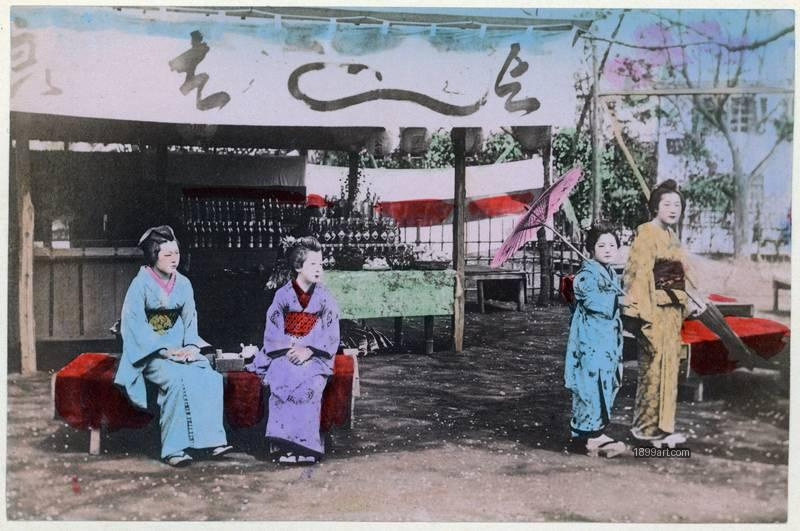
1899art Japan Yokohama – Geisha at Chōjiyu (Chōji-yu) Blossoms Park Pavilion, c. 1890 Handcolored 1900s 1899art
From the 1899art Archive: Hand-colored albumen photograph depicting a staged outdoor scene of geisha and maiko seated and standing at a pavilion within Chōjiyu (Chōji-yu) Blossoms Park in Yokohama. The women are arranged on low benches beneath a simple wooden shelter bearing a painted signboard, while flowering trees and garden elements frame the setting. One figure stands holding a paper umbrella, adding a vertical accent to the otherwise horizontal composition.
Japan · c. 1895–1910 · Hand-colored photograph
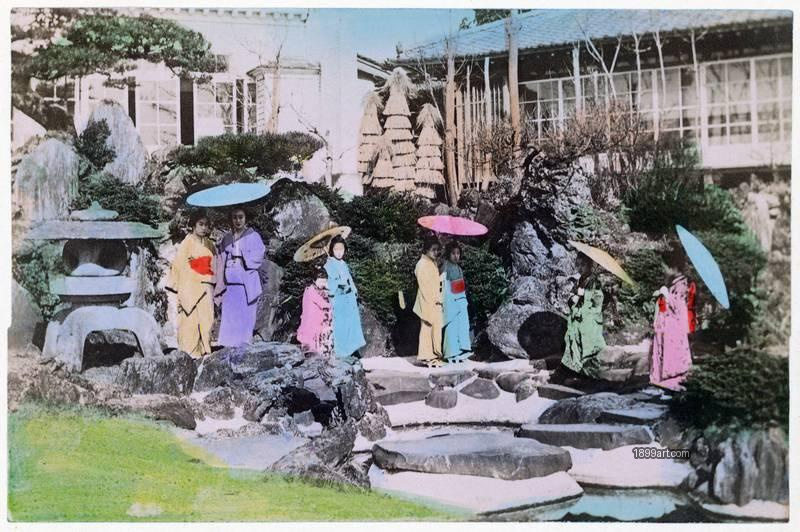
1899art Japan Prince Hotta’s Garden – Maiko in a Landscaped Garden, c. 1890 Handcolored 1899art
From the 1899art Archive: Hand-colored albumen photograph depicting a group of maiko posed within the landscaped grounds of Prince Hotta’s Garden in Edo (present-day Tokyo). The young women are arranged along stone paths and stepping stones bordering a pond, some standing and others walking, several holding paper umbrellas (wagasa). They wear formal kimono appropriate to their apprentice status, with carefully styled coiffures and visible obi, and are positioned to create a balanced rhythm across the garden setting. The photograph was originally produced as a monochrome albumen print and later carefully hand-colored in accordance with late 19th-century Yokohama School studio practices. Although staged, the scene reflects a controlled outdoor photographic environment rather than an interior studio, using the features of a daimyō garden—stone lanterns, artificial rock formations, trimmed vegetation, water, and bridges—as a reusable scenic backdrop. The models are not depicted as individual personalities but as maiko performing a visual role, presenting an idealized and composed image of youth, refinement, and seasonal leisure for the export market.
Japan · c. 1895–1910 · Hand-colored photograph
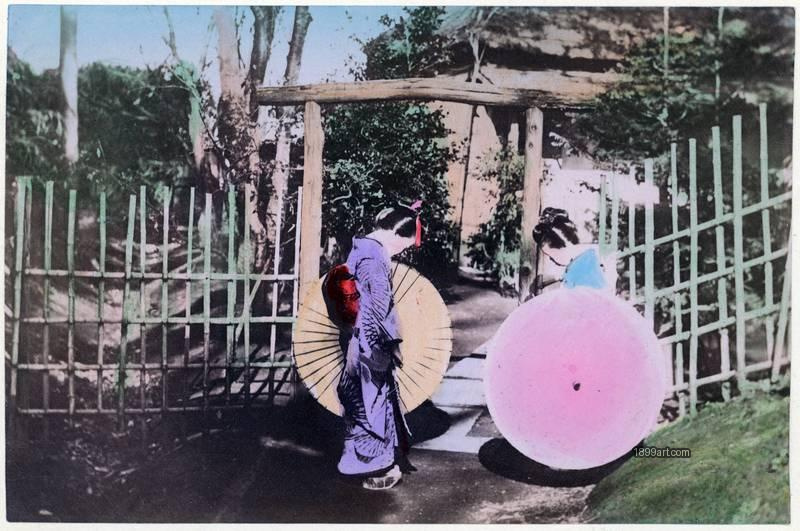
1899art Japan Prince Hotta’s Garden – Maiko with Paper Umbrellas at a Garden Entrance, c. 1890 Handcolored 1900s 1899art
From the 1899art Archive: Hand-colored albumen photograph depicting two maiko standing at what is very likely a garden entrance or transitional gateway within Prince Hotta’s Garden, Edo (Tokyo). The young women hold large paper umbrellas (wagasa) and are positioned before a simple wooden gate structure flanked by bamboo fencing, marking a boundary between exterior space and the landscaped garden beyond. The narrow path and controlled fencing emphasize the notion of entry and passage.
Originally produced as a monochrome albumen print and later hand-colored in the Yokohama School tradition, the image forms part of a staged outdoor series using the garden not only as a scenic backdrop but as a narrative space, moving from approach to interior views. The figures function as studio models (maiko) rather than named individuals, contributing to an idealized representation of refinement, order, and transition.
Japan · c. 1895–1910 · Hand-colored photograph
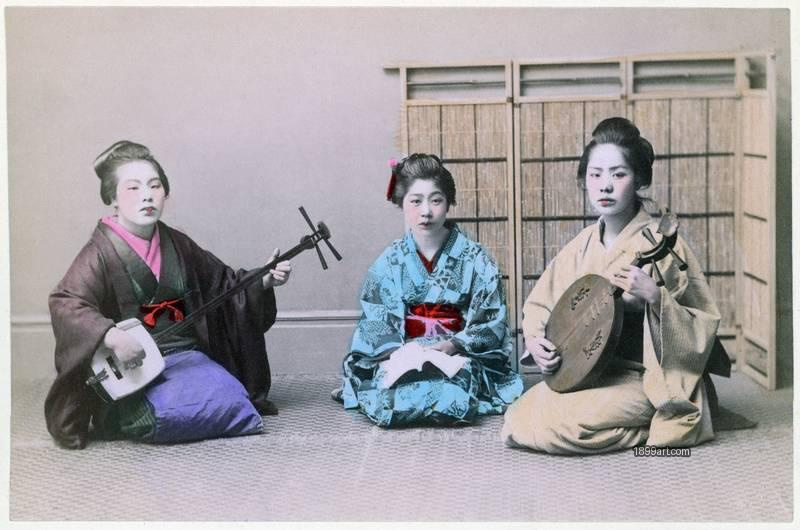
1899art Japan Maiko with Traditional Musical Instruments, c. 1890 Handcolored Enami 1899art
From the 1899art Archive: Hand-colored albumen photograph depicting three maiko (apprentice geisha) seated on the floor in an interior studio setting. The young women wear formal kimono with carefully arranged coiffures typical of apprentice status. Two of the maiko hold traditional Japanese musical instruments: on the left, a shamisen (three-stringed lute), and on the right, a tsuzumi (hand drum). The central figure sits without an instrument, likely positioned as a vocalist or as the visual anchor of the composition.
The photograph was originally produced as a monochrome albumen print and later delicately hand-colored in accordance with late 19th-century Yokohama School practices. The neutral interior backdrop, folding screen, and floor matting emphasize the figures and their instruments, presenting music as a refined cultural practice associated with maiko training. As with many export photographs of the period, the scene is carefully staged and represents an idealized performance setting, rather than a documentary depiction of an actual musical event.
Japan · c. 1895–1910 · Hand-colored photograph
1899art Japan Maiko Working with Textiles, B1092 – WASHER WOMAN, c. 1890 Handcolored 1899art
From the 1899art Archive: Albumen photograph depicting three young women used as studio models in a staged scene of textile washing and handling. The original studio title “WASHER WOMAN” appears printed within the image, confirming the motif as a standardized genre subject. One figure examines and smooths a long fabric panel, a second lifts and adjusts hanging cloths, while the third kneels beside a wooden tub washing textiles. The arrangement presents multiple stages of fabric care within a single, carefully composed scene.
The photograph forms part of a commercially produced studio series for the export market. An identical uncolored albumen print, bearing the same title, is preserved in the collections of Lombardia Beni Culturali, where it is catalogued as B1092 – “Washing Woman.” Hand-colored versions, such as the present example, were produced to enhance textile patterns and visual clarity. Although the title designates the depicted activity, the scene remains a studio-constructed genre composition, not a documentary record of actual washerwomen or labor conditions.
Contact & Credits
Purpose of this site
YokohamaSchool.org is intended as a reference and context resource for the history and surviving works of the Yokohama School of hand-colored photography.
It does not claim to be complete and will be expanded over time.
Focus
Historical research, visual analysis, digital preservation and curated examples of original works from the period c. 1860–1920.
This website is currently in its early phase. Further sections on sources, studios and bibliography will follow.
YokohamaSchool.org is part of the wider 1899art project:
www.1899art.com.
Usage Rights & Legal Notice – 1899art Archive
All images published on 1899art.com originate from the 1899art Archive and are provided for cultural, educational, and historical reference purposes only.
Permitted use
Images may be linked, embedded, or shared on external websites and platforms exclusively in their original, unmanipulated form, provided that:
– the source is clearly credited as “1899art”, and
– a visible and clickable link to https://1899art.com accompanies the image.
Prohibited use
Any form of modification, including but not limited to cropping, retouching, recoloring, compositing, filtering, AI-based processing, or the creation of derivative works, is strictly prohibited without prior written permission.
Commercial use, resale, redistribution as standalone files, or inclusion in third-party archives or databases is also not permitted without explicit authorization.
Rights status
While the original photographs may be in the public domain due to age, the digital reproductions, curatorial selection, restoration decisions, metadata, and contextual presentation are the intellectual property of the 1899art Archive.
By using images from this website, you agree to respect these conditions. Automated downloading, scraping, or use of images for machine learning or AI training purposes is expressly prohibited.
EU / International Copyright Notice
All images published by the 1899art Archive are protected under European and international copyright law.
Any reproduction, redistribution, modification, AI-based processing, or commercial use beyond the explicitly permitted low-resolution web sharing is prohibited without prior written consent of the 1899art Archive.
This applies equally to high-resolution files obtained through unauthorized access, third-party leaks, or archival reproductions.
DMCA Copyright Notice & Protection
All images and digital files published by the 1899art Archive are protected by international copyright law and the Digital Millennium Copyright Act (DMCA).
Unauthorized reproduction, distribution, modification, AI processing, or commercial use of any image or high-resolution file from the 1899art Archive is strictly prohibited.
The unauthorized possession or dissemination of high-resolution files does not constitute a license and does not grant any rights of use.
Any infringement will result in DMCA takedown notices, platform removal requests, and, where applicable, legal action.