High-resolution original files are available from the 1899art Archive.
Original scans have a minimum resolution of 6,000 × 9,000 pixels.
Depending on the original source medium, original master scans of up to 15,000 × 20,000 pixels are available.
Only the low-resolution images displayed on the 1899art website may be linked, shared, or embedded on external websites, and only in their original, unmanipulated form, provided that clear attribution to “1899art” is given and a clearly visible link to https://1899art.com is included.
Any use, distribution, or publication of high-resolution files, whether obtained intentionally or inadvertently, is strictly prohibited.
Any modification, alteration, recomposition, recoloring, AI processing, or commercial reuse beyond simple linking and sharing is not permitted without prior written consent of the
1899art Archive.
YOKOHAMA SCHOOL BACK TO MAIN PAGE
Album 4 – 50 Motifs of the Yokohama School. All photographs are carefully reconstructed and described based on extensive research.
We strive for the highest possible accuracy in all attributions and contextual information.
Japan · c. 1895–1910 · Hand-colored photograph
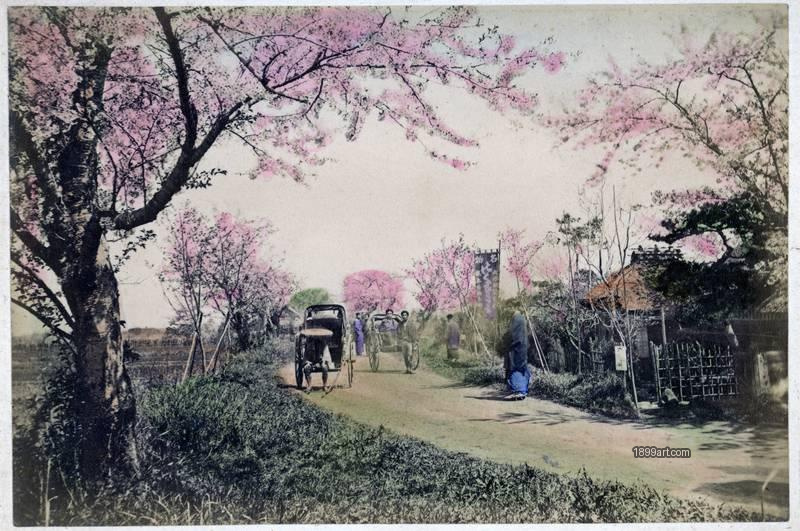
1899art Cherry blossom avenue with rickshas near Tokyo, likely along the Edogawa area, circa 1895–1905 1899art
From the 1899art Archive: This hand-colored albumen print depicts a cherry blossom avenue during the spring hanami season, showing pedestrians and rickshas traveling along a tree-lined road. The scene reflects the popularity of suburban riverside and canal districts near Tokyo as leisure destinations during the late Meiji period.
The soft hand coloring emphasizes the pink blossoms and muted spring landscape, a characteristic aesthetic of Yokohama School photography produced for both domestic and foreign audiences. While the exact location cannot be identified with certainty, the setting is consistent with well-known cherry-blossom promenades in the greater Tokyo area, often associated in period sources with the Edogawa region.
The presence of rickshas and traditional clothing suggests a date in the late 19th to very early 20th century, prior to the widespread dominance of photographic postcards.
Japan · c. 1895–1910 · Hand-colored photograph
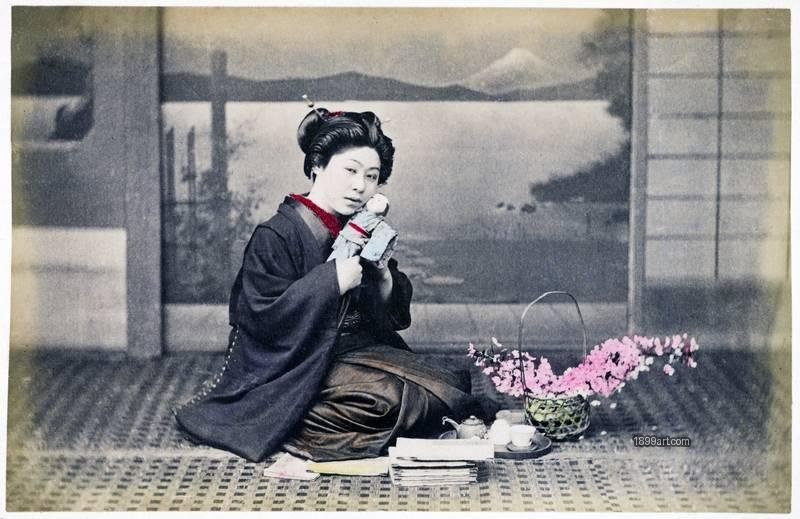
1899art Studio portrait of a young girl with doll and tea set on a patterned rug, Japan, late Meiji period Handcolored 1900s 1899art
From the 1899art Archive: This hand-colored studio photograph depicts a young Japanese girl seated indoors, holding a doll in her hands. She is positioned on a distinctive patterned studio rug, a furnishing frequently encountered in works attributed to Kusakabe Kimbei’s Yokohama studio and considered a characteristic element of his interior compositions.
In front of the girl, a small tea set is carefully arranged, while a basket filled with cherry blossoms introduces a seasonal reference to spring. The painted studio backdrop suggests a calm lakeside landscape with distant mountains, reinforcing the staged and symbolic nature of the scene rather than a documentary setting.
Japan · c. 1895–1910 · Hand-colored photograph
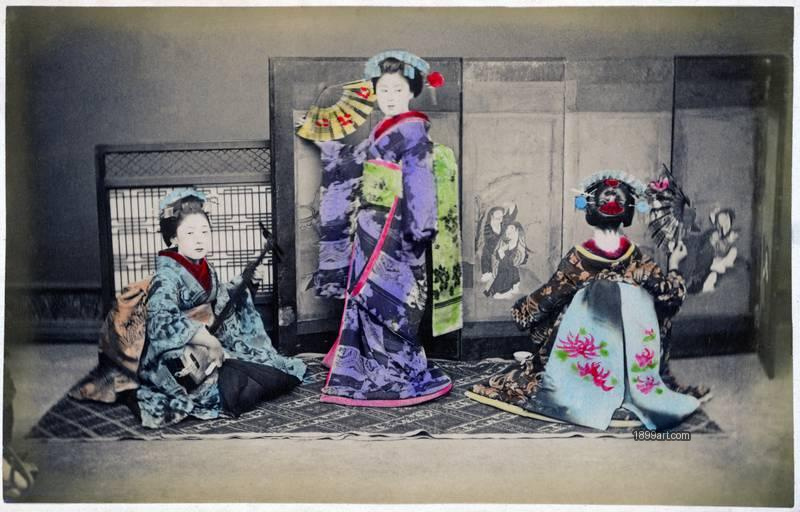
1899art Three maiko in formal attire posed in a studio interior, Japan, late Meiji period Handcolored 1900s 1899art
From the 1899art Archive: This hand-colored studio photograph depicts three maiko (apprentice geisha) arranged in a carefully composed interior scene. Their youthful appearance, long-sleeved furisode kimono, elaborate darari-style obi, and ornate hairstyles with seasonal hair ornaments clearly identify them as maiko rather than fully qualified geisha. One maiko stands holding a folding fan, while the others are seated on a patterned studio rug, forming a balanced and deliberate composition.
The use of a distinctive woven studio carpet, painted folding screens (byōbu), controlled poses, and restrained yet precise hand-coloring is highly characteristic of the work of Kusakabe Kimbei and his studio. Such images were created for the export market and present an idealized, ceremonial view of maiko culture rather than a documentary scene. The photograph can be confidently dated to the late 1890s to early 1900s and attributed to Kimbei or his workshop, consistent with its inclusion in a Kimbei album.
Japan · c. 1895–1910 · Hand-colored photograph
1899art Garden pavilion with seated women at a traditional residence, Japan, late Meiji period 1899art
From the 1899art Archive: This hand-colored photograph shows a group of women seated and standing on the veranda of a traditional Japanese pavilion, overlooking a carefully arranged garden with pruned pines, shrubs, and stone elements. The tiled roof, wooden architecture, and open engawa (veranda) frame the figures, whose brightly tinted garments provide gentle points of color within the otherwise subdued palette. The scene appears staged rather than documentary, emphasizing harmony between architecture, figures, and landscape.
The composition, selective hand-coloring (notably the accents in clothing), and idealized garden setting are characteristic of studio and outdoor-view photographs produced for the export market during the late Meiji period (c. 1890s–early 1900s). The visual language strongly aligns with the work of Kusakabe Kimbei or his workshop, and the photograph is consistent with images commonly found in Kimbei albums, presenting a refined, serene vision of Japanese domestic and garden life.
Japan · c. 1895–1910 · Hand-colored photograph
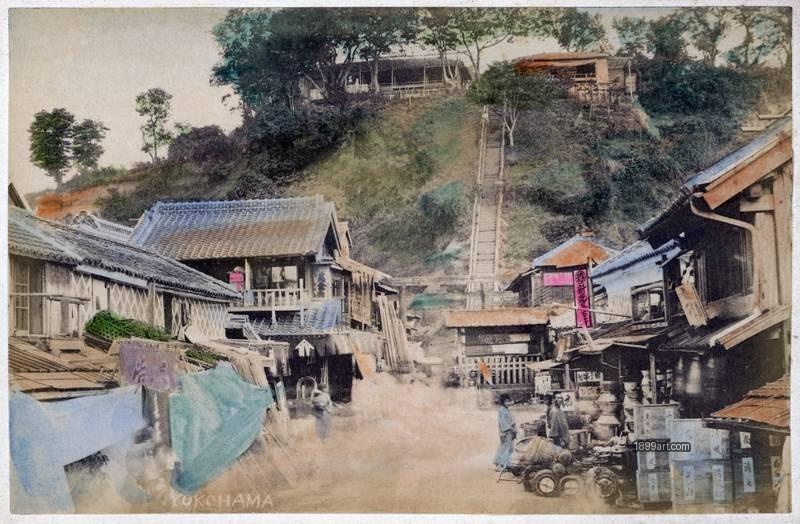
1899art Motomachi Hyakudan-zaka (The Hundred Steps), Yokohama Handcolored 1900s 1899art
From the 1899art Archive: his hand-colored albumen photograph depicts Motomachi Hyakudan-zaka, the famous “Hundred Steps” in Yokohama, a steep stone staircase connecting the Motomachi commercial district near the harbor with the elevated residential and temple areas above. Shops, carts, and pedestrians line the approach, while the long central stairway leads the viewer’s eye upward into the hillside.
The scene dates to the Meiji period, most likely the 1890s, during Yokohama’s rapid transformation into an international port city. The hand-applied color, the scratched inscription “Yokohama,” and the documentary yet carefully composed perspective are characteristic of photographs produced by Yokohama studios for the export market and are fully consistent with works associated with the Kimbei atelier.
Japan · c. 1895–1910 · Hand-colored photograph
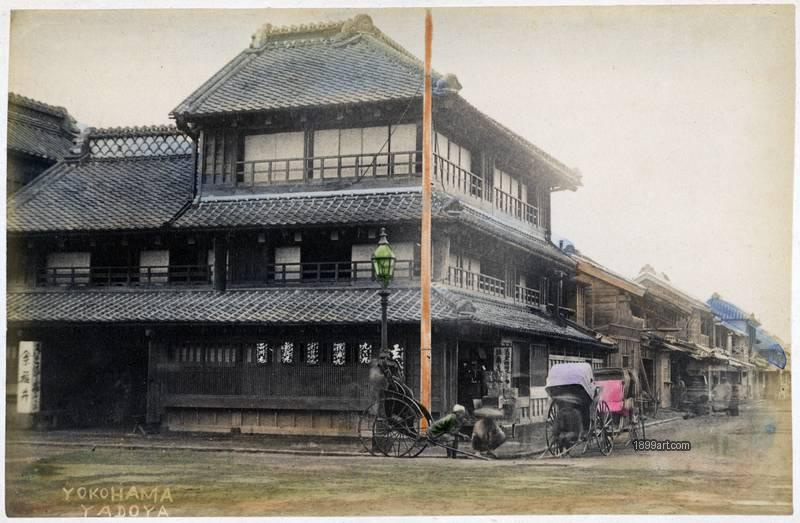
1899art Japan Yadoya (Inn) on a Street in Yokohama Handcolored 1900s 1899art
From the 1899art Archive: This hand-colored albumen photograph shows a yadoya—a traditional Japanese inn—along a street in Yokohama. The word “Yokohama Yadoya” is scratched directly into the emulsion, clearly identifying both the location and the function of the building. The multi-story wooden structure with tiled roofs, deep eaves, and latticework reflects late Edo to early Meiji architectural styles adapted to an emerging port city.
In the foreground, rickshaws wait along the street, emphasizing Yokohama’s role as a hub for travelers, merchants, and foreign visitors during the Meiji period. The careful hand coloring, balanced street perspective, and documentary clarity are characteristic of Yokohama School photography and are fully consistent with works produced for the export market in the late 19th century, including those associated with the Kimbei atelier.
Japan · c. 1895–1910 · Hand-colored photograph
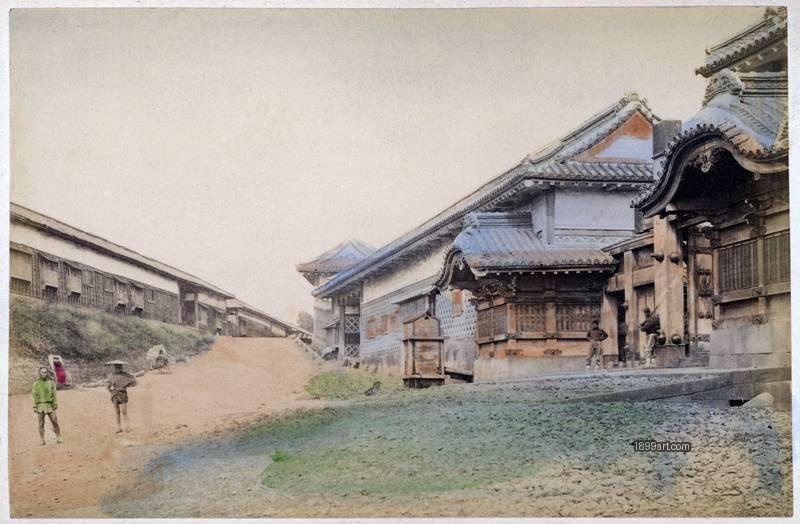
1899art Japan Former Matsudaira daimyo residence at Nagatacho, Tokyo, early Meiji period Handcolored 1900s 1899art
From the 1899art Archive: This hand-colored albumen photograph shows the former residence of Matsudaira, Governor of Dewa, located in Nagatacho, Tokyo. The estate was later associated with the Kan’in-no-miya imperial household, reflecting the reassignment of former daimyo properties following the Meiji Restoration.
A uniformed guard is visible standing at the gate, illustrating the continued presence of traditional security roles during the early Meiji period. The guard’s hairstyle may represent a chonmage, highlighting the coexistence of samurai-era customs and emerging modern structures in Japan during the late 19th century.
Japan · c. 1895–1910 · Hand-colored photograph
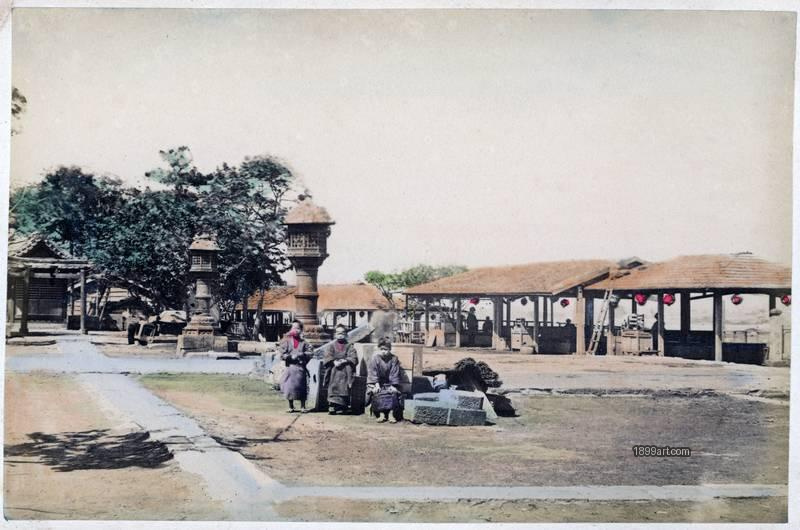
1899art Japan Temple precinct on Mount Atago (Atagoyama), Tokyo (Edo), late 19th century Handcolored 1900s 1899art
From the 1899art Archive: This hand-colored albumen photograph shows a temple precinct on Mount Atago (Atagoyama) in Tokyo (formerly Edo). The scene depicts open courtyards, shrine-related buildings, and groups of people engaged in everyday activities, reflecting the dual religious and social function of the site.
Atagoyama, rising approximately 25.7 meters, was the highest natural elevation within the former Edo city limits and a popular destination during the late Edo and early Meiji periods. The attribution to Mount Atago is supported by comparable historical photographs and curated Japanese sources, including the archival collection presented on the website Yamada-kun no Sekai (やまだくんのせかい), which documents multiple 19th-century views of Atagoyama and its surroundings.
Japan · c. 1895–1910 · Hand-colored photograph
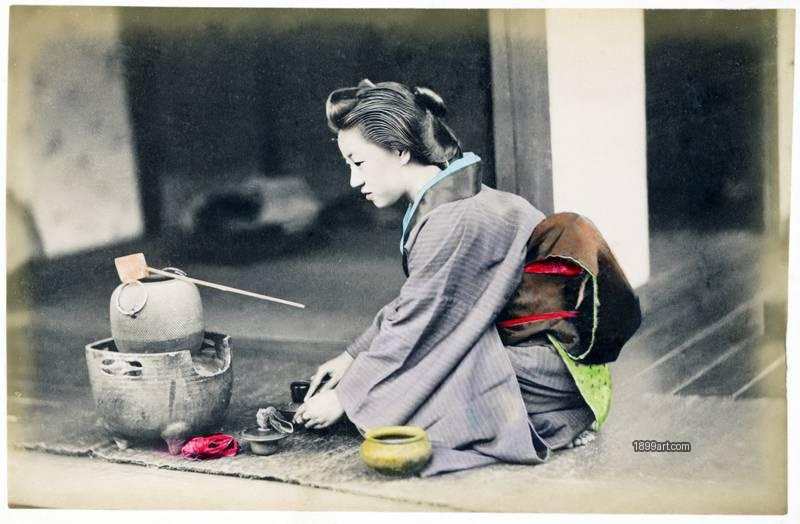
1899art Young girl preparing tea, Japan, Meiji period (c. 1890s) 1899art
From the 1899art Archive:This hand-colored albumen photograph depicts a young Japanese girl kneeling on the floor while preparing tea beside a traditional iron kettle (kama). The scene is carefully staged, showing tea utensils arranged on the tatami and a restrained interior background typical of studio compositions from the late Meiji period.
The hairstyle, kimono, and the presence of tea implements suggest an educational or domestic setting rather than a formal tea ceremony. Such images were commonly produced by Yokohama studios for export, combining everyday cultural practices with a calm, intimate atmosphere. The subtle hand-coloring emphasizes selected details while preserving the photographic softness characteristic of late 19th-century Japanese albumen prints.
Japan · c. 1895–1910 · Hand-colored photograph
1899art Group of Meiko with a Young Music Student in a Studio Interior, Japan, c. 1890–1900 Handcolored 1900s 1899art
From the 1899art Archive: This hand-colored studio photograph shows a group of meiko posed in traditional attire, arranged around musical instruments typical of the period, including the shamisen. The scene reflects the carefully staged aesthetic of Yokohama School photography rather than a documentary moment.
At the center sits a young boy, likely a music student or studio assistant, resting against one of the meiko. His presence introduces an age and role contrast common in studio compositions of the time and should be understood as part of the photographic arrangement, not as a narrative or symbolic element.
Japan · c. 1895–1910 · Hand-colored photograph
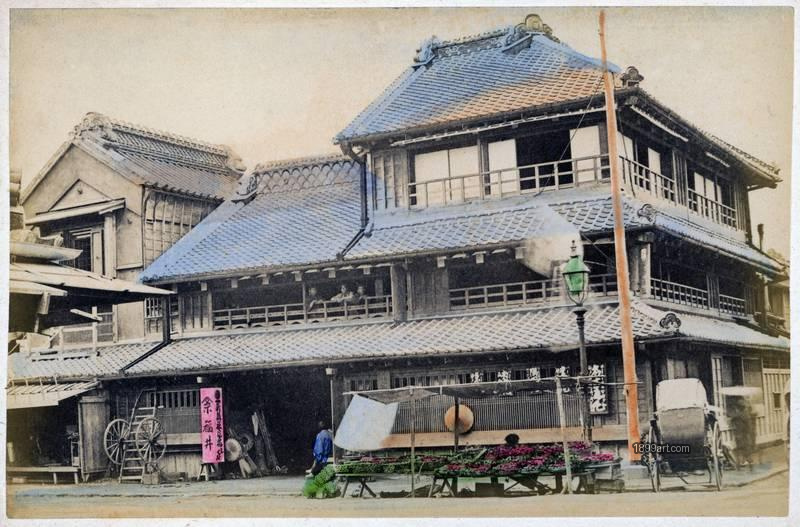
1899art Japan Fukuiya Ryokan (Steamship Inn) on Benten-dōri, Bashamichi, Yokohama, mid-Meiji period Handcolored 1900s 1899art
From the 1899art Archive: This hand-colored albumen photograph shows the Fukuiya Ryokan, a so-called kisen-yado (steamship inn), located on Benten-dōri 5-chōme in Bashamichi, Yokohama, during the mid-Meiji period (c. 1885–1895). Such inns catered primarily to travelers connected with maritime traffic, foreign trade, and steamship lines operating from the port of Yokohama.
The imposing multi-storey wooden building with tiled roofs, wraparound balconies, and traditional shopfront architecture reflects the hybrid urban character of Yokohama at the time—commercial, port-oriented, yet still deeply rooted in Japanese construction traditions. In the foreground, street activity, a goods display, and a rickshaw situate the building within everyday urban life. The photograph is characteristic of Yokohama School photography, where documentary precision and commercial presentation were combined for both Japanese and international audiences.
Japan · c. 1895–1910 · Hand-colored photograph
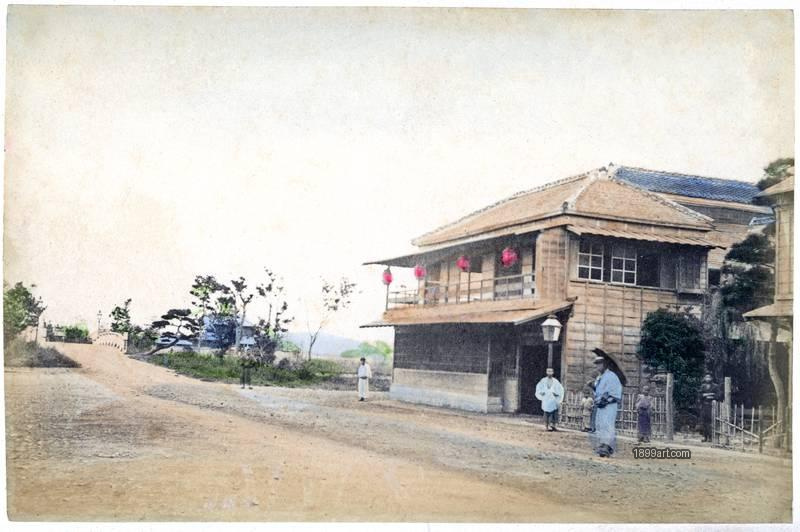
1899art A roadside teahouse or inn near a bridge in Yokohama, Japan Handcolored 1900s 1899art
From the 1899art Archive: Hand-colored albumen print showing a roadside building near a small bridge in Yokohama, late 19th century.
The bridge and street layout correspond to known Yokohama views from the Motomachi–Benten-dōri area.
Although sometimes misidentified in later sources as the Junpuro, the architectural features clearly differ from confirmed photographs of that establishment.
Japan · c. 1895–1910 · Hand-colored photograph
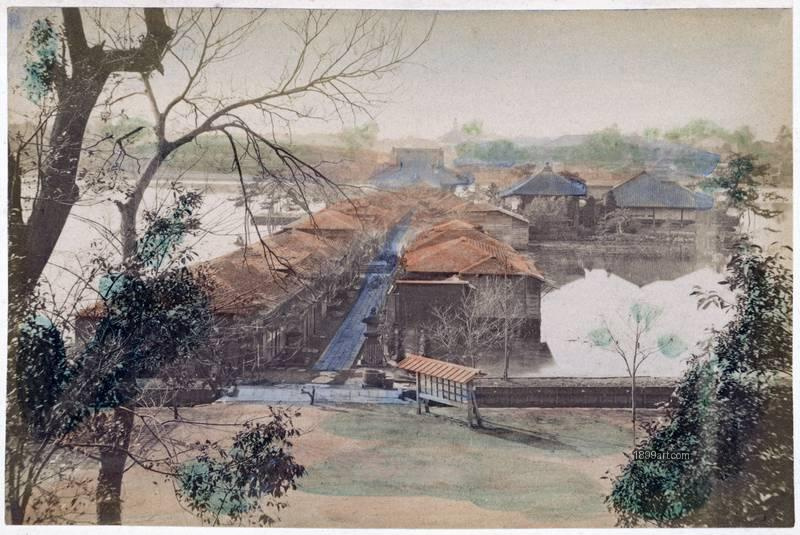
1899art Bridge and inner compounds near a castle complex, Japan Handcolored 1900s 1899art
From the 1899art Archive:Hand-colored albumen print showing a bridge and rows of traditional buildings along an inner waterway, Japan, late 19th century.
The elevated viewpoint, covered bridge, and orderly architectural layout suggest a castle or former daimyō compound rather than a commercial urban bridge.
Although sometimes misidentified online as Ebisu Bridge in Osaka, the scene does not correspond to known views of that location.
Japan · c. 1895–1910 · Hand-colored photograph
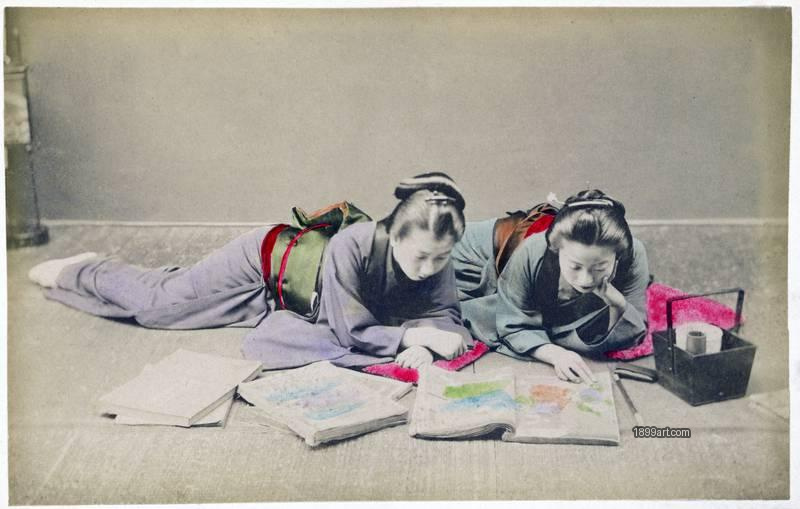
1899art Two maiko studying illustrated albums, studio scene attributed to the Yokohama School (possibly Kusakabe Kimbei) Handcolored 1900s 1899art
From the 1899art Archive: This hand-colored albumen photograph shows two maiko (apprentice geisha) lying side by side on a tatami mat while quietly studying illustrated albums. Their youthful features, elaborate natural hairstyles, and softly colored kimono clearly identify them as maiko rather than fully trained geisha.
The relaxed, intimate atmosphere reflects a private moment of learning and leisure, emphasizing education, refinement, and companionship during the apprenticeship stage. Such scenes were popular subjects in late Meiji-period Yokohama photography, appealing to both domestic and Western audiences fascinated by everyday cultural life in Japan.
Japan · c. 1895–1910 · Hand-colored photograph
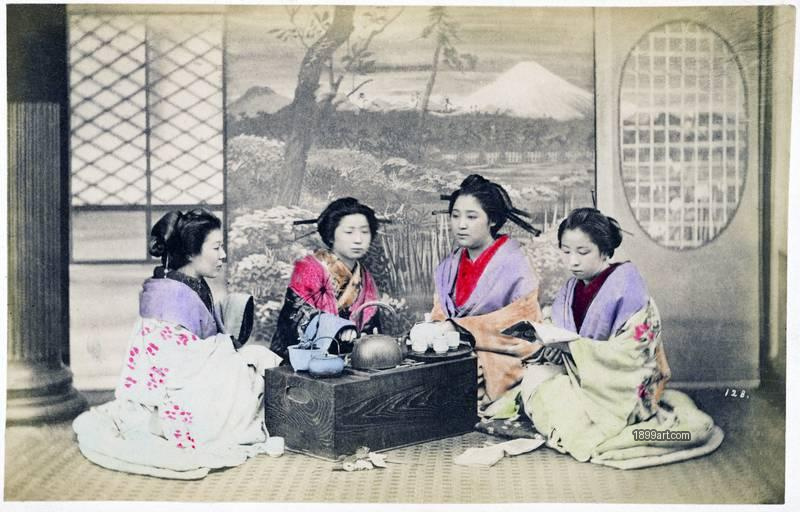
1899art Japan Four maiko gathered for a tea ceremony, studio scene with Mount Fuji backdrop, no. 128 (Kusakabe Kimbei) Handcolored 1900s Enami 1899art
From the 1899art Archive: This hand-colored albumen photograph depicts four maiko (apprentice geisha) seated around a low tea stand in a carefully staged studio interior. The young women are shown in coordinated seasonal kimono, engaged in a quiet moment of tea preparation and conversation. Their youthful hairstyles and restrained ornamentation clearly identify them as maiko rather than fully trained geisha.
The painted backdrop, featuring a landscape with Mount Fuji, the patterned studio carpet, and the intimate yet formal composition are all characteristic of late Meiji-period Yokohama studio photography. The visible image number “128” corresponds to known cataloguing practices of Kusakabe Kimbei, making an attribution to Kimbei highly plausible. The photograph exemplifies his refined approach to staged genre scenes intended for the international market around the turn of the 20th century.
Japan · c. 1895–1910 · Hand-colored photograph
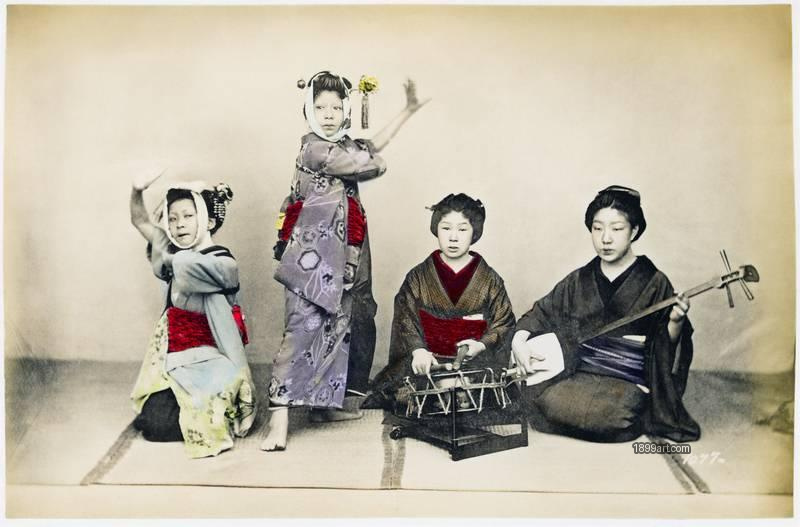
1899art Japan No. 1077 – Group of child performers with shamisen and small drum (attributed to Kusakabe Kimbei) Handcolored 1900s 1899art
From the 1899art Archive: This hand-colored studio photograph depicts a group of young meiko (apprentice geisha) engaged in music and dance during the Meiji period. Two of the girls are shown in expressive performance poses, while others accompany them with traditional instruments such as the shamisen and a small drum, reflecting formal training in the performing arts.
The composition, costumes, hairstyles, and confident handling of instruments indicate that the figures are genuine meiko rather than staged substitutes. The engraved image number “1077” corresponds to established catalogue practices of Kusakabe Kimbei, whose work frequently documented authentic performers in carefully arranged studio settings intended for both domestic and international audiences.
Japan · c. 1895–1910 · Hand-colored photograph
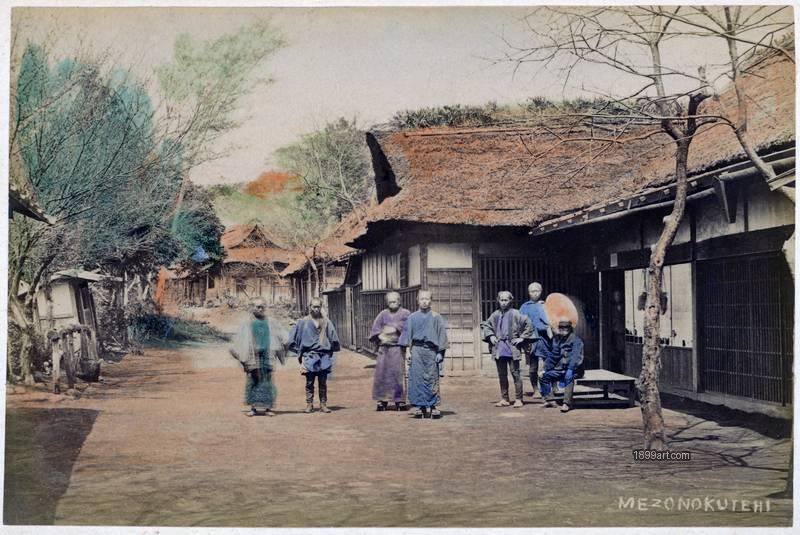
1899art Village Scene at Mezonokuchi (Mizonokuchi), near Yokohama, along the Tōkaidō Route, Japan. Handcolored 1900s 1899art
From the 1899art Archive: This hand-colored albumen photograph depicts a rural village scene at Mezonokuchi (modern Mizonokuchi, Kawasaki), a settlement located between Edo (Tokyo) and Yokohama along the historic Tōkaidō road. The Latin inscription “MEZONOKUCHI” visible in the lower right corner reflects the common practice of Yokohama studios to label photographs for a Western audience in the late 19th century.
The image shows local inhabitants standing in a courtyard surrounded by traditional thatched-roof houses, offering a rare documentary view of everyday life on the outskirts of the rapidly modernizing port cities. The composition, coloring style, and Romanized caption are characteristic of Yokohama School photography of the Meiji period (c. 1880–1895), and the photograph fits well within albums associated with the Kusakabe Kimbei circle, although a definitive studio attribution cannot be confirmed.
Japan · c. 1895–1910 · Hand-colored photograph
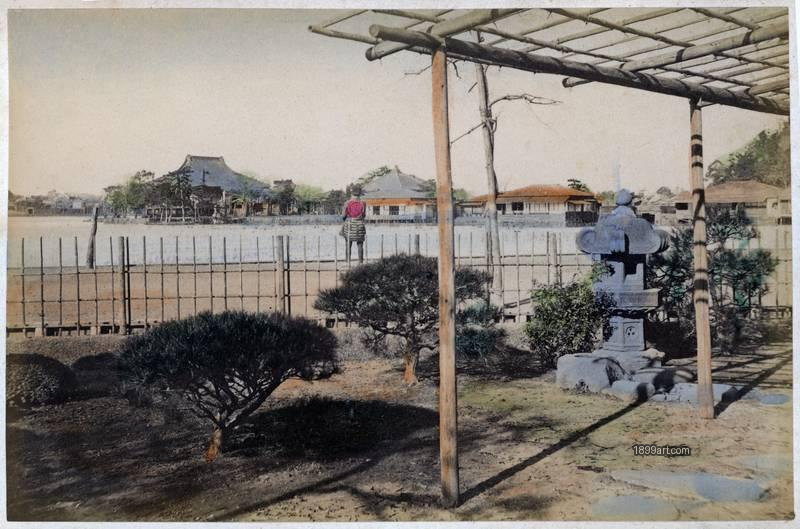
1899art Benten Temple across Shinobazu Pond, Ueno Park, Tokyo, Japan. (attributed) Handcolored 1900s 1899art
From the 1899art Archive: This hand-colored albumen photograph most likely shows the Benten-dō temple seen across Shinobazu Pond in Ueno Park, Tokyo, a location frequently depicted in Meiji-period photography.
The stone lantern, garden layout, and the arrangement of temple buildings across the water correspond closely to known views of the Shinobazu area.
Ueno Park, established in 1873 as one of Japan’s first public parks, and Shinobazu Pond—famous for its lotus blossoms—were popular subjects for both Japanese and foreign audiences in the late 19th century.
Although no original caption is visible, the composition and setting strongly support an attribution to this well-documented site.
Japan · c. 1895–1910 · Hand-colored photograph
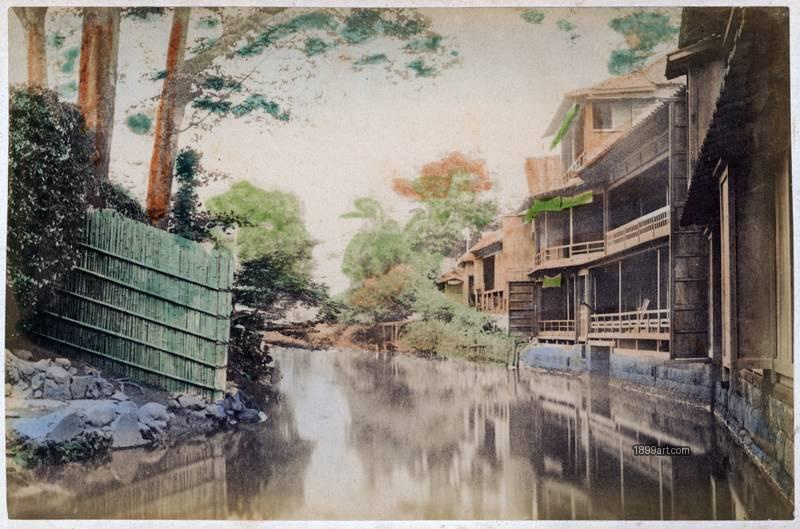
1899art Waterside houses and canal at Oji, Tokyo, Japan, with wooden fence along the left bank Handcolored 1900s 1899art
From the 1899art Archive: This hand-colored albumen photograph shows a quiet canal scene at Oji, Tokyo, photographed during the late Meiji period. Traditional wooden houses line the right side of the canal, their balconies and verandas opening directly onto the water, while a distinctive wooden fence runs along the left bank, serving as shoreline reinforcement.
The combination of canal alignment, fencing, and architectural layout closely matches other known views of the Oji area, including photographs labeled “Ogiya at Oji, Tokyo.” Slight variations in perspective suggest that the location was photographed multiple times from nearby vantage points, a practice typical of Yokohama School studios such as Kusakabe Kimbei.
Japan · c. 1895–1910 · Hand-colored photograph
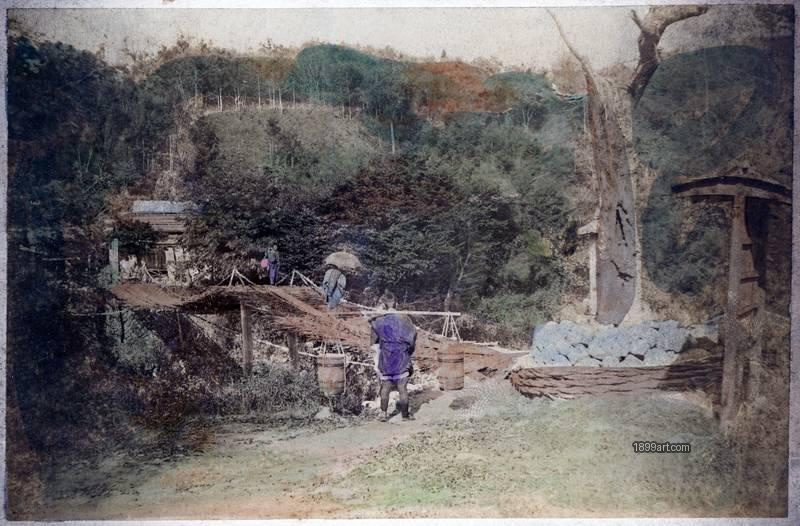
1899art Rural footbridge with porter carrying suspended vessels, Japan (Meiji period) Handcolored 1900s 1899art
From the 1899art Archive: This hand-colored photograph depicts a rural scene in Japan during the Meiji period (late 19th century).
A porter is shown crossing a simple wooden footbridge while carrying a shoulder pole (tenbin) with two suspended vessels, a common method of transporting everyday goods in pre-industrial Japan.
The vessels could have been used for water or other daily necessities such as foodstuffs or materials; however, the image itself does not provide sufficient evidence to determine their specific contents. The surrounding landscape, with simple structures and a wooded hillside, suggests a rural setting and emphasizes the everyday labor and infrastructure of the period.
Japan · c. 1895–1910 · Hand-colored photograph
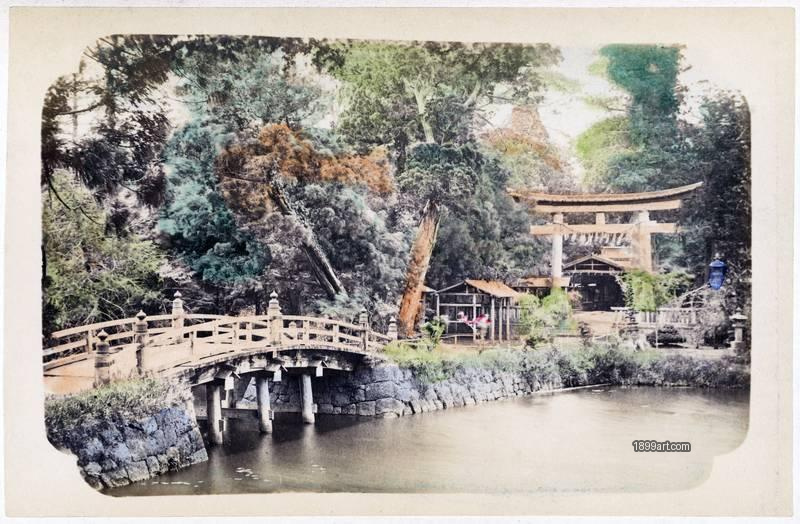
1899art Japan, Bridge leading toward a Shinto torii gate Handcolored 1900s 1899art
From the 1899art Archive: A hand-colored albumen photograph showing a small bridge crossing a waterway and leading toward a Shinto torii gate within a wooded shrine setting. The scene emphasizes the traditional spatial sequence from bridge to sacred entrance, a common feature in Shinto shrine landscapes. The exact location cannot be determined with certainty, but the composition is characteristic of shrine approaches in late Edo to early Meiji-period Japan.
Japan · c. 1895–1910 · Hand-colored photograph
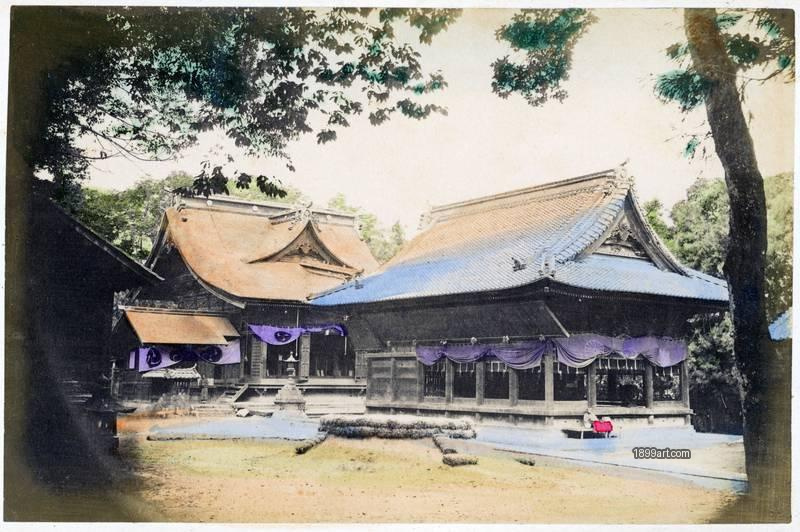
1899art Shrine buildings of the Futarasan Shrine complex, Nikkō, Japan. Handcolored 1900s 1899art
From the 1899art Archive: This hand-colored albumen photograph most likely depicts part of the Futarasan Shrine complex in Nikkō, Japan. The shrine is dedicated to Mount Futarasan (Mount Nantai), the sacred mountain that dominates the religious landscape of the region. Founded in 766 by the Buddhist monk Shōdō Shōnin, Futarasan Shrine forms one of the spiritual cores of Nikkō alongside Tōshō-gū and Rinnō-ji.
The architecture shown reflects traditional Shinto shrine design of the late Edo to early Meiji period, with expansive wooden halls and ceremonial textiles visible along the eaves. Such views were popular subjects in Yokohama School photography and were frequently included in late-19th-century souvenir albums intended for foreign visitors.
Japan · c. 1895–1910 · Hand-colored photograph
1899art Japan Two maiko seated in a tea ceremony interior Handcolored 1900s 1899art
From the 1899art Archive: This hand-colored albumen photograph shows two young maiko seated on tatami mats in a quiet interior setting, engaged in a tea-related moment. The arrangement of utensils on the floor, the folded cloth, and the restrained posture suggest a staged but culturally accurate depiction of refined domestic ritual rather than a formal public tea ceremony.
The hairstyles, kimono patterns, and obi styling are consistent with maiko attire of the late 19th century. Such carefully composed studio scenes were typical of Yokohama School photography and were produced for export albums, often emphasizing grace, restraint, and cultural intimacy rather than documentary realism. While no inscription is visible, the setting, carpet style, and staging are consistent with works associated with Kusakabe Kimbei or his immediate studio circle.
Japan · c. 1895–1910 · Hand-colored photograph
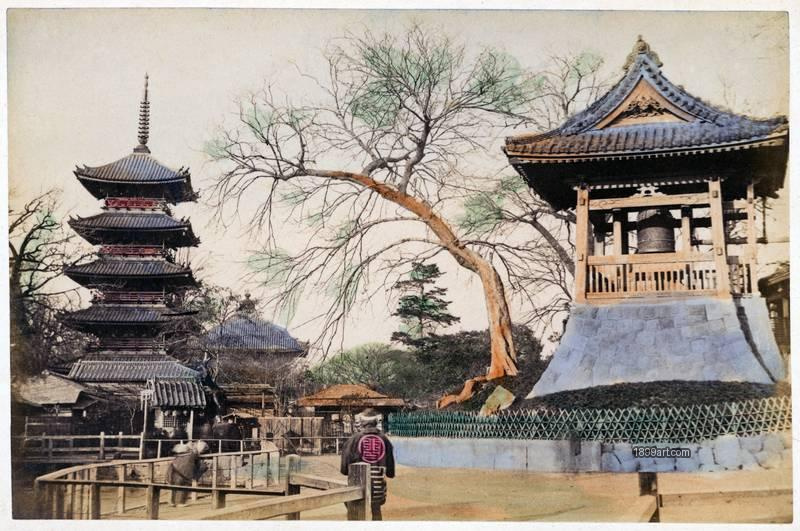
1899art Bell tower and five-storied pagoda at Benten-yama, Asakusa (Senso-ji), Tokyo, Japan. Handcolored 1900s 1899art
From the 1899art Archive: This hand-colored albumen photograph depicts the bell tower (shōrō) of Benten‑yama at Senso‑ji, Asakusa, during the Meiji period. The bell, shown on the right, was part of the traditional system that marked time for the city of Edo and later Tokyo, comparable in function to the bells of Kan’ei‑ji in Ueno.
On the left appears the five-storied pagoda of Senso-ji, photographed before its destruction during the air raids of the Second World War. The scene is closely associated with the famous haiku by Matsuo Bashō — “Hana no kumo / kane wa Ueno ka / Asakusa ka” — which evokes the competing sounds of temple bells drifting over Edo. The composition, hand-coloring, and architectural focus are characteristic of late 19th-century Yokohama School photography, produced for both documentary and aesthetic appreciation.
Japan · c. 1895–1910 · Hand-colored photograph
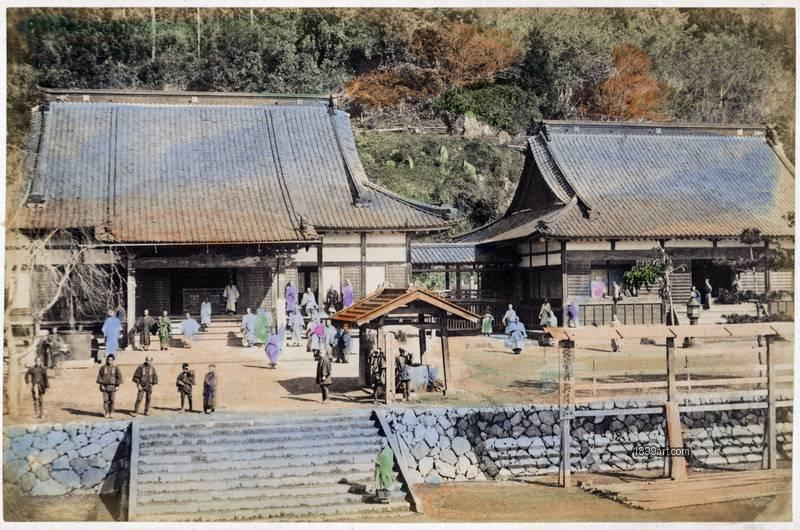
1899art Kenchō-ji Temple precinct with twin halls, Kamakura, Japan (late 19th century) Handcolored 1900s 1899art
From the 1899art Archive: This hand-colored albumen photograph depicts the main precinct of Kenchō-ji, the oldest Zen temple in Kamakura, founded in 1253 and serving as the head temple of the Rinzai school of Zen Buddhism. The image shows two principal temple halls facing an open courtyard, with visitors, monks, and attendants moving through the sacred space.
The photograph captures Kenchō-ji not as a static monument but as a living religious center, reflecting its historical role as a major Zen institution with hundreds of affiliated temples throughout Japan. The elevated viewpoint, architectural clarity, and restrained hand-coloring are characteristic of late Meiji-period Yokohama School photography, intended to document prominent cultural and religious sites for both Japanese and international audiences.
Japan · c. 1895–1910 · Hand-colored photograph
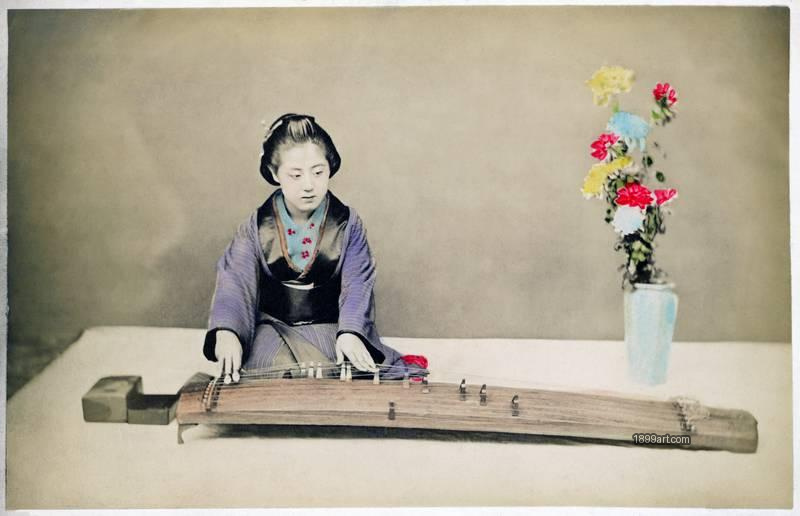
1899art Young Meiko Playing the Koto – Studio Portrait, Japan (Meiji Period, c. 1890s) Handcolored 1900s 1899art
From the 1899art Archive: This hand-colored albumen photograph shows a young meiko seated in a studio setting, playing the koto, a traditional Japanese string instrument associated with refined musical training. Her formal kimono, composed posture, and focused expression emphasize discipline and education rather than performance spectacle.
The sparse composition—neutral backdrop, carefully placed instrument, and a simple flower arrangement—reflects the Yokohama studio aesthetic of the late Meiji period. Such images were created to document authentic training practices of meiko, highlighting music as a core element of their cultural education rather than theatrical display.
Japan · c. 1895–1910 · Hand-colored photograph
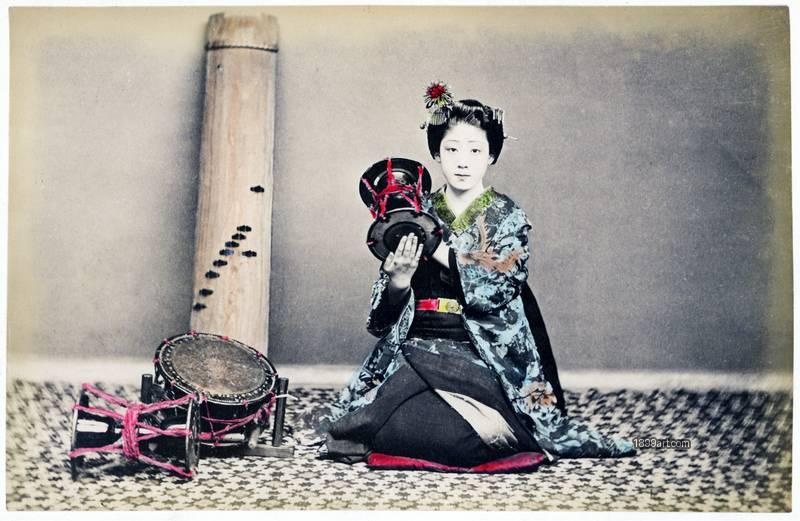
1899art Young Meiko with Tsuzumi Drum – Studio Portrait, Japan (Meiji Period, c. 1890s) Handcolored 1900s 1899art
From the 1899art Archive: This hand-colored albumen photograph depicts a meiko seated formally in a studio interior, holding a tsuzumi (hand drum), a core instrument in traditional Japanese music and dance training. Her composed posture, elaborate hairstyle with a seasonal ornament, and richly patterned kimono clearly identify her as an apprentice within the classical performing arts.
The surrounding instruments are deliberately arranged: a larger drum placed on the floor beside her and a vertically stored koto (Japanese zither) positioned prominently against the wall. The koto is not shown in use but serves as a visual and proportional reference, anchoring the composition and reinforcing the instructional, disciplined character of the scene rather than suggesting active performance.
Such Meiji-period studio portraits were intended to document authentic training roles within the traditional arts. The controlled placement of instruments emphasizes education, hierarchy, and formal practice, presenting the meiko as a student of established musical disciplines rather than as a symbolic or purely decorative figure.
Japan · c. 1895–1910 · Hand-colored photograph
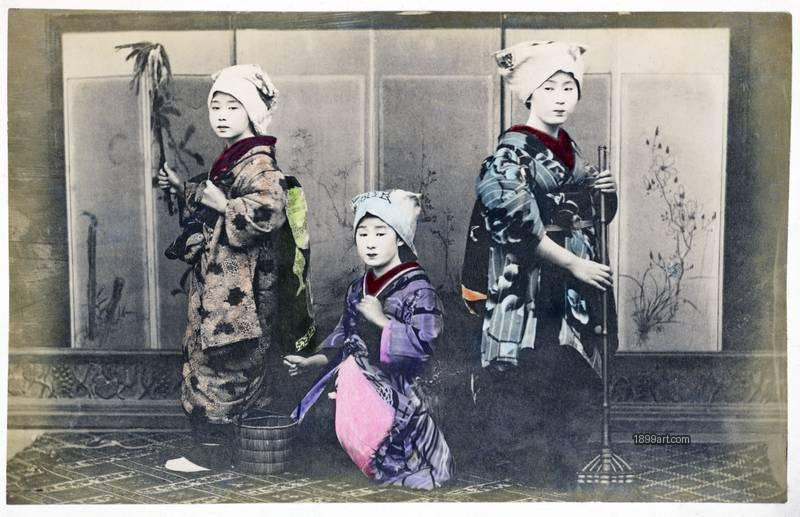
1899art Meiko Performing Household Chores – Studio Scene, Japan (Meiji Period, c. 1890s) Handcolored 1900s 1899art
From the 1899art Archive: This hand-colored studio photograph shows three meiko engaged in everyday household tasks, each holding traditional cleaning tools such as brooms and buckets. Their coordinated poses, matching head coverings, and formal arrangement indicate a staged studio composition, yet the activities depicted reflect authentic aspects of meiko training, which included discipline, service, and attentiveness alongside music and dance.
Rather than portraying performance, the image emphasizes daily work and order within the okiya (training house). Such photographs were common in Meiji-period Yokohama photography and were intended to present meiko as industrious apprentices rooted in structured routine, reinforcing their role as students of etiquette and cultural refinement rather than entertainers alone.
Japan · c. 1895–1910 · Hand-colored photograph
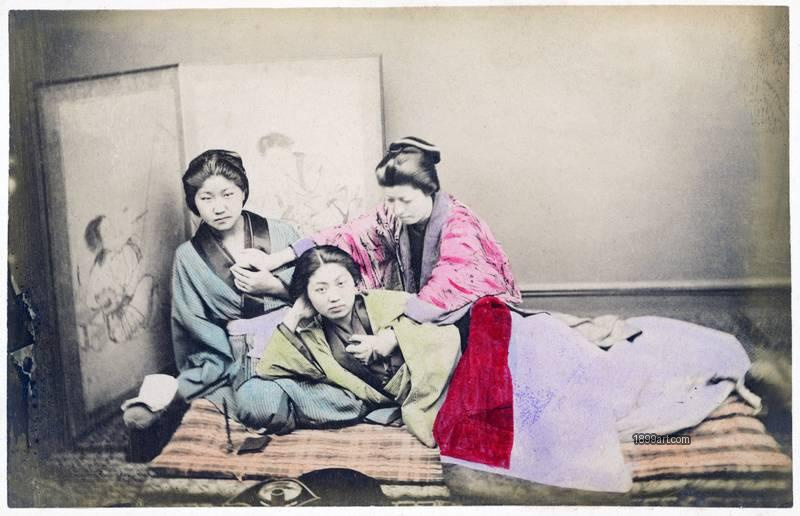
1899art Anma Treatment on Meiko at Rest – Intimate Studio Scene, Japan (Meiji Period, c. 1890s) Handcolored 1900s 1899art
From the 1899art Archive: The scene most plausibly represents a staged depiction of anma, a traditional Japanese form of body-based treatment practiced throughout the late Edo and early Meiji periods. The reclining meiko appears as the patient, partially covered and passive, while the older woman applies firm, deliberate physical contact consistent with anma techniques. The second meiko participates actively as an assistant, supporting the intervention rather than receiving treatment herself. Such studio photographs did not document a specific session but visualized a recognizable therapeutic practice for foreign audiences, emphasizing controlled touch, hierarchy, and bodily regulation.
Japan · c. 1895–1910 · Hand-colored photograph
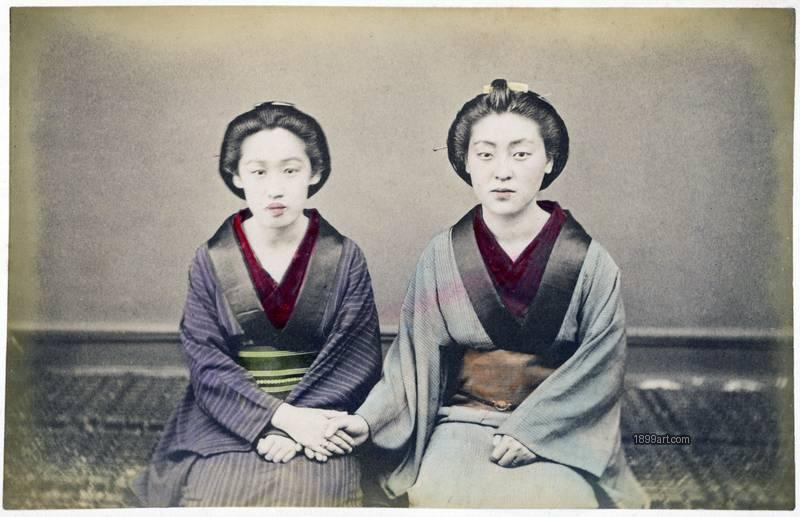
1899art Two Meiko Seated Together – Formal Studio Portrait, Japan (Meiji Period, c. 1890s) Handcolored 1900s 1899art
From the 1899art Archive: This hand-colored studio photograph shows two meiko seated closely side by side, their hands gently touching in a composed and formal pose. Their youthful faces, restrained hairstyles, and subdued kimono patterns clearly indicate apprentice status rather than fully trained geisha. The direct, calm gaze toward the camera reflects the discipline and composure expected of meiko even at a young age.
The image is carefully staged but emotionally restrained, emphasizing training, closeness, and hierarchy rather than performance. Such paired portraits were common in Meiji-period Yokohama photography, presenting meiko as embodiments of refinement, order, and harmony—qualities that appealed strongly to Western audiences while still rooted in authentic apprentice geisha culture.
Japan · c. 1895–1910 · Hand-colored photograph
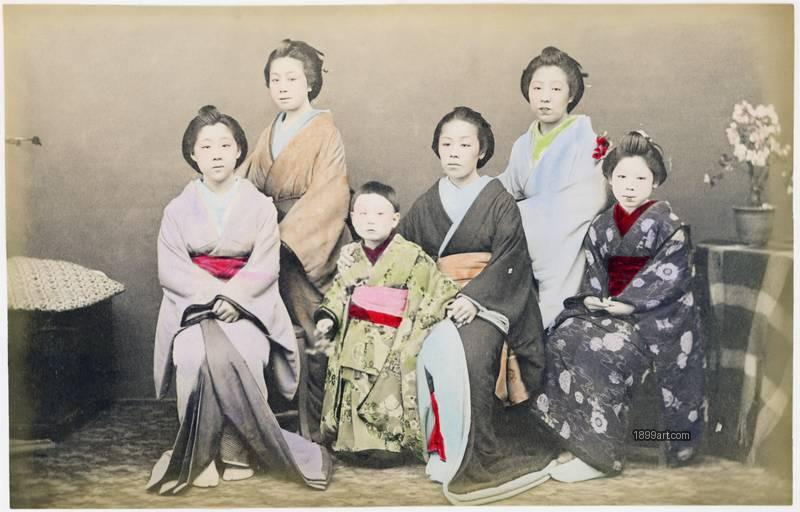
1899art Group Portrait of Meiko with a Young Child – Studio Scene, Japan (Meiji Period, c. 1890s) Handcolored 1899art
From the 1899art Archive: This hand-colored studio photograph depicts a group of meiko (apprentice geisha) arranged in a formal seated and standing composition, with a very young child placed at the center. The girls’ hairstyles, subdued yet elegant kimono, and calm expressions clearly indicate meiko rather than fully trained geisha. The central child, dressed in an ornate kimono, is noticeably younger and serves as a visual and symbolic focal point.
Such group portraits were common in Meiji-period Yokohama photography and often reflect the continuum of training and age within the okiya system. The inclusion of a small child emphasizes lineage, apprenticeship, and early socialization into cultural roles, rather than performance. The image conveys hierarchy, care, and collective identity—presenting the meiko not as isolated individuals, but as members of a structured, interdependent world shaped by tradition and discipline.
Japan · c. 1895–1910 · Hand-colored photograph
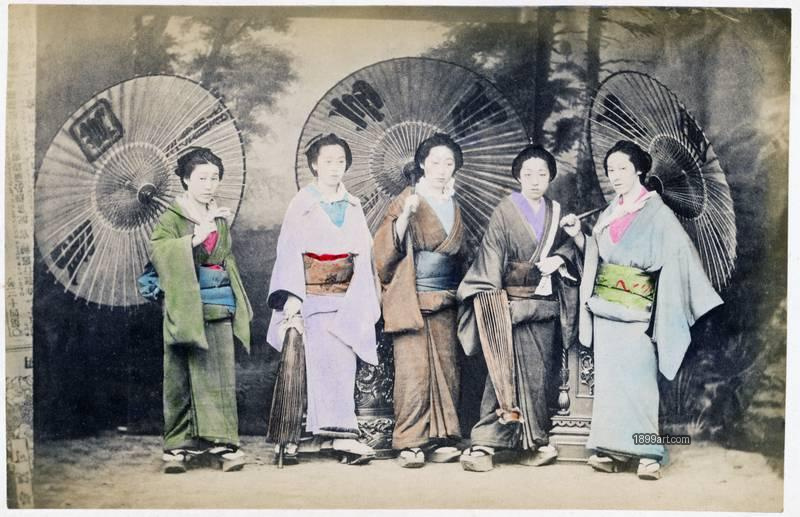
1899art Five Meiko with Parasols – Studio Portrait from the Yokohama School, Japan, c. 1870s Handcolored 1899art
From the 1899art Archive: This hand-colored albumen photograph depicts five meiko (apprentice geisha) posed in a formal studio arrangement, each holding a traditional Japanese parasol. Their youthful appearance, coordinated kimono, restrained hairstyles, and composed posture correspond closely to documented visual conventions for meiko portraits produced by the Yokohama School in the late 19th century.
An identical photograph is preserved in a major international museum collection (The Metropolitan Museum of Art, New York), where it is catalogued under a neutral title typical of earlier institutional descriptions. The repeated appearance of this image in museum and archival contexts confirms its status as a widely circulated export photograph of the 1870s. While museum records often avoid occupational labels, the visual and stylistic evidence strongly supports identification of the sitters as meiko, reflecting authentic apprenticeship representation rather than theatrical or fictional staging. The photograph exemplifies the Yokohama School’s studio aesthetics, careful posing, and delicate hand-coloring intended for Western collectors.
Japan · c. 1895–1910 · Hand-colored photograph
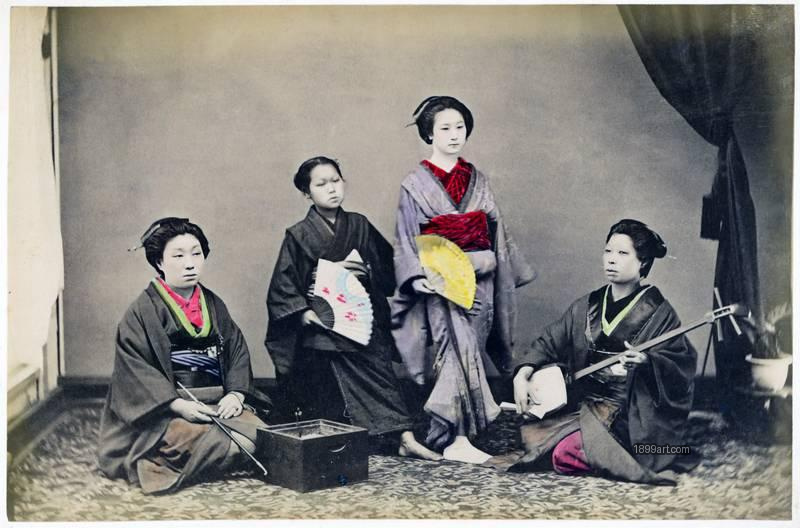
1899art Group of Meiko with Musical Instruments and Folding Fans – Studio Portrait, Japan, c. 1870s–1880s Handcolored 1899art
From the 1899art Archive: This hand-colored albumen photograph shows a group of meiko (apprentice geisha) arranged in a formal studio setting. The figures are depicted with traditional accessories associated with meiko training and performance, including a shamisen, folding fans, and a small presentation box. Their youthful facial features, subdued yet coordinated kimono, and restrained hairstyles are consistent with documented visual representations of meiko rather than fully trained geisha.
The carefully balanced composition and neutral backdrop are characteristic of Yokohama School studio photography produced for the export market in the late 19th century. The presence of musical instruments reflects the educational and performative role of meiko within the geisha system, emphasizing discipline and apprenticeship rather than theatrical role-play. The photograph represents an authentic studio portrayal aligned with contemporary archival and museum-held examples of meiko imagery from the period.
Japan · c. 1895–1910 · Hand-colored photograph
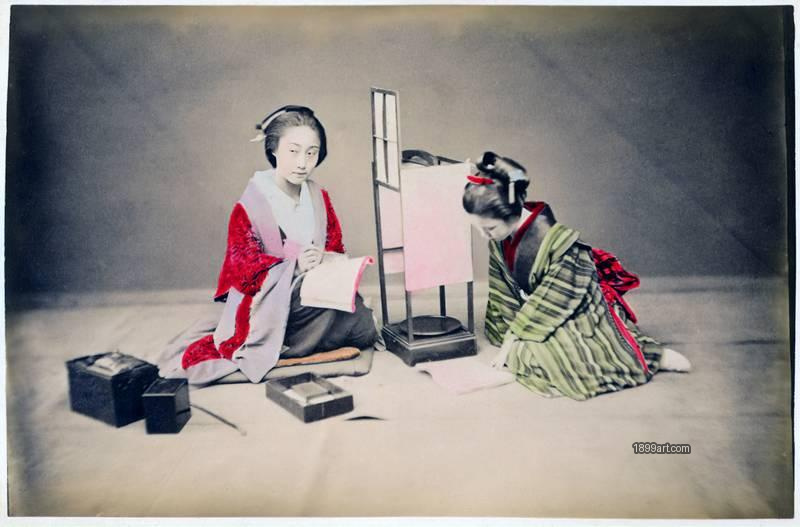
1899art Two Meiko Engaged in Calligraphy Practice – Studio Scene, Japan, c. 1870s–1880s Handcolored 1899art
From the 1899art Archive: This hand-colored albumen photograph depicts two meiko (apprentice geisha) in a studio setting, shown engaged in the practice of calligraphy and writing, an essential part of their formal education. One meiko is seated upright, holding a sheet of paper, while the other kneels attentively, focused on her work on the floor. Writing tools, boxes, and a simple paper stand emphasize the instructional nature of the scene.
The youthful appearance of the figures, their restrained hairstyles, and the comparatively subdued kimono are consistent with meiko rather than fully trained geisha. The composition reflects the Yokohama School’s approach to staged yet credible representations of daily training and refinement, intended to communicate cultural discipline and accomplishment to a foreign audience. The image highlights the intellectual and artistic education central to the meiko apprenticeship, beyond music and dance.
Japan · c. 1895–1910 · Hand-colored photograph
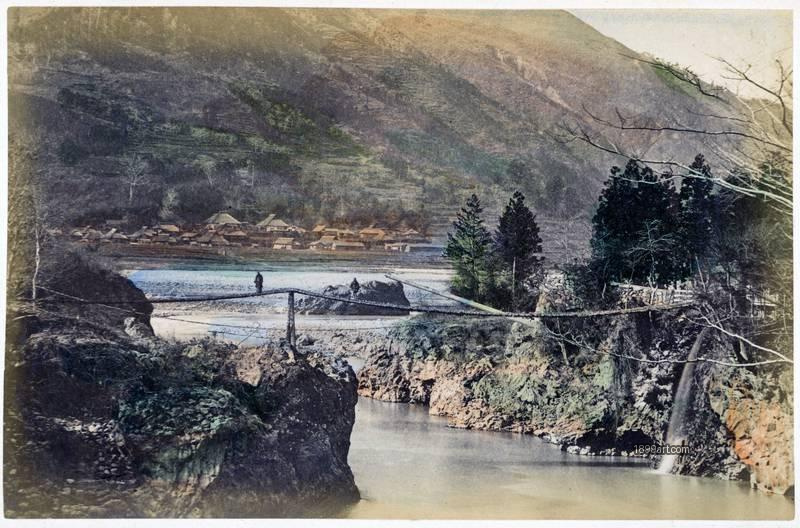
1899art Vine Bridge over the Fujikawa River, Suruga Province, Japan (c. 1890) Handcolored 1900s 1899art
From the 1899art Archive: This hand-colored albumen photograph depicts a traditional vine suspension bridge spanning the Fujikawa River in what was historically Suruga Province (present-day Shizuoka Prefecture). The bridge is constructed from intertwined wisteria vines (fuji) anchored on both riverbanks—an engineering method that was widely noted by Western travelers for its apparent fragility and remarkable durability.
The scene shows the river cutting through a rocky gorge, with cultivated fields and a rural settlement visible beyond the bridge. One or more figures can be seen crossing, emphasizing the scale of the landscape and the everyday use of this structure despite its unusual construction. Such vine bridges were characteristic of mountainous regions in central Japan before the widespread adoption of modern timber and steel bridges.
A closely matching photograph of the same bridge appears in Japanese and Western archives, including an example captioned “A Country Bridge… formed by two vines of the Fuji (wisteria) growing on opposite banks of the River Fujikawa”, confirming both the location and construction method. The present image belongs to the Yokohama School tradition and dates to the late 19th century.
Japan · c. 1895–1910 · Hand-colored photograph
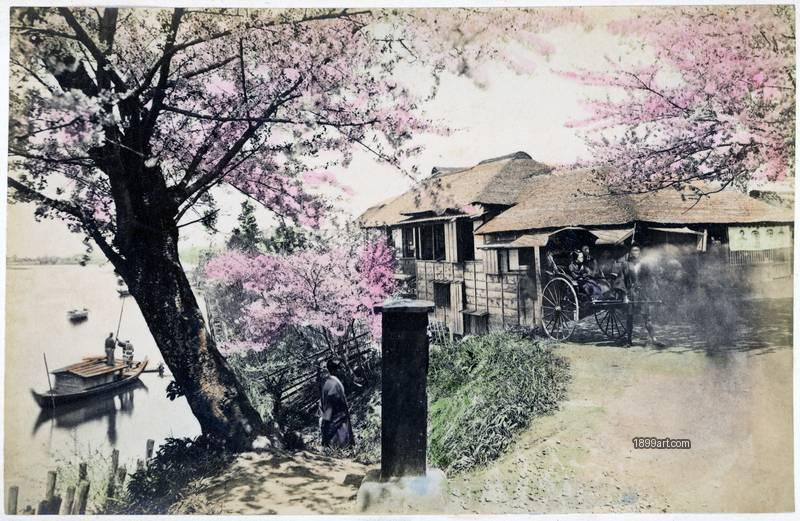
1899art Cherry Blossoms along a Canal, Negishi (Horiwari), Yokohama, Japan (c. 1890–1900) Handcolored 1899art
From the 1899art Archive: This hand-colored albumen photograph shows a canal-side scene during the cherry blossom season, very likely in the Negishi area of Yokohama, possibly along the historic Horiwari canal. A large flowering cherry tree dominates the foreground, while traditional wooden buildings line the waterway. A small boat is moored along the canal, and a horse-drawn carriage stands on the road, indicating local transport and everyday activity.
The combination of canal infrastructure, sloped embankments, riverside buildings, and cherry blossoms closely matches other known late-19th-century views from Negishi, an area frequently photographed by studios of the Yokohama School. While no definitive inscription confirms the exact location, the landscape, architectural details, and transport elements strongly support an attribution to Yokohama’s Negishi district during the Meiji period.
Japan · c. 1895–1910 · Hand-colored photograph
1899art Temporary earthen bridges across the Sakawa River, Japan, c. 1871 Handcolored 1899art
From the 1899art Archive: This hand-colored albumen photograph shows the Sakawa River (Sakawagawa) with temporary earthen crossings used by pedestrians in the early Meiji period. Such provisional bridges, made from compacted earth and gravel, were a common solution during low water levels and seasonal travel, but were considered dangerous and unreliable.
The scene closely corresponds to an albumen print dated 1871 and documented in Western travel photography of Japan, where similar views of the Sakawa River are described as “temporary bridges” giving travelers a false sense of security. Contemporary travel guides, such as Ryokō Yōjinshū (1810), explicitly warned against these crossings due to frequent collapses and sudden floods.
The wide riverbed, shallow channels, sparse figures, and distant tree line confirm the identification as the Sakawa River region rather than an urban waterway. This photograph belongs to the broader visual tradition of early Meiji landscape documentation intended for foreign audiences.
Japan · c. 1895–1910 · Hand-colored photograph
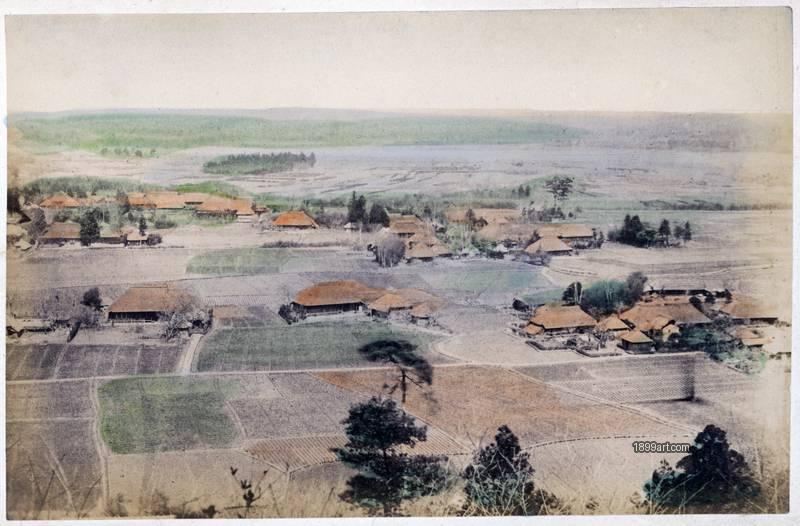
1899art Rural village landscape with cultivated fields, Japan, late 19th century Handcolored 1900s 1899art
From the 1899art Archive: This hand-colored albumen photograph presents a wide rural panorama of a Japanese village in the late 19th century. Thatched-roof farmhouses are scattered among carefully divided agricultural fields, emphasizing the structured land use typical of the late Edo to early Meiji transition period.
The elevated viewpoint suggests the photograph was taken from a hillside or lookout point, offering a comprehensive overview of daily rural life rather than an urban or ceremonial setting. The absence of prominent infrastructure and the dominance of farmland indicate an agrarian economy largely untouched by early industrial modernization.
The image exemplifies the landscape genre popular among Yokohama School photographers, created primarily for foreign audiences seeking an idealized yet documentary view of Japan’s countryside.
Japan · c. 1895–1910 · Hand-colored photograph
1899art Nijūbashi Bridges, Inner Moat of Edo Castle, Tokyo, Japan (Transitional Phase) Handcolored 1900s 1899art
From the 1899art Archive: This hand-colored albumen photograph depicts the famous Nijūbashi bridge ensemble at the inner moat of Edo Castle (today the Imperial Palace) in Tokyo during a transitional phase of reconstruction in the late Meiji period, likely in the late 1880s. The foreground bridge is already constructed in stone, while the rear bridge still appears to be wooden, reflecting an intermediate stage between the original wooden bridges and the later stone-and-iron structures completed by the end of the decade.
The coexistence of stone and wood within the same composition provides a precise chronological marker and illustrates Japan’s rapid modernization following the Meiji Restoration. Such iconic views were frequently selected by Yokohama School photographers, including studios associated with Kusakabe Kimbei, for their symbolic representation of continuity and change at the political heart of Tokyo.
Japan · c. 1895–1910 · Hand-colored photograph
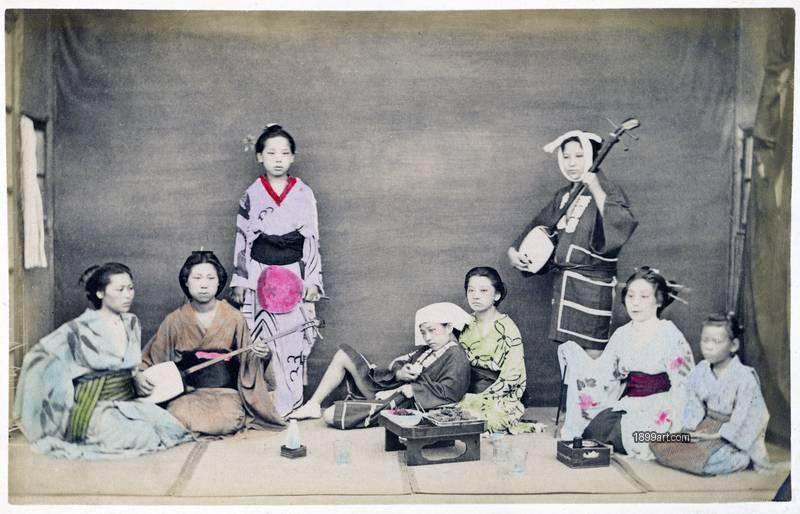
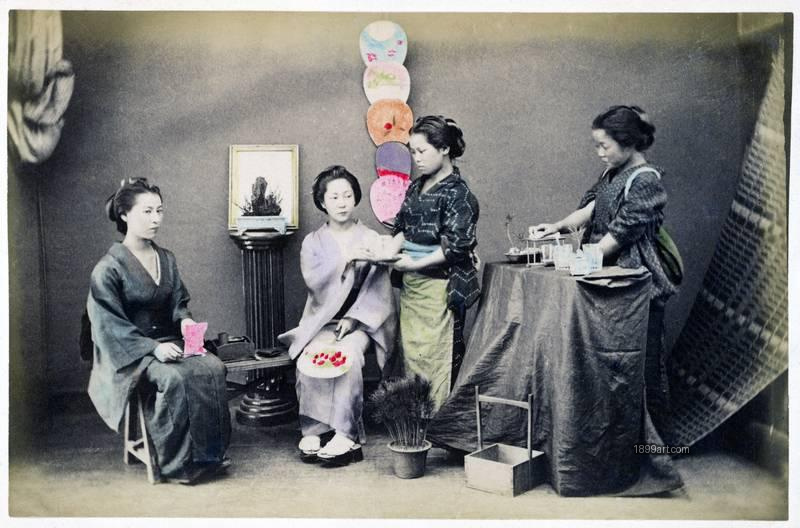
1899art Studio Scene of Women Preparing Confections and Tea, Japan Handcolored 1900s 1899art
From the 1899art Archive:This hand-colored albumen photograph presents a carefully staged studio scene showing several young women engaged in the preparation and serving of sweets and tea. One woman is seated, while others attend to her with trays, utensils, and glassware, suggesting a moment of refined hospitality rather than everyday domestic labor. The arrangement of objects—including serving tables, containers, and decorative elements—emphasizes ritual, presentation, and etiquette.
Such compositions were characteristic of Yokohama School studio photography of the late 19th century, created for both documentary and commercial purposes. The image reflects contemporary Western interest in Japanese social customs and feminine refinement, while the hand coloring highlights textiles, accessories, and selected details to enhance visual appeal and cultural legibility for foreign audiences.
Japan · c. 1895–1910 · Hand-colored photograph
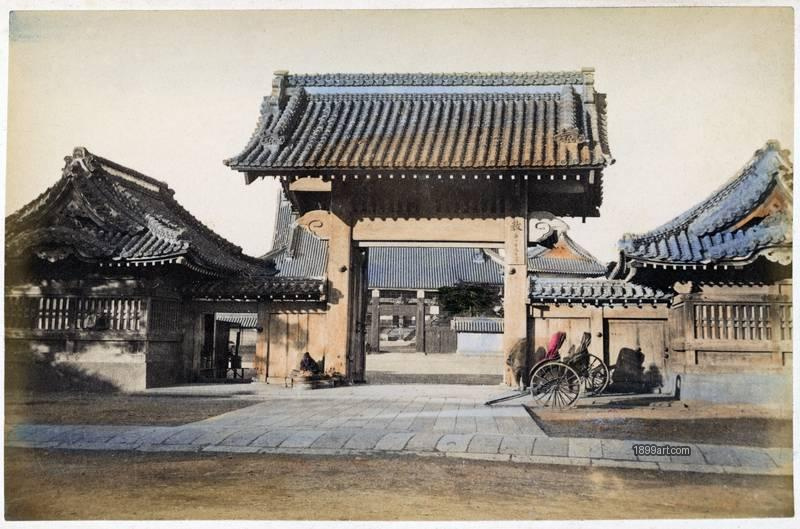
1899art Yushima Seidō (Confucian Temple), Tokyo Handcolored 1900s 1899art
From the 1899art Archive: This hand-colored albumen photograph depicts the main gate of Yushima Seidō, the historic Confucian temple of Tokyo. The complex was established in 1690 under Tokugawa Tsunayoshi, shōgun of the Edo period, and served as the intellectual center of Neo-Confucian learning in Japan.
Yushima Seidō functioned not only as a religious site but also as a state-controlled educational institution, laying important foundations for Japan’s modern school system. The monumental gate architecture, restrained ornamentation, and formal symmetry reflect Confucian ideals of order and discipline. The presence of a rickshaw situates the photograph in the late 19th to early 20th century, consistent with Yokohama School architectural views produced for both documentary and export purposes.
Japan · c. 1895–1910 · Hand-colored photograph
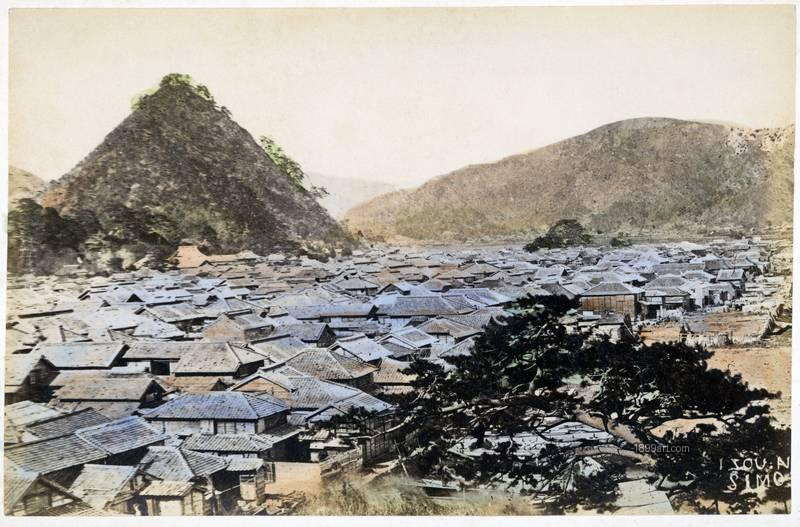
1899art Yamanaka Onsen – Village and Rooftops beneath the Kakusenkei Gorge, Japan (Meiji Period) Handcolored 1900s 1899art
From the 1899art Archive: This hand-colored photograph shows the village of Yamanaka Onsen, a historic hot spring town in Ishikawa Prefecture, seen beneath the distinctive mountain slopes of the Kakusenkei Gorge.
The characteristic silhouette of the surrounding hills, together with the broad valley floor and dense arrangement of traditional rooftops, allows a confident identification of the location. Yamanaka Onsen was one of the most renowned spa towns of the Kaga region and a frequent subject of late 19th-century photography.
During the Meiji period, the area was celebrated not only for its thermal waters but also for its refined local craftsmanship, particularly Yamanaka lacquerware and wood-turning traditions. The photograph captures the settlement before modern redevelopment, preserving the historic structure of the town in its natural mountain setting.
Japan · c. 1895–1910 · Hand-colored photograph
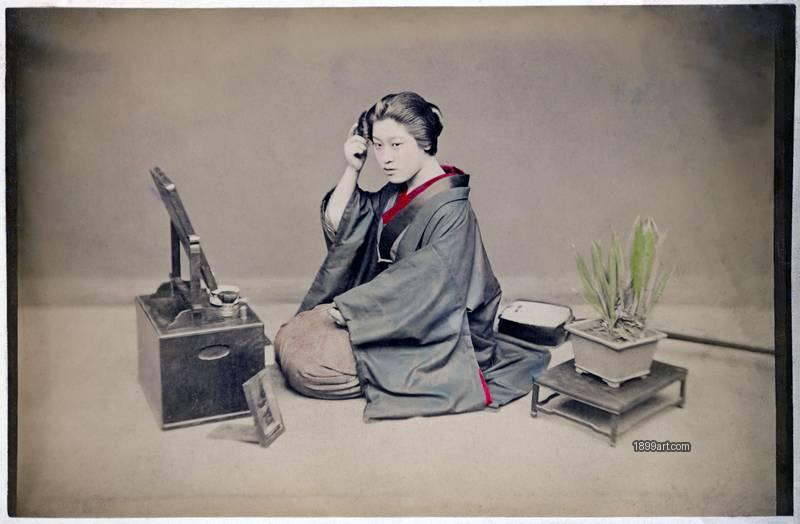
1899art Young Japanese Maiko at Her Dressing Table, Meiji Period Handcolored 1900s 1899art
From the 1899art Archive: This hand-colored albumen photograph from the Meiji period (late 19th century) shows a young Japanese make seated on the floor beside a traditional dressing table (kyōdai) with mirror and personal accessories. She is captured in a quiet, introspective moment, adjusting her hair, a gesture that emphasizes intimacy and everyday refinement rather than theatrical posing.
The sparse studio setting includes a small bonsai or potted plant on a low stand and personal toiletry boxes, objects commonly used in Yokohama studio photography to suggest domestic elegance and cultivated taste. The woman’s kimono is delicately hand-colored, with restrained use of red pigments highlighting the inner lining and collar, characteristic of high-quality Meiji-era coloration.
Japan · c. 1895–1910 · Hand-colored photograph
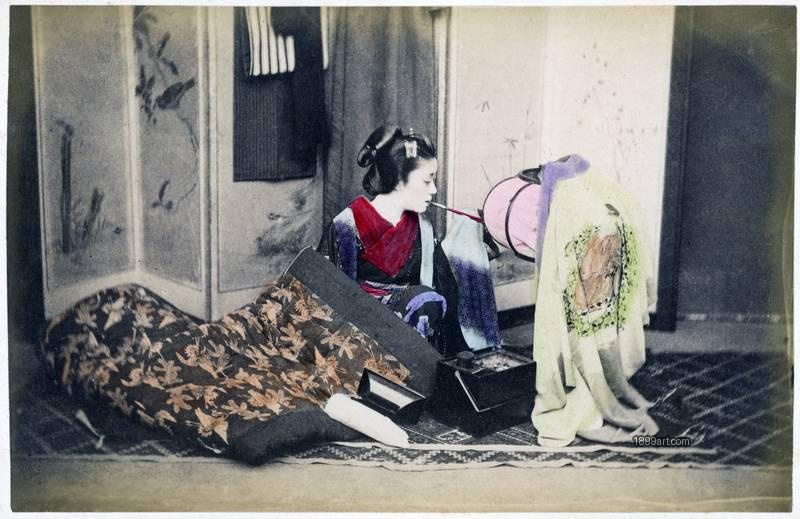
1899art Geisha Lighting a Paper Lantern Handcolored 1900s 1899art
From the 1899art Archive: This hand-colored studio photograph from the Meiji period depicts a young woman kneeling indoors while lighting a paper lantern placed in front of her. The posture, gesture, and focused gaze strongly suggest a moment of preparation rather than leisure.
The woman is dressed in a refined kimono with a deep red inner collar, a detail commonly associated with geisha or apprentice geisha (maiko) rather than ordinary domestic wear. Her hairstyle, bearing, and the carefully staged composition further support an interpretation within the geisha milieu, even though the scene itself is clearly arranged in a photographic studio.
Around her are typical studio props of the Yokohama School: a patterned studio carpet, a folding screen painted with natural motifs, storage boxes, and textiles. Such elements were frequently used to construct an idealized image of Japanese feminine culture for an international audience, blending recognizable cultural symbols with controlled, theatrical lighting.
Japan · c. 1895–1910 · Hand-colored photograph
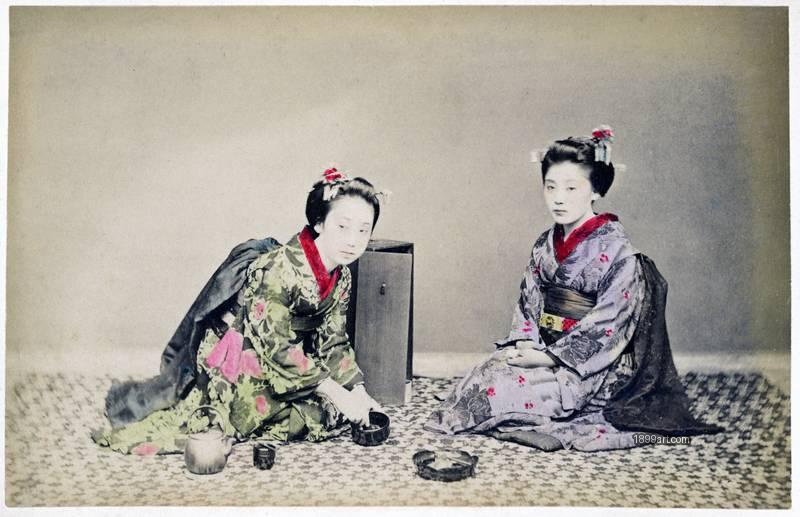
1899art Two Maiko Seated with Tea Utensils Handcolored 1900s 1899art
From the 1899art Archive: This hand-colored albumen photograph from the Meiji period depicts two maiko (apprentice geisha) seated on the floor in a formal studio setting. Their deep red eri (inner kimono collars), elaborate hairstyles with kanzashi hair ornaments, and youthful facial features clearly identify them as maiko rather than fully trained geisha or ordinary women.
Arranged before them are tea utensils, including bowls and containers, suggesting a cultivated, professional environment associated with maiko training and performance culture. The objects are presented symbolically rather than functionally, consistent with Yokohama School studio compositions intended to represent refined aspects of Japanese arts.
Japan · c. 1895–1910 · Hand-colored photograph
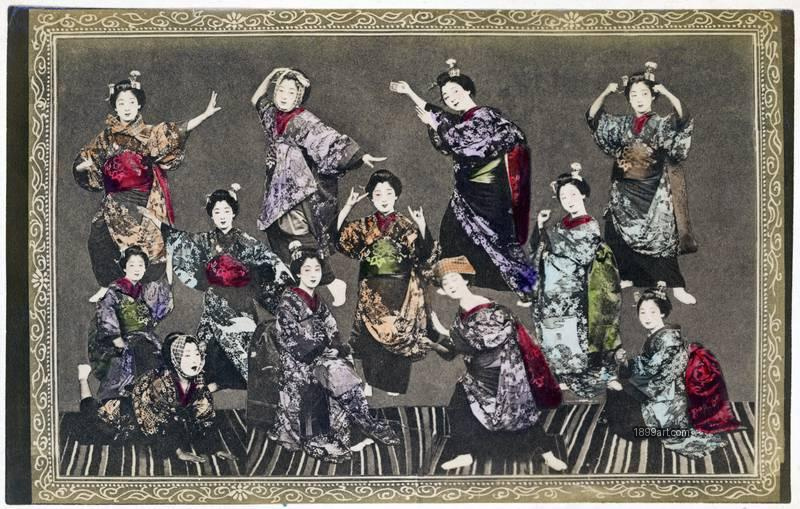
1899art Composite Study of Dancing Maiko Handcolored 1900s 1899art
From the 1899art Archive: This hand-colored albumen photomontage from the Meiji period presents a large ensemble of maiko (apprentice geisha) captured in a wide range of expressive dance poses. Each figure is shown in mid-movement, with raised arms, turned torsos, and stylized gestures that clearly reference classical maiko and geisha dance vocabulary rather than theatrical or folkloric performance.
The image is not a single exposure but a carefully constructed composite, assembled from multiple studio portraits and arranged into a unified, rhythmically balanced composition. The repeated use of the same models in different poses suggests deliberate choreographic intent, transforming individual studio photographs into a dynamic visual study of movement.
While similar composite dance images from the Yokohama School period are known in museum and private collections, this exact arrangement is not documented online and differs significantly in pose selection, figure count, and overall layout. This strongly indicates an independent variant or previously undocumented composition, rather than a reproduction of a known plate.
Japan · c. 1895–1910 · Hand-colored photograph
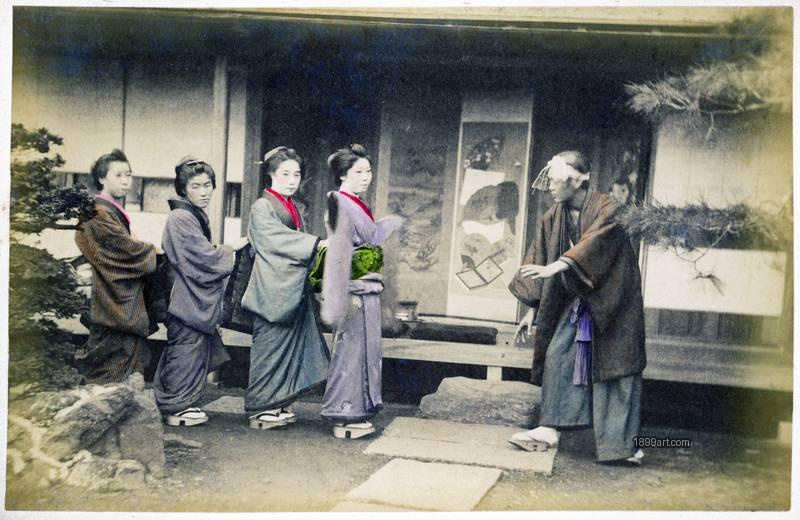
1899art Instruction and Formation – Maiko Training Scene with Instructor, Japan, c. 1890–1900 Handcolored 1899art
From the 1899art Archive: This rare hand-colored albumen photograph depicts a structured training scene involving four young maiko (apprentice geisha) under the guidance of an older male instructor. The figures are arranged in a deliberate sequence, suggesting a formal exercise rather than a performance or everyday interaction.
The instructor demonstrates posture, gesture, and spatial positioning, while the maiko observe attentively, awaiting their turn. The absence of musical instruments, audience elements, or theatrical movement indicates that this is not an entertainment scene but a moment of instruction and discipline, likely focused on etiquette, controlled movement, and ceremonial conduct—core elements of maiko education.
Such training scenes were rarely photographed in the late 19th century, as commercial Yokohama photography typically favored finished performances or idealized studio portraits. The image therefore offers an exceptional glimpse into the process of formation rather than its polished result, documenting the pedagogical structure behind the geisha tradition.
Japan · c. 1895–1910 · Hand-colored photograph
1899art Tea Practice Between Two Maiko – Instructional Interior Scene, Japan, c. 1890–1900 Handcolored 1899art
From the 1899art Archive: This hand-colored albumen photograph shows two maiko (apprentice geisha) seated opposite each other in a sparse interior, engaged in a formalized tea practice. The arrangement of utensils between them—tea bowl, container, and preparation tools—indicates a training situation rather than a social tea gathering.
The posture of both figures is controlled and attentive. One maiko appears to observe while the other performs a precise movement, suggesting a pedagogical exchange focused on etiquette, timing, and correct handling of objects. The restrained setting, with minimal decoration and no audience, reinforces the interpretation of this scene as instructional practice within the maiko education system.
Such images are uncommon within late 19th-century Yokohama photography, which usually emphasized finished performances or idealized portraits. By contrast, this photograph documents the process of learning—quiet, repetitive, and disciplined—offering rare visual insight into the internal training that preceded public appearance.
Japan · c. 1895–1910 · Hand-colored photograph
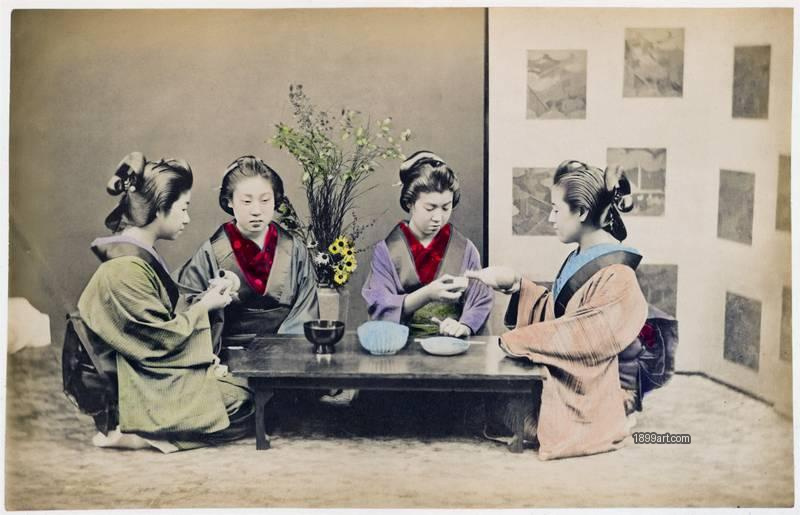
1899art Maiko Tea Practice in a Group Setting – Instructional Interior Scene, Japan, c. 1890–1900 Handcolored 1899art
From the 1899art Archive: This hand-colored albumen photograph depicts four maiko (apprentice geisha) seated around a low table, engaged in a structured tea practice. The scene captures a moment of coordinated instruction: one maiko hands a bowl to another, while the remaining participants observe or prepare their own movements, indicating a collective training exercise rather than a social tea gathering.
The setting is deliberately restrained, with minimal furnishings, a simple floral arrangement, and hanging artworks used as compositional balance rather than decoration. The focus lies on posture, hand positioning, and the sequential handling of tea utensils—core elements of maiko education. Selective hand-coloring emphasizes collars, garments, and vessels, guiding the viewer’s attention to hierarchy, discipline, and form.
Images documenting process-oriented training among maiko are comparatively rare within late 19th-century Yokohama photography, which more often presents idealized or performative scenes. This photograph stands out for its instructional clarity and quiet realism, offering insight into the pedagogical foundations behind public geisha culture.
Japan · c. 1895–1910 · Hand-colored photograph
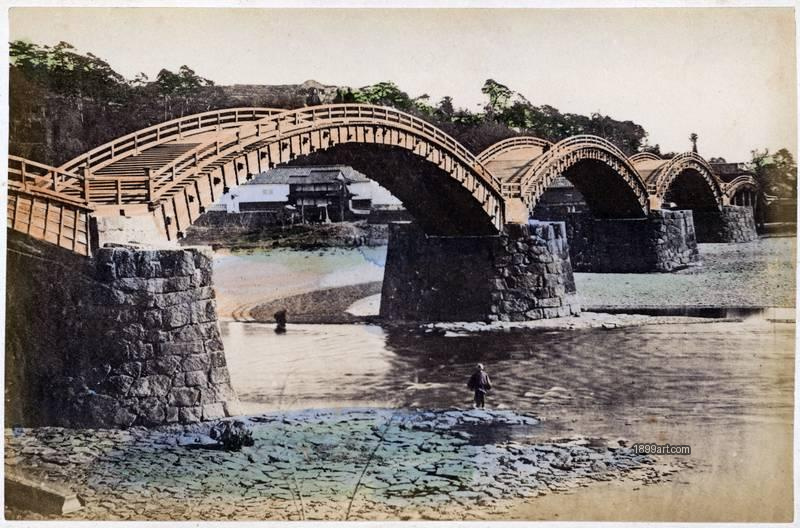
1899art The Kintai Bridge (Kintai-kyō), Iwakuni – Five-Span Wooden Arch Bridge over the Nishiki River, Japan, c. 1890 1899art
From the 1899art Archive: This hand-colored albumen photograph depicts the Kintai Bridge in Iwakuni, one of the most celebrated bridges in Japan. The structure is instantly recognizable by its five consecutive wooden arch spans, resting on massive stone piers set in the Nishiki River.
Originally completed in 1673, the bridge was renowned in the Meiji period for its sophisticated engineering: wooden arches assembled without metal nails, designed to withstand seasonal flooding. The photograph shows the bridge from downstream, emphasizing the rhythm of the arches and the contrast between light wooden superstructure and heavy stone foundations. Small human figures near the riverbank provide scale and confirm everyday use rather than a staged studio scene.
Images of the Kintai Bridge were popular among late 19th-century photographers, yet high-quality hand-colored views like this one remain comparatively scarce. The photograph documents not only a landmark of Japanese civil engineering, but also the Meiji-era fascination with blending traditional craftsmanship and modern photographic documentation.
Contact & Credits
Purpose of this site
YokohamaSchool.org is intended as a reference and context resource for the history and surviving works of the Yokohama School of hand-colored photography.
It does not claim to be complete and will be expanded over time.
Focus
Historical research, visual analysis, digital preservation and curated examples of original works from the period c. 1860–1920.
This website is currently in its early phase. Further sections on sources, studios and bibliography will follow.
YokohamaSchool.org is part of the wider 1899art project:
www.1899art.com.
Usage Rights & Legal Notice – 1899art Archive
All images published on 1899art.com originate from the 1899art Archive and are provided for cultural, educational, and historical reference purposes only.
Permitted use
Images may be linked, embedded, or shared on external websites and platforms exclusively in their original, unmanipulated form, provided that:
– the source is clearly credited as “1899art”, and
– a visible and clickable link to https://1899art.com accompanies the image.
Prohibited use
Any form of modification, including but not limited to cropping, retouching, recoloring, compositing, filtering, AI-based processing, or the creation of derivative works, is strictly prohibited without prior written permission.
Commercial use, resale, redistribution as standalone files, or inclusion in third-party archives or databases is also not permitted without explicit authorization.
Rights status
While the original photographs may be in the public domain due to age, the digital reproductions, curatorial selection, restoration decisions, metadata, and contextual presentation are the intellectual property of the 1899art Archive.
By using images from this website, you agree to respect these conditions. Automated downloading, scraping, or use of images for machine learning or AI training purposes is expressly prohibited.
EU / International Copyright Notice
All images published by the 1899art Archive are protected under European and international copyright law.
Any reproduction, redistribution, modification, AI-based processing, or commercial use beyond the explicitly permitted low-resolution web sharing is prohibited without prior written consent of the 1899art Archive.
This applies equally to high-resolution files obtained through unauthorized access, third-party leaks, or archival reproductions.
DMCA Copyright Notice & Protection
All images and digital files published by the 1899art Archive are protected by international copyright law and the Digital Millennium Copyright Act (DMCA).
Unauthorized reproduction, distribution, modification, AI processing, or commercial use of any image or high-resolution file from the 1899art Archive is strictly prohibited.
The unauthorized possession or dissemination of high-resolution files does not constitute a license and does not grant any rights of use.
Any infringement will result in DMCA takedown notices, platform removal requests, and, where applicable, legal action.