High-resolution original files are available from the 1899art Archive.
Original scans have a minimum resolution of 6,000 × 9,000 pixels.
Depending on the original source medium, original master scans of up to 15,000 × 20,000 pixels are available.
Only the low-resolution images displayed on the 1899art website may be linked, shared, or embedded on external websites, and only in their original, unmanipulated form, provided that clear attribution to “1899art” is given and a clearly visible link to https://1899art.com is included.
Any use, distribution, or publication of high-resolution files, whether obtained intentionally or inadvertently, is strictly prohibited.
Any modification, alteration, recomposition, recoloring, AI processing, or commercial reuse beyond simple linking and sharing is not permitted without prior written consent of the
1899art Archive.
YOKOHAMA SCHOOL BACK TO MAIN PAGE
Album 5 – 39 Motifs of the Yokohama School. All photographs are carefully reconstructed and described based on extensive research. We strive for the highest possible accuracy in all attributions and contextual information. If you believe any information is incorrect, please contact us and include your source.
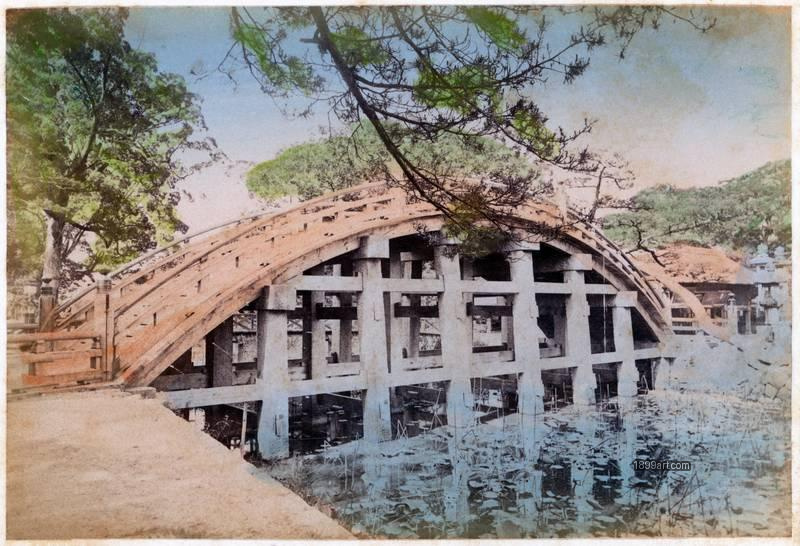
From the 1899art Archive: This hand-colored albumen photograph shows the iconic Taikobashi Bridge at Sumiyoshi Taisha in Osaka. The steeply arched wooden structure, supported by massive vertical pillars, spans a shallow pond and marks the symbolic transition from the secular to the sacred within the shrine complex.
The image is attributed to Kusakabe Kimbei and corresponds to the studio catalog reference A381 – “Taikobashi (Bridge), Sumiyoshi in Osaka.” Produced during the late Meiji period (ca. 1890–1900), it belongs to the tradition of Yokohama export photography, originally printed as an albumen photograph and later carefully hand-colored for the Western market.
Japan · c. 1895–1910 · Hand-colored photograph
1899art Barrel Maker at Work, Japan Handcolored 1900s 1899art
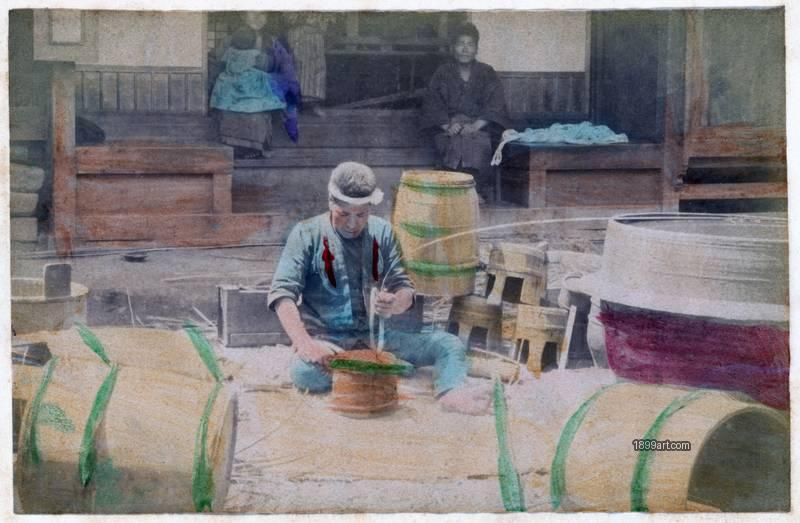
From the 1899art Archive: This hand-colored albumen photograph depicts a barrel maker seated on the ground while assembling a wooden cask, surrounded by finished and unfinished barrels. The craftsman works with focused precision, binding the staves with wooden hoops, while additional figures appear quietly in the background, situating the scene within a workshop or courtyard setting.
The photograph is attributed to Kusakabe Kimbei and originates from the same Meiji-period album as related Kimbei works (ca. 1890–1900). It belongs to the tradition of Yokohama export photography, produced as an albumen print and later hand-colored to present traditional Japanese craftsmanship to a Western audience.
Japan · c. 1895–1910 · Hand-colored photograph
1899art Japan Boys’ Festival On May, Yokohama Handcolored 1900s 1899art
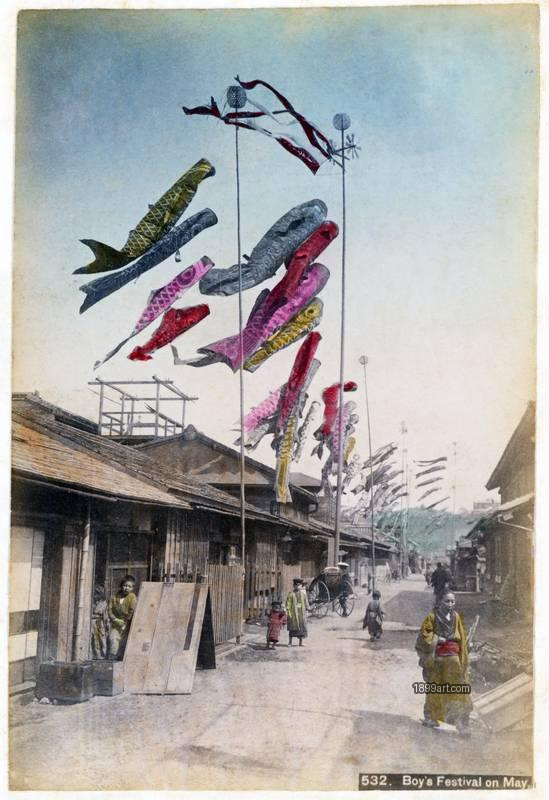
From the 1899art Archive: This hand-colored albumen photograph shows a street scene in Yokohama during the Boys’ Festival (Tango no Sekku), celebrated in early May. Large carp-shaped windsocks (koinobori) are raised high above the wooden houses, symbolizing strength, perseverance, and wishes for the well-being of boys, while townspeople and children move through the street below.
The image is attributed to Kusakabe Kimbei and corresponds to the studio catalog number 532 – “BOYS’ FESTIVAL ON MAY, YOKOHAMA.” Produced in the late Meiji period (ca. 1890–1900), the photograph belongs to the tradition of Yokohama export photography, originally printed as an albumen photograph and later carefully hand-colored for the Western market.
Japan · c. 1895–1910 · Hand-colored photograph
1899art Cherry Blossom Season with Geisha in Ueno Park, TokyoHandcolored 1900s 1899art
From the 1899art Archive: This hand-colored albumen photograph shows a spring scene in Ueno Park, where cherry trees (sakura) in full bloom line a wide avenue. Beneath the blossoms, visitors stroll along the path, including elegantly dressed geisha, whose colorful kimono and parasols stand out against the pale pink canopy of flowers, creating a carefully balanced composition of nature and urban life.
The image is attributed to Kusakabe Kimbei and corresponds to the studio catalog number 677 – “Ueno Park, Tokio.” Produced in the late Meiji period (ca. 1890–1900), the photograph belongs to the tradition of Yokohama export photography, originally printed as an albumen photograph and later hand-colored for the Western market.
Japan · c. 1895–1910 · Hand-colored photograph
1899art Sacred Sika Deer at Nara Park Handcolored 1900s 1899art
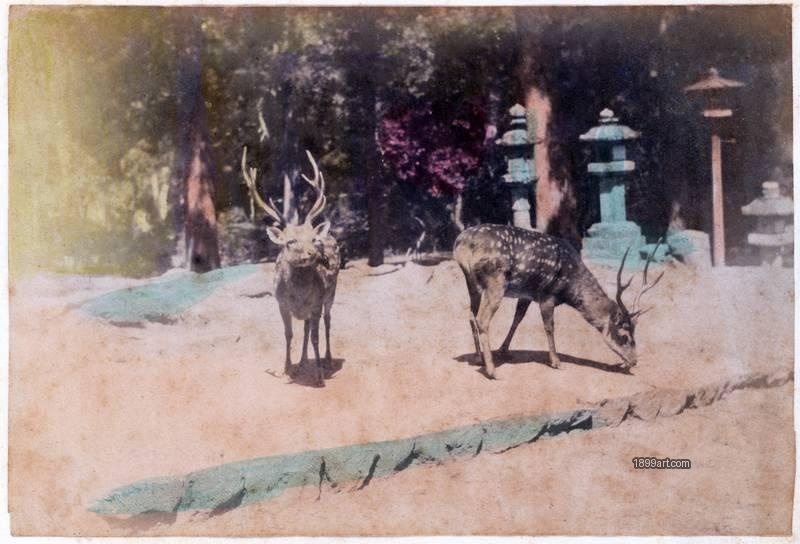
From the 1899art Archive: This hand-colored albumen photograph shows sika deer roaming freely within Nara Park, set against a backdrop of shrine lanterns and forested grounds. The calm presence of the animals, one grazing and one standing alert, reflects the close coexistence of wildlife, ritual space, and daily life that has long characterized this sacred landscape.
The image is attributed to Kusakabe Kimbei and dates to the late Meiji period (ca. 1890–1900). In Nara, deer were traditionally regarded as sacred messengers of the gods, particularly in connection with the nearby Kasuga Taisha. The photograph belongs to the tradition of Yokohama export photography, originally produced as an albumen print and later hand-colored for the Western market.
Japan · c. 1895–1910 · Hand-colored photograph
1899art Rice Field Workers during Planting Season, Japan Handcolored 1900s 1899art
From the 1899art Archive: This hand-colored albumen photograph depicts a group of rural workers standing barefoot in a flooded rice field during the planting season. Wearing straw hats and simple work garments, they hold traditional tools while moving carefully through the shallow water, their reflections faintly visible on the surface. The scene conveys the collective rhythm and physical precision required for wet-rice cultivation, a foundation of everyday life in pre-industrial Japan.
The image is attributed to Kusakabe Kimbei and dates to the late Meiji period (ca. 1890–1900). It belongs to the tradition of Yokohama export photography, in which scenes of agricultural labor were staged or carefully observed, printed as albumen photographs, and later hand-colored for a Western audience interested in rural Japanese life.
Japan · c. 1895–1910 · Hand-colored photograph
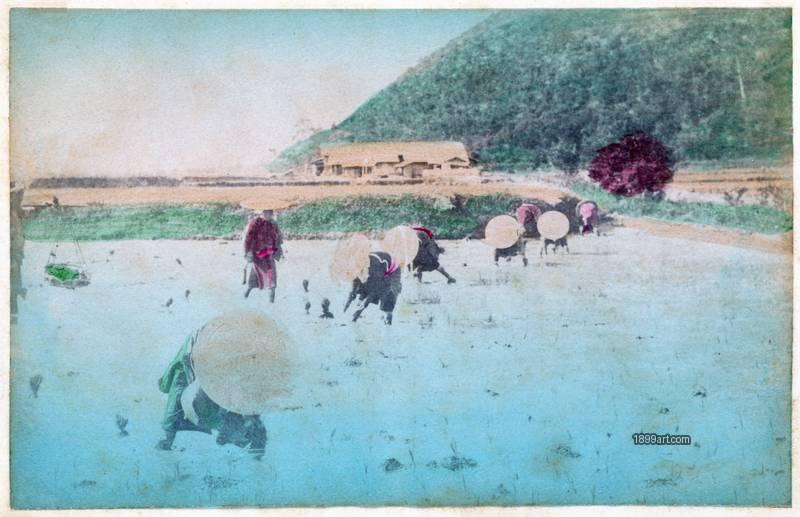
1899art Rice Planting in a Rural Landscape, Japan Handcolored 1900s 1899art
From the 1899art Archive: This hand-colored albumen photograph presents a wide view of rice planting in a flooded field, with workers bent low as they move methodically through the shallow water. Broad straw hats dominate the composition, while a low farmhouse and wooded hillside form a calm backdrop, emphasizing the close relationship between agriculture, settlement, and landscape in rural Japan.
The image is attributed to Kusakabe Kimbei and dates to the late Meiji period (ca. 1890–1900). It belongs to the tradition of Yokohama export photography, in which scenes of everyday rural labor were captured as albumen prints and later hand-colored to present an idealized yet detailed view of traditional Japanese life for an international audience.
Japan · c. 1895–1910 · Hand-colored photograph
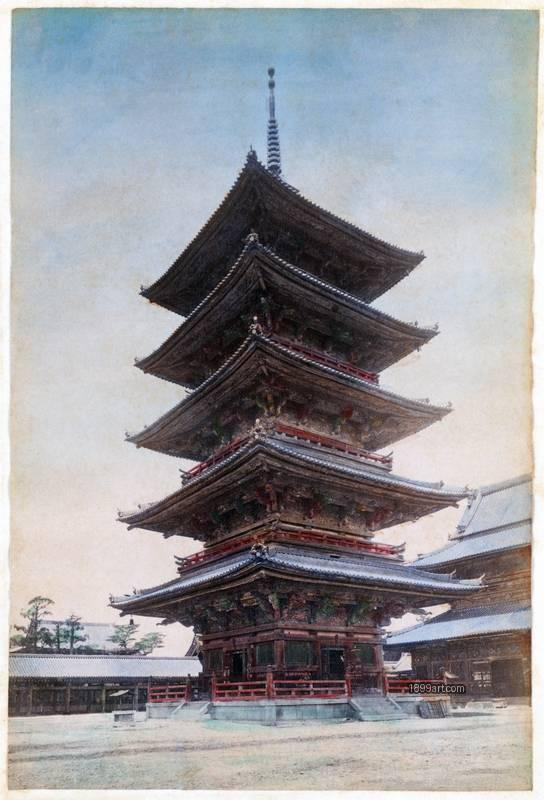
1899art Five-Story Pagoda of Kōfuku-ji, Nara Handcolored 1900s 1899art
From the 1899art Archive: This hand-colored albumen photograph depicts the imposing five-story pagoda of Kōfuku-ji in Nara. Rising in balanced tiers with deep overhanging eaves, the pagoda dominates the temple grounds, its richly detailed wooden structure emphasizing vertical rhythm, symmetry, and the refined craftsmanship of traditional Japanese Buddhist architecture.
The image is attributed to Kusakabe Kimbei and dates to the late Meiji period (ca. 1890–1900). It belongs to the tradition of Yokohama export photography, originally produced as an albumen print and later hand-colored to convey the architectural monumentality and spiritual significance of Japan’s historic temples to a Western audience.
Japan · c. 1895–1910 · Hand-colored photograph
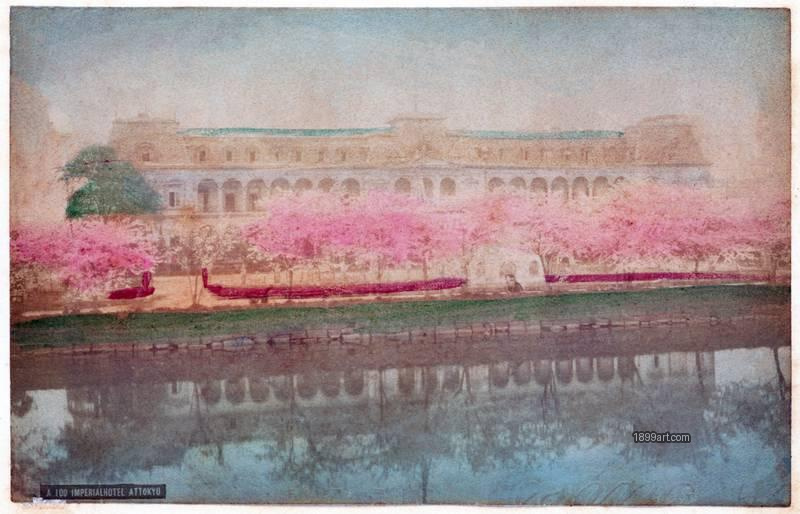
1899art Imperial Hotel in Tokyo during Cherry Blossom Season Handcolored 1900s 1899art
From the 1899art Archive: This hand-colored albumen photograph presents a wide view of the Imperial Hotel in Tokyo, seen across a calm body of water reflecting the building’s long façade. Rows of cherry trees in full bloom line the foreground, their pink blossoms forming a soft horizontal band that contrasts with the restrained symmetry and pale stone architecture of the hotel behind.
The image is attributed to Kusakabe Kimbei and corresponds to the studio catalog number A100 – “IMPERIAL HOTEL AT TOKIO.” Produced in the late Meiji period (ca. 1890–1900), the photograph belongs to the tradition of Yokohama export photography, originally printed as an albumen photograph and later hand-colored to emphasize both modern urban architecture and the seasonal beauty of Japan for a Western audience.
Japan · c. 1895–1910 · Hand-colored photograph
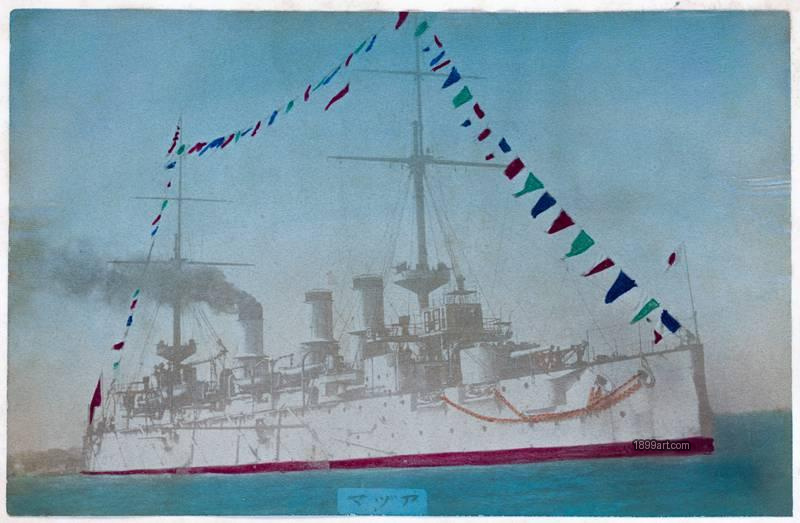
1899art Armored Cruiser Azuma of the Imperial Japanese Navy Handcolored 1900s 1899art
From the 1899art Archive: This hand-colored albumen photograph depicts the armored cruiser Azuma dressed with signal flags, seen at sea in a formal or ceremonial setting. The ship’s silhouette—heavy guns, twin funnels, and tall masts—reflects the rapid naval modernization of Japan at the turn of the 20th century, when Western shipbuilding technology was combined with emerging imperial ambition.
Azuma was built in France in the late 1890s for the Imperial Japanese Navy and later took part in major naval engagements during the Russo-Japanese War (1904–1905). In the following years it served primarily as a training vessel for long-distance voyages. The photograph belongs to the tradition of Yokohama export photography, produced as an albumen print and later hand-colored to present Japan’s modern naval power to an international audience.
Japan · c. 1895–1910 · Hand-colored photograph
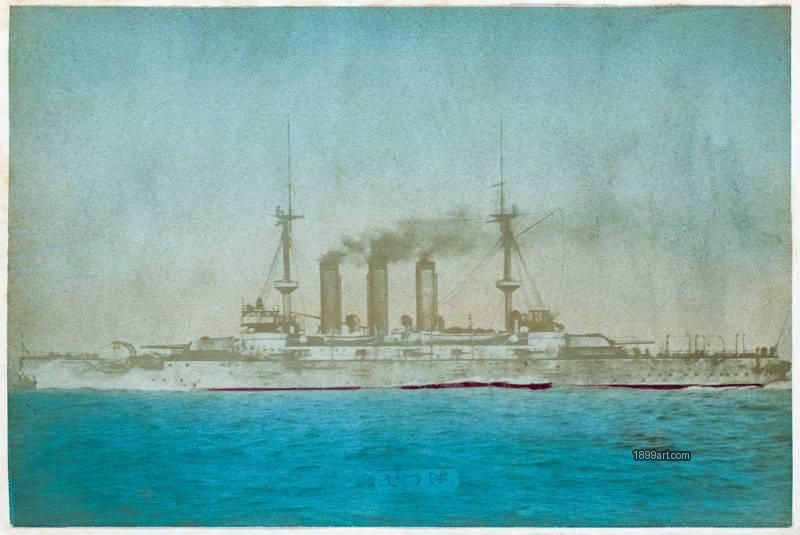
1899art Battleship Hatsuse of the Imperial Japanese Navy Handcolored 1900s Enami 1899art
From the 1899art Archive: This hand-colored albumen photograph depicts the Japanese battleship Hatsuse underway at sea, its long, low hull and prominent funnels emitting dark smoke against a pale sky. The powerful silhouette reflects the rapid modernization of Japan’s navy at the turn of the 20th century, when large steel battleships became symbols of national strength and technological progress.
Hatsuse was the third of four battleships of the Shikishima class, built in England by Armstrong, Whitworth & Co. and launched in 1899 for the Imperial Japanese Navy. During the Russo-Japanese War, the ship was lost in 1904 after striking naval mines, marking one of the earliest major losses of a modern Japanese battleship. The photograph belongs to the tradition of Yokohama export photography, produced as an albumen print and later hand-colored for an international audience interested in Japan’s emerging naval power.
Japan · c. 1895–1910 · Hand-colored photograph
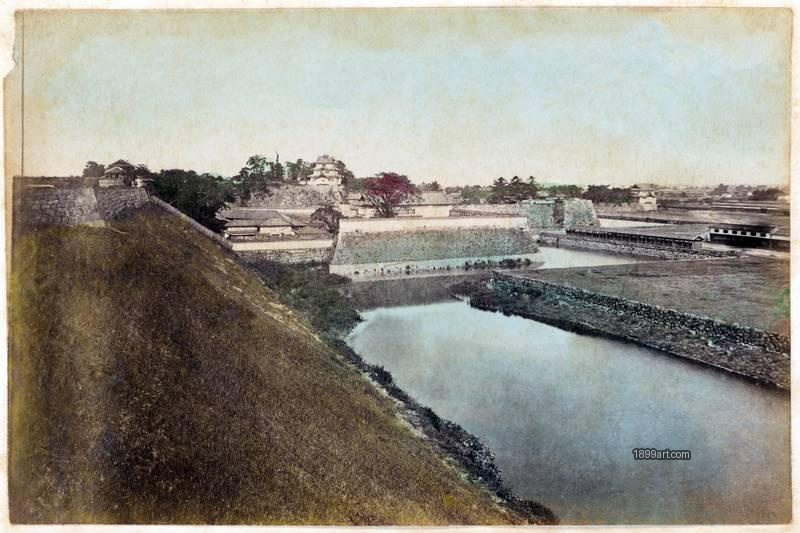
1899art Moats and Stone Walls of Edo Castle, Tokyo, Japan Handcolored 1900s 1899art
From the 1899art Archive: This hand-colored albumen photograph presents a broad view of the massive stone ramparts and water-filled moats of Edo Castle in Tokyo. The layered defenses—sloping earthen embankments, carefully fitted stone walls, and wide moats—define the monumental scale of the former shogunal stronghold, with low buildings and bridges receding into the distance.
The image is attributed to Kusakabe Kimbei and dates to the late Meiji period (ca. 1890–1900). Edo Castle served as the seat of the Tokugawa shoguns for over two and a half centuries; following the Meiji Restoration, the site became the Imperial Palace. The photograph belongs to the tradition of Yokohama export photography, originally printed as an albumen photograph and later hand-colored to convey Japan’s historical and political landscape to a Western audience.
Japan · c. 1895–1910 · Hand-colored photograph
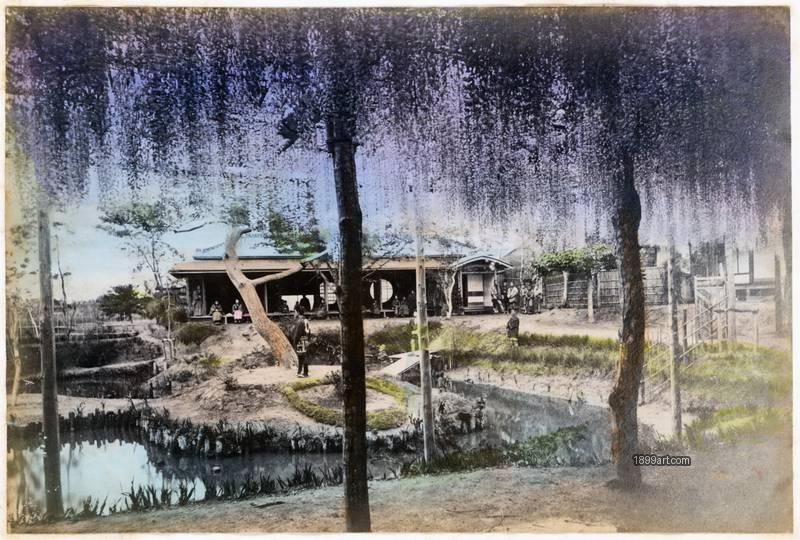
1899art Wisteria Blossoms at Kameido Tenjin Shrine, Tokyo, Japan Handcolored 1900s 1899art
From the 1899art Archive: This hand-colored albumen photograph depicts the serene grounds of Kameido Tenjin Shrine in Tokyo, celebrated for its cascading wisteria (fuji) blossoms. Hanging clusters of flowers form a soft canopy above a garden pond, bridges, and pavilions, while visitors move quietly through the carefully composed landscape, emphasizing the seasonal beauty and contemplative atmosphere of the shrine.
The image is attributed to Kusakabe Kimbei and dates to the late Meiji period (ca. 1890–1900). The shrine is dedicated to Sugawara no Michizane, revered as the deity of learning, and was designed in 1662 after the Dazaifu Tenmangū. Its distinctive garden scenery—frequently depicted in ukiyo-e prints by artists such as Utagawa Hiroshige—made Kameido Tenjin one of Edo’s most famous seasonal viewing sites, a reputation reflected in this Yokohama export photograph.
Japan · c. 1895–1910 · Hand-colored photograph
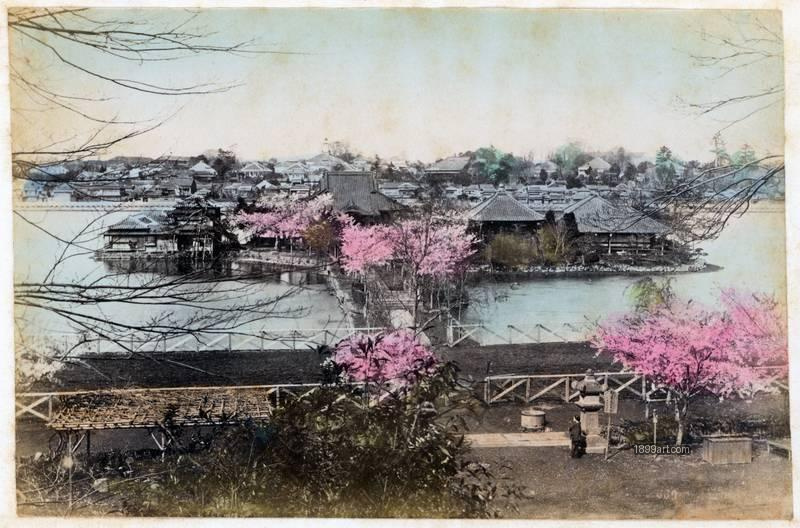
1899art Shinobazu Pond with Cherry Blossoms, Ueno Park, Tokyo, Japan Handcolored 1900s Enami 1899art
From the 1899art Archive: This hand-colored albumen photograph presents a wide view of Shinobazu Pond in Ueno Park, framed by cherry trees in bloom. Pavilions and traditional buildings line the water’s edge, while bridges and walkways connect the shoreline to the central area of the pond, creating a layered composition that balances architecture, water, and seasonal nature.
The image is attributed to Kusakabe Kimbei and corresponds to the studio catalog number 669 – “SHINOBAZU (POND) UYENO, TOKIO.” Produced in the late Meiji period (ca. 1890–1900), the photograph belongs to the tradition of Yokohama export photography and was originally printed as an albumen photograph before being carefully hand-colored to emphasize the scenic and recreational character of one of Tokyo’s most celebrated landscapes.
Japan · c. 1895–1910 · Hand-colored photograph
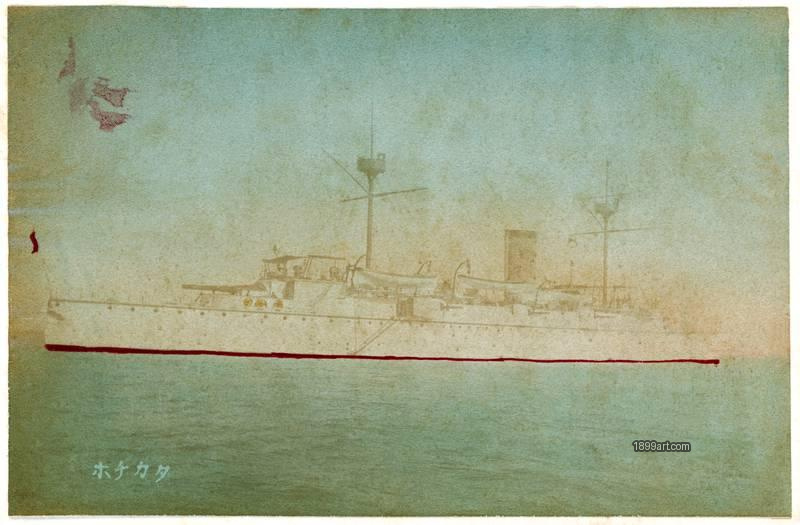
1899art Protected Cruiser of the Naniwa Class, Imperial Japanese Navy Handcolored 1900s 1899art
From the 1899art Archive: This hand-colored albumen photograph depicts a protected cruiser of the Naniwa class underway at sea, shown in a clear side profile that emphasizes the long hull, single funnel, and tall masts typical of late-19th-century naval design. A thin red boot-top line accentuates the waterline, while the pale coloration softens the vessel’s mechanical mass, presenting a balanced image of speed, power, and control.
The Naniwa-class cruisers were designed by George Rendel and built in Britain during the 1880s for the Imperial Japanese Navy. Based on the influential Esmeralda design, these ships played an important role in Japan’s early naval modernization and remained in service from 1886 until the early 20th century. The photograph belongs to the tradition of Yokohama export photography, produced as an albumen print and later hand-colored to present Japan’s emerging naval strength to an international audience.
Japan · c. 1895–1910 · Hand-colored photograph
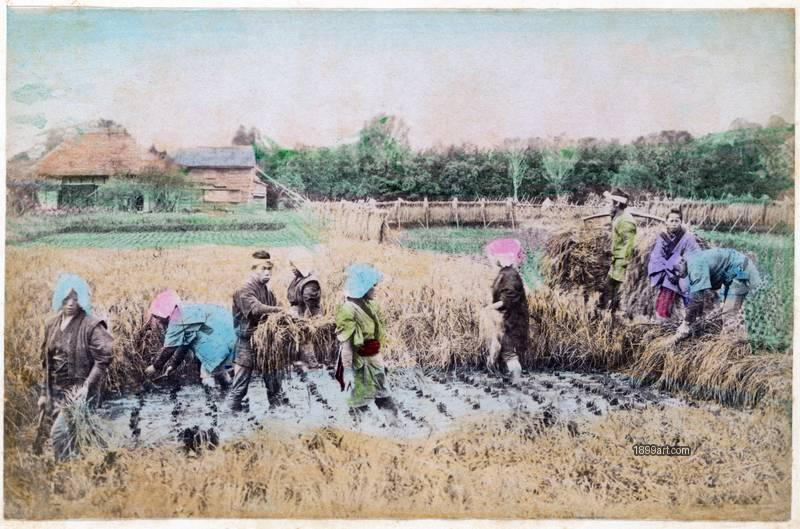
1899art Peasants Harvesting Rice in Rural Japan Handcolored 1900s 1899art
From the 1899art Archive: This hand-colored albumen photograph depicts rural laborers harvesting rice in a flooded field, working collectively as they cut, bundle, and carry the ripe stalks. Men and women move carefully through the mud, dressed in practical garments and head coverings, while thatched farm buildings and cultivated plots form a quiet rural backdrop.
The image is attributed to Kusakabe Kimbei and corresponds to the studio catalog number E18 – “PEASANTS HARVESTING RICE.” Produced in the late Meiji period (ca. 1890–1900), the photograph belongs to the tradition of Yokohama export photography, in which scenes of agricultural life were documented as albumen prints and later hand-colored for Western audiences interested in Japan’s rural economy and everyday customs.
Japan · c. 1895–1910 · Hand-colored photograph
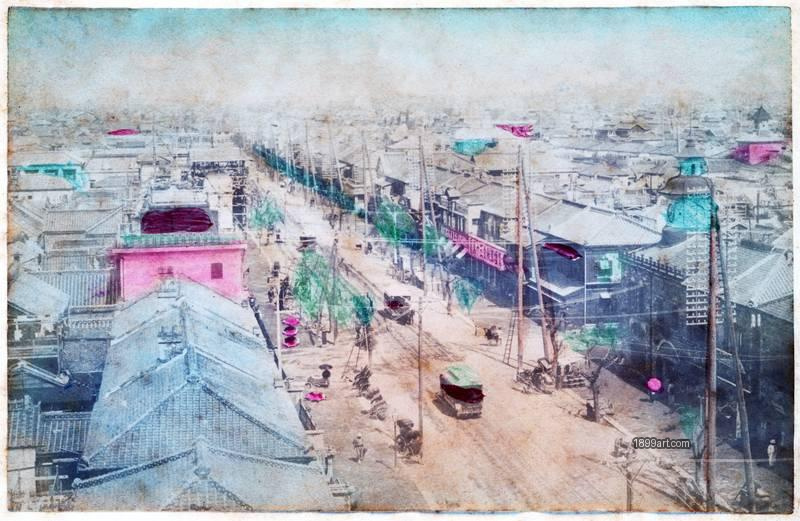
1899art Panoramic View of a Modernizing City Street, Japan Handcolored 1900s 1899art
From the 1899art Archive: This hand-colored albumen photograph presents an elevated panoramic view of a broad urban street lined with tiled rooftops, wooden buildings, and telegraph poles. Pedestrians, carts, and rickshaws animate the wide roadway, while the dense arrangement of houses and shops conveys the rapid transformation of Japanese cities at the turn of the 20th century.
The image is attributed to Kusakabe Kimbei and dates to the late Meiji period (ca. 1890–1900). Although no studio number is visible on this print, the photograph corresponds to a well-known Kimbei city panorama and is reproduced in the publication Japan 1900 (Japan 1900, TASCHEN), confirming its circulation and recognition within the canon of Meiji-era Yokohama photography.
Japan · c. 1895–1910 · Hand-colored photograph
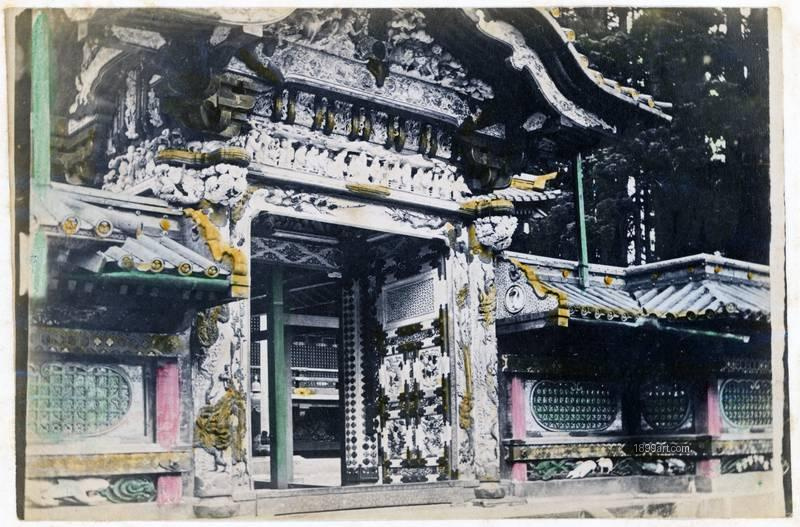
1899art Chinese-Style Gate (Karamon) at Nikkō Tōshō-gū Handcolored 1900s 1899art
From the 1899art Archive: This hand-colored albumen photograph shows the richly ornamented Chinese-style gate (Karamon) at Nikkō Tōshō-gū, distinguished by its elaborate carvings, gilded details, and layered roof structure. The dense decorative program—mythical creatures, floral motifs, and symbolic reliefs—reflects the highly refined craftsmanship and visual opulence characteristic of the shrine complex at Nikkō.
The image corresponds to the studio caption “1595. China Wood Gate, Nikko” and is attributed to Kusakabe Kimbei, dating to the late Meiji period (ca. 1890–1900). It belongs to the tradition of Yokohama export photography, originally produced as an albumen print and later hand-colored to emphasize architectural detail and surface richness for a Western audience fascinated by Japan’s monumental sacred architecture.
Japan · c. 1895–1910 · Hand-colored photograph
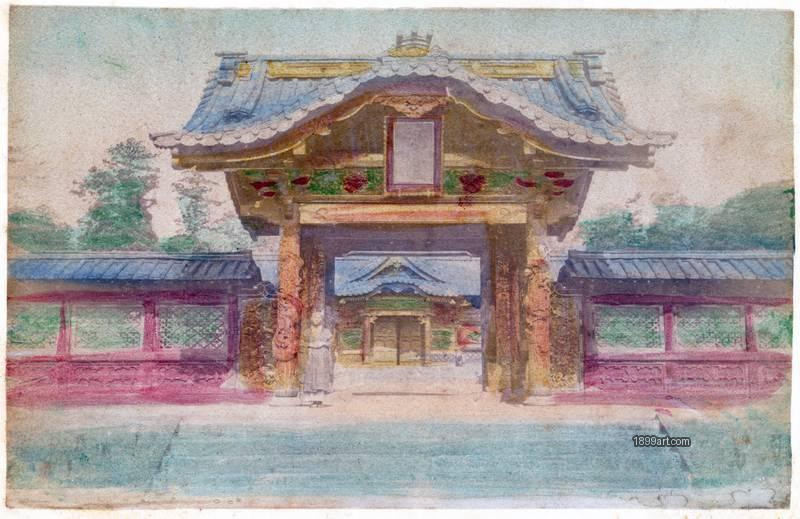
1899art Karamon Gate at the Tokugawa Mausoleum, Shiba, Tokyo, Japan Handcolored 1900s 3 1899art
From the 1899art Archive: This hand-colored albumen photograph depicts the richly ornamented Karamon (Chinese-style gate) at the Tokugawa mausoleum complex in Shiba Zōjō-ji, Tokyo. The strictly axial composition—stone steps leading through successive gates toward the inner sanctuary—emphasizes ceremonial order, symmetry, and the visual language of Tokugawa authority.
The image is attributed to Kusakabe Kimbei and corresponds to the studio catalog number No. 525 – “SHIBA AT TOKYO.” The existence of multiple prints with identical architecture but differing hand-coloring confirms standard Yokohama studio practice and does not indicate a change of location. Produced in the late Meiji period (ca. 1890–1900), the photograph belongs to the tradition of Yokohama export photography.
Japan · c. 1895–1910 · Hand-colored photograph
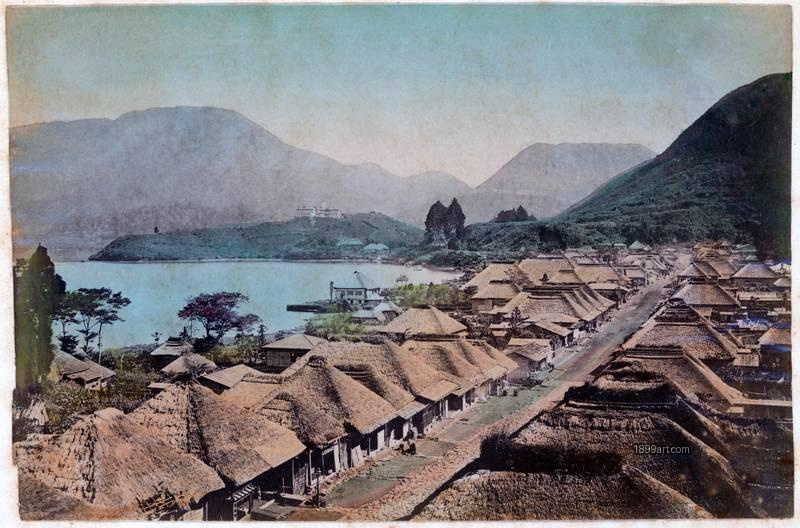
1899art Japan Hakone Village and Palace Handcolored 1900s 1899art
From the 1899art Archive: This hand-colored albumen photograph presents an elevated view of Hakone, showing rows of thatched-roof houses stretching along a straight road beside a calm body of water, with forested hills and distant mountains rising behind. The orderly village layout and prominent roofs convey the character of a post town on the historic Tōkaidō route, set within the dramatic landscape of the Hakone region.
The image is attributed to Kusakabe Kimbei and corresponds to the studio caption “1669. HAKONE VILLAGE & PALACE.” Produced in the late Meiji period (ca. 1890–1900), the photograph belongs to the tradition of Yokohama export photography and was originally printed as an albumen photograph before being hand-colored to emphasize architectural rhythm, settlement structure, and the scenic harmony between village and landscape.
Japan · c. 1895–1910 · Hand-colored photograph
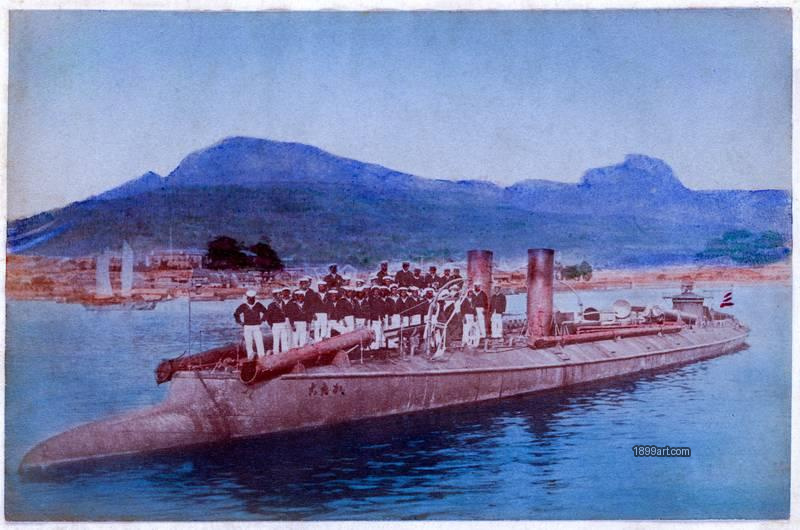
1899art Torpedo Boat Kotaka Anchored at Sasebo during the First Sino-Japanese War Handcolored 1900s 1899art
From the 1899art Archive: This hand-colored albumen photograph shows the Japanese torpedo boat Kotaka (Tiger Falcon) anchored at Sasebo, with its crew assembled on deck. The vessel’s low-profile hull, twin funnels, and forward torpedo apparatus reflect a late-19th-century experimental naval design focused on speed and agility rather than armor, while the mountainous coastline situates the scene within one of Japan’s principal naval bases.
Kotaka was designed in Japan in 1885 and built by Yarrow & Co. in Scotland, before being shipped in sections and completed in Japan in 1887 for the Imperial Japanese Navy. The photograph dates to the period of the First Sino-Japanese War, a conflict fought between Japan and Qing China that marked Japan’s emergence as a modern naval power. During this war, Sasebo functioned as a key operational harbor, and Kotaka is widely regarded as a forerunner of the later torpedo boat destroyer.
Japan · c. 1895–1910 · Hand-colored photograph
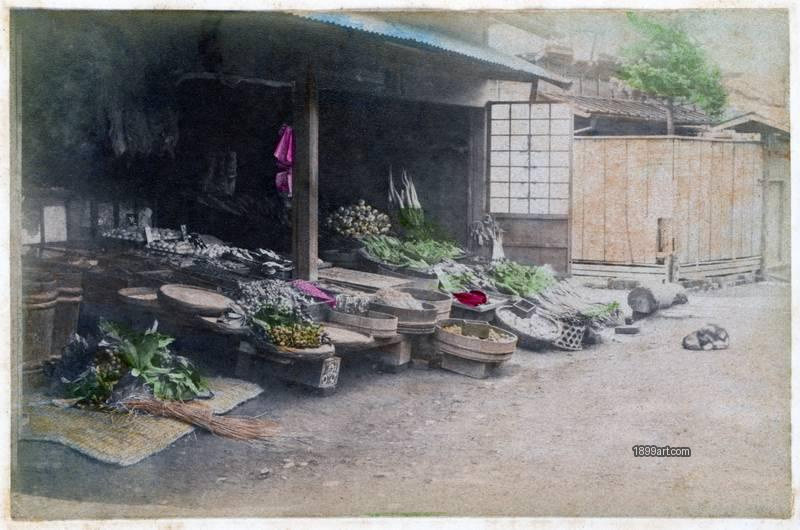
1899art Vegetable Stall on a Village Street, Japan Handcolored 1900s 1899art
From the 1899art Archive: This hand-colored albumen photograph depicts a small vegetable stall set along a quiet village street, with baskets, trays, and shallow tubs arranged directly on the ground. Fresh produce—leafy greens, roots, and bundled vegetables—is laid out in an informal yet orderly manner beneath a simple wooden roof, while household structures and sliding doors frame the background, conveying the everyday rhythm of local commerce.
The image is attributed to Kusakabe Kimbei and dates to the late Meiji period (ca. 1890–1900). It belongs to the tradition of Yokohama export photography, in which scenes of ordinary life were carefully composed and later hand-colored to present the textures of rural and small-town Japan to a Western audience interested in daily customs rather than monumental sites.
Japan · c. 1895–1910 · Hand-colored photograph
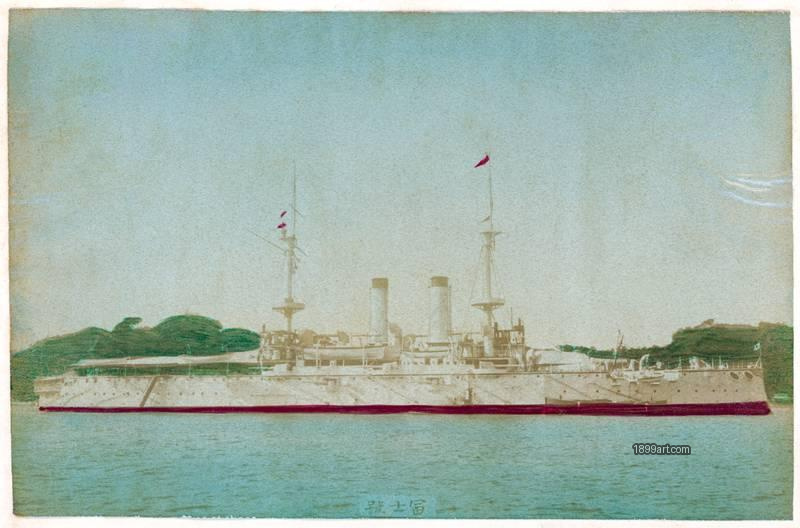
1899art Battleship Fuji of the Imperial Japanese Navy Handcolored 1900s 1899art
From the 1899art Archive: This hand-colored albumen photograph depicts the Japanese battleship Fuji underway at sea, shown in a clear side profile that emphasizes its long armored hull, twin funnels, and tall military masts. The thin red boot-top line along the waterline and the calm coastal backdrop highlight the ship’s imposing yet balanced silhouette, characteristic of late 19th-century pre-dreadnought design.
Fuji was the lead ship of the Fuji class and the first battleship of the Imperial Japanese Navy, built in Great Britain due to Japan’s limited industrial capacity at the time. Commissioned in the late 1890s, it played a significant role in the Russo-Japanese War, including major engagements such as Port Arthur and Tsushima. After the war, Fuji was reclassified as a coastal defense and training ship, later converted into a hulk, marking the transition from early battleship experimentation to a new era of naval warfare.
Japan · c. 1895–1910 · Hand-colored photograph
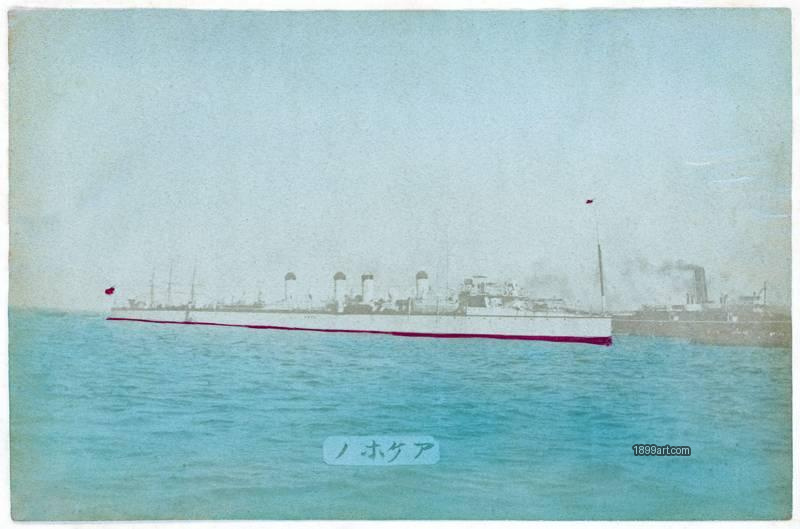
1899art Ikazuchi-Class Destroyer (Meiji Period, c. 1900) Handcolored 1899art
From the 1899art Archive: This hand-colored albumen photograph depicts a Japanese destroyer of the Ikazuchi class (雷型駆逐艦), shown in a clear side profile at sea. The vessel’s silhouette is defined by its four evenly spaced funnels, low freeboard, elongated hull, and characteristic bow details, all of which correspond precisely to the destroyers built by Yarrow in Great Britain for the Imperial Japanese Navy at the turn of the 20th century. The thin red boot-top line and restrained coloring are typical of Yokohama export photography of the Meiji era.
The photograph is attributed to Kusakabe Kimbei and dates to approximately 1899–1905. While the ship’s exact identity cannot be confirmed with certainty, its proportions and construction clearly place it within the Ikazuchi class, which included vessels such as Inazuma (電) and its sister ships. The original album caption reads ホクア (Hokua), suggesting either a contemporaneous alternative designation or a sister ship rather than a later Western or post-Meiji destroyer. The image documents Japan’s rapid naval modernization during the Meiji period and the emergence of the modern destroyer type.
Japan · c. 1895–1910 · Hand-colored photograph
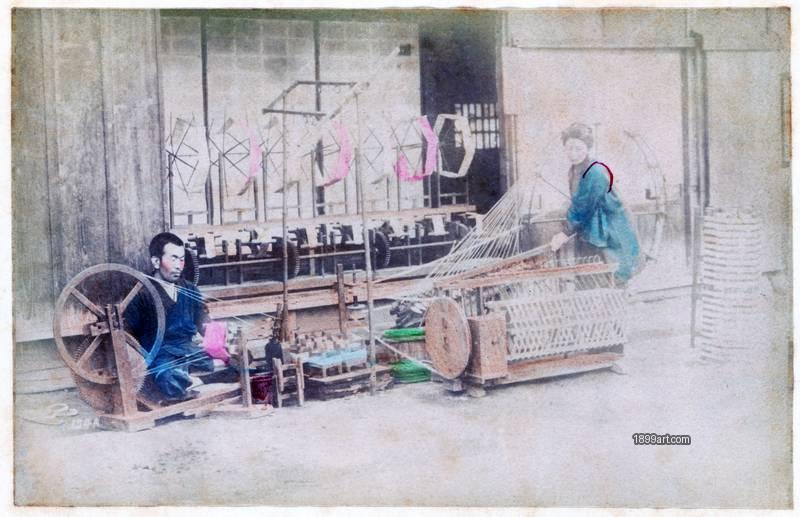
1899art Silk Spinning Workshop, Japan (Early Meiji Period) 1899art
From the 1899art Archive: This photograph depicts a silk spinning workshop in Japan during the early Meiji period, showing two workers operating traditional spinning and winding machinery. Multiple reels and spindles are visible in the background, illustrating the mechanized stages of silk production that became increasingly important to Japan’s export economy in the late 19th century. The scene is presented with a clear documentary focus, emphasizing tools, workflow, and the physical arrangement of the workspace.
The image corresponds to the early catalogued photograph “C.8. Spining Silk” and is attributed to Kusakabe Kimbei, dating to approximately 1878–1885. It represents Kimbei’s early, largely uncolored documentary work, created before his later, more elaborately hand-colored Yokohama photographs. The existence of both uncolored and hand-colored versions of this motif reflects Kimbei’s practice of reissuing successful early studies for the international market.
Japan · c. 1895–1910 · Hand-colored photograph
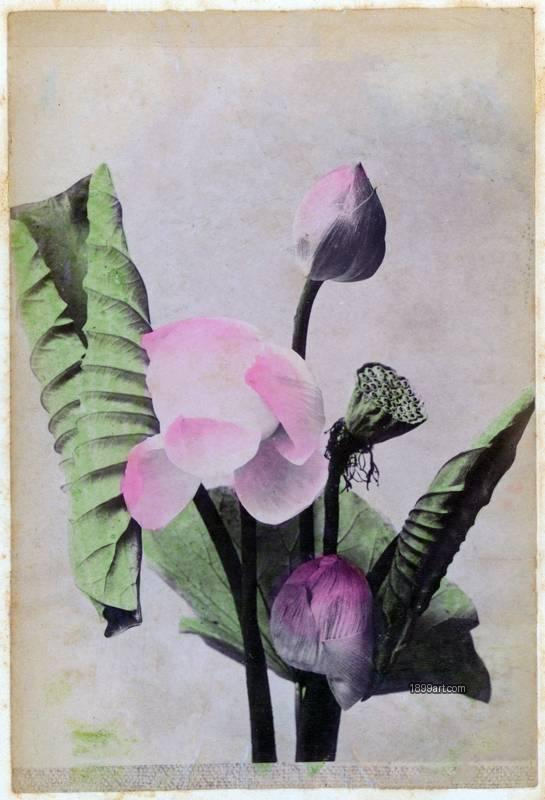
1899art Lotus Flower, Meiji Period Final image from a Kusakabe Kimbei album 1899art
From the 1899art Archive: This hand-colored albumen photograph depicts a lotus flower in several stages of growth, including a fully opened blossom, unopened buds, and a seed pod.
The image appears as the final plate in a Kusakabe Kimbei album, suggesting a deliberate curatorial choice rather than a purely documentary function. The lotus, a symbol of purity and completion in East Asian visual culture, is frequently used as a closing motif in Meiji-period albums.
Although stylistically comparable to contemporary botanical studies, no identical print or series has been identified, and the photographer cannot be securely attributed. The image should therefore be regarded as part of a Kimbei-curated album context, with authorship remaining uncertain.
Japan · c. 1895–1910 · Hand-colored photograph
1899art Ox Carts on a Mountain Road Japan, Meiji period (late 19th century) Handcolored 1899art
From the 1899art Archive: This hand-colored albumen photograph shows ox-drawn carts on a rural mountain road, accompanied by figures in traditional working dress. The scene reflects everyday transport practices in late 19th-century Japan, where animal power remained essential in agricultural and regional logistics.
Several visually related versions of this motif are known today, produced by different studios during the Meiji period. However, no original title, negative number, or studio attribution has been conclusively identified for this specific image.
The photograph is preserved as part of this Kusakabe Kimbei album, where it appears without caption or numbering. Its inclusion should therefore be understood as album-curated rather than author-attributed, and the photographer remains unknown.
Japan · c. 1895–1910 · Hand-colored photograph
1899art Mount Fujiyama seen from Yoshiwara on the Tōkaidō Road, Japan 1899art
From the 1899art Archive: This hand-colored albumen photograph depicts Mount Fujiyama seen from Yoshiwara along the historic Tōkaidō road, reflected in a quiet marshland foreground. The scene is characterized by still water, reeds, and sparse vegetation, creating a soft mirror-like reflection of the mountain and reinforcing the calm, contemplative mood typical of late Meiji landscape imagery.
The printed caption “FUJIJAMA FROM YOSHIWARA, TOKAIDO” appears directly on the mount, a format characteristic of Kusakabe Kimbei’s Yokohama studio output. To the side of the caption, space was traditionally reserved for a negative or catalogue number; in this example, the number is no longer legible, likely due to fading, trimming, or mount wear. Such loss is common among album-assembled prints and does not affect attribution.
Japan · c. 1895–1910 · Hand-colored photograph
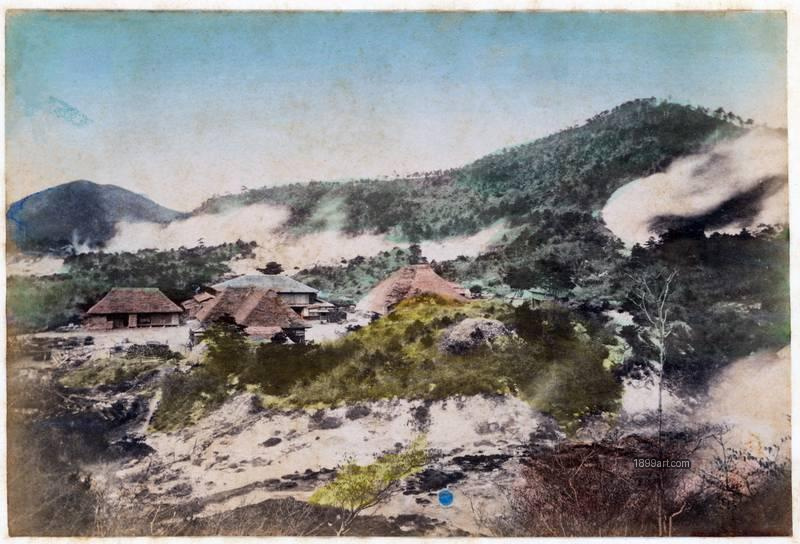
1899art Unzen hot springs at Kojukō, Shimabara Peninsula, Japan 1899art
From the 1899art Archive: This hand-colored albumen photograph depicts the geothermal landscape of the Unzen hot springs at Kojukō on the Shimabara Peninsula, Kyushu. Nestled among forested hills, traditional thatched buildings cluster around areas of visible steam, emphasizing the volcanic activity that has defined the region for centuries.
Unzen was one of Japan’s most renowned hot spring areas during the Meiji period, known both for therapeutic bathing and for its dramatic natural scenery. The rising steam, scattered dwellings, and layered mountain backdrop convey a transitional moment in Japanese landscape photography, where documentary realism merges with carefully applied hand-coloring to enhance atmosphere rather than strict accuracy.
Japan · c. 1895–1910 · Hand-colored photograph
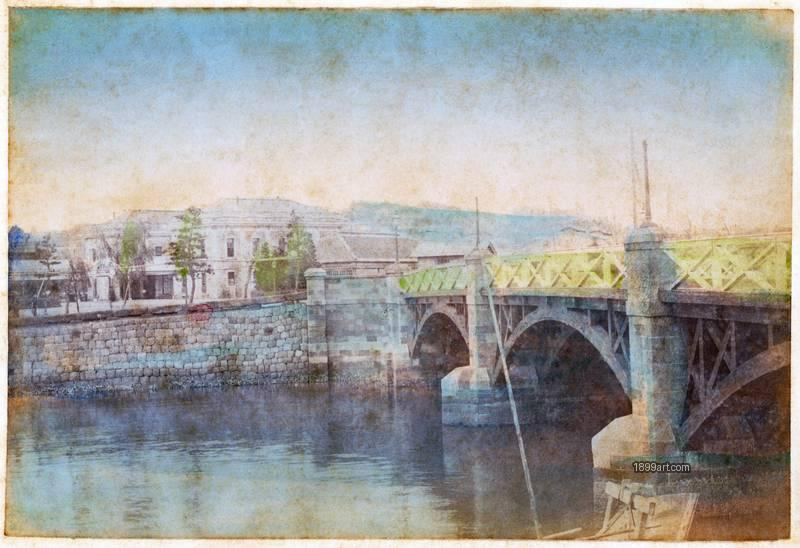
1899art Bentenbashi Bridge and early railway station at Yokohama, Japan 1899art
From the 1899art Archive: This hand-colored albumen photograph depicts Bentenbashi Bridge (Benten-bashi) spanning a canal in Yokohama, with the early Yokohama railway station visible in the background. The bridge, identifiable by its three arched spans and iron lattice structure, was constructed in 1871 under the authority of Japan’s Ministry of Public Works as part of the rapid modernization of the treaty port.
The scene reflects Yokohama’s transformation in the early Meiji period, when Western engineering, stone embankments, and rail infrastructure reshaped the urban landscape. The calm waterway, masonry quays, and hybrid architectural forms illustrate the coexistence of imported industrial design with local urban planning.
Japan · c. 1895–1910 · Hand-colored photograph
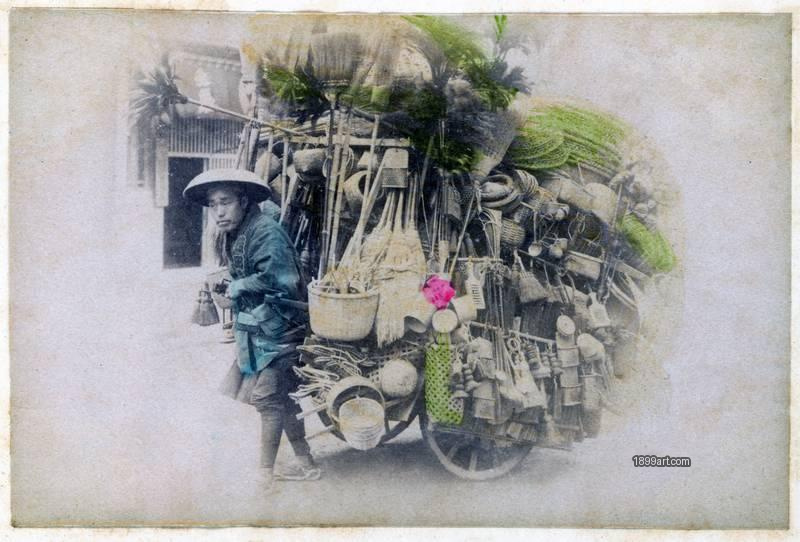
1899art Japan Street Vendor with Bicycle Handcolored 1900s 1899art
From the 1899art Archive: This hand-colored albumen photograph shows a Japanese street vendor pushing an exceptionally overloaded handcart filled with everyday goods such as baskets, brushes, ropes, household utensils, and agricultural tools. The sheer density of objects, carefully arranged and suspended from the cart, creates a striking visual inventory of late-19th-century material culture.
Such images were highly popular within the Yokohama school of photography and frequently included in souvenir albums produced for foreign visitors during the Meiji period. The selective hand-coloring—most notably the vivid accent on a single flower—enhances the pictorial impact while preserving the documentary character of the scene.
Japan · c. 1895–1910 · Hand-colored photograph
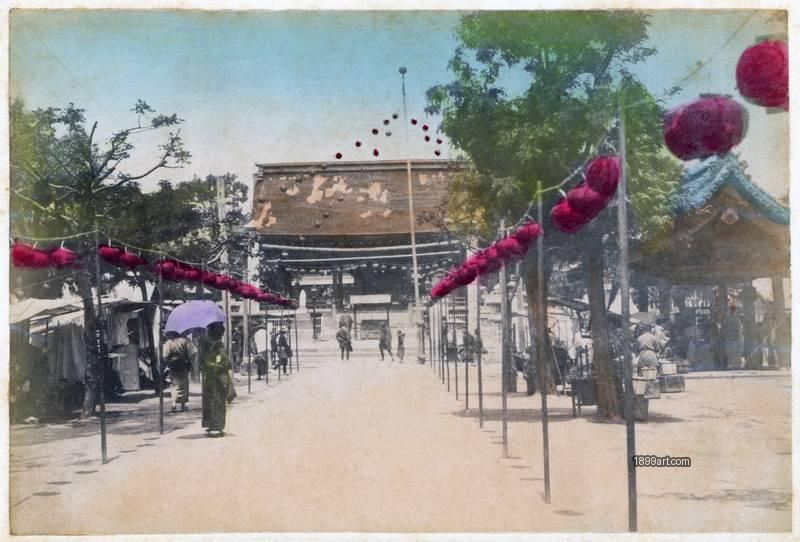
1899art Approach to Nankō Temple, Kobe, decorated with festival lanterns 1899art
From the 1899art Archive: This hand-colored albumen photograph depicts the ceremonial approach to Nankō Temple in Kobe, lined with temporary stalls and decorated with rows of suspended paper lanterns. The central axis leads the viewer toward the temple gate, while visitors, vendors, and passersby animate the broad avenue beneath the trees.
The selective hand-coloring—most notably the vivid red lanterns—emphasizes the festive character of the scene while preserving the documentary clarity typical of late 19th-century Yokohama-school photography. Such compositions were popular among foreign visitors, combining architectural views with everyday urban life during the early Meiji period.
The photograph corresponds to the view commonly titled “Nankō Temple of Kobe” and is known from institutional collections, including Syracuse University. Although no photographer’s imprint is visible on this print, its numbering style (A582) and pictorial treatment are consistent with commercially distributed Yokohama-school albums, including those associated with Kusakabe Kimbei.
Japan · c. 1895–1910 · Hand-colored photograph
1899art Outer moat and stone walls of Tokyo Castle (Edo Castle) 1899art
From the 1899art Archive:This hand-colored albumen photograph shows the outer moat and massive stone ramparts of Edo Castle, historically known as Tokyo Castle and today forming the core of the Imperial Palace grounds. The calm water of the moat reflects the sloping masonry walls and trees lining the embankment, while a small vermilion gate structure punctuates the otherwise subdued architectural palette.
The composition emphasizes horizontality and distance, creating a quiet, almost painterly atmosphere characteristic of late Meiji-period Yokohama-school landscape photography. Subtle hand-coloring—cool blues in the water and sky, muted greens in the foliage, and restrained red accents—enhances depth without overpowering the photographic base.
The visible caption “No. 141 B. Tokyo Castle” aligns with known Kusakabe Kimbei numbering conventions, supporting an attribution to his studio or immediate commercial circle.
Japan · c. 1895–1910 · Hand-colored photograph
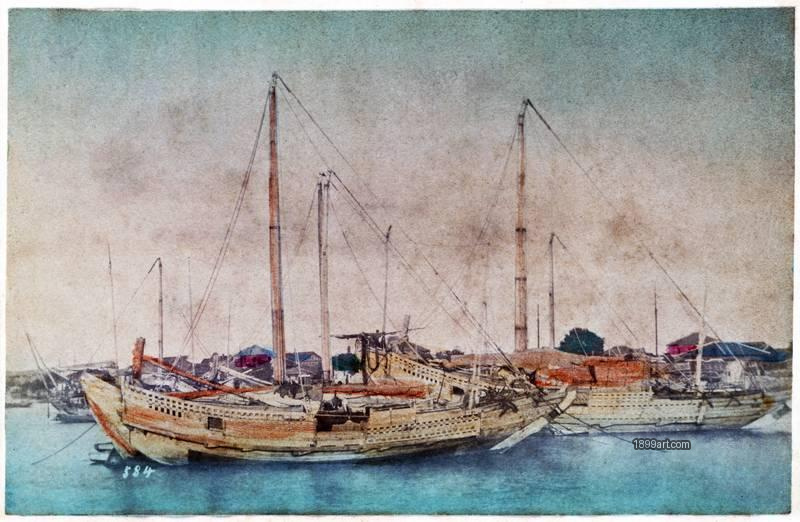
1899art No. 584 – traditional cargo boats anchored in a Japanese harbor 1899art
From the 1899art Archive: This hand-colored albumen print depicts a group of traditional Japanese wooden cargo boats moored side by side in a calm harbor, their tall masts and rigging forming a dense vertical pattern against the sky. The vessels are likely coastal trading boats used for regional transport of goods along Japan’s shoreline during the late 19th century. The careful hand coloring emphasizes the warm tones of the wooden hulls and the cool blue of the water, a hallmark of Yokohama School photography.
The number “584” is clearly scratched directly into the photographic surface at the lower left, rather than printed. This method of inscription is characteristic of studio cataloguing practices of the period and strongly suggests an original negative or early albumen print numbered within a commercial series. The absence of a printed caption, combined with the incised number and the style of coloration, is consistent with works distributed in Kusakabe Kimbei albums of the 1880s–1890s.
Japan · c. 1895–1910 · Hand-colored photograph
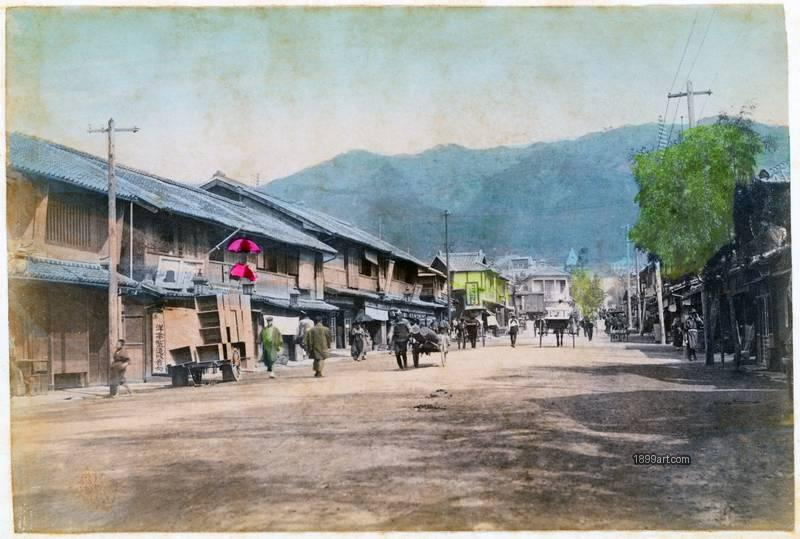
1899art Motomachi Street, Kobe, during the Meiji period Handcolored 1900s 1899art
From the 1899art Archive: This hand-colored albumen photograph depicts Motomachi Street in Kobe during the Meiji period (1868–1912). The scene captures the lively atmosphere of a traditional Japanese shopping street, with pedestrians moving along the wide, unpaved road, while carts and oxen indicate everyday commercial transport and local trade.
Hand coloring was commonly applied to photographs of this era to lend a sense of realism and visual warmth to otherwise monochrome prints. Here, subtle color accents animate clothing, shopfronts, and foliage, enhancing the documentary character of the image.
The photograph offers a valuable glimpse into urban life in late-19th-century Japan, reflecting both continuity with earlier townscapes and the gradual modernization that characterized the Meiji era, particularly in port cities such as Kobe.
Japan · c. 1895–1910 · Hand-colored photograph
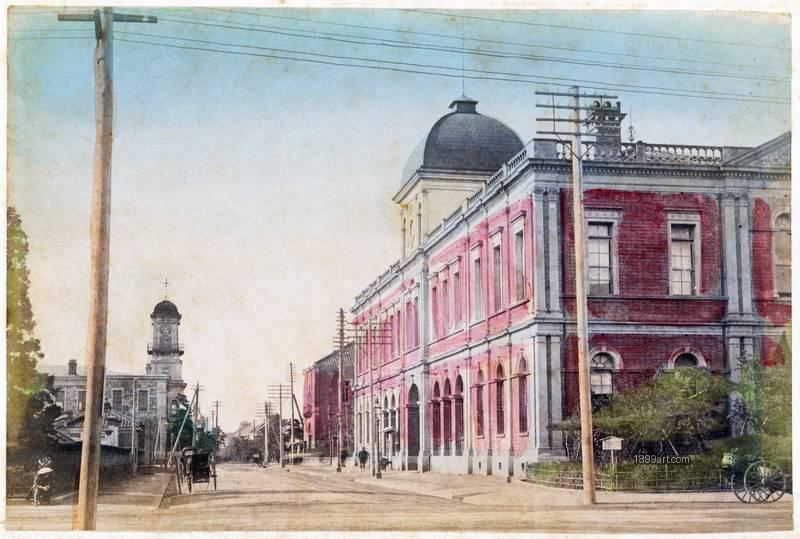
1899art Yokohama Post Office and early international postal services in Meiji Japan Handcolored 1900s 1899art
From the 1899art Archive: This hand-colored photograph depicts the former post office in Yokohama, a city that played a central role in the introduction of international postal services in Japan during the Meiji period (1868–1912). Following the opening of the port of Yokohama to foreign trade in 1859, the city quickly became a key hub for diplomatic, commercial, and communication networks connecting Japan with the outside world.
The Yokohama Post Office was established in 1875 as one of the first facilities in Japan dedicated to international mail exchange, marking an important milestone in the modernization of the country’s postal and communication infrastructure. Architecturally influenced by Western models, the building reflects the broader adoption of European-style public architecture in treaty ports during this period.
Japan · c. 1895–1910 · Hand-colored photograph
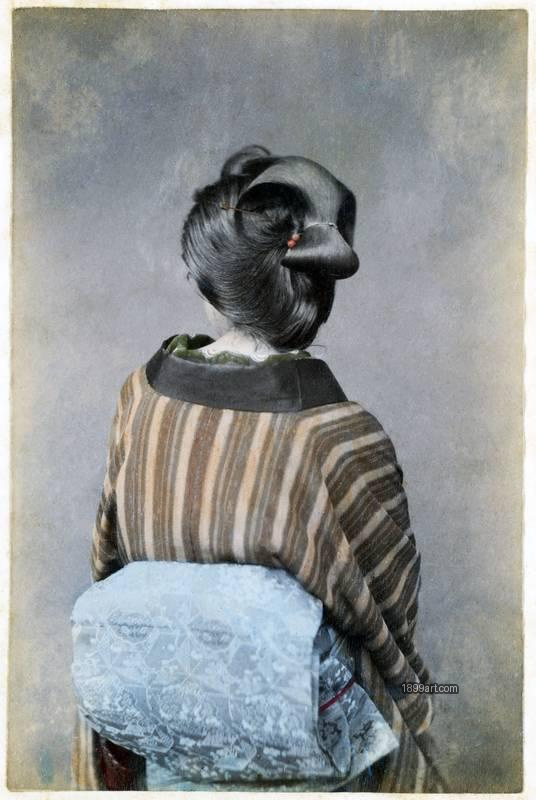
1899art Geisha Hairstyle (Shimada), Rear View, c. 1900, Meiji period Japan Handcolored 1899art
From the 1899art Archive:This hand-coloured albumen photograph shows the rear view of a fully trained geisha, with particular emphasis on her hairstyle. The hair is arranged in a restrained shimada-style coiffure (shimada-mage), a mature and formal hairstyle worn by adult women and, in professional contexts, by geisha rather than maiko.
The coiffure is compact and carefully balanced, with the hair drawn smoothly back and gathered into a controlled topknot. Notably absent are the youthful elements associated with maiko hairstyles, such as kanoko silk bindings, prominent kanzashi hair ornaments, or exaggerated lateral volume. Instead, the form is calm, symmetrical, and economical, reflecting discipline, experience, and social maturity.
The choice of a rear view is deliberate. By turning the figure away from the viewer, the photograph shifts attention from facial expression to craft and structure—the precision of the hairstyle, the quiet alignment of kimono collar and obi, and the overall composure of the figure. This visual restraint aligns with the geisha ideal of controlled elegance rather than overt display.
Such images were typical of Yokohama School studio photography, where different stages of female professional identity were carefully differentiated for the export market. In contrast to the more decorative and youthful presentation of maiko, this photograph presents the geisha as a figure of refinement and mastery, defined by form, balance, and understatement rather than ornament.
Japan · c. 1895–1910 · Hand-colored photograph
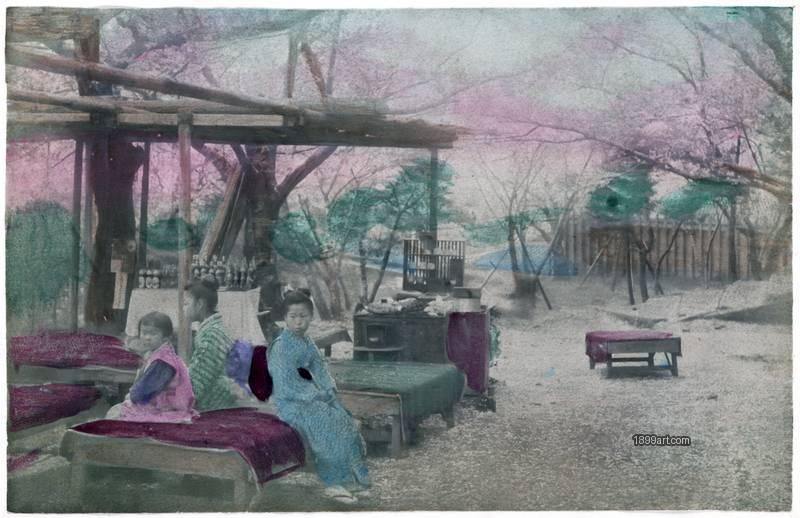
1899art Women and children resting beneath cherry blossoms, near Yokohama, circa 1900 Handcolored 1900s 1899art
From the 1899art Archive: This hand-colored albumen print depicts women and children resting on low wooden benches beneath flowering cherry trees, likely during the spring blossom season in the Yokohama area. The informal setting—simple wooden shelters, temporary seating, and open parkland—suggests a popular excursion site rather than a formal garden.
Based on visual characteristics and historical context, the scene is plausibly associated with the Nogeyama hillside near Yokohama, a well-known destination for cherry blossom viewing around the turn of the 20th century and a location frequently photographed by Yokohama School studios, including Kusakabe Kimbei. However, no definitive landmark is visible, and the exact location cannot be confirmed.
Japan · c. 1895–1910 · Hand-colored photograph
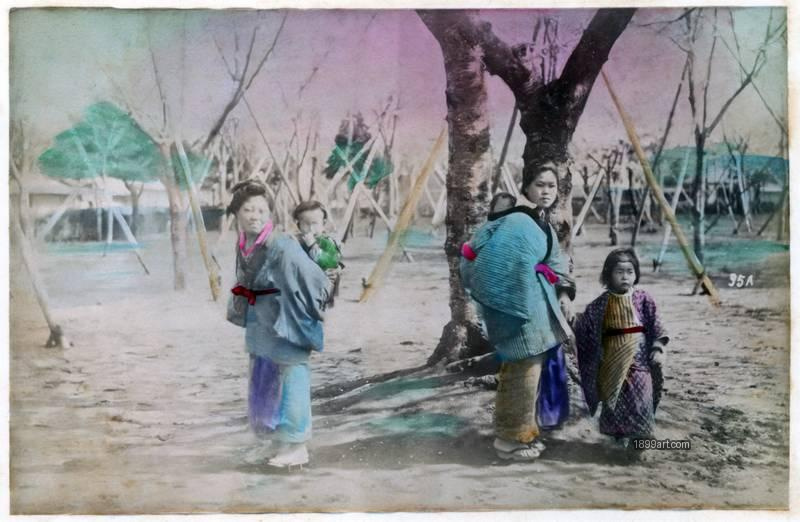
1899art JWomen with children in a park setting, Yokohama area (No. 95A), circa 1890–1900 Handcolored 1900s 1899art
From the 1899art Archive:This hand-colored albumen print shows three women and two children standing among young, supported trees in an open park-like landscape. One woman carries an infant on her back, while another stands beside a small child, suggesting an everyday family scene rather than a posed studio composition. The trees, reinforced with wooden supports, indicate a newly planted public space, likely photographed in early spring before full foliage.
The number “95 A”, scratched directly into the photographic surface, corresponds to a structured image numbering system characteristic of Yokohama School commercial photography. Such catalog numbers were commonly used by studios like Kusakabe Kimbei to organize and reproduce popular motifs for the tourist market.
Contact & Credits
Purpose of this site
YokohamaSchool.org is intended as a reference and context resource for the history and surviving works of the Yokohama School of hand-colored photography.
It does not claim to be complete and will be expanded over time.
Focus
Historical research, visual analysis, digital preservation and curated examples of original works from the period c. 1860–1920.
This website is currently in its early phase. Further sections on sources, studios and bibliography will follow.
YokohamaSchool.org is part of the wider 1899art project:
www.1899art.com.
Usage Rights & Legal Notice – 1899art Archive
All images published on 1899art.com originate from the 1899art Archive and are provided for cultural, educational, and historical reference purposes only.
Permitted use
Images may be linked, embedded, or shared on external websites and platforms exclusively in their original, unmanipulated form, provided that:
– the source is clearly credited as “1899art”, and
– a visible and clickable link to https://1899art.com accompanies the image.
Prohibited use
Any form of modification, including but not limited to cropping, retouching, recoloring, compositing, filtering, AI-based processing, or the creation of derivative works, is strictly prohibited without prior written permission.
Commercial use, resale, redistribution as standalone files, or inclusion in third-party archives or databases is also not permitted without explicit authorization.
Rights status
While the original photographs may be in the public domain due to age, the digital reproductions, curatorial selection, restoration decisions, metadata, and contextual presentation are the intellectual property of the 1899art Archive.
By using images from this website, you agree to respect these conditions. Automated downloading, scraping, or use of images for machine learning or AI training purposes is expressly prohibited.
EU / International Copyright Notice
All images published by the 1899art Archive are protected under European and international copyright law.
Any reproduction, redistribution, modification, AI-based processing, or commercial use beyond the explicitly permitted low-resolution web sharing is prohibited without prior written consent of the 1899art Archive.
This applies equally to high-resolution files obtained through unauthorized access, third-party leaks, or archival reproductions.
DMCA Copyright Notice & Protection
All images and digital files published by the 1899art Archive are protected by international copyright law and the Digital Millennium Copyright Act (DMCA).
Unauthorized reproduction, distribution, modification, AI processing, or commercial use of any image or high-resolution file from the 1899art Archive is strictly prohibited.
The unauthorized possession or dissemination of high-resolution files does not constitute a license and does not grant any rights of use.
Any infringement will result in DMCA takedown notices, platform removal requests, and, where applicable, legal action.