High-resolution original files are available from the 1899art Archive.
Original scans have a minimum resolution of 6,000 × 9,000 pixels.
Depending on the original source medium, original master scans of up to 15,000 × 20,000 pixels are available.
Only the low-resolution images displayed on the 1899art website may be linked, shared, or embedded on external websites, and only in their original, unmanipulated form, provided that clear attribution to “1899art” is given and a clearly visible link to https://1899art.com is included.
Any use, distribution, or publication of high-resolution files, whether obtained intentionally or inadvertently, is strictly prohibited.
Any modification, alteration, recomposition, recoloring, AI processing, or commercial reuse beyond simple linking and sharing is not permitted without prior written consent of the
1899art Archive.
YOKOHAMA SCHOOL BACK TO MAIN PAGE
Album 6 – 24 Motifs of the Yokohama School. All photographs are carefully reconstructed and described based on extensive research.
We strive for the highest possible accuracy in all attributions and contextual information.
If you believe any information is incorrect, please contact us and include your source.
Japan · c. 1895–1910 · Hand-colored photograph
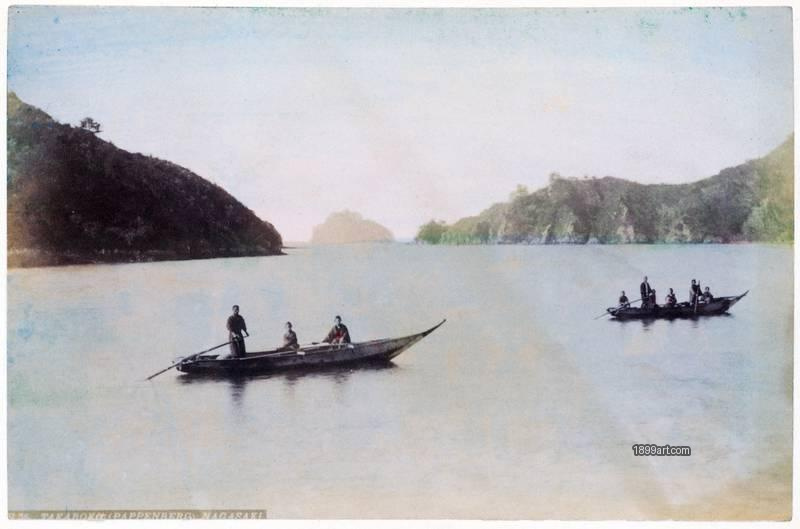
1899art Japan Takaboko (Pappenberg) in Nagasaki, Boats on Water Handcolored 1900s 1899art
From the 1899art Archive: A hand-colored view shows small boats on calm water at Takaboko (Pappenberg) in Nagasaki, Japan. Their dark hulls contrasting with the pale surface.
Japan · c. 1895–1910 · Hand-colored photograph
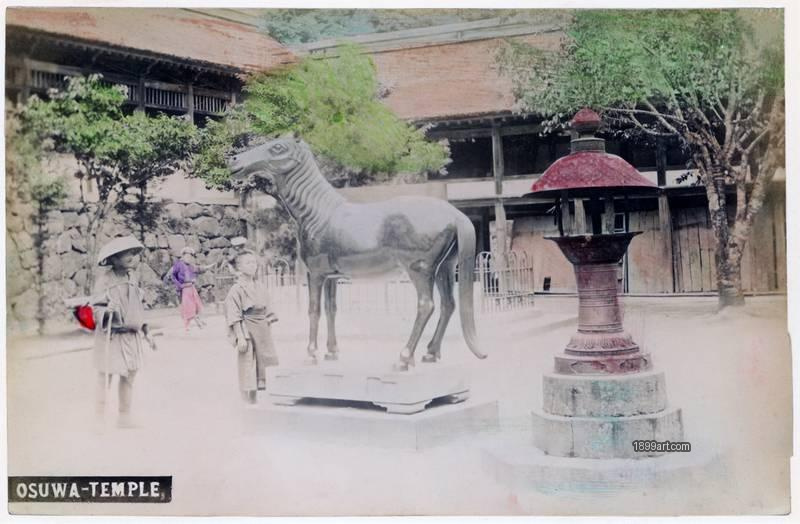
1899art Japan Bronze Horse Statue (Koma) at Osuwa-Temple in Nagasaki with Visitors Handcolored 1900s 1899art
From the 1899art Archive: Osuwa-Temple in Nagasaki, Japan. A large bronze horse statue stands on a stone pedestal beside a low railing, with several visitors gathered nearby. Traditional buildings and trees are visible in the background.
Japan · c. 1895–1910 · Hand-colored photograph
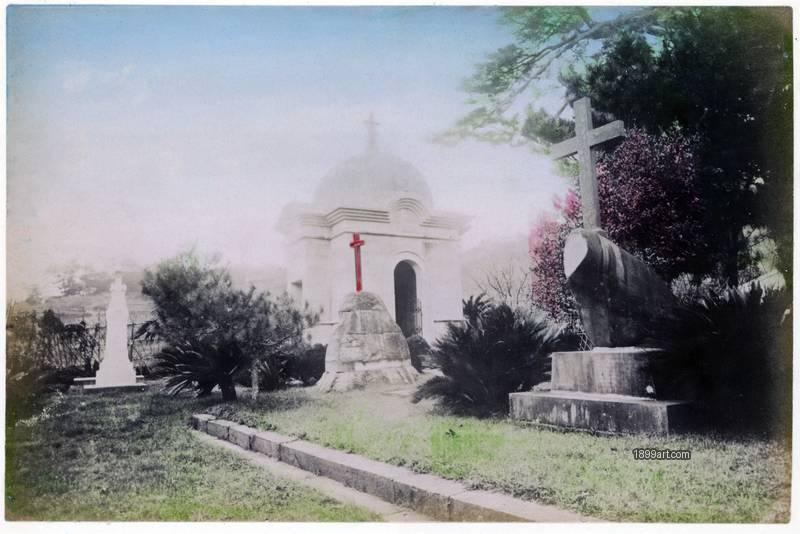
1899art Japan Inasa, Nagasaki - Christian Cemetery Scene Handcolored 1900s 1899art
From the 1899art Archive: A quiet cemetery scene at Inasa, Nagasaki shows tall crosses and grave markers arranged among trees, with a footpath leading through the grounds. Several small buildings and distant hills are visible beyond the graves, suggesting a rural setting.
Japan · c. 1895–1910 · Hand-colored photograph
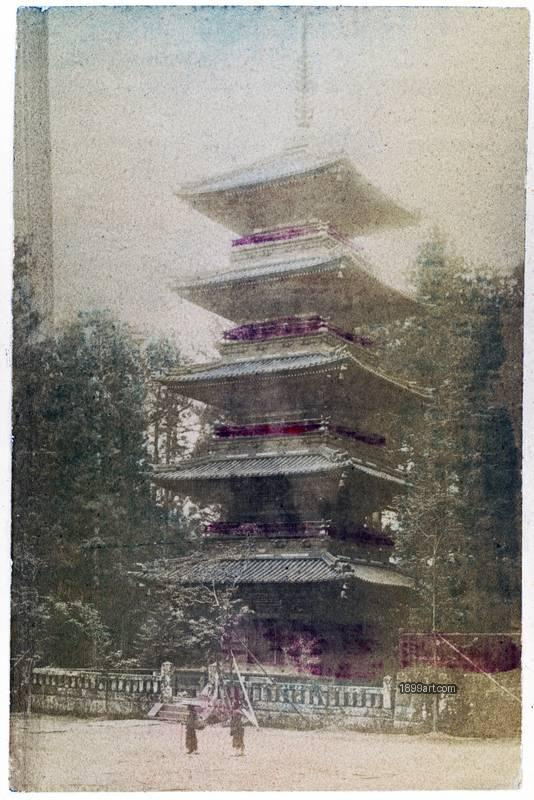
1899art Japan Gojūnotō, the five-storied pagoda of the Nikkō Tōshō‑gū Shrine in Japan. Handcolored 1900s 1899art
From the 1899art Archive: Gojūnotō, the five-storied pagoda of the Nikkō Tōshō‑gū Shrine in Japan rises above surrounding trees, its layered roofs and finial forming a tall vertical silhouette. Soft color tints highlight the architecture and foliage against a pale sky.
Japan · c. 1895–1910 · Hand-colored photograph
1899art Japan - Dejima, a historic artificial island in Nagasaki Bay, Harbor and Buildings Handcolored 1900s 1899art
From the 1899art Archive: A harbor view in Japan Dejima, a historic artificial island in Nagasaki Bay, Japan. Calm water with small boats near the shore. Low waterfront buildings and distant hillside structures line the edge of the bay.
Japan · c. 1895–1910 · Hand-colored photograph
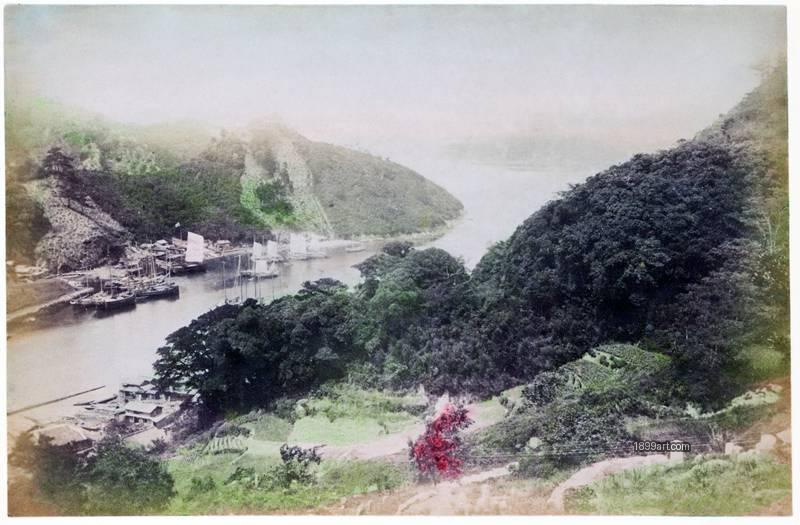
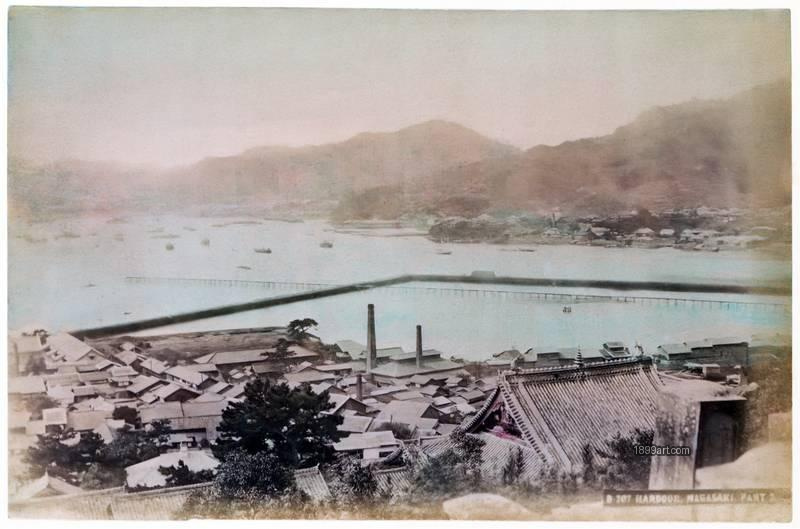
1899art Nagasaki Bay, Japan, with the island of Takaboko. Harbor and Hillside Landscape Handcolored 1900s 1899art
From the 1899art Archive: Nagasaki Bay, Japan, with the island of Takaboko. A harbor scene shows small boats on calm water near a shoreline, with buildings clustered along a hillside. Layered hills rise in the background above the settlement, suggesting a coastal town framed by a broad bay.
Japan · c. 1895–1910 · Hand-colored photograph
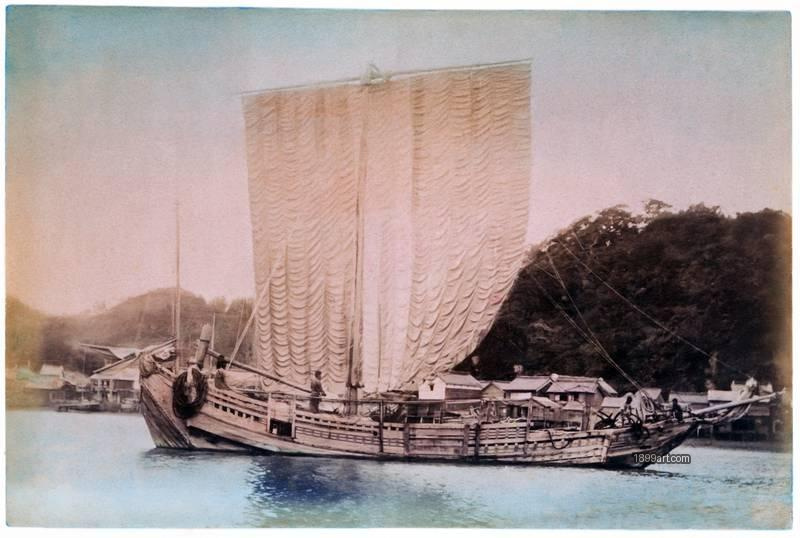
1899art Japan Traditional Japanese sailing junk Handcolored 1900s 1899art
From the 1899art Archive: A Japanese sailing junk with a single mast and large sail moves across calm water. The scene is rendered in hand-applied color, with distant shoreline and sky forming a quiet backdrop.
Japan · c. 1895–1910 · Hand-colored photograph
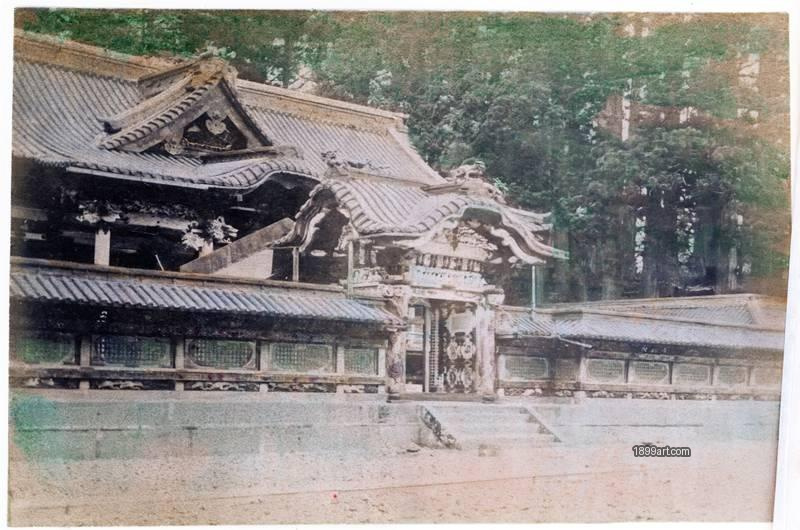
1899art Japan Tōshō-gū Shrine Handcolored 1900s 1899art
From the 1899art Archive: The Tōshō-gū Shrine is a Shintō shrine in Nikkō. The gate stands prominently at the entrance to a shrine complex, framed by trees and traditional buildings. Figures gather near the gateway, suggesting everyday activity along the approach.
Japan · c. 1895–1910 · Hand-colored photograph
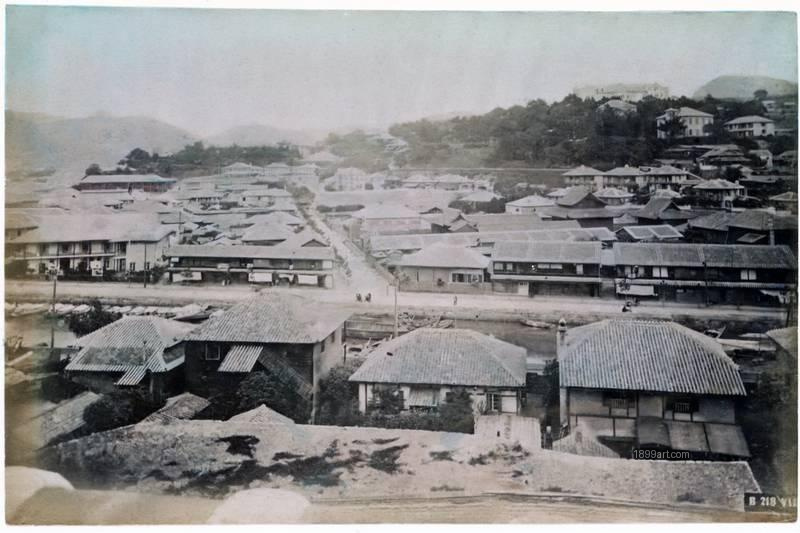
1899art Ōura in Nagasaki, Japan Panorama Handcolored 1900s 1899art
From the 1899art Archive: The panoramic view shows The foreign settlement of Ōura in Nagasaki, Japan, around 1899. The view was taken from Minamiyamate. The temple-like building at the center is the Confucius Shrine, completed in October 1893 and still in use today. with clustered wooden buildings arranged along a waterfront. Boats and shoreline activity are visible, with distant hills forming the backdrop.
Japan · c. 1895–1910 · Hand-colored photograph
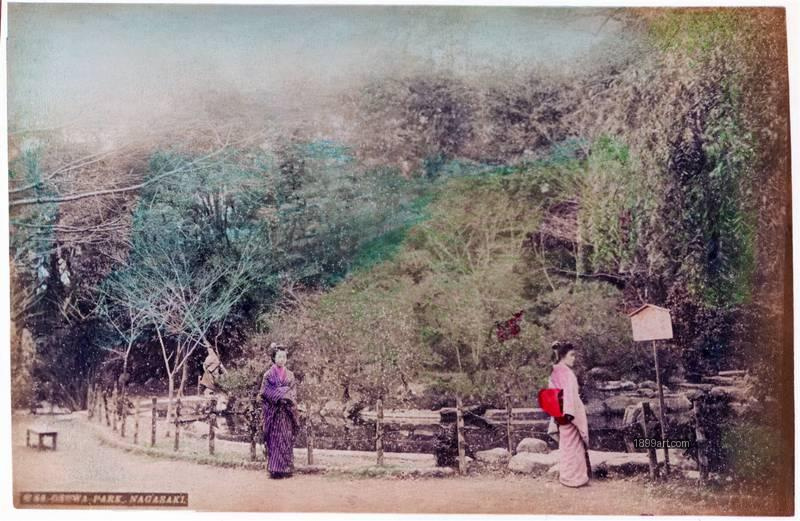
1899art Japan Japanese Women in Ōsuwa Park (also known as Nagasaki Park) in Nagasaki Handcolored 1900s Kimbei 1899art
From the 1899art Archive: Ōsuwa Park (also known as Nagasaki Park) in Nagasaki, Japan, photographed in the late 19th or early 20th century. Considered the oldest park in Nagasaki Prefecture, it is located beside the Suwa Shrine. The historical photograph depicts two women in traditional kimonos walking through the park, which is known for its tranquil atmosphere, featuring a pond and a small animal enclosure. among trees, shrubs, and a pathway. They wear patterned kimono and hold parasols, arranged in a calm, formal grouping.
Japan · c. 1895–1910 · Hand-colored photograph
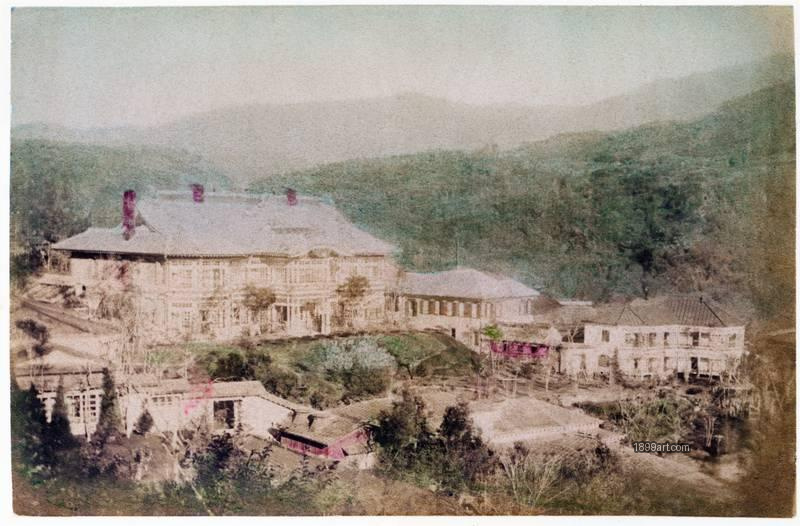
1899art Fujiya Hotel in Miyanoshita, Hakone, Kanagawa Prefecture, Japan. Handcolored 1900s 1899art
From the 1899art Archive: This hand-colored black-and-white photograph from the Meiji period depicts the hotel’s distinctive architecture, which blends Western and Japanese design elements. Opened in 1878, the Fujiya Hotel was one of Japan’s first hotels catering to foreign guests.
Japan · c. 1895–1910 · Hand-colored photograph
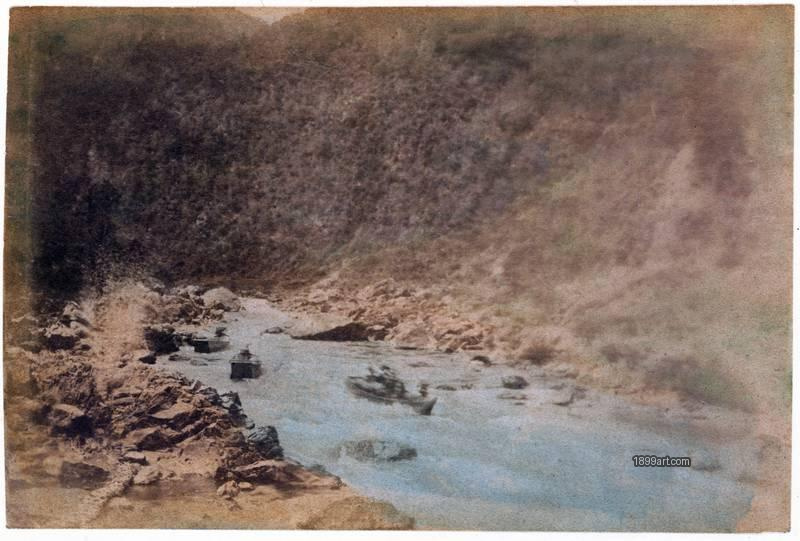
1899art Hozu Rapids near Kyoto, Japan. Handcolored 1900s 1899art
From the 1899art Archive: This historical view depicts river transport through the fast-flowing, white-water rapids, with several small boats navigating passengers or cargo downstream. The rocky riverbanks are lined with dense vegetation. Although it appears to be a reproduction rather than an original photograph, the image effectively conveys the scene of traditional river transport.
Japan · c. 1895–1910 · Hand-colored photograph
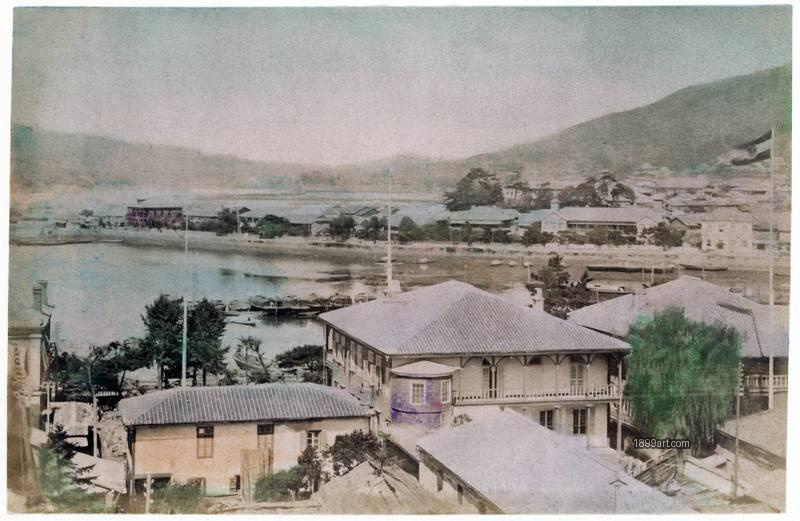
1899art Historic view of Nagasaki Harbor and the foreign settlements of Ōura and Higashiyamate, Nagasaki, Japan, photographed around the 1870s. Handcolored 1900s 1899art
From the 1899art Archive:On the right stood the Belle Vue Hotel, founded in 1863, while Dejima—the historic trading post—is visible in the background. The image captures Nagasaki’s unique role as Japan’s principal gateway to the world during the Edo period, when it was the country’s only port open to foreign trade under direct shogunate control, facilitating exchange primarily with the Dutch and Chinese. This international legacy is commemorated today at the Nagasaki Museum of History and Culture.
Japan · c. 1895–1910 · Hand-colored photograph
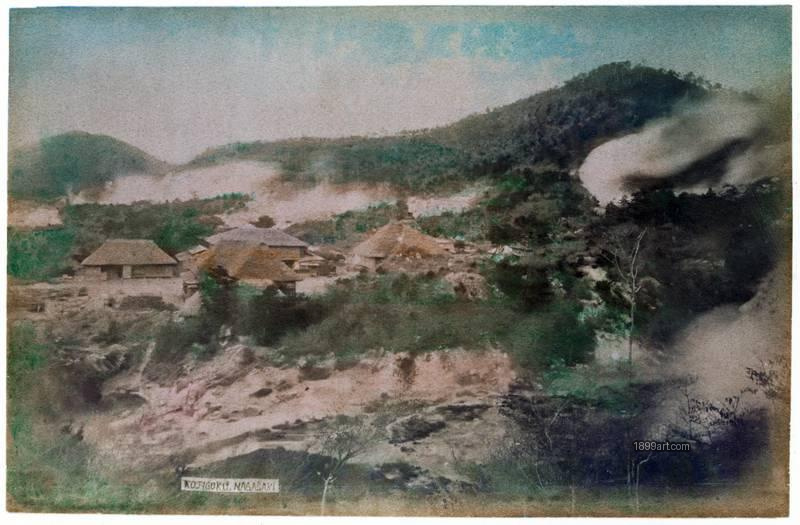
1899art Kojigoku (“Little Hell”) in the Unzen region of Nagasaki, Japan. Handcolored 1900s 1899art
From the 1899art Archive: This historical view shows a volcanically active onsen area, where steam vents (fumaroles) rise from the ground due to geothermal activity. The traditional buildings are likely part of an onsen complex or bathhouse. Kojigoku Onsen is a well-known attraction celebrated for its thermal baths and surrounding natural scenery. The Unzen region also holds historical significance as a site of Christian persecution during the Edo period.
Japan · c. 1895–1910 · Hand-colored photograph
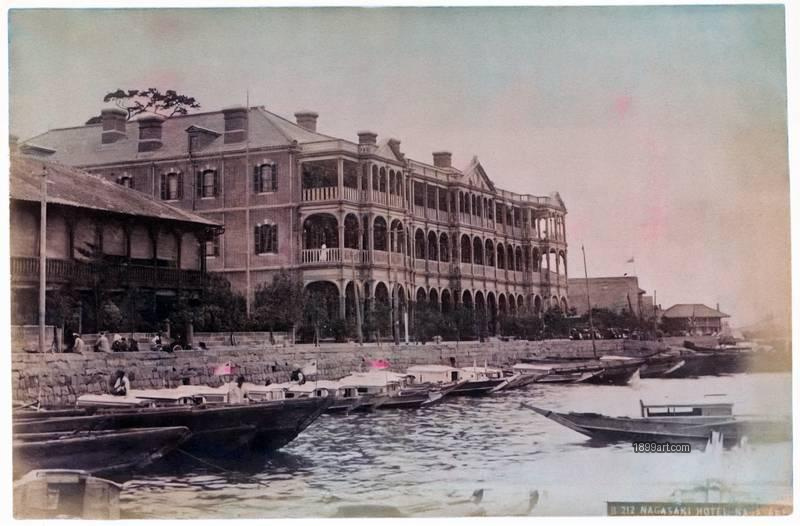
1899art The historic Nagasaki Hotel, opened in 1898 in Nagasaki, Japan. Handcolored 1900s 1899art
From the 1899art Archive: Regarded as the most luxurious hotel in Asia at the time, the three-story brick building featured a distinctive wooden veranda along the waterfront. It was exceptionally modern for its era, offering electric lighting, call bells, fire alarms, and telephones in every room. The restaurant was led by a French head chef and was renowned for its cuisine.
Japan · c. 1895–1910 · Hand-colored photograph
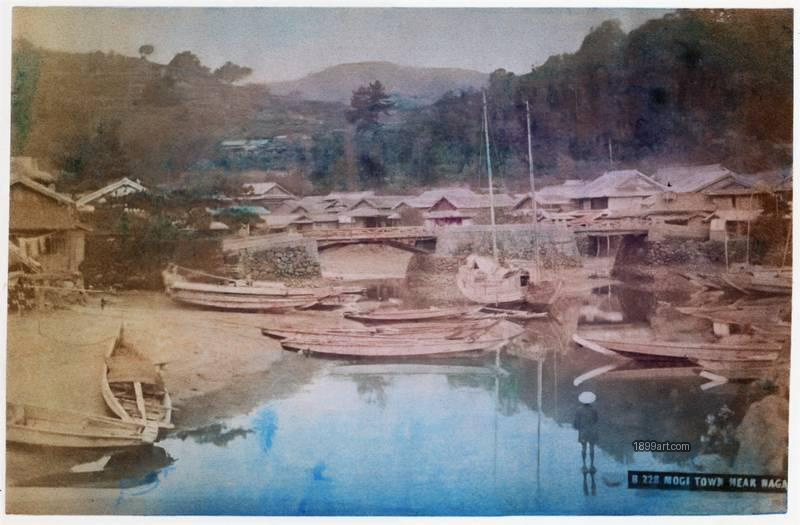
1899art Hand-colored photograph of Mogi, a fishing port near Nagasaki, Japan, from the late 19th century. Handcolored 1900s Enami 1899art
From the 1899art Archive: This historical image captures life in a traditional Japanese harbor before large-scale modernization. Fishing boats rest in shallow waters, with traditional buildings lining the coast. A stone bridge spans a small stream flowing into the harbor, while densely wooded mountains rise in the background.
Japan · c. 1895–1910 · Hand-colored photograph
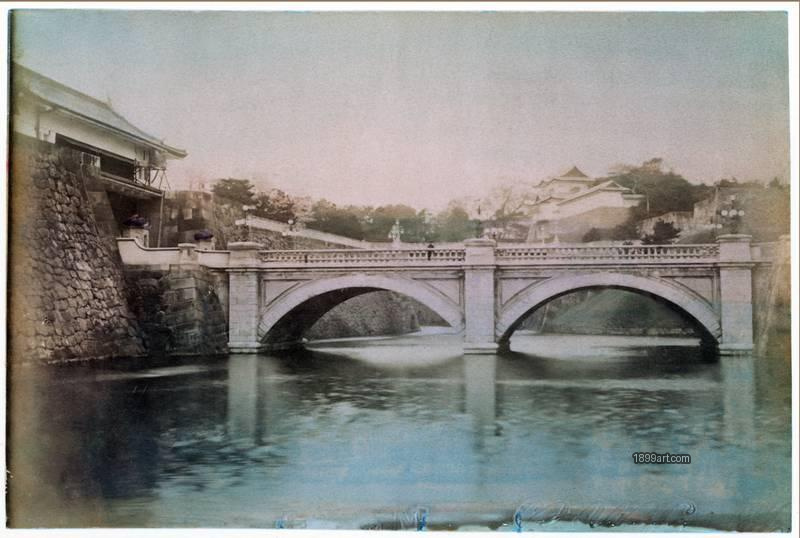
1899art The Nijūbashi Bridge marking the entrance to the Imperial Palace in Tokyo, Japan. Handcolored 1900s 1899art
From the 1899art Archive: One of Japan’s most iconic bridges—its name meaning “Double Bridge”—Nijūbashi stands on the former grounds of Edo Castle at the heart of Tokyo, today the residence of the Japanese Emperor. This hand-colored photograph dates to around 1912 and shows the bridge spanning the palace moat, a long-standing and popular photographic landmark.
Japan · c. 1895–1910 · Hand-colored photograph
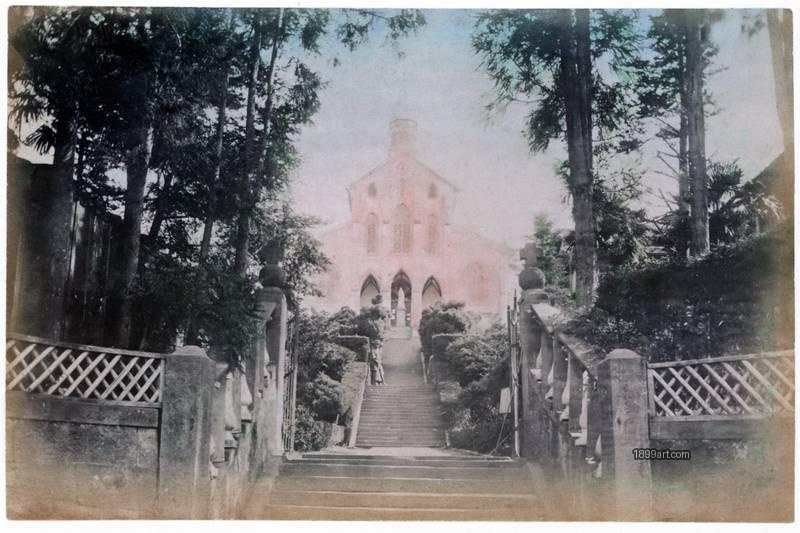
1899art The Ōura Church (Ōura Tenshudō) in Nagasaki, Japan.Handcolored 1900s 1899art
From the 1899art Archive: Also officially known as the Basilica of the Twenty-Six Holy Martyrs of Japan, this church was built in 1864 by French missionaries for the foreign community. It is the oldest surviving Catholic church in Japan and is dedicated to the memory of the twenty-six Christians executed in 1597. In 2018, it was inscribed as a UNESCO World Heritage Site as part of the Hidden Christian Sites in the Nagasaki Region.
Japan · c. 1895–1910 · Hand-colored photograph
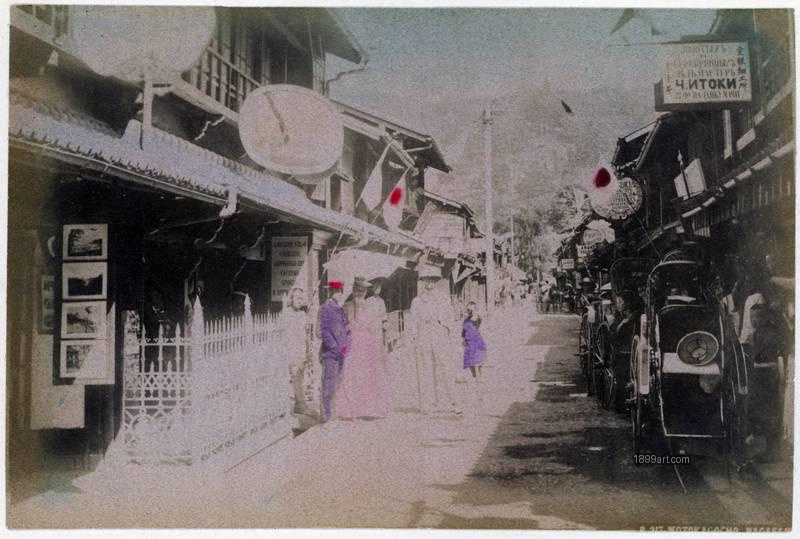
1899art Historic street scene in Nagasaki, Japan, showing rickshaws along the right side of the road. Handcolored 1900s 1899art
From the 1899art Archive: Careful reading of the shop signs identifies the location as Funadaikumachi, a historic district bordering the foreign settlement. The sign “T. Shirayama” (upper left) marks the studio of Shirayama Tanemichi (Seiryū Shirayama), a well-known Nagasaki photographer. He is standing with customers in front of his Shop. The oval sign “Fine Art Curios / No. 28 Funadaikumachi” provides a precise address within the district. On the right, “C. Itoki”—with a star and Cyrillic lettering—refers to the shop of Chiyoji Itoki, a prominent art and curios dealer who catered especially to the Russian fleet that regularly overwintered in Nagasaki; his shop was located at No. 27 Funadaikumachi.
Japan · c. 1895–1910 · Hand-colored photograph
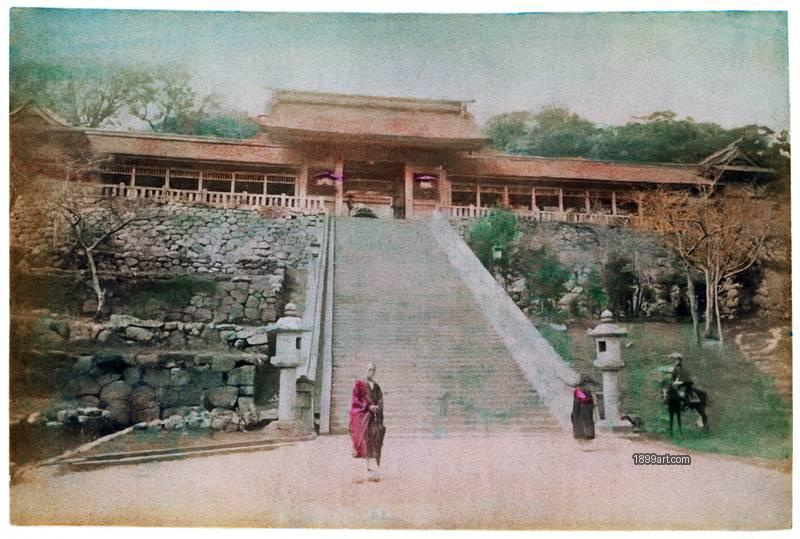
1899art The Suwa Shrine (Suwa-jinja) in Nagasaki, Japan, as it appeared in the late 19th or early 20th century. Handcolored 1900s 1899art
From the 1899art Archive: Nagasaki’s most important Shinto shrine, Suwa Shrine was founded in 1625 and relocated to its present site in 1648 to counter the spread of Christianity in the region. Dedicated to the deity Suwa-no-Okami, the shrine is believed to offer protection from misfortune. Each October it hosts the Nagasaki Kunchi Festival, one of Japan’s three major folk festivals. The shrine is approached by a long stone staircase of more than 250 steps.
Japan · c. 1895–1910 · Hand-colored photograph
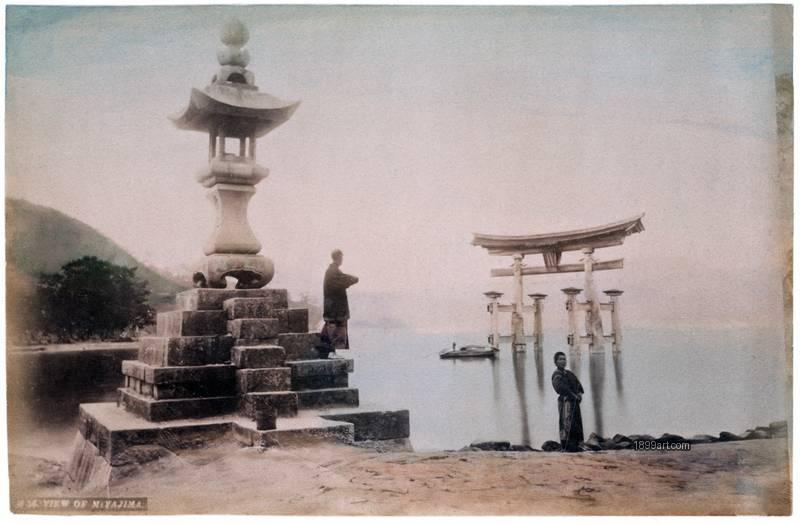
1899art Historic view of the Itsukushima Shrine and its famous “floating” torii gate on Miyajima Island, Japan. Handcolored 1890s 1899art
From the 1899art Archive: Built over the water to avoid disturbing the island’s sacred ground, the shrine complex is celebrated as one of Japan’s three most scenic landscapes. The Itsukushima Shrine is traditionally dated to 593 and was rebuilt in its present form in 1168 under the patronage of a powerful samurai. This image is a hand-colored albumen print from the second half of the 19th century.
Japan · c. 1895–1910 · Hand-colored photograph
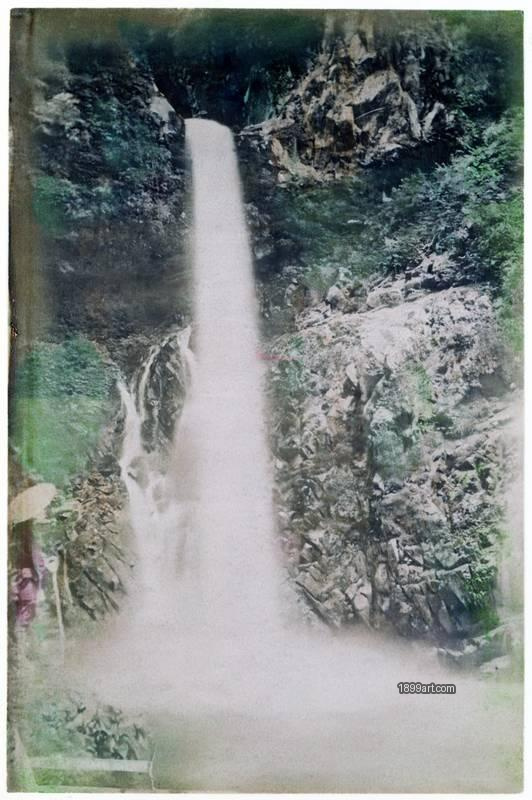
1899art The Nunobiki Falls near Kobe, Japan. Handcolored 1900s 1899art
From the 1899art Archive: This historic view depicts the Nunobiki Falls, a series of four waterfalls—Ontaki, Mentaki, Tsutsumigadaki, and Meotodaki—regarded as one of Japan’s three sacred “divine waterfalls.” Located close to Shin-Kobe Station, the falls are a popular hiking destination and have long been a recurring motif in Japanese art and literature, including ukiyo-e woodblock prints.
Japan · c. 1895–1910 · Hand-colored photograph
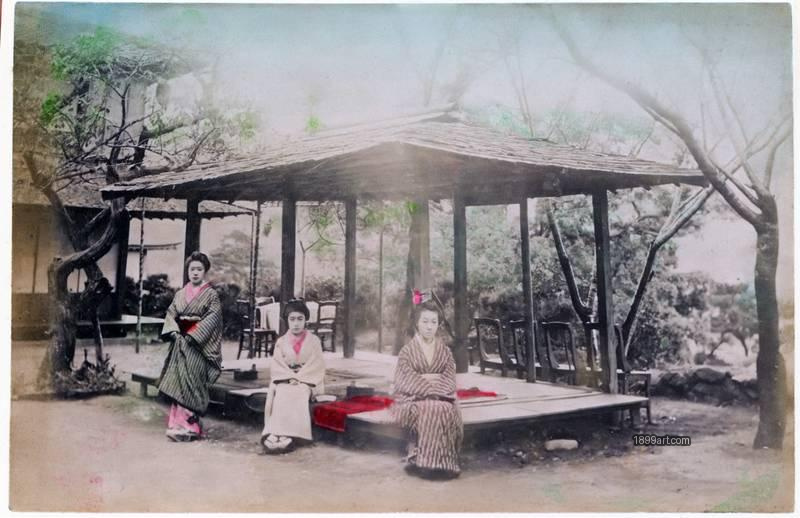
1899art Teahouse in Suwa Park, Yokohama, Japan. Handcolored 1900s 1899art
From the 1899art Archive: The image depicts the teahouse in Suwa Park, clearly identified as such within the photograph.
The scene most likely shows a carefully staged setting, typical of late 19th-century Japanese studio and location photography. During this period, photographers often used actresses—frequently presented as geishas—to construct idealized images of everyday life that aligned with Western expectations of Japanese culture. Such compositions were not documentary in a strict sense but were intended to convey atmosphere, tradition, and cultural symbolism.
Japan · c. 1895–1910 · Hand-colored photograph
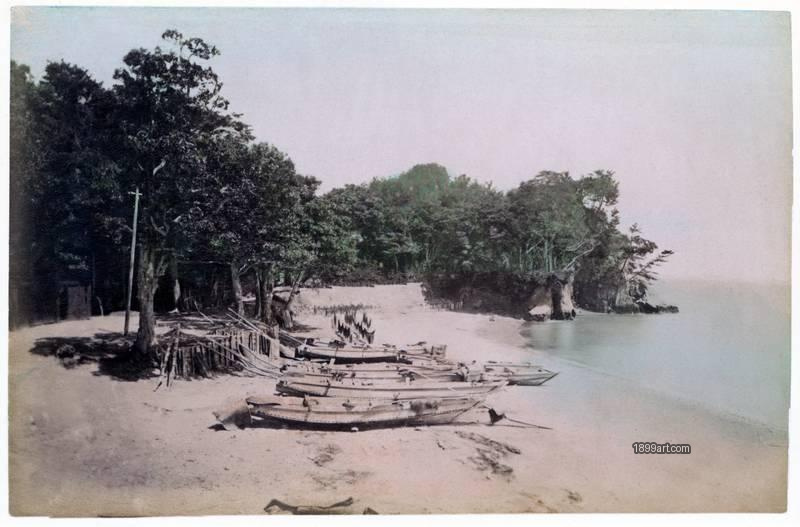
1899art Fishing Boats on the Beach at Tomioka Handcolored 1900s 1899art
From the 1899art Archive: The image shows fishing boats along the shoreline of Tomioka, Japan. This historical photograph dates to the 19th century and depicts a calm, idyllic coastal scene. Tomioka is located on the Pacific coast of central Fukushima, and the image is often associated with the Yokohama School, reflecting its serene composition and documentary-style portrayal of everyday coastal life before modernization.
Contact & Credits
Purpose of this site
YokohamaSchool.org is intended as a reference and context resource for the history and surviving works of the Yokohama School of hand-colored photography.
It does not claim to be complete and will be expanded over time.
Focus
Historical research, visual analysis, digital preservation and curated examples of original works from the period c. 1860–1920.
This website is currently in its early phase. Further sections on sources, studios and bibliography will follow.
YokohamaSchool.org is part of the wider 1899art project:
www.1899art.com.
Usage Rights & Legal Notice – 1899art Archive
All images published on 1899art.com originate from the 1899art Archive and are provided for cultural, educational, and historical reference purposes only.
Permitted use
Images may be linked, embedded, or shared on external websites and platforms exclusively in their original, unmanipulated form, provided that:
– the source is clearly credited as “1899art”, and
– a visible and clickable link to https://1899art.com accompanies the image.
Prohibited use
Any form of modification, including but not limited to cropping, retouching, recoloring, compositing, filtering, AI-based processing, or the creation of derivative works, is strictly prohibited without prior written permission.
Commercial use, resale, redistribution as standalone files, or inclusion in third-party archives or databases is also not permitted without explicit authorization.
Rights status
While the original photographs may be in the public domain due to age, the digital reproductions, curatorial selection, restoration decisions, metadata, and contextual presentation are the intellectual property of the 1899art Archive.
By using images from this website, you agree to respect these conditions. Automated downloading, scraping, or use of images for machine learning or AI training purposes is expressly prohibited.
EU / International Copyright Notice
All images published by the 1899art Archive are protected under European and international copyright law.
Any reproduction, redistribution, modification, AI-based processing, or commercial use beyond the explicitly permitted low-resolution web sharing is prohibited without prior written consent of the 1899art Archive.
This applies equally to high-resolution files obtained through unauthorized access, third-party leaks, or archival reproductions.
DMCA Copyright Notice & Protection
All images and digital files published by the 1899art Archive are protected by international copyright law and the Digital Millennium Copyright Act (DMCA).
Unauthorized reproduction, distribution, modification, AI processing, or commercial use of any image or high-resolution file from the 1899art Archive is strictly prohibited.
The unauthorized possession or dissemination of high-resolution files does not constitute a license and does not grant any rights of use.
Any infringement will result in DMCA takedown notices, platform removal requests, and, where applicable, legal action.