High-resolution original files are available from the 1899art Archive.
Original scans have a minimum resolution of 6,000 × 9,000 pixels.
Depending on the original source medium, original master scans of up to 15,000 × 20,000 pixels are available.
Only the low-resolution images displayed on the 1899art website may be linked, shared, or embedded on external websites, and only in their original, unmanipulated form, provided that clear attribution to “1899art” is given and a clearly visible link to https://1899art.com is included.
Any use, distribution, or publication of high-resolution files, whether obtained intentionally or inadvertently, is strictly prohibited.
Any modification, alteration, recomposition, recoloring, AI processing, or commercial reuse beyond simple linking and sharing is not permitted without prior written consent of the
1899art Archive.
YOKOHAMA SCHOOL BACK TO MAIN PAGE
Album 7 – 50 Motifs of the Yokohama School. All photographs are carefully reconstructed and described based on extensive research.
We strive for the highest possible accuracy in all attributions and contextual information.
If you believe any information is incorrect, please contact us and include your source.
Japan · c. 1895–1910 · Hand-colored photograph
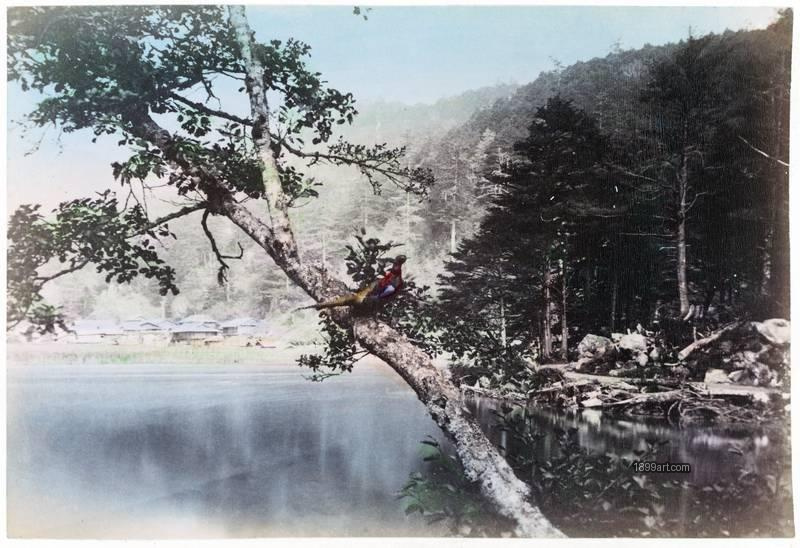
1899art Japan pheasant Bird on Tree Branch Handcolored 1900s 1899art
From the 1899art Archive:This hand-colored albumen photograph depicts a quiet lakeside scene in a wooded mountain landscape, produced around the turn of the 20th century. A tree trunk extends diagonally across the foreground, forming the compositional axis of the image and guiding the eye from the near shore across the calm water toward the forested hills beyond.
Perched on the branch is a pheasant, delicately hand-colored in restrained tones of red, blue, and ochre. The coloration is applied sparingly, allowing the bird to stand out without disturbing the subdued harmony of greens, greys, and cool blues that dominate the surrounding landscape. Rather than serving as a purely naturalistic detail, the pheasant functions as a quiet focal point, introducing a sense of balance and stillness to the scene.
On the far shore, small buildings are faintly visible, rendered with minimal detail and deliberately set back within the composition. Their presence subtly situates the landscape within a human environment while preserving the overall atmosphere of calm and distance. The water surface remains largely undisturbed, reflecting the trees and shoreline in soft, slightly diffused tones characteristic of albumen printing and later hand-coloring.
The photograph avoids dramatic staging in favor of a contemplative image concept. Nature is presented as an ordered, inhabitable space in which animal life, landscape, and human presence coexist quietly. The work is characteristic of late 19th-century Japanese souvenir photography, where the emphasis lies less on precise geographic identification than on conveying an idealized and atmospheric vision of the natural world.
Japan · c. 1895–1910 · Hand-colored photograph
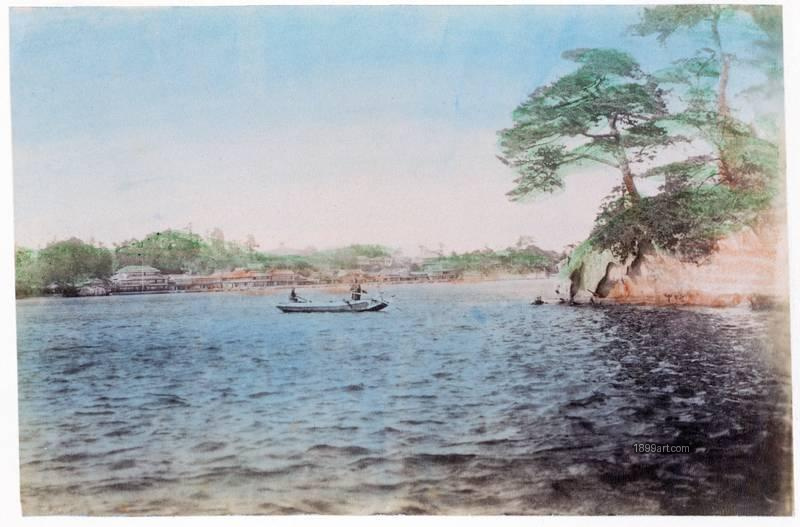
1899art Matsushima Bay — The Pine Islands of Japan Handcolored 1900s 1899art
From the 1899art Archive: This image depicts Matsushima Bay, traditionally celebrated as one of Japan’s Three Most Scenic Views. The bay is renowned for its poetic landscape of more than 260 small islands covered with pine trees, a feature reflected in its name, which means “Pine Islands.” As early as the 17th century, the scholar Hayashi Razan praised Matsushima as one of the most beautiful sights in Japan. In the scene, a sailboat moves across the calm water, with buildings in the distance and a rocky, tree-covered island anchoring the right foreground.
Japan · c. 1895–1910 · Hand-colored photograph
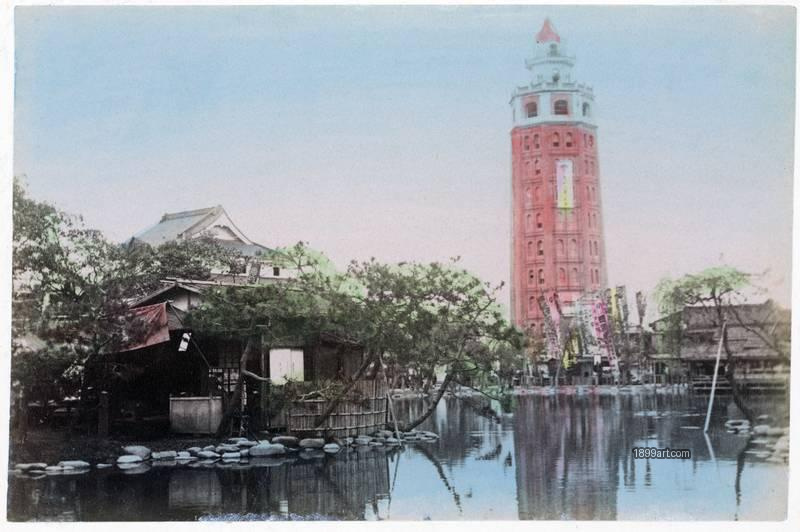
1899art Ryōunkaku — Japan’s First Western-Style Skyscraper Handcolored 1900s 1899art
From the 1899art Archive: This image shows the Ryōunkaku, also known as the “Cloud-Surpassing Pavilion,” located in Asakusa, Tokyo. Opened in 1890, it was Japan’s first Western-style skyscraper and, at 69 meters tall, the highest building in the country at the time. Situated in Asakusa’s lively entertainment district, the tower featured a brick façade and a design reminiscent of a lighthouse, symbolizing Japan’s rapid modernization during the Meiji era. The Ryōunkaku was severely damaged and ultimately dismantled following the Great Kantō Earthquake of 1923.
Japan · c. 1895–1910 · Hand-colored photograph
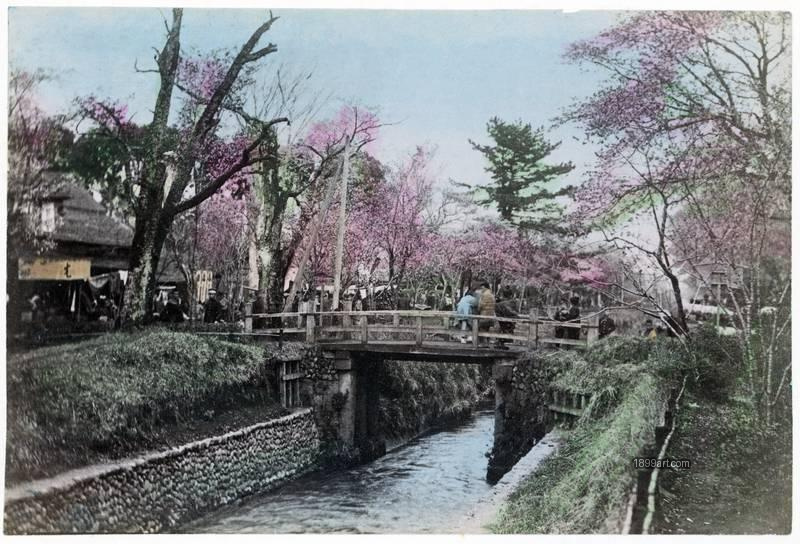
1899art Koganei Bridge — Cherry Blossoms along the Tamagawa Aqueduct Handcolored 1900s 1899art
From the 1899art Archive: This hand-colored photograph from the late 19th to early 20th century shows cherry blossoms at Koganei in Tokyo, centered on Koganei Bridge (Koganei-bashi), a celebrated hanami site along the Tamagawa Aqueduct. The cherry trees lining this area were reportedly first planted in 1737 to frame the aqueduct, and by the late 18th century the site had become a popular destination for blossom viewing. Originally a wooden structure frequently rebuilt, Koganei Bridge was replaced in 1856 by a stone bridge funded by local residents—the historically significant structure visible in the image today.
Japan · c. 1895–1910 · Hand-colored photograph
1899art Yokohama: Kusakabe Kimbei — Dancing on Banquet Geisha Group in Kimono Handcolored 1900s 1899art
From the 1899art Archive: This hand-colored photograph by Kusakabe Kimbei depicts a lively banquet scene staged within a traditional Japanese interior. A group of women and men, dressed in richly patterned kimono, are gathered around low trays of food while several figures perform expressive dance movements, their raised arms suggesting music, rhythm, and celebration. Painted screens in the background show landscapes and plants, framing the scene and reinforcing its carefully composed, theatrical quality. Typical of Yokohama School studio work around 1900, the image combines documentary elements with deliberate staging, offering foreign audiences an idealized glimpse of Japanese social life, entertainment, and ritualized festivity at the turn of the century.
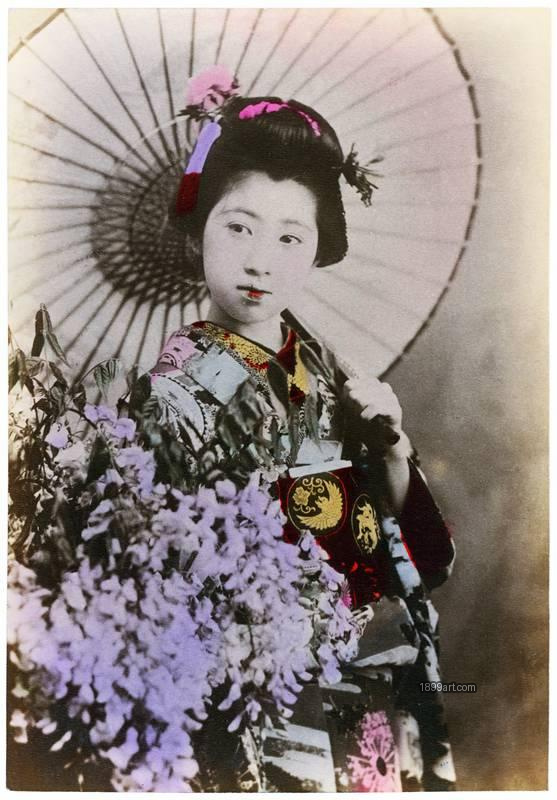
From the 1899art Archive: This hand-colored albumen print depicts a young woman, likely a maiko (apprentice geisha), in Japan during the late 19th century. The photograph belongs to the tradition of Yokohama Shashin, a genre of studio photography produced during the Meiji period primarily for foreign visitors. The image shows the woman dressed in a formal kimono, holding a traditional paper umbrella (wagasa), and framed by cascading wisteria blossoms, a motif associated with elegance and seasonal beauty.
Japan · c. 1895–1910 · Hand-colored photograph
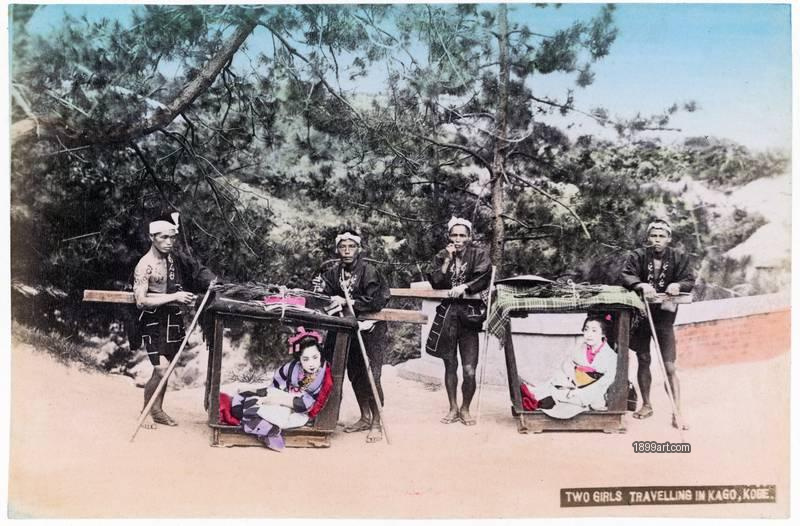
1899art Kobe — Travel by Kago in the Meiji Era Handcolored 1900s 1899art
From the 1899art Archive: This hand-colored albumen photograph from the late 19th century shows two women traveling in traditional Japanese palanquins known as kago near Kobe. Such open litters, carried by two bearers (kago-ya) using a single shoulder pole, were a common means of transport for ordinary people before the widespread adoption of rickshaws and railways, particularly in mountainous regions. More elaborate enclosed palanquins (norimono) were reserved for the nobility.
The bearers are lightly clothed and hold ikizue (breathing staffs), used to regulate breathing and pace while walking; one bearer on the left displays traditional tattoos. The photograph dates to the Meiji period, a time of rapid modernization when scenes of traditional life were increasingly documented for foreign audiences. Images of this kind were commonly produced and hand-colored for export by leading photographers such as Kusakabe Kimbei or Felice Beato. The captioned location suggests a mountain road near Kobe, possibly leading to destinations such as the Arima hot springs, where the use of kago persisted longer than in urban centers.
Japan · c. 1895–1910 · Hand-colored photograph
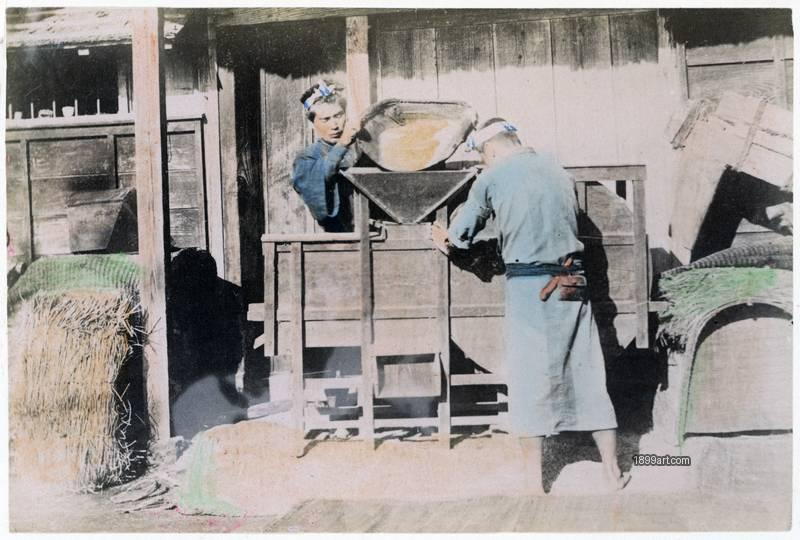
1899art Yokohama Shashin — Traditional Rice Winnowing in Rural Japan Handcolored 1900s 1899art
From the 1899art Archive: This hand-colored albumen print captures a moment of traditional Japanese rice processing, likely dating to the late 19th or early 20th century. Produced in the style known as Yokohama Shashin, a form of Meiji-era photography created primarily for foreign audiences, the image shows two individuals operating a wooden winnowing machine used to separate rice grains from chaff after threshing. The carefully staged yet practical scene offers a rare visual insight into everyday agricultural labor and rural life in Japan during a period of rapid modernization. The specific location and identities of the figures are not recorded, emphasizing the image’s role as a representative genre scene rather than a documentary portrait.
Japan · c. 1895–1910 · Hand-colored photograph
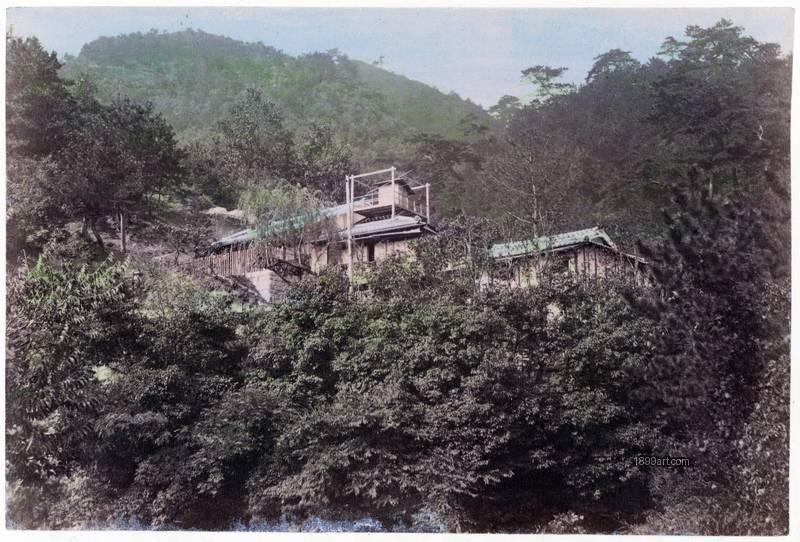
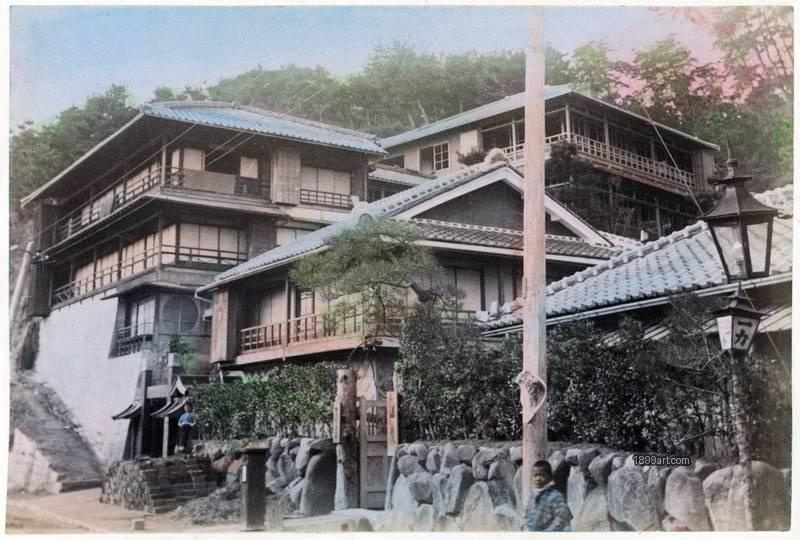
1899art Miyauchi Hotel — A Ryokan in the Hills of Kiga Handcolored 1900s 1899art
From the 1899art Archive:This hand-colored photograph shows the former Miyauchi Hotel in Kiga, a traditional Japanese inn (ryokan) set within a wooded, hilly landscape. Likely dating from the late Meiji period, the image reflects architectural forms designed to harmonize with the surrounding natural environment. Photographs of this kind were typically produced as albumen prints and later hand-colored, serving as popular souvenirs for Western visitors seeking impressions of Japan’s regional scenery and traditional hospitality at the turn of the century.
Japan · c. 1895–1910 · Hand-colored photograph
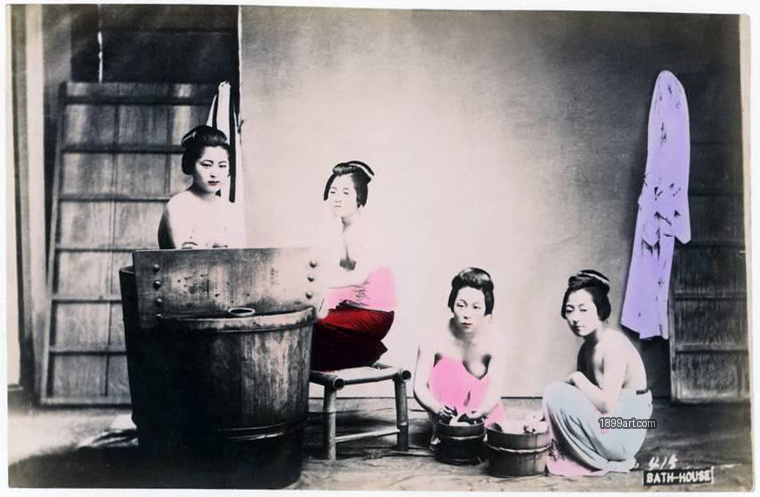
1899art Japan Yokohama Shashin — Home Bathing (B 1098) Traditional Bathing Handcolored 1900s 1899art
From the 1899art Archive: This historical hand-colored albumen photograph from Japan dates to the Meiji period and represents a staged genre scene intended to illustrate everyday bathing culture. The image shows four women in a traditional bath-house setting (sento or ofuro): one seated in a large wooden tub while others prepare to bathe using smaller tubs nearby. Originally captured in black and white and later colored by hand, the print exemplifies the Yokohama Shashin tradition, in which Japanese photographers produced carefully composed scenes for foreign clientele.
Such photographs were frequently made by leading studios associated with the Yokohama School, including photographers like Kusakabe Kimbei. The original work is known under the title B 1098 Home Bathing.
Japan · c. 1895–1910 · Hand-colored photograph
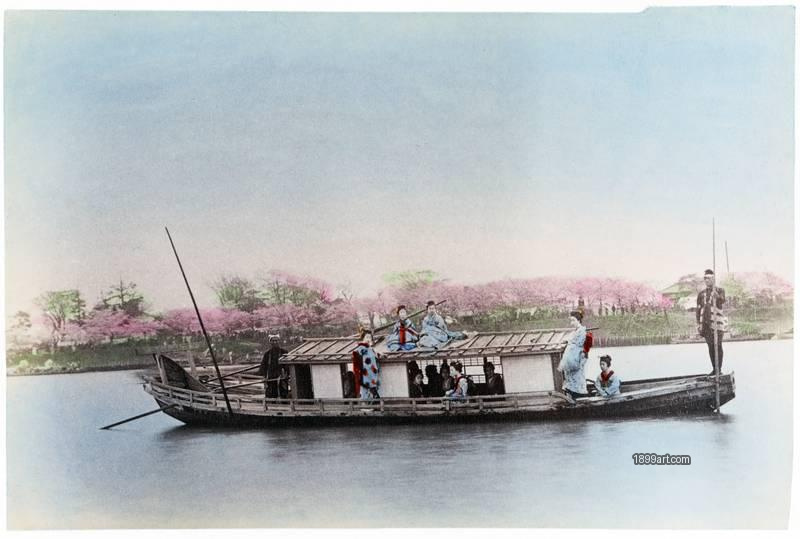
1899art Sumida River — Pleasure Boat during the Hanami Season Handcolored 1900s Kimbei 1899art
From the 1899art Archive: This hand-colored photograph, likely dating to around 1875, depicts a leisurely boat excursion in Tokyo. The scene shows men and women in traditional dress traveling aboard a covered sampan, a small boat commonly used for transport and pleasure outings. Along the riverbank, cherry trees in full bloom frame the waterway, clearly indicating the hanami season, when viewing blossoms was a popular social pastime.
Such roofed pleasure boats were frequently used on rivers such as the Sumida, offering city residents and visitors a relaxed way to enjoy seasonal scenery. Originally photographed in black and white and later carefully hand-colored, the image reflects everyday urban leisure in Japan during the early years of the Meiji period, blending documentary observation with the aesthetic conventions of Yokohama School photography.
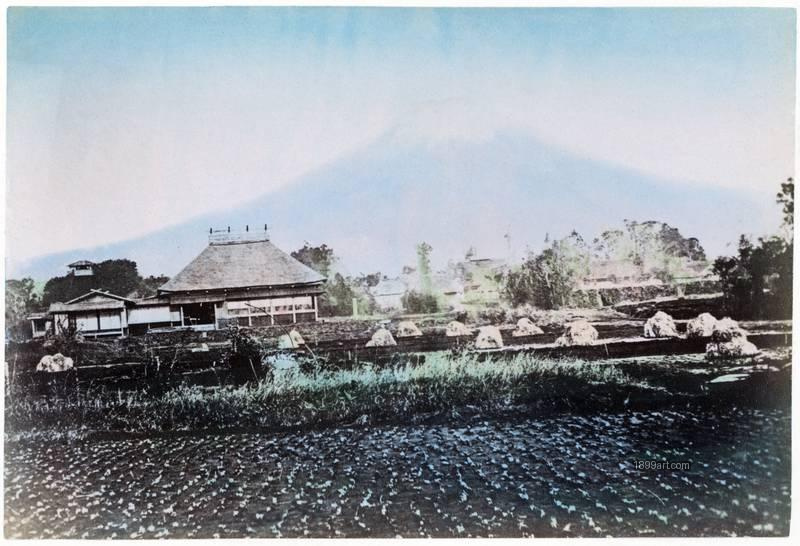
From the 1899art Archive: This hand-colored photograph depicts a rural scene in Japan with traditional buildings and cultivated fields set beneath Mount Fuji, Japan’s highest peak at 3,776 meters. Rising prominently in the background, Fuji serves not only as a dominant natural feature but also as a powerful national symbol, long associated with spiritual significance and cultural identity. The foreground shows elements of agricultural life and vernacular architecture, possibly thatched-roof houses, situating the scene firmly within the rural landscape of the late 19th or early 20th century.
Japan · c. 1895–1910 · Hand-colored photograph
1899art Suwayama Onsen — A Lost Spa Resort above Kobe, Japan. Handcolored 1900s 1899art
From the 1899art Archive:This historical photograph depicts Suwayama Onsen, a former hot spring resort located on the wooded slopes of Suwayama hill overlooking Kobe, around 1910. During the Meiji period and continuing into the Taishō period, Suwayama was a popular leisure and spa destination, frequented by visitors seeking relaxation and scenic views above the growing port city.
The original bathhouses and resort buildings no longer survive. Much of the area was destroyed during air raids in the Second World War, and the site is now known as Suwayama Park. The image thus preserves the memory of a vanished recreational landscape, representative of early modern Japan’s spa culture and hillside resorts.
Japan · c. 1895–1910 · Hand-colored photograph
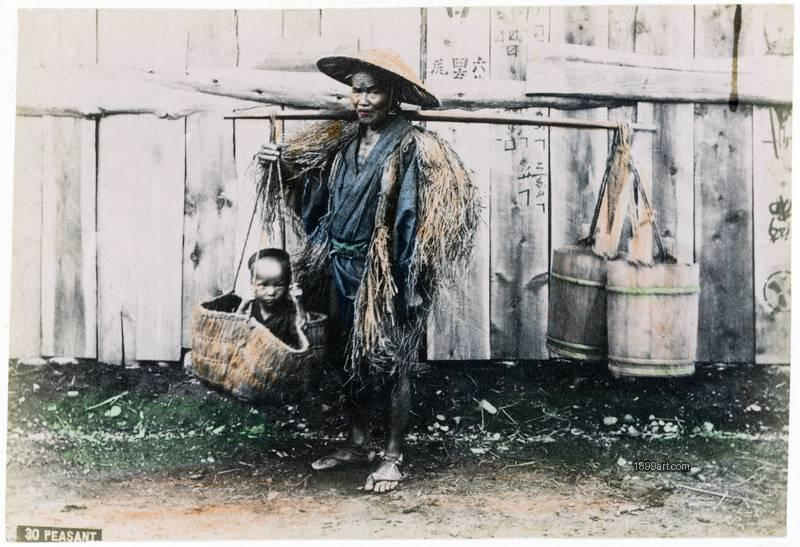
1899art Japanese Farmer Carrying a Child — Rural Life in the 1890s Handcolored 1900s 1899art
From the 1899art Archive: This hand-colored albumen print from the 1890s portrays a Japanese farmer balancing everyday burdens along a rural path. Dressed in a traditional straw raincoat (mino) and a conical hat (sugegasa), he carries a shoulder pole (tenbin-bō) from which hang a basket holding a young boy and a bucket, a practical arrangement emblematic of agrarian life in late 19th-century Japan. The careful hand-coloring softens the scene while preserving photographic detail, aligning the image with the Yokohama School tradition of genre photographs produced for foreign audiences.
Japan · c. 1895–1910 · Hand-colored photograph
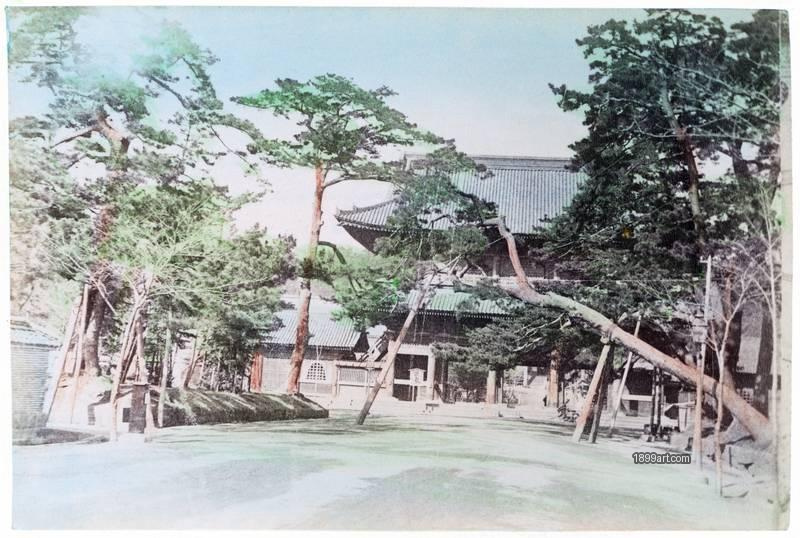
1899art Nanzen-ji — Gate of a Rinzai Zen Temple Handcolored 1900s 1899art
From the 1899art Archive: This hand-colored photograph, dating from approximately 1880 to 1910, depicts the gate of Nanzen-ji, one of Japan’s most important Zen temples, located in Kyoto. Nanzen-ji serves as the head temple of the Nanzen-ji branch of Rinzai Zen, a school known for its emphasis on discipline, meditation, and monastic training.
Japan · c. 1895–1910 · Hand-colored photograph
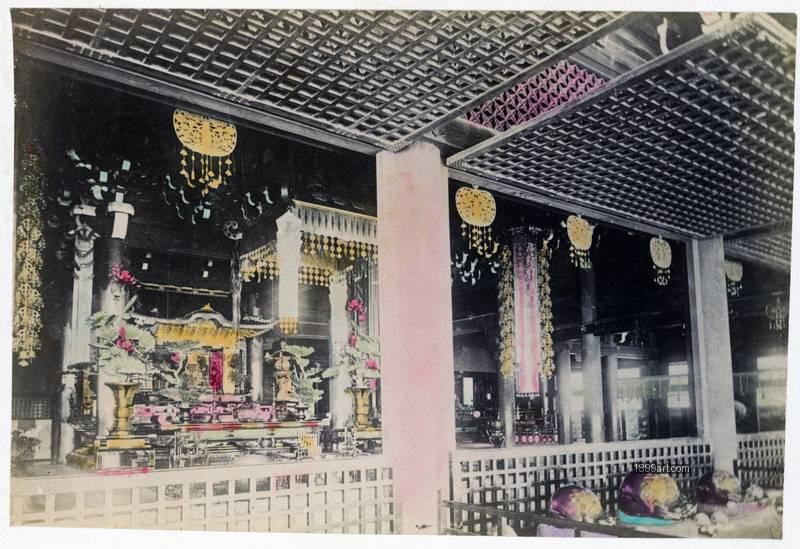
1899art Japan: Chion-in — Interior of the Head Temple of Pure Land Buddhism Handcolored 1900s 1899art
From the 1899art Archive: This image depicts the interior of Chion-in, the head temple of the Jōdo Buddhism, located in Kyoto. Founded by the monk Hōnen, the Jōdo school teaches that rebirth in the Western Paradise (Pure Land) of Amida Buddha can be attained through the sincere recitation of the Nembutsu, the name of Amida Buddha. The temple’s principal structures, including the main hall (Miei-dō), were constructed in the early 17th century and exemplify monumental Buddhist architecture of the early Edo period. Chion-in is also renowned for its immense Sanmon gate—the largest wooden gate in Japan—and its massive temple bell, weighing approximately 70 tons. The interior view emphasizes the scale, solemnity, and devotional atmosphere of one of Japan’s most important centers of Buddhist practice.
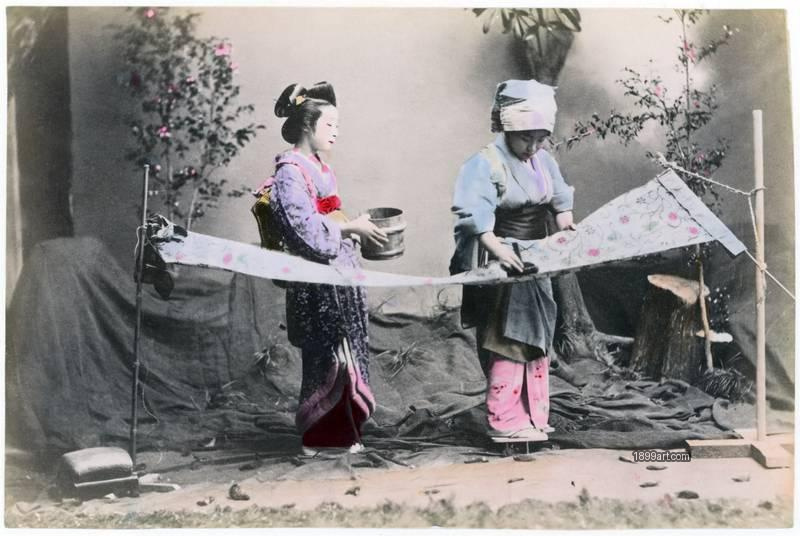
Japan · c. 1895–1910 · Hand-colored photograph
1899art Domestic Textile Work — Studio Genre Scene from Meiji-Era Japan Handcolored 1900s 1899art
From the 1899art Archive: This hand-colored albumen print from late 19th-century Japan depicts two women engaged in textile or laundry-related work, presented as a carefully arranged studio scene. Dressed in traditional kimono, they are shown stretching lengths of fabric or preparing laundry, a motif commonly used to represent domestic life. Originally photographed in black and white, the image was later colored by hand using transparent, water-based pigments applied by skilled Japanese colorists, allowing fine photographic detail to remain visible beneath the color.
Japan · c. 1895–1910 · Hand-colored photograph
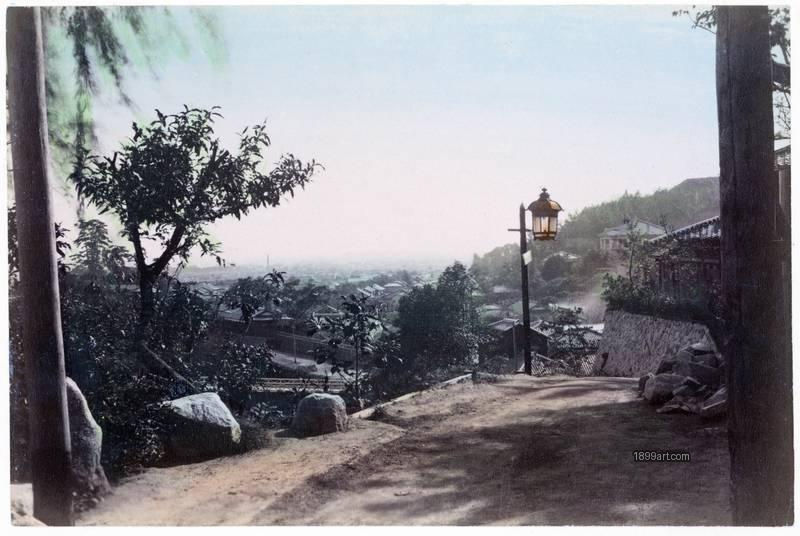
1899art Japan Maruyama Yaami Hotel — Approach Road above the City Handcolored 1900s 1899art
From the 1899art Archive: This hand-colored albumen photograph from the 1890s presents a historic view of the approach road leading to the Maruyama Yaami Hotel in Kyoto. The hotel was situated on a hillside in the Higashiyama, and the image captures the ascending roadway that guided visitors toward its front entrance. From this vantage point, the photograph offers a panoramic impression of Kyoto’s urban landscape below, framed by traditional architecture and gently rising terrain. Originally taken in black and white and later hand-colored, the image reflects the Yokohama School aesthetic and the popularity of such views among Western travelers. Hotels and scenic access routes like this were frequently photographed to convey both the refinement of modern accommodations and the picturesque character of Kyoto’s historic hillsides at the close of the 19th century.
Japan · c. 1895–1910 · Hand-colored photograph
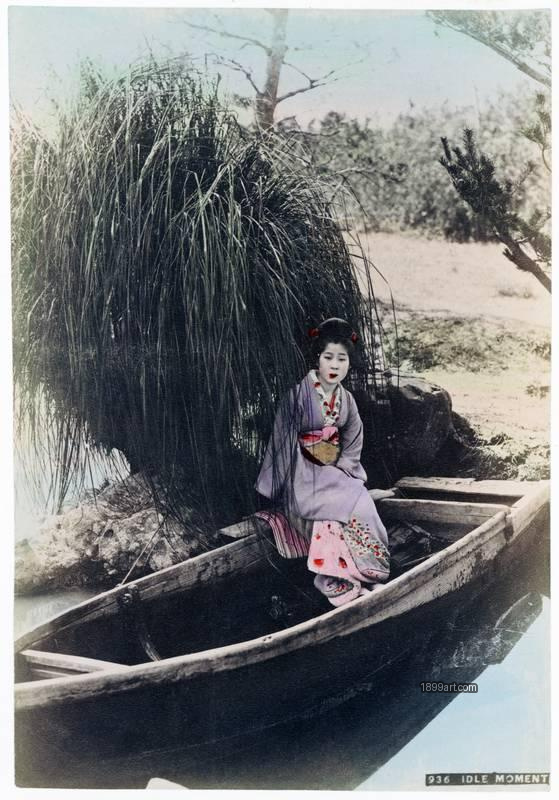
1899art Japan Idle Moment (No. 936) — Geisha in a Boat during the Meiji Era Handcolored 1900s Enami 1899art
From the 1899art Archive: This hand-colored albumen photograph from late 19th-century Japan depicts a woman identified as a geisha—or possibly a high-ranking courtesan—posed in a small wooden boat amid dense reeds or waterside vegetation. The image bears the title Idle Moment and the catalog number 936, reflecting the commercial naming conventions commonly used by photographic studios of the period.
Japan · c. 1895–1910 · Hand-colored photograph
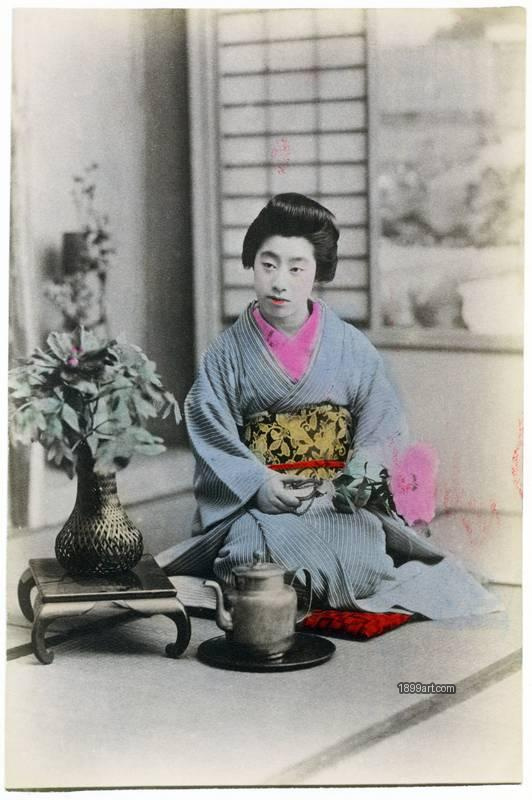
1899art Geisha at Rest — Interior Genre Scene from the Meiji Era Handcolored 1900s 1899art
From the 1899art Archive: This hand-colored albumen photograph from the late 19th to early 20th century depicts a Japanese woman, likely a geisha, seated in a traditional interior setting. Originally captured in black and white and later carefully colored by hand, the image reflects the photographic practices of the Meiji period, when such works were widely produced as souvenirs for Western visitors.
The woman is shown wearing a formal kimono, seated calmly before a low wooden table on which rest a teapot and a flower arrangement in a vase. These elements evoke the refined domestic arts associated with geisha culture, including tea preparation and flower arrangement (ikebana). Rather than documenting an unguarded moment, the scene is likely a studio composition designed to convey serenity, elegance, and cultural depth—presenting an idealized vision of Japanese femininity, artistic training, and contemplative leisure rooted in traditional aesthetics and Zen-influenced values.
Japan · c. 1895–1910 · Hand-colored photograph
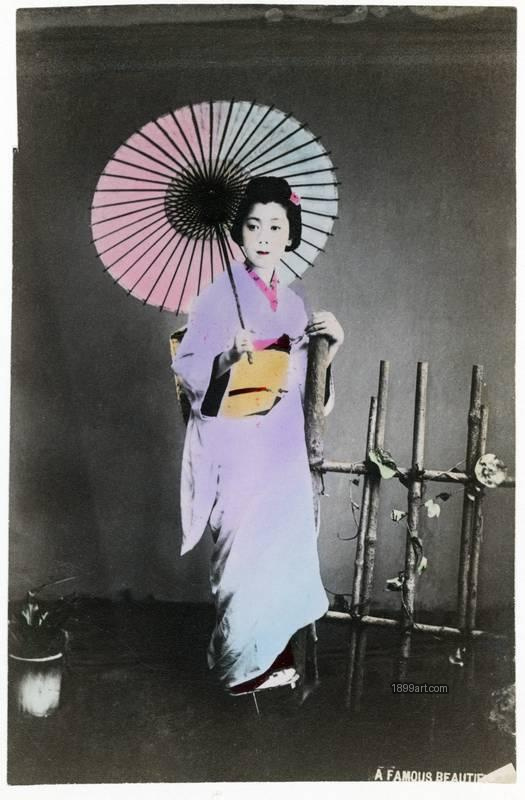
1899art Japan A Famous Beauty — Studio Portrait in Traditional Attire Handcolored 1900s 1899art
From the 1899art Archive: This hand-colored albumen photograph presents a studio portrait of a woman posed in a traditional kimono while holding a paper umbrella (wagasa), a motif frequently used in late 19th-century Japanese photography. Images of this kind typically depicted geishas, maiko (apprentice geishas), or actresses dressed in classical attire, emphasizing grace, elegance, and cultural refinement rather than individual identity.
Originally photographed in black and white and later colored by hand, the print belongs to the tradition of Yokohama Shashin. Produced primarily for foreign buyers, such portraits were carefully staged to present an idealized image of Japanese beauty, combining theatrical pose, symbolic accessories, and meticulous coloration. The title A Famous Beauty reflects the commercial naming conventions of the period, suggesting admiration and archetype rather than a specific, named individual.
Japan · c. 1895–1910 · Hand-colored photograph
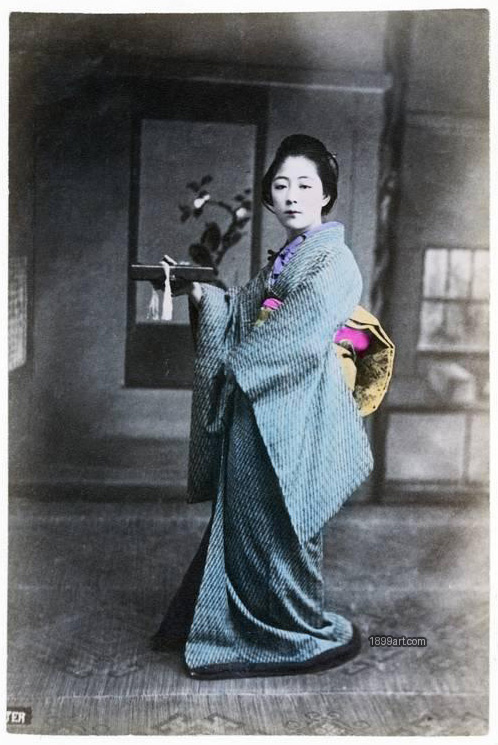
1899art Japan Japanese Woman holding a Wajima-nuri Handcolored 1900s 1899art
From the 1899art Archive: This hand-colored albumen photograph presents a carefully staged studio portrait of a young woman standing frontally and gazing directly toward the camera. She wears a patterned dove-blue to gray-blue kimono with a repeating geometric weave, secured by a wide obi tied at the back into a large, sculptural bow in gold-yellow with pink accents. Her hair is styled in a traditional nihongami coiffure, adorned with restrained accessories that emphasize refinement rather than ornament.
Japan · c. 1895–1910 · Hand-colored photograph
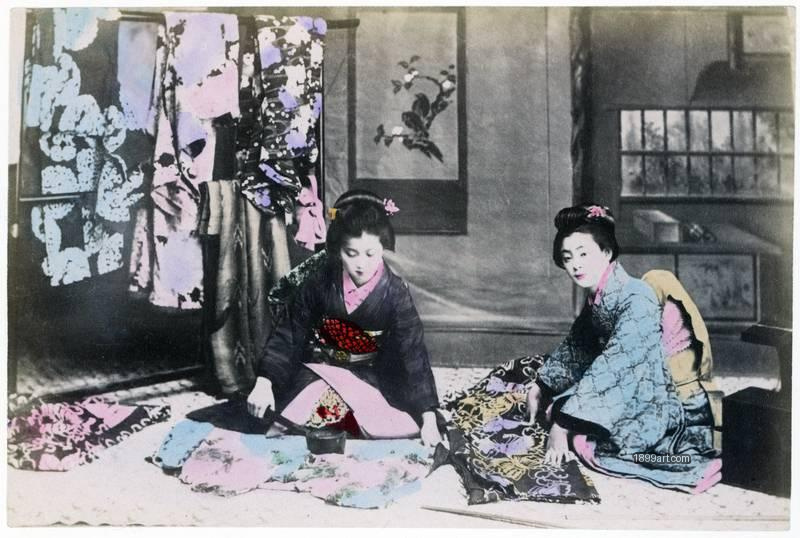
1899art Kimbei Motif Japanese Dress Makers (No. 620) — Studio Genre Scene from the Meiji Era Handcolored 1900s 1899art
From the 1899art Archive: This hand-colored albumen photograph from the Meiji period depicts two women engaged in textile work, presented as a carefully staged studio scene. Known under the title Japanese Dress Makers (Motif No. 620), the image belongs to the tradition of Yokohama Shashin, a genre widely produced for Western visitors at the turn of the 20th century.
Originally photographed in black and white, the print was later meticulously hand-colored using transparent watercolor pigments, a process often carried out by highly trained Japanese artisans—sometimes former ukiyo-e woodblock printers—who applied color without obscuring photographic detail. The women are shown working with lengths of fabric, emphasizing manual skill, order, and domestic craftsmanship rather than individual identity. The photograph is attributed to Kusakabe Kimbei, whose studio specialized in such idealized representations of everyday Japanese life, blending documentary themes with deliberate visual composition.
Japan · c. 1895–1910 · Hand-colored photograph
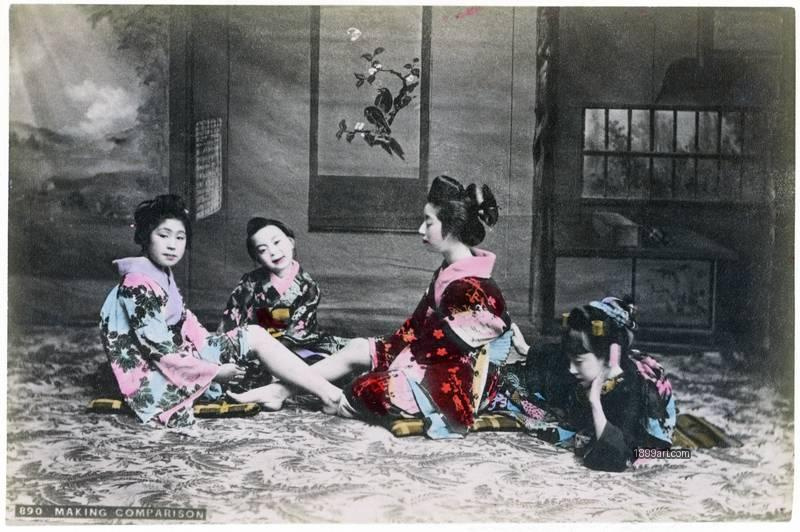
1899art Making Comparison (No. 890) — Studio Genre Scene by Kusakabe Kimbei Handcolored 1900s 1899art
From the 1899art Archive: This hand-colored albumen photograph, titled Making Comparison and catalogued as No. 890, is a studio genre scene attributed to Kusakabe Kimbei and produced within the Yokohama School tradition during the late 19th century. The image depicts a group of young women—likely maiko or performers—seated informally on floor cushions within a staged interior. Each figure wears a differently patterned kimono, and their varied postures, gestures, and expressions are carefully arranged to invite visual comparison.
Japan · c. 1895–1910 · Hand-colored photograph
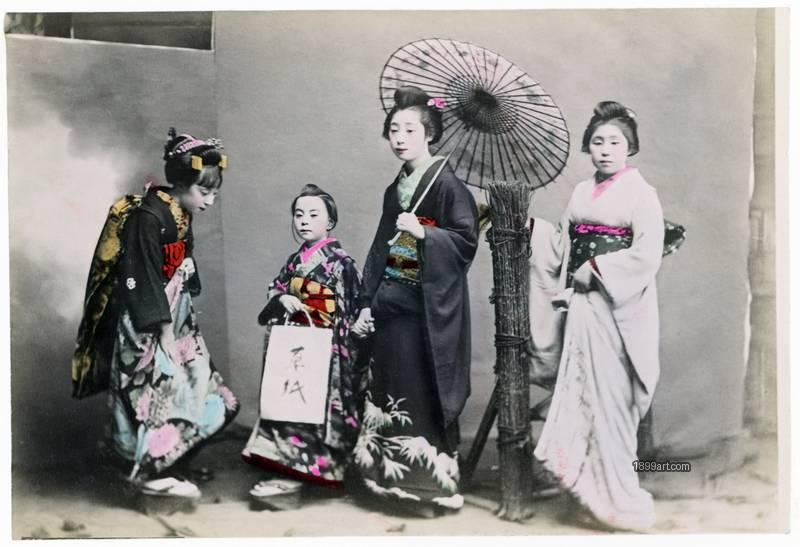
1899art Japan Sakura — Studio Group Portrait with Child Figure by Kusakabe Kimbei Handcolored 1900s 1899art
From the 1899art Archive: This hand-colored albumen photograph shows a carefully arranged studio group of four figures dressed in formal kimono. Among them is a small girl, positioned near the center of the composition, who carries a paper bag marked with the kanji 桜 (sakura, cherry blossom). Her youthful presence contrasts gently with the taller, older women beside her and introduces a subtle generational dimension to the scene.
The child’s role is clearly symbolic rather than documentary: she serves as a visual and thematic anchor for ideas of youth, innocence, and transience traditionally associated with sakura. The surrounding women—likely maiko or performers—are posed in composed, elegant stances around a paper umbrella (wagasa), reinforcing the staged, theatrical nature of the image. Originally photographed in black and white and later meticulously hand-colored, the scene exemplifies Yokohama School studio practice of the late Meiji era, offering foreign audiences an idealized tableau of femininity, beauty, and seasonal symbolism rather than a depiction of everyday life.
Japan · c. 1895–1910 · Hand-colored photograph
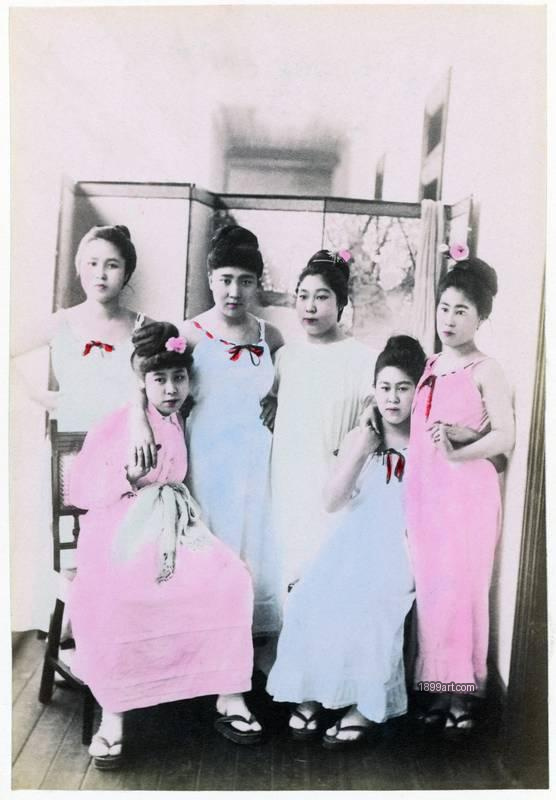
1899art Japan Girls associated with the Shimpuro (Shinpu-rō) brothel, Yokohama Handcolored 1900s 1899art
From the 1899art Archive: This photograph shows a posed group of young women associated with the Shimpuro (Shinpu-rō) brothel in Yokohama, one of the licensed pleasure districts that developed alongside the treaty port in the late 19th century. The women are arranged formally in an interior studio setting, wearing light-colored undergarments accented with hand-applied pink and red tones—typical of Yokohama School hand-coloring, where selective color was used to soften the image and guide the viewer’s eye.
The restrained poses, carefully styled hair, and subtle facial expressions reflect the dual nature of such photographs: simultaneously documentary and commercial. Produced primarily for foreign visitors, images like this were intended to present an idealized, orderly vision of life within Japan’s pleasure quarters rather than an unguarded reality. The brothel name in the title functions less as individual identification and more as a location marker, situating the image within Yokohama’s regulated entertainment culture of the Meiji era.
Japan · c. 1895–1910 · Hand-colored photograph
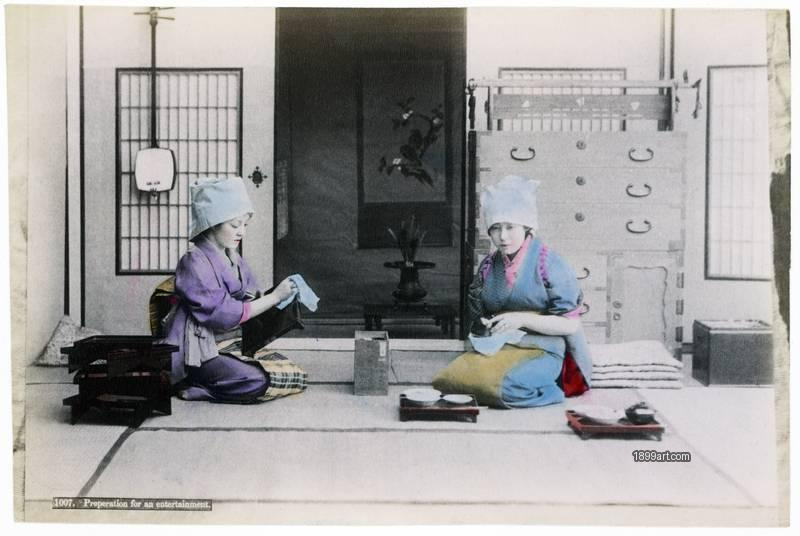
1899art Japan – Preparing for Entertainment Attributed to T. Enami, Yokohama School, Handcolored 1900s 1899art
From the 1899art Archive: This studio photograph depicts two young women seated indoors, engaged in quiet preparations before an evening entertainment. Dressed in light kimono and head coverings, they carefully fold textiles and arrange personal items on small trays, suggesting a transitional moment between private preparation and public appearance. The setting—tatami flooring, sliding screens, low furniture, and decorative alcove—reflects a carefully staged interior typical of Yokohama School photography.
The English caption “1007. Preparing for entertainment”, visible on the image, is a contemporary studio catalogue title created for the Western export market. The term “entertainment” was intentionally broad, referring to music, dance, or social performance, and avoids explicit description while evoking the refined atmosphere associated with Japan’s licensed pleasure and entertainment quarters in Yokohama.
Japan · c. 1895–1910 · Hand-colored photograph
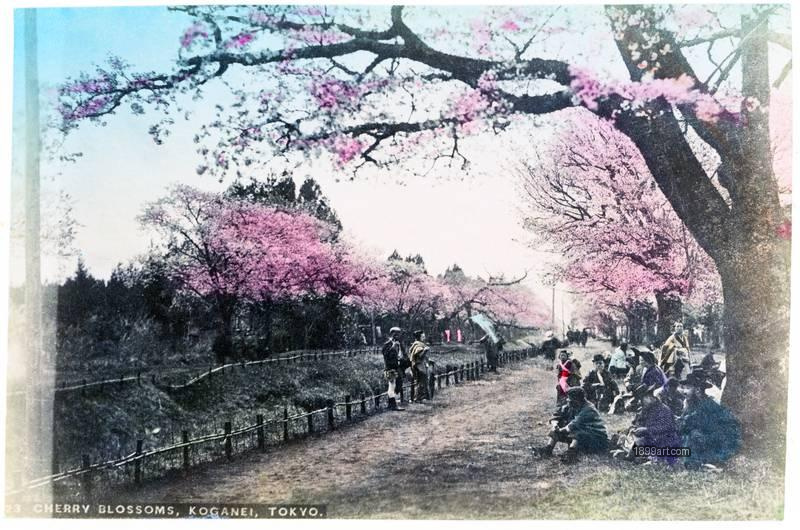
1899art Japan Cherry Blossom (Sakura) in Koganei, Tokyo Handcolored 1900s 1899art
From the 1899art Archive: This photograph depicts cherry blossoms in Koganei, near Tokyo, around the year 1912. Cherry blossoms (sakura) are a central symbol of Japanese culture and traditionally mark the arrival of spring.
Sakura embodies both beauty and transience, as the blossoms reach full bloom for only a brief period—often little more than a week. The custom of viewing the blossoms, known as hanami, has been practiced for centuries. Once a privilege of the aristocracy, hanami gradually became a popular social tradition, bringing people of all backgrounds together in parks and gardens to celebrate the fleeting beauty of nature.
Japan · c. 1895–1910 · Hand-colored photograph
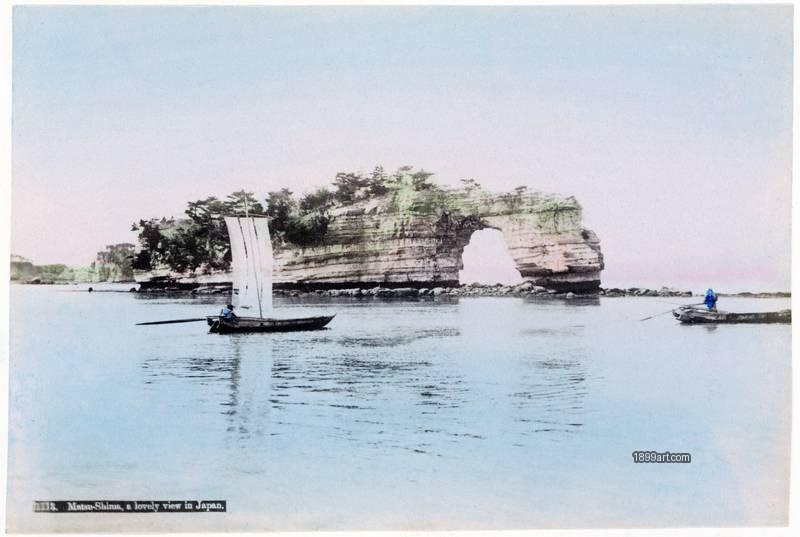
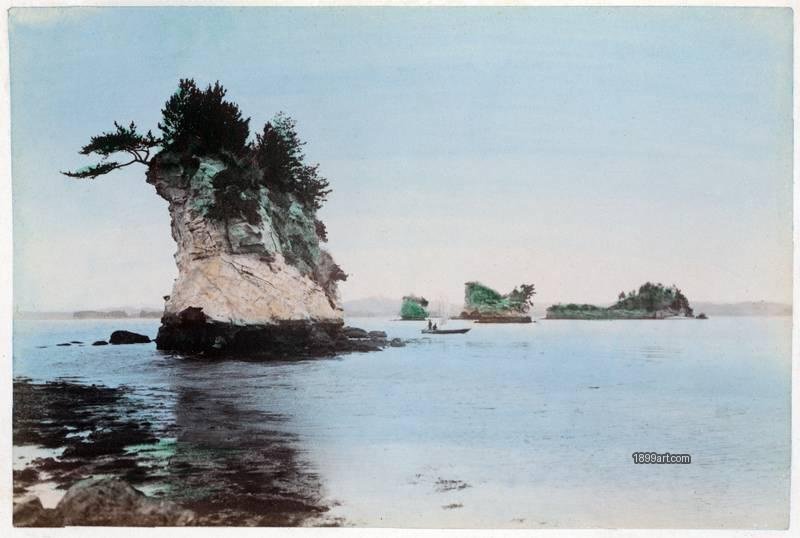
1899art Japan Matsushima Islands Natural Arch Handcolored 1900s 1899art
From the 1899art Archive: This photograph shows a natural rock arch in Matsushima Bay, a landscape traditionally celebrated as one of the Three Most Scenic Views of Japan. The bay is renowned for its more than 260 small islands, many of them covered with pine trees, creating a distinctive and highly picturesque seascape.
The name Matsushima literally means “pine islands,” reflecting the defining character of the region. Traditional wooden boats can be seen on the water, adding a human scale to the dramatic natural setting. The scene was photographed around 1904 in Miyagi Prefecture, located northeast of Sendai, and captures the enduring harmony between coastal nature and maritime life in early 20th-century Japan.
Japan · c. 1895–1910 · Hand-colored photograph
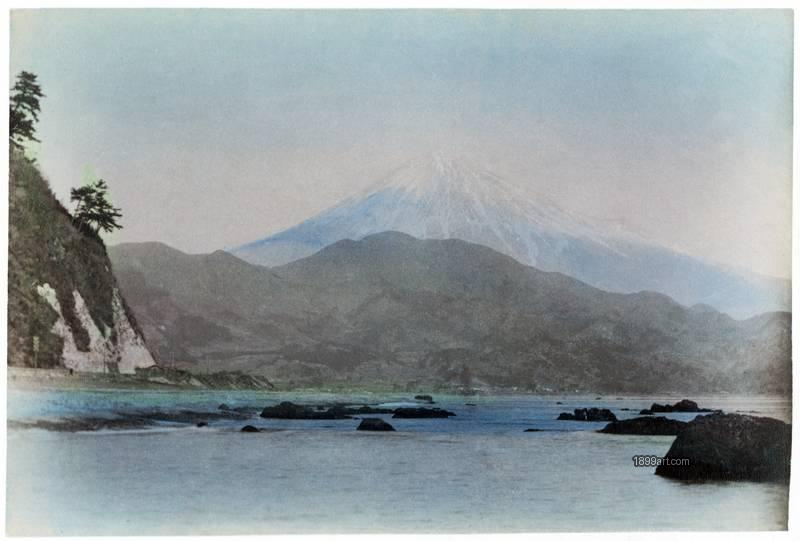
1899art Mount Fuji from the Coast Handcolored 1900s 1899art
From the 1899art Archive: This hand-colored albumen photograph presents Mount Fuji rising majestically in the distance, viewed from a quiet coastal shoreline. The calm sea, scattered rocks, and gently receding hills form a layered composition that guides the eye toward Japan’s most iconic mountain.
Mount Fuji has long been revered as a symbol of spiritual significance, natural beauty, and national identity. The soft, atmospheric hand-coloring—subtle blues in the water and sky, muted earth tones along the coast—reflects the aesthetic conventions of Yokohama School export photography, created for an international audience at the turn of the 20th century. The image emphasizes serenity and timelessness, capturing an idealized vision of the Japanese landscape that shaped global perceptions of Japan during the Meiji era.
Japan · c. 1895–1910 · Hand-colored photograph
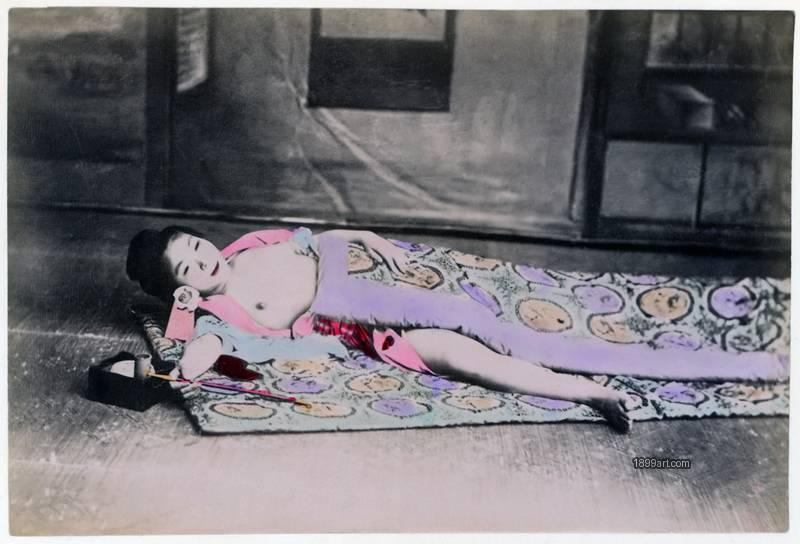
1899art Japan Reclining Japanese Woman Handcolored 1900s 1899art
From the 1899art Archive: This hand-colored albumen photograph depicts a young woman reclining on patterned textiles inside a traditional Japanese interior. She is shown resting on her side, partially draped in a decorated cloth, with her pose conveying calmness and intimacy rather than action. The sparse setting—wooden floor, sliding doors, and minimal furnishings—focuses attention on the figure and the carefully arranged fabrics.
The image belongs to the visual tradition of Yokohama School photography, produced primarily for the Western export market. Such scenes were often staged to present an idealized and aestheticized vision of femininity and domestic life. Selective hand-coloring, applied to the textiles and skin tones, softens the photographic realism and reflects the fusion of Western photographic techniques with Japanese pictorial sensibilities at the turn of the 20th century.
Japan · c. 1895–1910 · Hand-colored photograph
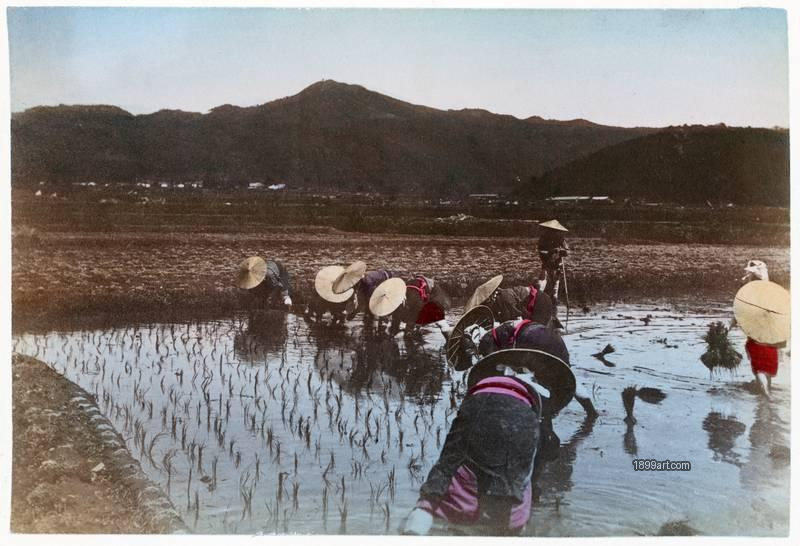
1899art Rice Transplanting (Taue), Japan Handcolored 1900s 1899art
From the 1899art Archive: This image shows Japanese rice farmers engaged in the traditional practice of rice transplanting, known in Japanese as taue. The scene captures women wearing traditional work clothing and conical straw hats as they carefully replant young rice seedlings by hand in flooded paddies.
Rice transplanting is a fundamental stage of wet-rice cultivation. Seedlings are first grown in nursery beds and then transferred to water-filled fields, where standing water helps suppress weeds and pests while supporting healthy growth. The fields remain flooded for much of the growing season and are drained shortly before harvest. Such work was—and in many regions of Asia still is—carried out manually through coordinated communal labor, reflecting both the agricultural knowledge and the social organization that sustained rural life in Japan at the end of the 19th century.
Japan · c. 1895–1910 · Hand-colored photograph
1899art Japan Godaidō Pavilion with Rickshaw and Geisha, Matsushima Handcolored 1900s 1899art
From the 1899art Archive: This hand-colored albumen photograph depicts the Godaidō Pavilion set on a small pine-covered island in Matsushima Bay, one of the landscapes traditionally celebrated as the Three Most Scenic Views of Japan. The pavilion is connected to the mainland by a narrow wooden bridge visible on the left, while traditional boats rest quietly in the sheltered water below.
In the foreground, a rickshaw occupies a central position, emphasizing the transition-era character of the scene. Rickshaws were a common means of short-distance transport during the Meiji period, especially in scenic or urban areas frequented by travelers. The seated passenger is a woman dressed in patterned kimono, likely posed to represent refined travel or leisure, while the puller stands beside the vehicle, reinforcing the image’s documentary appeal for foreign audiences.
To the right, a geisha stands near the water holding a traditional paper parasol. Her elaborate kimono, composed posture, and parasol identify her as a cultural figure associated with entertainment, elegance, and artistic accomplishment rather than everyday labor. The inclusion of a geisha adds a symbolic layer to the composition, blending landscape, architecture, and idealized representations of Japanese culture into a single, carefully staged scene.
Japan · c. 1895–1910 · Hand-colored photograph
1899art Street Scene in Matsushima Handcolored 1900s 1899art
From the 1899art Archive: This hand-colored albumen photograph depicts a street scene attributed to Matsushima, a well-known coastal destination near Sendai that was popular with travelers during the Meiji period. The gently rising road is lined with traditional wooden buildings and leafless trees, suggesting a cooler season or early spring. A wooded hillside in the background reinforces the impression of a small town set within a natural landscape rather than a large urban center.
In the foreground and along the street, a group of uniformed men—likely police or local officials of the Meiji era—stand in formation, while civilians move through the scene. A rickshaw is visible, indicating the presence of visitors and the town’s role as a frequented scenic or pilgrimage site. The combination of official presence, everyday activity, and traditional architecture provides a vivid snapshot of public life in provincial Japan at the turn of the 20th century.
Japan · c. 1895–1910 · Hand-colored photograph
1899art Matsushima Bay Miyagi Prefecture, Japan Handcolored 1900s 1899art
From the 1899art Archive: This image depicts Matsushima Bay, a landscape traditionally celebrated as one of the Three Most Scenic Views of Japan. The bay is renowned for its picturesque setting of more than 260 small islands, many densely covered with pine trees that define the character of the region.
The name Matsushima literally translates as “pine islands,” a direct reference to this distinctive landscape. The dramatic rock formations visible throughout the bay were shaped over time by wind and waves, creating a varied and visually striking coastline. Long admired for its natural beauty, Matsushima has also been a popular destination for travelers, known for its historic temples, teahouses, and boat excursions that allow visitors to experience the scenery from the water.
Japan · c. 1895–1910 · Hand-colored photograph
1899art Coast of Awajishima (Awaji Island), Seto Inland Sea. Attributed to Kusakabe Kimbei, Japan Handcolored 1900s 1899art
From the 1899art Archive: This hand-colored albumen photograph depicts the rugged coastline of Awaji Island (Awajishima), situated in the Seto Inland Sea. The scene is characterized by layered rock formations shaped by wind and waves, pine-covered cliffs, and a small sailing boat navigating the shallow coastal waters, providing a sense of scale and quiet movement within the landscape.
The image is stylistically consistent with the work of Kusakabe Kimbei and is therefore attributed to him. Kimbei was renowned for producing scenic views intended for the international market, often emphasizing iconic coastal formations and tranquil maritime scenes. The soft, atmospheric hand-coloring—subtle blues and greens in the water and sky combined with muted earth tones—reflects late 19th-century Japanese practices of enhancing monochrome photographs to create visually appealing souvenirs.
Awajishima lies in Hyōgo Prefecture and has long been noted for its dramatic shoreline within the Seto Inland Sea. Photographs like this exemplify how Japanese photographers of the Meiji period combined natural scenery, traditional sailing vessels, and refined hand-coloring techniques to shape Western perceptions of Japan’s coastal landscapes around 1900.
Japan · c. 1895–1910 · Hand-colored photograph
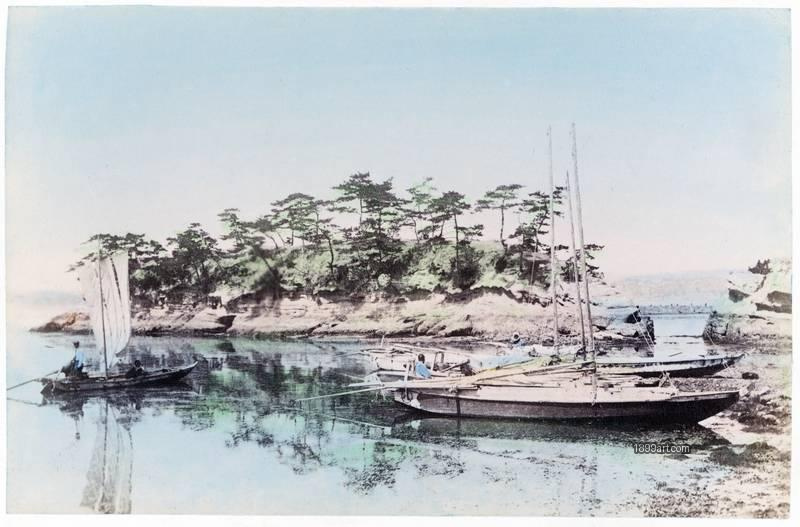
1899art Fishing Boats in Matsushima Bay Miyagi Prefecture, Japan, Meiji period Handcolored 1900s 1899art
From the 1899art Archive: This image depicts fishing boats in Matsushima Bay, a coastal landscape renowned for its more than 260 pine-covered islands and traditionally celebrated as one of the Three Most Scenic Views of Japan. Traditional Japanese sailing boats are shown near the shore of an island lined with wind-shaped pine trees, emphasizing the close relationship between maritime life and the natural environment.
Matsushima Bay lies along the coast of Miyagi Prefecture in the Tōhoku region. The photograph is a hand-colored print from a series devoted to documenting the famous bay, produced for both Japanese and international audiences during the Meiji period. Its calm composition and selective coloring enhance the sense of serenity and timeless beauty.
The poetic reputation of Matsushima is such that even the celebrated haiku poet Matsuo Bashō is said to have struggled to find words worthy of its beauty—an anecdote often cited to express the profound visual impact of this iconic landscape.
Japan · c. 1895–1910 · Hand-colored photograph
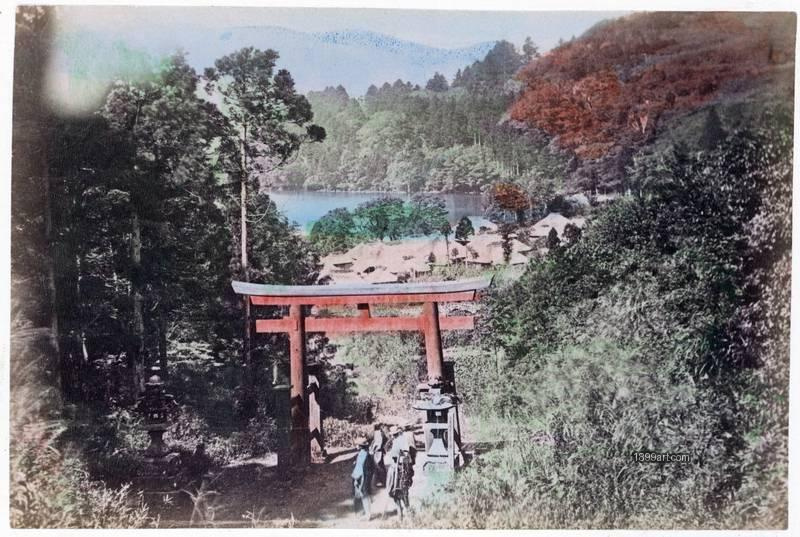
1899art Hakone Shrine on Lake Ashi Hakone, Japan Handcolored 1900s 1899art
From the 1899art Archive: This image depicts Hakone Shrine, located on the shore of Lake Ashi. The shrine is renowned for its striking red torii gates, which create a highly picturesque scene, particularly the large gate standing in the water at the lake’s edge, often referred to as the “Gate of Peace.”
Founded in 757 CE, Hakone Shrine has a history spanning more than 1,200 years. It is set within a dense forest of towering cedar trees, lending the site a deeply spiritual and contemplative atmosphere. Throughout history, the shrine has been closely associated with local legends as well as the culture of the samurai, who prayed here for protection and success on their journeys along the nearby Tōkaidō route.
Today, Hakone Shrine remains one of the most important spiritual sites in the region and a popular destination for visitors, admired for the harmonious combination of sacred architecture, natural landscape, and enduring cultural significance.
Japan · c. 1895–1910 · Hand-colored photograph
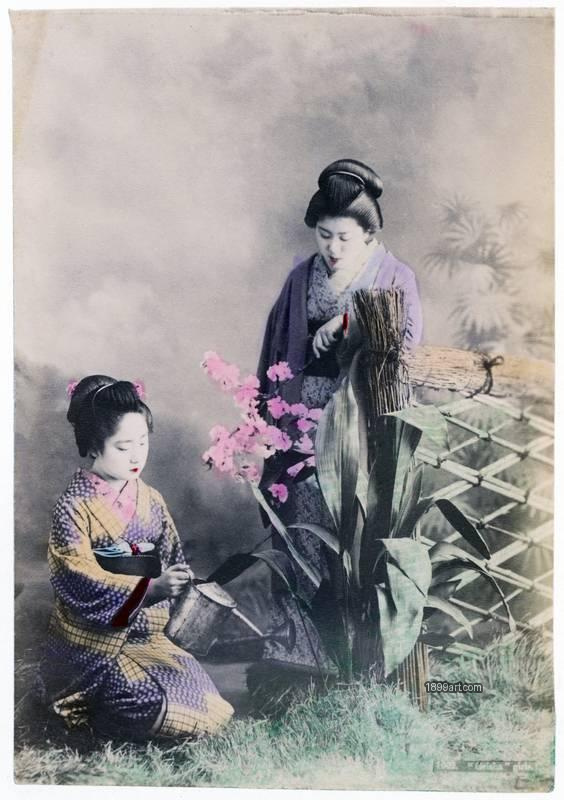
1899art Geisha Girls Japan, Meiji period Handcolored 1900s Enami 1899art
From the 1899art Archive: This hand-colored albumen photograph shows two geisha engaged in a quiet, carefully staged scene of floral arrangement. One woman kneels in the foreground, trimming or preparing stems, while the other stands behind a rustic wooden post and woven fence, thoughtfully placing blossoms among broad leaves. Their calm expressions and deliberate gestures emphasize refinement, concentration, and aesthetic discipline.
Both women wear finely patterned kimono and traditional hairstyles associated with geisha culture. Selective hand-coloring highlights soft purples, yellows, and the pink blossoms, while the background remains subdued, directing the viewer’s attention to the figures and their activity. The setting blends studio elements with garden-like motifs, creating an idealized scene rather than a purely documentary depiction.
Japan · c. 1895–1910 · Hand-colored photograph
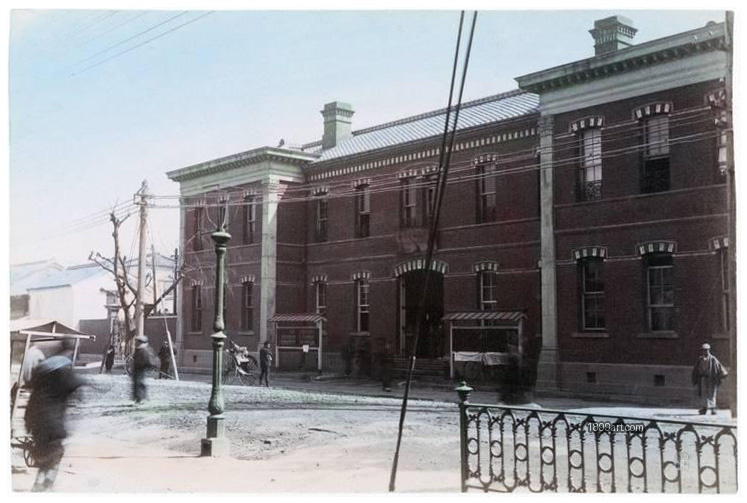
1899art Japan Kobe Post and Telegraph Office (Kōbe Yūbin Denshin Kyoku) Handcolored 1900s 1899art
From the 1899art Archive: This image depicts the former Kobe Post and Telegraph Office (神戸郵便電信局, Kōbe Yūbin Denshin Kyoku), an important public building of the Meiji era. Constructed in 1899, it served as a central hub for postal and telegraph communications in the rapidly developing port city of Kobe.
Located in the Kyōmachi district, the building was designed in a Western architectural style characteristic of late 19th-century Japan. Its red brick construction, symmetrical façade, and restrained decorative elements reflect the strong influence of European institutional architecture adopted during Japan’s modernization. As Kobe expanded as an international harbor, the post and telegraph office played a key role in connecting the city domestically and globally.
The building survived for nearly a century but was severely damaged during the Great Hanshin Earthquake in 1995. Due to the extent of the destruction, it was subsequently demolished. Today, photographs such as this preserve the memory of a landmark that symbolized modern infrastructure and communication in Meiji-period Japan.
Japan · c. 1895–1910 · Hand-colored photograph
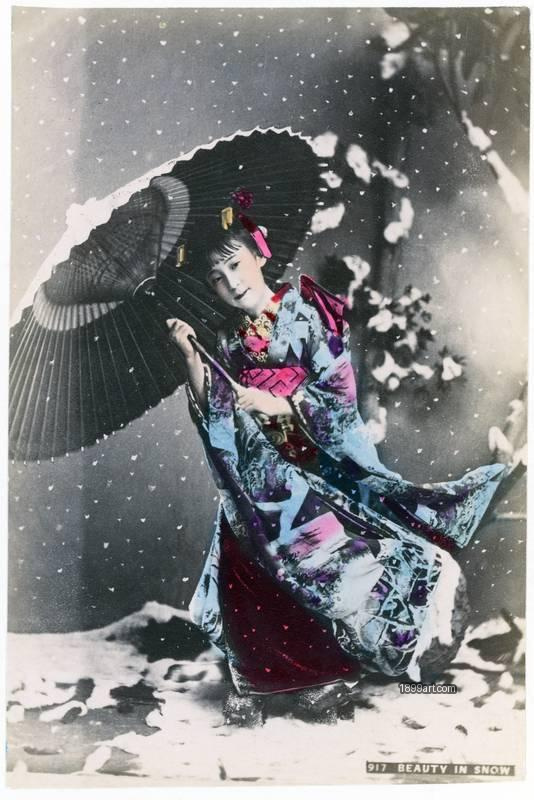
1899art No. 917 – Beauty in Snow By Kusakabe Kimbei, Japan, Meiji period Handcolored 1900s 1899art
From the 1899art Archive: This hand-colored albumen photograph portrays a young woman standing in falling snow, holding a traditional paper parasol. Dressed in a richly patterned kimono with flowing sleeves, she is shown in a dynamic pose that suggests movement through a winter landscape. The snowflakes, carefully added as a pictorial effect, create a dramatic contrast between the dark background and the brightly colored figure.
The selective hand-coloring emphasizes deep reds, purples, and blues in the kimono, while the surrounding scene remains largely monochrome. This contrast heightens the sense of elegance and theatricality, transforming the image into an idealized vision rather than a literal winter scene. The parasol and elaborate hairstyle further reinforce the figure’s association with refined femininity and classical beauty.
The printed English title “Beauty in Snow” and the catalogue number 917 are characteristic of the export photographs produced by Kusakabe Kimbei, one of the most prominent photographers of the Yokohama School. Images like this were created for Western audiences and reflect a late 19th-century fascination with Japan, presenting stylized seasonal motifs and poetic imagery that shaped international perceptions of Japanese culture around 1900.
Japan · c. 1895–1910 · Hand-colored photograph
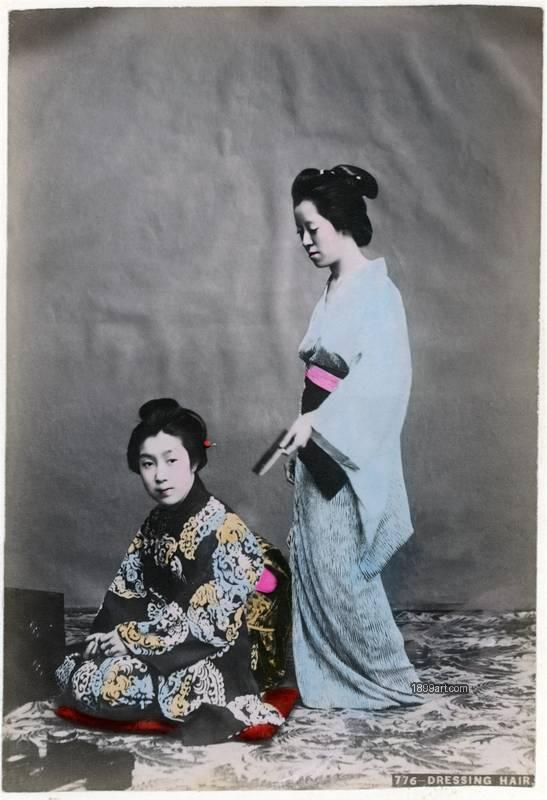
1899art Geisha Girls No. 776 – Dressing Hair Attributed to T. Enami, Japan, Meiji period Handcolored 1900s Enami 1899art
From the 1899art Archive: This hand-colored albumen photograph shows two women in a studio interior during the act of hair dressing. One woman is seated on the floor, her posture calm and composed, while the other stands behind her, holding a comb as she carefully arranges the hairstyle. The moment captured is intimate and transitional, focused on preparation rather than display.
The women wear contrasting kimono: the seated figure is dressed in a richly patterned garment with gold and dark tones, while the standing woman wears a lighter, more subdued kimono. Selective hand-coloring highlights details such as the obi, hair ornaments, and fabric patterns, while the neutral backdrop keeps the viewer’s attention on the figures and their interaction.
Japan · c. 1895–1910 · Hand-colored photograph
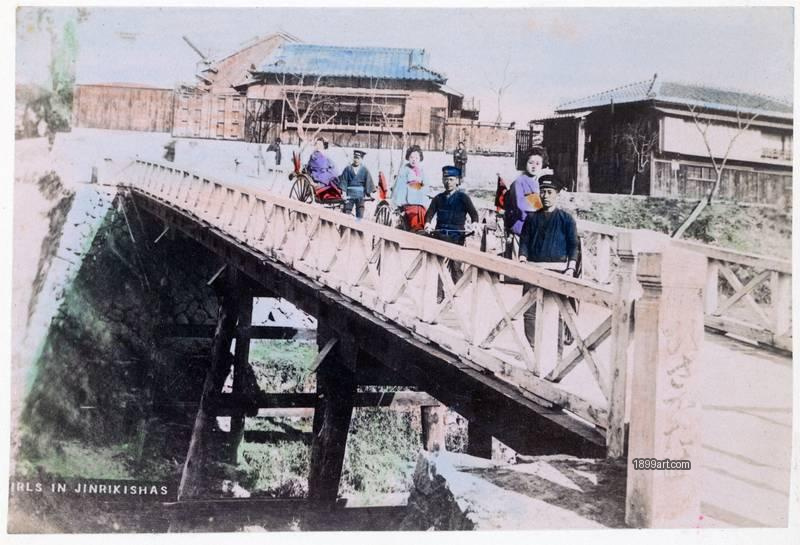
1899art Girls in Jinrikishas on a Wooden Bridge (Ebisu Bridge, Attributed) Handcolored 1900s 1899art
From the 1899art Archive: This hand-colored photographic postcard depicts a lively street scene from late 19th-century Japan, showing women and men gathered on and around a wooden bridge. Several figures are seated in or standing beside jinrikishas (rickshaws), a common mode of short-distance transport during the Meiji period. The presence of passengers, pullers, and pedestrians captures a moment of everyday movement and social interaction.
The bridge’s wooden construction, lattice-style railings, and urban surroundings are stylistically consistent with the Ebisu Bridge in Osaka, to which the scene is therefore attributed. In the background, traditional buildings with tiled roofs reinforce the impression of a growing commercial city adapting to modern life at the end of the 19th century.
Japan · c. 1895–1910 · Hand-colored photograph
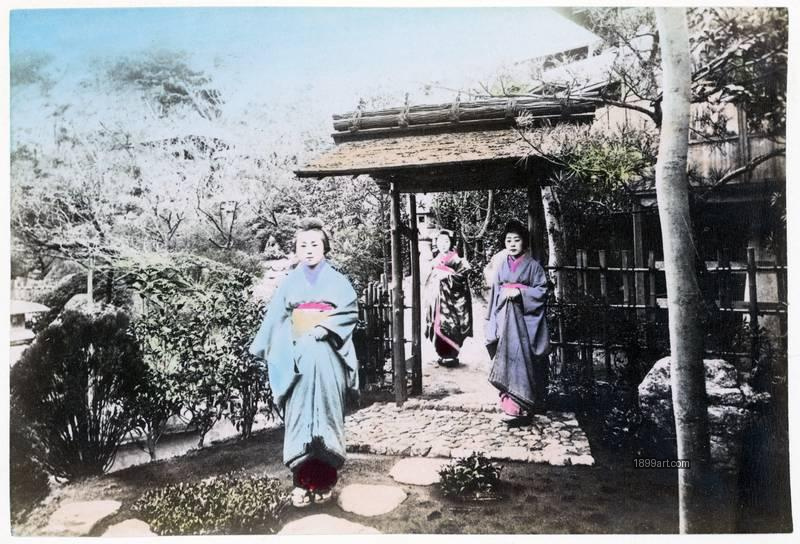
1899art Women Walking Through a Garden Gate Japan, Meiji period Handcolored 1900s 1899art
From the 1899art Archive: This hand-colored albumen photograph depicts three women walking along a stone path through a traditional Japanese garden. They pass beneath a simple wooden gate with a thatched roof, which serves as a transitional element between garden spaces. The carefully arranged shrubs, trees, and stepping stones emphasize harmony between architecture and nature.
The women wear elegant kimono in muted tones of blue, violet, and patterned fabrics, with subtle hand-coloring accentuating their garments and footwear. Their calm expressions and measured steps suggest a composed, almost ceremonial movement rather than hurried activity. The scene appears gently staged, presenting an idealized moment of refined leisure.
Japan · c. 1895–1910 · Hand-colored photograph
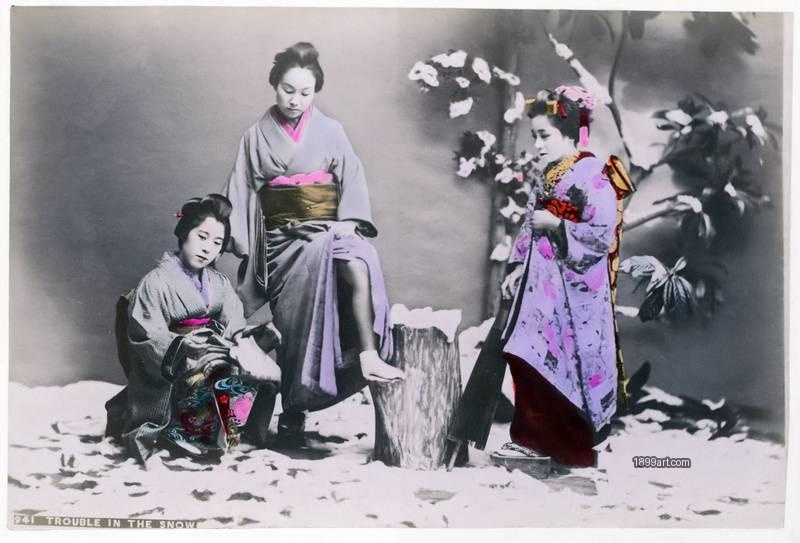
1899art Japan Meiko Girls No. 941 – Trouble in the Snow By Kusakabe Kimbei, Japan, Meiji period Handcolored 1900s 1899art
From the 1899art Archive: This hand-colored albumen photograph depicts three Meiko girls posed in a winter scene, surrounded by falling snow. Two women are seated or kneeling near a low wooden stump, while a third stands to the side holding a broom, suggesting a moment of mild disturbance or playful tension implied by the title “Trouble in the Snow.” The scene is clearly staged, combining theatrical gesture with seasonal symbolism rather than documenting an actual event.
Japan · c. 1895–1910 · Hand-colored photograph
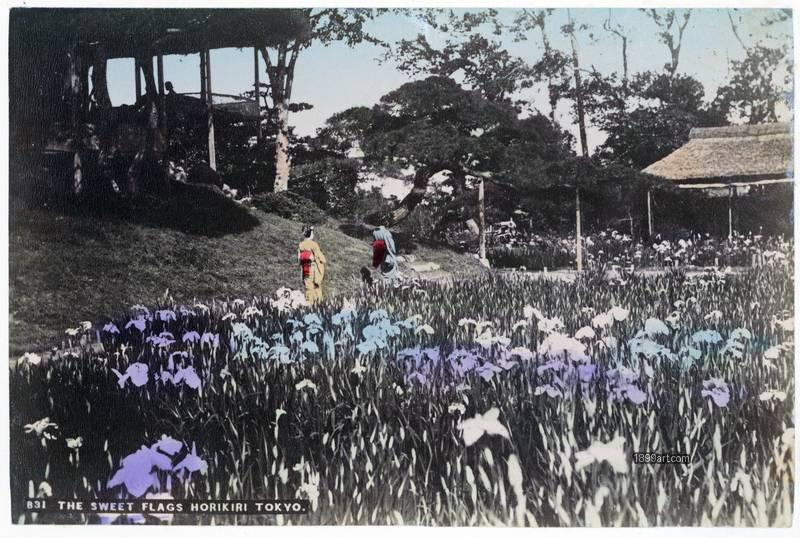
1899art Japan Geishas No. 831 – The Sweet Flags, Horikiri, Tokyo
Japan, Meiji period Handcolored 1900s Kimbei 1899art
From the 1899art Archive: This hand-colored albumen photograph shows an iris garden (shōbu, often translated as “sweet flags”) in Horikiri, an area historically famous for its seasonal flower displays. Dense rows of blooming irises fill the foreground, rendered with delicate hand-coloring in shades of violet, blue, and white, creating a rhythmic, almost painterly surface.
In the middle distance, two figures in traditional dress walk slowly along a path bordering the garden, providing scale and a sense of quiet movement. Behind them, trees, a rustic pavilion, and simple wooden structures frame the scene, reinforcing the impression of a cultivated landscape designed for leisure and contemplation.
Horikiri was a popular destination for flower viewing in the late Edo and Meiji periods, particularly during the iris-blooming season. Photographs such as this were produced for the domestic and export markets, celebrating Japan’s seasonal aesthetics and garden culture. The image combines documentary observation with careful staging and hand-coloring, offering an idealized vision of Tokyo’s suburban pleasure gardens around 1900.
Japan · c. 1895–1910 · Hand-colored photograph
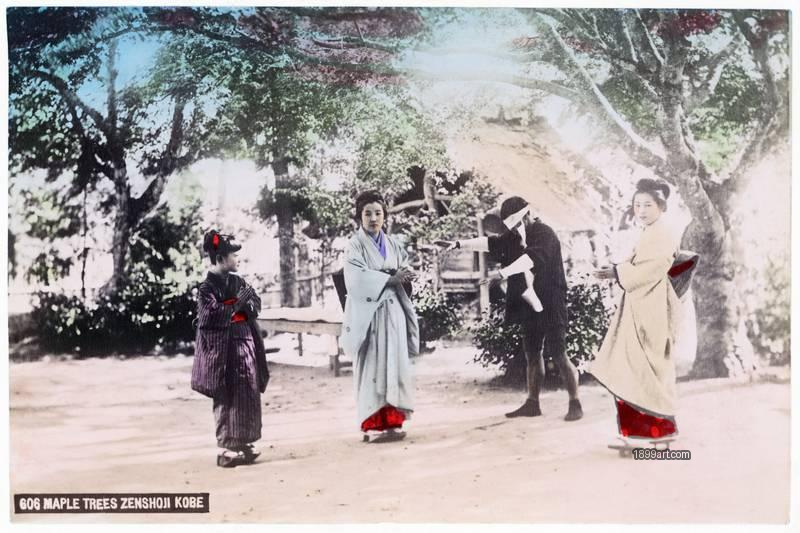
1899art Geishas Meikos No. 606 – Blindfold Game beneath the Maple Trees, Zenshōji, Kobe By Kusakabe Kimbei, Japan Handcolored 1900s 1899art
From the 1899art Archive: This hand-colored albumen photograph depicts a lively autumn scene beneath maple trees at Zenshōji in Kobe. Three women in elegant kimono stand along a shaded garden path, their garments subtly highlighted with selective hand-coloring, particularly in the obi and footwear. The temple grounds and surrounding trees frame the scene as a place of leisure and seasonal enjoyment.
In the background, a man wearing a blindfold appears to be engaged in a traditional game similar to blind man’s buff (mekakushi oni). His searching posture and playful movement introduce a light, humorous narrative element that contrasts with the composed stillness of the women in the foreground. This juxtaposition of refined elegance and informal play gives the image a gentle sense of everyday life rather than a purely posed tableau.
Japan · c. 1895–1910 · Hand-colored photograph
1899art Japan No. 920 – An Afternoon Pipe By Kusakabe Kimbei, Japan, Meiji period Handcolored 1900s Enami 1899art
From the 1899art Archive: This hand-colored albumen photograph depicts three women seated on the floor of a traditional Japanese interior during a quiet afternoon moment. One woman in the center carefully passes a long pipe to the woman on the right, while the third rests to the side, observing the exchange. A small tobacco box and accessories are placed between them, emphasizing the ritualized nature of the act.
The women wear richly patterned kimono, with selective hand-coloring highlighting reds, pinks, and decorative details in the obi and hair ornaments. The restrained interior—sliding screens, painted panels, and a neutral backdrop—keeps the focus on the figures and their interaction, creating a composed yet intimate scene.
Japan · c. 1895–1910 · Hand-colored photograph
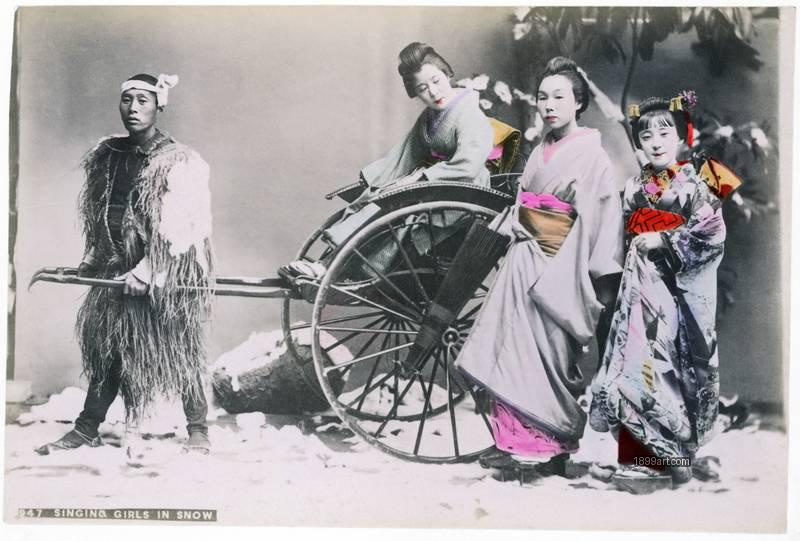
1899art Japan No. 947 – Singing Girls in Snow By Kusakabe Kimbei, Japan, Meiji period Handcolored 1900s 1899art
From the 1899art Archive: This hand-colored albumen photograph presents a staged winter scene showing three young women standing beside a jinrikisha (rickshaw), pulled by a man dressed in heavy winter clothing. Snow covers the ground, creating a stark, monochrome setting against which the richly colored garments of the women stand out vividly.
The women wear elegant kimono with brightly colored obi and hair ornaments, rendered in strong pinks, reds, and patterned fabrics through selective hand-coloring. Their poised stances and attentive expressions suggest a performative moment, echoed by the title “Singing Girls in Snow,” which implies musical or vocal entertainment rather than literal movement. The rickshaw functions both as a prop and a marker of modern Meiji-era transport, linking leisure, performance, and travel.
The dramatic contrast between the white snow, dark background, and decorative color accents is characteristic of Kusakabe Kimbei’s late 19th-century export work. Like other snow-themed compositions in his 900-series, the image favors theatrical presentation over documentary realism. It offers Western viewers an idealized vision of seasonal beauty and feminine refinement, using winter as a pictorial device to heighten elegance and narrative interest in turn-of-the-century Japan.
Contact & Credits
Purpose of this site
YokohamaSchool.org is intended as a reference and context resource for the history and surviving works of the Yokohama School of hand-colored photography.
It does not claim to be complete and will be expanded over time.
Focus
Historical research, visual analysis, digital preservation and curated examples of original works from the period c. 1860–1920.
This website is currently in its early phase. Further sections on sources, studios and bibliography will follow.
YokohamaSchool.org is part of the wider 1899art project:
www.1899art.com.
Usage Rights & Legal Notice – 1899art Archive
All images published on 1899art.com originate from the 1899art Archive and are provided for cultural, educational, and historical reference purposes only.
Permitted use
Images may be linked, embedded, or shared on external websites and platforms exclusively in their original, unmanipulated form, provided that:
– the source is clearly credited as “1899art”, and
– a visible and clickable link to https://1899art.com accompanies the image.
Prohibited use
Any form of modification, including but not limited to cropping, retouching, recoloring, compositing, filtering, AI-based processing, or the creation of derivative works, is strictly prohibited without prior written permission.
Commercial use, resale, redistribution as standalone files, or inclusion in third-party archives or databases is also not permitted without explicit authorization.
Rights status
While the original photographs may be in the public domain due to age, the digital reproductions, curatorial selection, restoration decisions, metadata, and contextual presentation are the intellectual property of the 1899art Archive.
By using images from this website, you agree to respect these conditions. Automated downloading, scraping, or use of images for machine learning or AI training purposes is expressly prohibited.
EU / International Copyright Notice
All images published by the 1899art Archive are protected under European and international copyright law.
Any reproduction, redistribution, modification, AI-based processing, or commercial use beyond the explicitly permitted low-resolution web sharing is prohibited without prior written consent of the 1899art Archive.
This applies equally to high-resolution files obtained through unauthorized access, third-party leaks, or archival reproductions.
DMCA Copyright Notice & Protection
All images and digital files published by the 1899art Archive are protected by international copyright law and the Digital Millennium Copyright Act (DMCA).
Unauthorized reproduction, distribution, modification, AI processing, or commercial use of any image or high-resolution file from the 1899art Archive is strictly prohibited.
The unauthorized possession or dissemination of high-resolution files does not constitute a license and does not grant any rights of use.
Any infringement will result in DMCA takedown notices, platform removal requests, and, where applicable, legal action.