High-resolution original files are available from the 1899art Archive.
Original scans have a minimum resolution of 6,000 × 9,000 pixels.
Depending on the original source medium, original master scans of up to 15,000 × 20,000 pixels are available.
Only the low-resolution images displayed on the 1899art website may be linked, shared, or embedded on external websites, and only in their original, unmanipulated form, provided that clear attribution to “1899art” is given and a clearly visible link to https://1899art.com is included.
Any use, distribution, or publication of high-resolution files, whether obtained intentionally or inadvertently, is strictly prohibited.
Any modification, alteration, recomposition, recoloring, AI processing, or commercial reuse beyond simple linking and sharing is not permitted without prior written consent of the
1899art Archive.
YOKOHAMA SCHOOL BACK TO MAIN PAGE
Gallery 8 – 24 Motifs of the Yokohama School. All photographs are carefully reconstructed and described based on extensive research.
We strive for the highest possible accuracy in all attributions and contextual information.
If you believe any information is incorrect, please contact us and include your source.
Japan · c. 1895–1910 · Hand-colored photograph
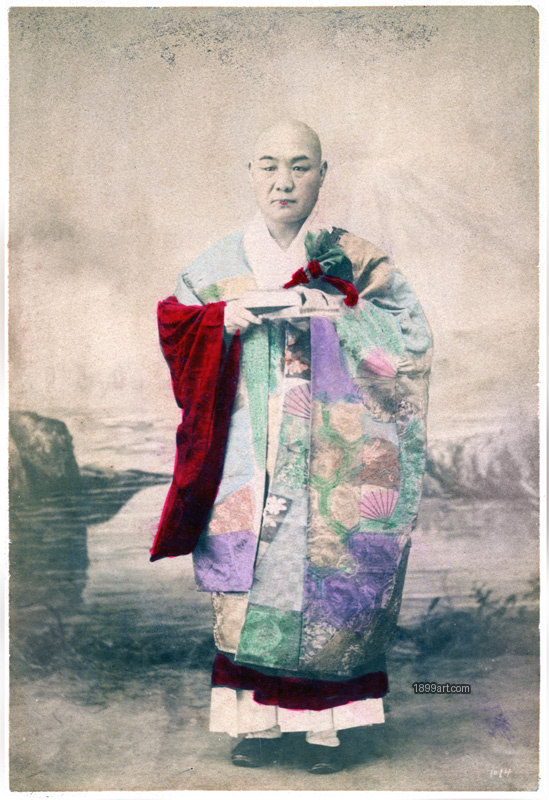
1899art Buddhist Priest in Ceremonial Robes, Japan, Late 19th Century Handcolored 1900s 1899art
From the 1899art Archive: This image shows a hand-colored studio portrait of a Japanese Buddhist priest (monk), photographed in the late 19th century during the Meiji period. Such photographs were typically produced as albumen prints and were widely created in Japanese studios for Western travelers and collectors, notably by photographers such as Felice Beato and Kusakabe Kimbei.
The monk is depicted wearing an elaborate, multi-layered ceremonial robe, known as a kasaya, distinguished by its intricate patterns and rich coloration. This garment signifies religious status and spiritual discipline, while the calm, dignified pose reflects the visual language of Buddhist portraiture as interpreted through late 19th-century studio photography in Japan.
Japan · c. 1895–1910 · Hand-colored photograph
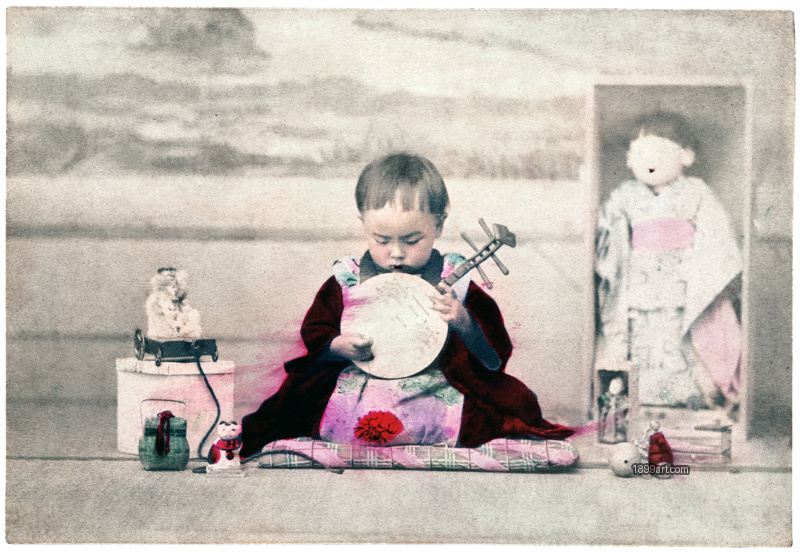
1899art Child Musician with Dolls, Japan, Meiji Period (c. 1880) Handcolored 1900s 1899art
From the 1899art Archive: This hand-colored photograph depicts a young child in traditional Japanese clothing, seated in the formal seiza posture and playing a small plucked string instrument, most likely a gekkin (yueqin) or a closely related lute-type instrument that was popular in Japan during the late 19th century.
The scene is carefully staged and dates to the late Meiji period, circa 1880–1890. Surrounding the child is a deliberately arranged selection of objects associated with childhood, play, and domestic refinement. To the left appears a mechanical toy monkey (karakuri-omocha), positioned on a small pedestal and likely operated by a winding mechanism. Such karakuri toys were popular during the Edo and early Meiji periods and represent the intersection of play, craftsmanship, and early mechanical ingenuity.
On the floor near the child are small cat figurines, probably simple children’s toys or protective talismans, reflecting the cultural association of cats with domestic harmony and guardianship. To the right stands a large doll or child figure, placed upright in a frame-like setting, accompanied by smaller doll forms—elements that further emphasize the staged, symbolic nature of the composition rather than a candid domestic moment.
Japan · c. 1895–1910 · Hand-colored photograph
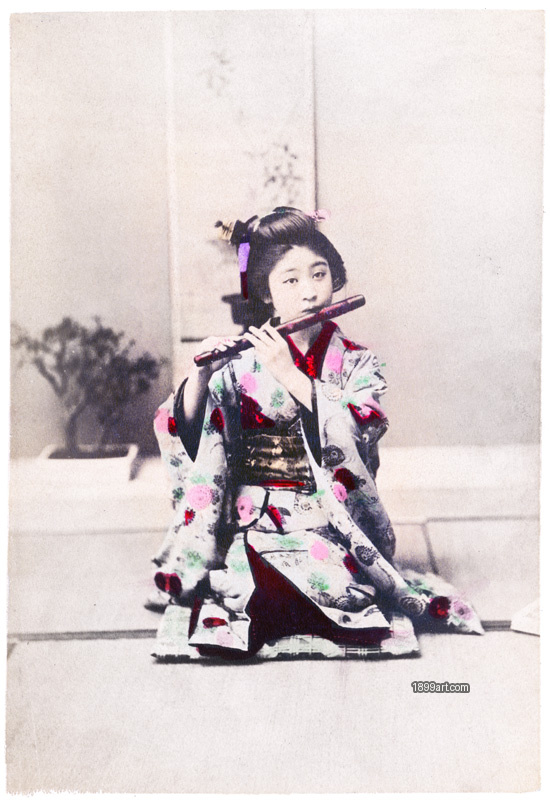
1899art Dancing Girl with Flute (B1184), Japan, Meiji Period (c. 1880s) Handcolored 1900s 1899art
From the 1899art Archive: This hand-colored photograph shows a young girl in traditional Japanese attire, seated in the formal seiza posture and engaged in a musical performance. The printed caption on the photograph, “B1184 – Dancing Girl with Flute,” strongly suggests a catalogued studio production rather than a unique or purely documentary scene. Although the instrument visible in the image resembles a small stringed lute—possibly a gekkin or a related instrument—the title reflects the studio’s commercial naming conventions, which were often generalized or adapted for a Western audience and do not always correspond precisely to the depicted instrument.
The presence of the catalogue number and English title is characteristic of Yokohama School photography and closely aligns with the numbering systems used by major studios of the period. In particular, the format “B + number + English title” is highly consistent with works attributed to Kusakabe Kimbei, whose extensive catalog featured similar genre scenes of children, musicians, and performers intended for export. While definitive attribution cannot be made without a matching catalogue reference, the title style, numbering, and subject matter make a Kimbei attribution plausible. Surrounding props, including dolls and carefully arranged objects, further reinforce the staged studio setting typical of Meiji-era commercial photography aimed at collectors and foreign travelers.
Japan · c. 1895–1910 · Hand-colored photograph
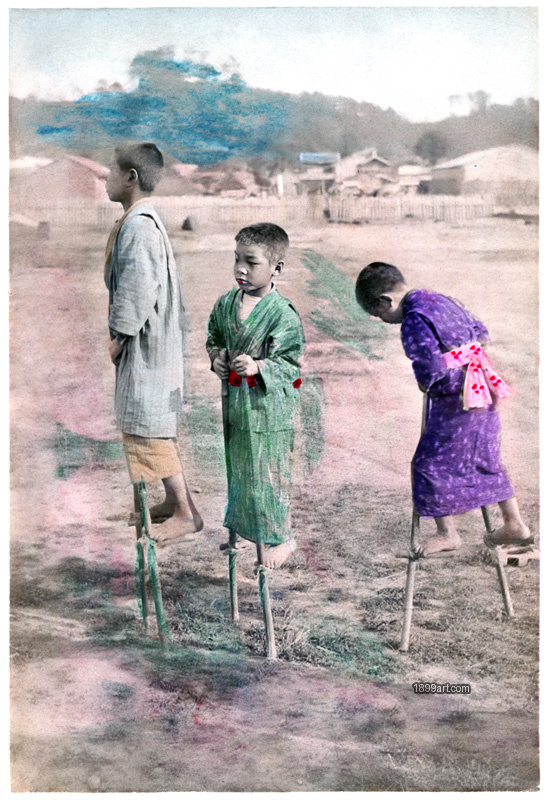
1899art Children Playing on Bamboo Stilts (Takeuma), Rural Japan, Meiji Period (c. 1880s–1890s) Handcolored 1900s 1899art
From the 1899art Archive: This hand-colored Japanese photograph, dating to the late 19th century, depicts three young boys playing outdoors in a rural setting. Dressed in simple patterned yukata, the children are shown balancing on handmade bamboo stilts, known in Japan as takeuma. The scene captures a moment of movement and play, conveying both the energy of childhood and the everyday life of the countryside during the Meiji period.
Playing on takeuma was a popular traditional pastime for children, valued not only for entertainment but also for developing balance and coordination. Images like this were often carefully composed to present an idealized vision of Japanese rural life, emphasizing innocence, tradition, and harmony with nature. The combination of playful action, traditional clothing, and an outdoor setting makes this photograph a representative example of late 19th-century genre photography from Japan.
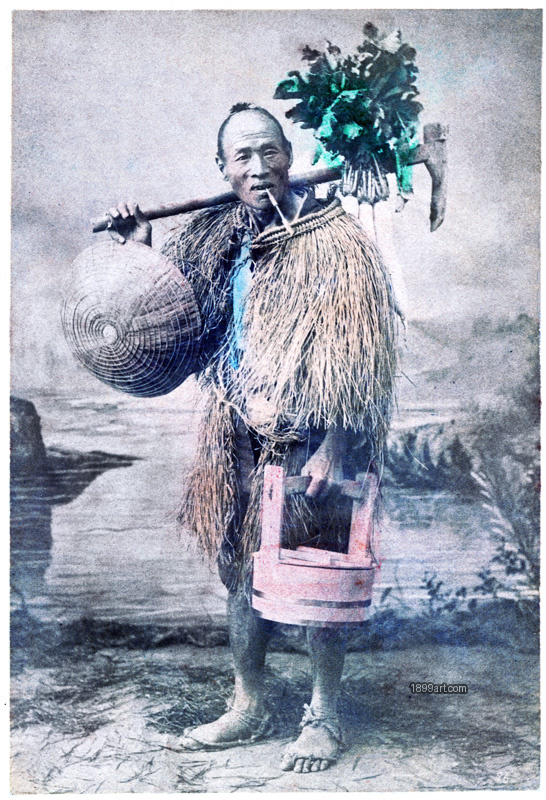
From the 1899art Archive: This historical hand-colored photograph depicts a Japanese farmer and dates to the 19th century. The printed caption “B96 – Farmer” identifies it as a catalogued studio image, produced during the Meiji period for commercial distribution. The photograph is part of the collection of the New York Public Library, where many comparable Yokohama School images are preserved today.
The man is shown wearing traditional rural clothing, including a straw raincoat (mino) and a woven basket hat, and holding agricultural tools associated with everyday farm labor.
Japan · c. 1895–1910 · Hand-colored photograph
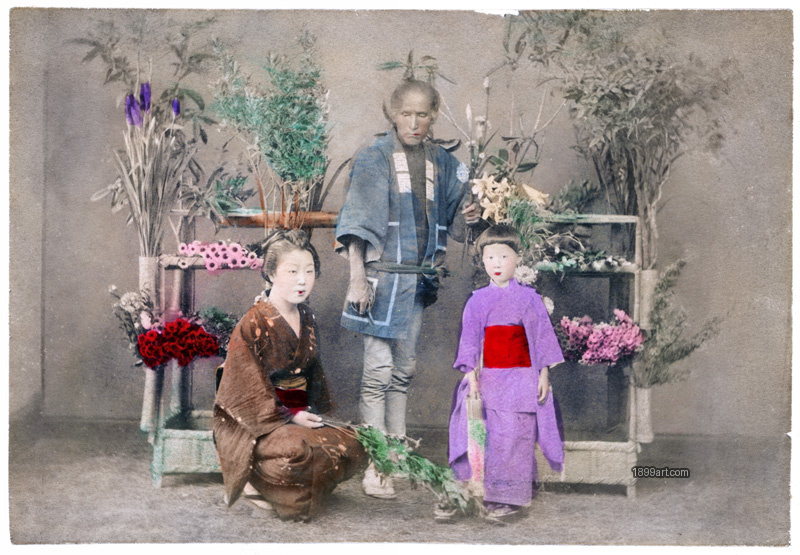
1899art Family of Flower Sellers, Japan, Meiji Period (c. 1890) Handcolored 1900s 1899art
From the 1899art Archive: This historical Japanese photograph, dating to around 1890, depicts a family of flower sellers—most likely a husband, wife, and child—arranged in a carefully staged studio setting. Surrounded by floral displays and plant arrangements, the scene reflects a genre of late 19th-century Yokohama photography that presented everyday professions and family life to Western travelers. Such images were commonly produced as souvenirs, with studios associated with photographers such as Kusakabe Kimbei playing a prominent role in shaping this visual tradition.
The composition refers to the cultural importance of flower arrangement in Japan, closely linked to the aesthetic principles of ikebana, the art of “living flowers.” Beyond simple commerce, the display of plants symbolizes harmony between nature and human life, emphasizing balance, order, and refinement.
Japan · c. 1895–1910 · Hand-colored photograph
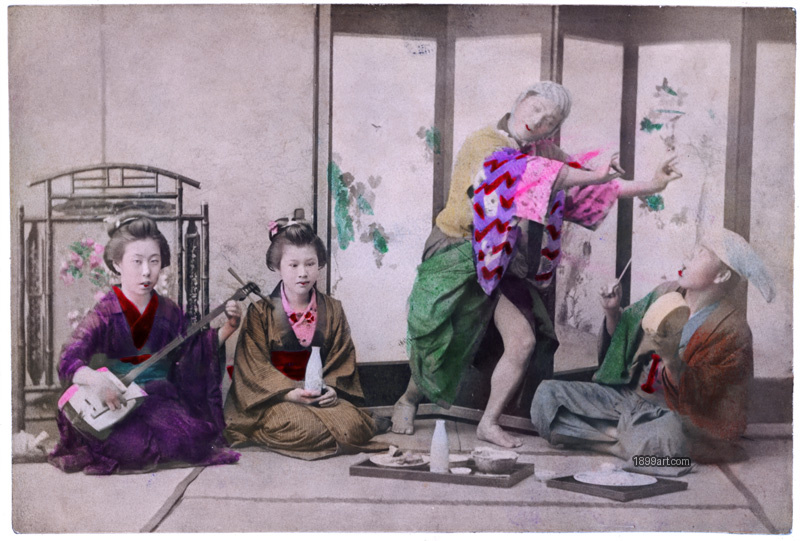
1899art Humorous Interior Scene with Musicians and Performers, Japan, Meiji Period (c. 1890) Handcolored 1900s 1899art
From the 1899art Archive: This rare hand-colored Japanese photograph, dating to around 1890, presents a carefully staged interior scene combining music, performance, and humor. Seated on tatami mats, two young women on the left play traditional instruments, including a shamisen, while the figures to the right engage in exaggerated gestures and playful interaction. The composition evokes elements of popular theatrical or comic traditions, such as folk performance or Kyōgen-inspired humor, rather than a straightforward depiction of everyday life.
Unlike the idealized and orderly genre scenes commonly produced for Western markets, this image embraces movement, bodily expression, and visual ambiguity. The lively poses, partial informality of dress, and theatrical interaction suggest a deliberate exploration of comic or satirical themes. Such motifs were produced in far smaller numbers and are therefore rarely encountered today, making this photograph an unusual and historically significant example of Meiji-era studio photography that captures a more playful and less standardized vision of Japanese cultural life.
Japan · c. 1895–1910 · Hand-colored photograph
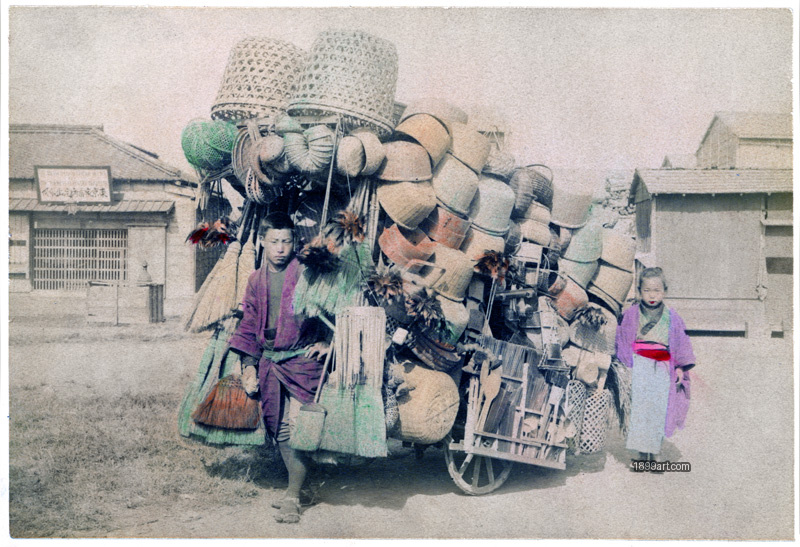
1899art Brother and Sister beside a Handcart Loaded with Baskets and Brooms, Japan, 1880 Handcolored 1900s 1899art
From the 1899art Archive: This rare photograph depicts a brother and sister standing beside a heavily loaded handcart filled with baskets and brooms, captured in Japan in 1880. The scene presents a moment of everyday working life, showing itinerant or rural trade practices typical of the early Meiji period. The figures are dressed in simple traditional clothing, and the overloaded cart emphasizes both physical labor and resourcefulness in a pre-industrial economy.
The photograph is attributed to Kusakabe Kimbei, one of the most prominent photographers of the Yokohama School. Unlike many studio-based genre scenes produced for foreign markets, this image is notable for its documentary character and restrained composition. The photograph is preserved in the collection of the Tokyo Photographic Art Museum, where it is catalogued under accession number 10010304. Its limited circulation and institutional provenance make it an especially significant visual record of everyday life in late 19th-century Japan.
Japan · c. 1895–1910 · Hand-colored photograph
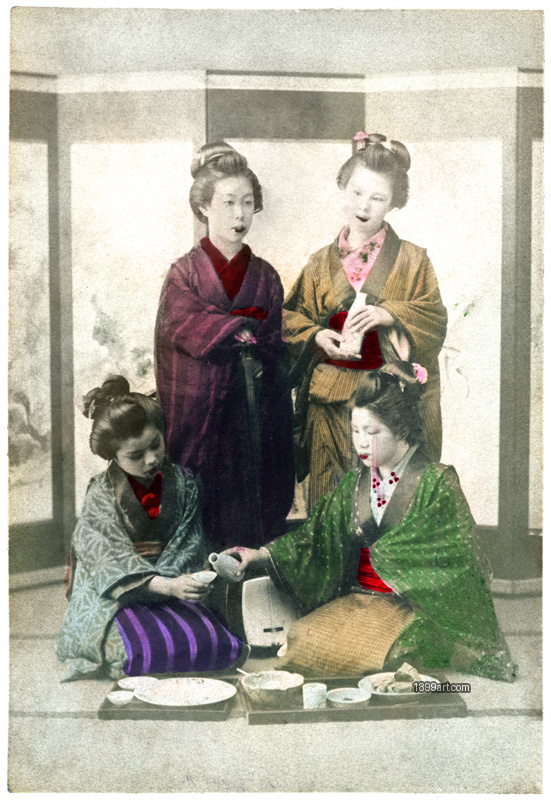
1899art Japan Japanese Tea Ceremony Handcolored 1900s 1899art
From the 1899art Archive: This rare hand-colored Japanese photograph depicts four young women gathered indoors, engaged in the preparation and serving of tea. Seated and standing before a simple interior backdrop with sliding panels, the figures are dressed in richly patterned kimono, their poses carefully arranged to emphasize harmony, gesture, and quiet interaction. The tea utensils placed on low trays in the foreground suggest a refined domestic or semi-ceremonial setting rather than a public teahouse scene.
Although the photograph is not recorded in major online archives and remains largely undocumented, it originates from the same album as other securely attributed works of Kusakabe Kimbei, making an attribution to his studio plausible. The composition reflects the Yokohama School’s approach to genre photography: staged yet intimate, presenting idealized aspects of Japanese female domestic life for foreign audiences. Its apparent uniqueness and absence from institutional collections make this image a particularly valuable example of late 19th-century Meiji-era studio photography.
Japan · c. 1895–1910 · Hand-colored photograph
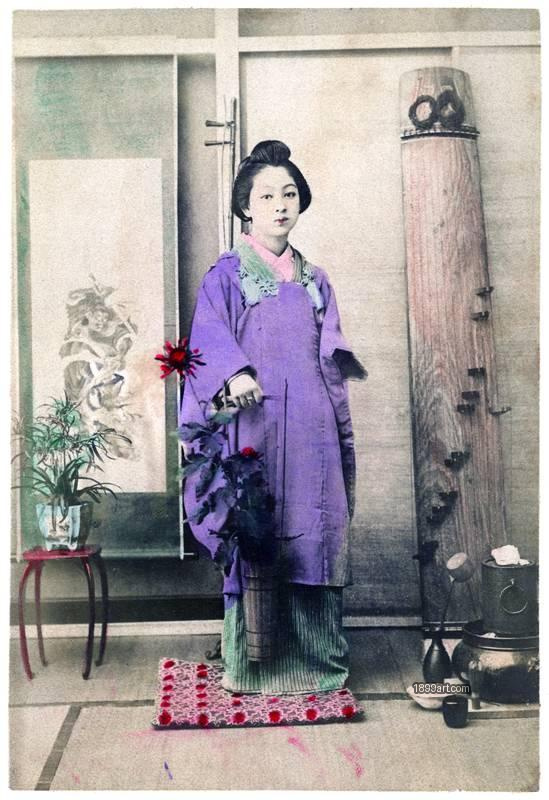
1899art Girl (B 1011), Japan, Meiji Period - Girl with Koto (c. 1890) Handcolored 1900s 1899art
From the 1899art Archive: This hand-colored Japanese studio photograph, titled “B 1011 – Girl,” dates to the late Meiji period and presents a young woman standing in a carefully arranged interior setting. She is dressed in a layered kimono ensemble with a long over-garment, her posture calm and self-contained. In her hand she holds a floral branch, while the surrounding props—painted sliding screens, a small side table with a potted plant, and a vertically stored koto (traditional Japanese zither)—form a refined and symbolically charged domestic backdrop typical of Yokohama School studio interiors.
Japan · c. 1895–1910 · Hand-colored photograph
1899art Officer’s Daughter, Japan, Meiji Period (1880s) Handcolored 1899art
From the 1899art Archive:This hand-colored Japanese studio photograph, commonly known under the English title “Officer’s Daughter,” dates to the 1880s and belongs to the visual tradition of the Yokohama School. The image presents a young woman posed in a refined interior setting, dressed in layered kimono and depicted with a calm, composed expression. The careful arrangement of costume, posture, and surrounding space reflects the aesthetic conventions of late 19th-century export photography, which aimed to present idealized images of Japanese femininity to Western audiences.
The photograph is preserved in our album associated with Kusakabe Kimbei, indicating that the motif was distributed through his studio. At the same time, the image has historically been variously attributed to Adolfo Farsari, Baron Raimund von Stillfried-Rathenitz, and Kusakabe Kimbei, reflecting the shared studios, exchanged negatives, and overlapping catalogues of Yokohama photographers during this period. As such, the photograph stands as a representative example of Meiji-era studio practice, where authorship can remain fluid while the cultural and historical significance of the image remains clear.
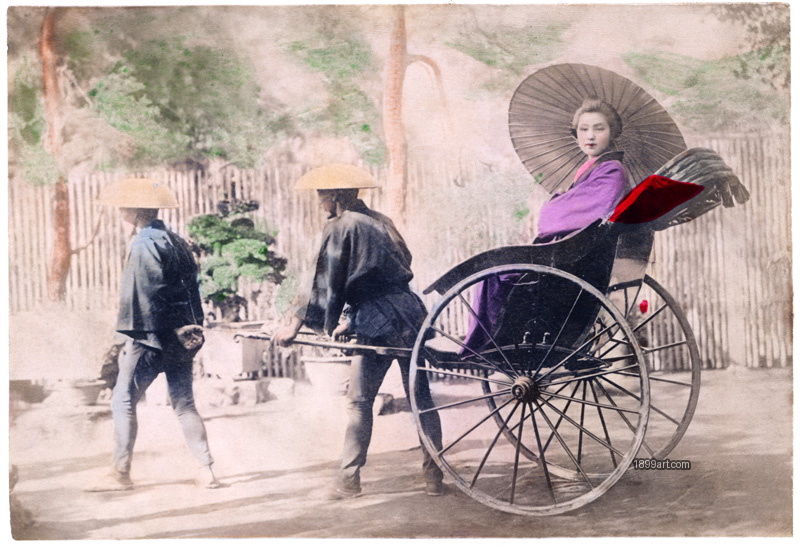
From the 1899art Archive: This hand-colored Japanese photograph, catalogued under the title “B1030 – Jinrikisha,” shows a woman seated in a rickshaw drawn by two runners along a tree-lined road. Wearing an elegant kimono and holding a paper parasol, she looks calmly toward the camera, her composed posture contrasting with the forward motion and physical labor of the pullers. The scene balances movement and stillness, presenting modern urban transport within a traditionally styled setting.
The English title and catalogue number strongly indicate production within the Yokohama School system and are consistent with the numbering practices of Kusakabe Kimbei. Rickshaw scenes such as this were popular export motifs in the late 19th century, symbolizing both everyday mobility and the visual appeal of Japanese dress and customs for foreign audiences. The careful hand-coloring highlights textiles, skin tones, and landscape details, reinforcing the image’s role as a refined yet idealized representation of Meiji-period life.
Japan · c. 1895–1910 · Hand-colored photograph
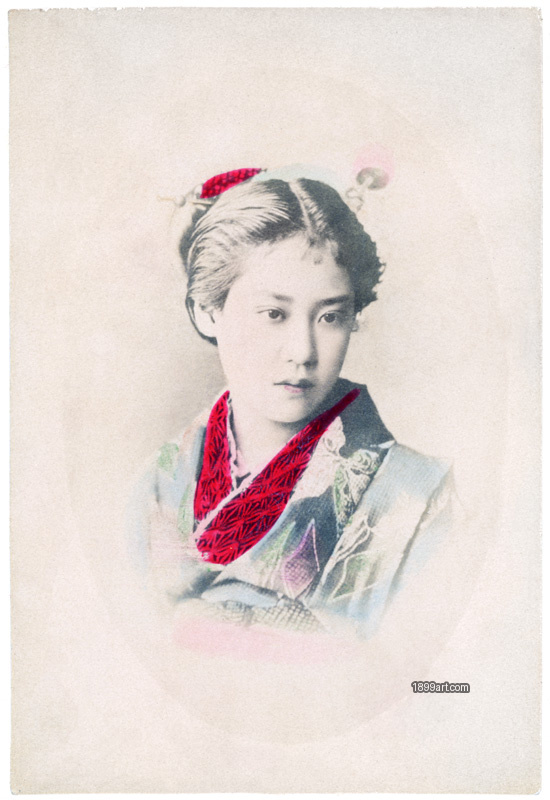
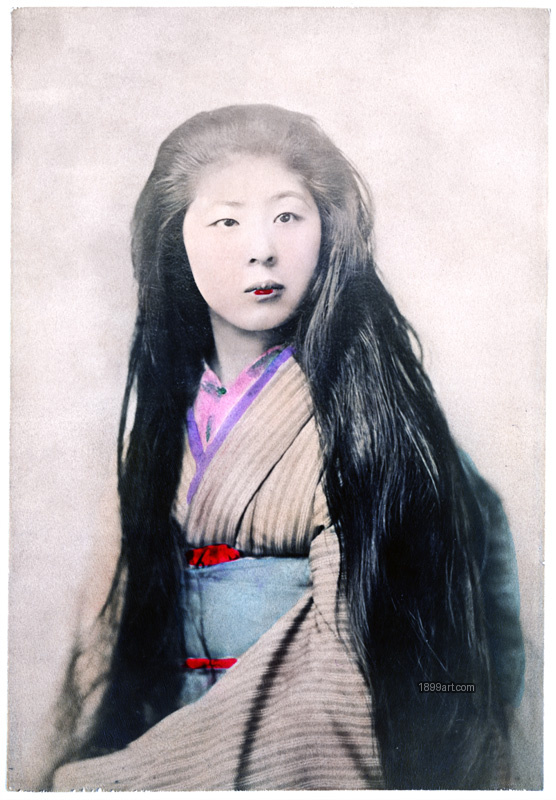
1899art Portrait of a Young Woman (No. 1236), Japan, Meiji Period (c. 1890s) Handcolored 1900s 1899art
From the 1899art Archive: This hand-colored Japanese studio portrait depicts a young woman shown in three-quarter view against a plain, neutral background. Her exceptionally long, loose hair flows over her shoulders and down her back, a striking feature that gives the image a quiet intensity and sense of individuality. She wears a finely patterned kimono with a contrasting obi, and her calm yet alert gaze is directed slightly away from the camera, lending the portrait a contemplative, almost introspective character.
The number “1236,” incised directly into the photographic surface, indicates a catalogued studio production rather than a private portrait. Such engraved numbers are characteristic of Yokohama School practices and strongly suggest commercial distribution for the foreign market. While no printed title survives, the numbering system and stylistic features are consistent with work associated with Kusakabe Kimbei or closely related studios. The restrained composition and subtle hand-coloring focus attention on the sitter herself, making this image an elegant example of late Meiji-era portrait photography.
Japan · c. 1895–1910 · Hand-colored photograph
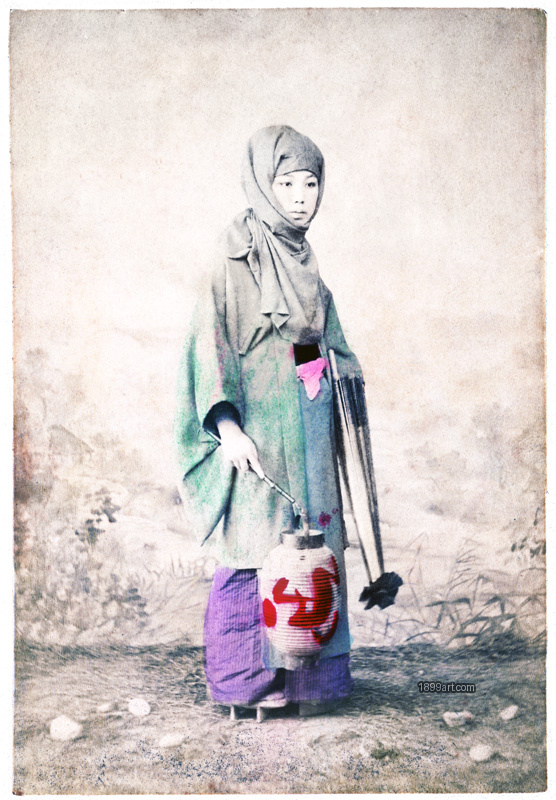
1899art Young Girl with Lantern, Japan, Meiji Period (c. 1890s) Handcolored 1900s 1899art
From the 1899art Archive: This hand-colored Japanese studio photograph shows a young girl standing outdoors against a softly painted backdrop, dressed in layered traditional clothing and wearing a headscarf. In her right hand she holds a paper lantern marked with a bold character, while a bundle of long sticks or tools rests at her side. Her upright posture and direct, serious expression lend the image a quiet dignity, contrasting with the simplicity of the objects she carries.
The photograph is known from inclusion in at least one contemporary album associated with Kusakabe Kimbei, indicating distribution through his studio. Beyond this album context, the image appears to be largely undocumented in institutional or online collections, suggesting limited circulation. As such, it represents a rare example of Meiji-era genre photography depicting youth and everyday roles, combining staged studio practice with visual references to working life and movement within late 19th-century Japan.
Japan · c. 1895–1910 · Hand-colored photograph
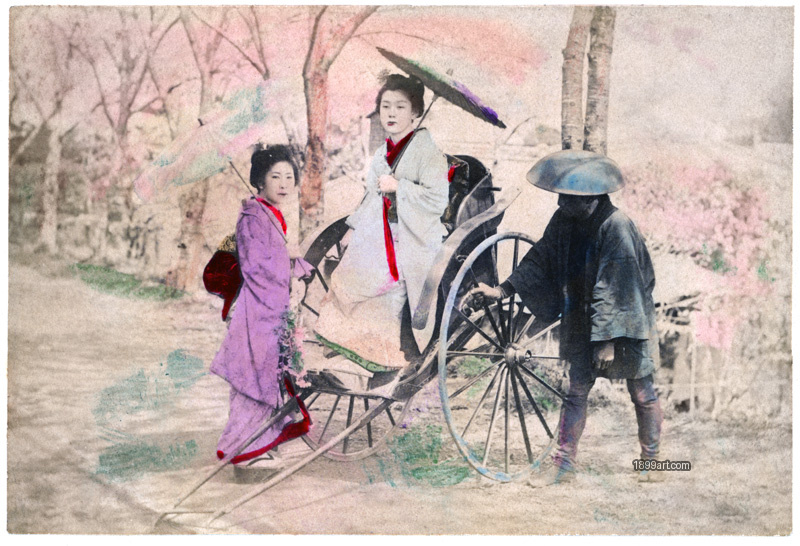
1899art Two Women with Jinrikisha and Driver, Japan, Meiji Period (c. 1890s) Handcolored 1900s 1899art
From the 1899art Archive: This hand-colored Japanese photograph depicts two women in traditional kimono positioned beside and within a jinrikisha (rickshaw), accompanied by the driver standing at the front. One woman is seated in the rickshaw holding a paper parasol, while the other stands nearby, turning toward the viewer. The scene is set along a tree-lined path, rendered with softly painted foliage that suggests an outdoor environment while retaining the controlled composition of a studio-staged image.
The contrast between the elegantly dressed women and the plainly clothed rickshaw puller emphasizes social roles and mobility in late Meiji-period Japan. Images of jinrikisha were among the most popular motifs of Yokohama School photography, symbolizing modern transportation within a traditional cultural framework. The composition, hand-coloring style, and subject matter are consistent with photographs distributed by studios associated with Kusakabe Kimbei, presenting an idealized yet informative view of everyday travel and social interaction in the late 19th century.
Japan · c. 1895–1910 · Hand-colored photograph
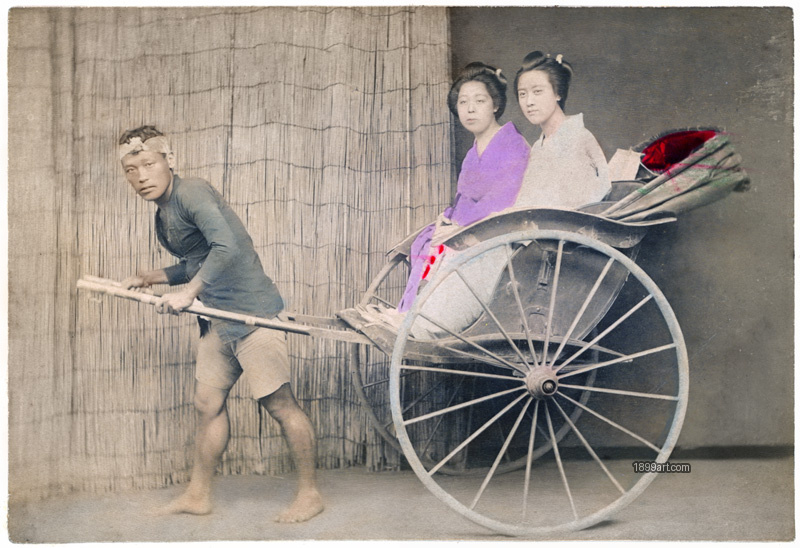
1899art Two Women in a Jinrikisha with Puller, Japan, Meiji Period (c. 1890s) Handcolored 1900s Enami 1899art
From the 1899art Archive: This hand-colored Japanese photograph depicts two women seated side by side in a jinrikisha (rickshaw), pulled by a barefoot runner moving forward along a bamboo-screened wall. The women wear traditional kimono and look calmly toward the camera, their composed expressions contrasting with the physical exertion and forward-leaning posture of the puller. The close framing and neutral background emphasize the figures and the rickshaw itself rather than a specific location.
Such images were characteristic of Yokohama School photography, in which scenes of everyday transport were carefully staged for foreign audiences. The jinrikisha, a symbol of modern mobility in late 19th-century Japan, allowed photographers to juxtapose elegance and labor within a single composition. The restrained hand-coloring highlights garments and skin tones while preserving the documentary clarity of the scene, making this photograph a representative example of Meiji-period genre photography distributed through major commercial studios, plausibly including those associated with Kusakabe Kimbei.
Japan · c. 1895–1910 · Hand-colored photograph
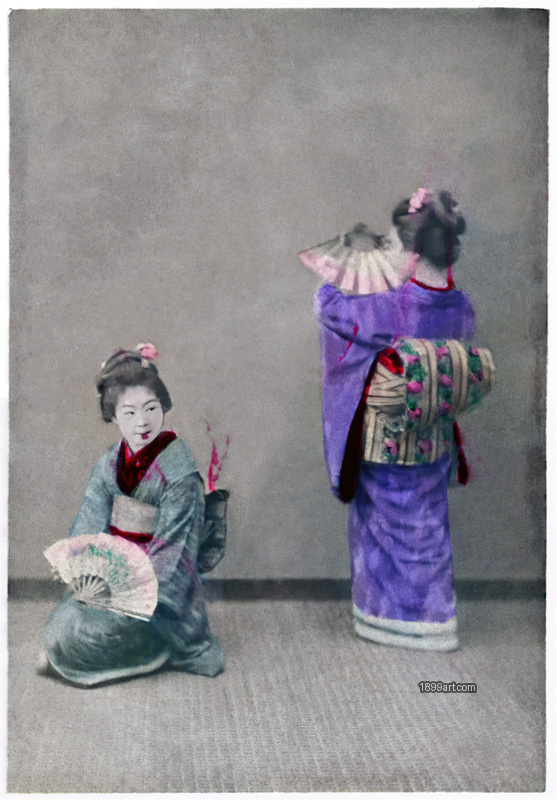
1899art Two Meiko with Folding Fans, Japan, Meiji Period (c. 1890s) Handcolored 1900s 1899art
From the 1899art Archive: This hand-colored Japanese studio photograph depicts two meiko posed in contrasting positions, both holding folding fans. One figure kneels in the foreground, turned slightly toward the viewer, while the other stands with her back partially facing the camera, creating a deliberate play between frontality and reversal. Their richly patterned kimono and carefully styled hair emphasize form, texture, and controlled gesture rather than narrative action. The neutral studio backdrop focuses attention on posture, costume, and the visual rhythm created by the fans.
Although the surface of the print shows pronounced spotting and age-related discoloration, the image originates from the same contemporary album as other Kimbei photographs and appears to be otherwise undocumented online. Such paired compositions were commonly produced to demonstrate elegance, movement, and compositional balance for foreign audiences, often referencing dance or refined feminine comportment rather than specific individuals. The rarity of this motif outside its album context underscores its value as a unique example of late Meiji-era studio photography, where staging and symbolism outweighed documentary intent.
Japan · c. 1895–1910 · Hand-colored photograph
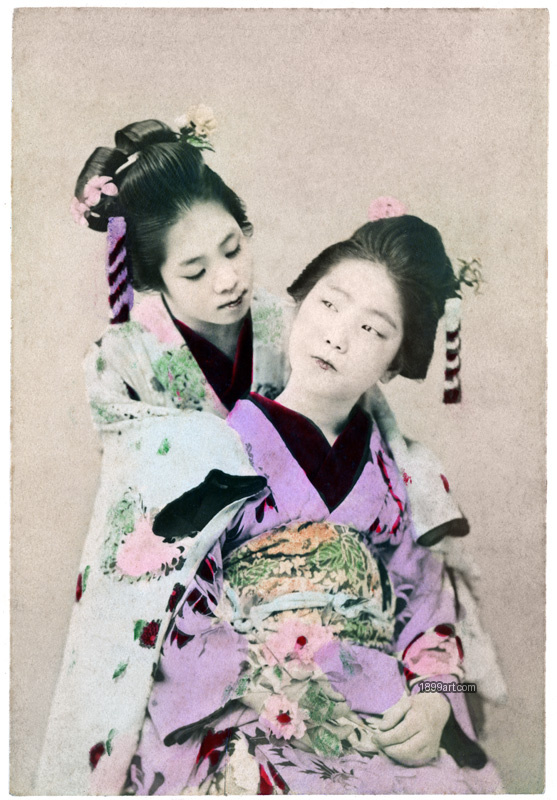
1899art Two Meiko in an Intimate Studio Pose, Japan, Meiji Period (c. 1890s) Handcolored 1900s 1899art
From the 1899art Archive: This hand-colored Japanese studio photograph depicts two meiko posed in close physical proximity, creating an unusually intimate and emotionally nuanced composition. One woman stands behind the other, gently leaning forward, while the seated figure turns her head slightly, her expression calm and introspective. Their elaborate hairstyles, floral hair ornaments, and richly patterned kimono are rendered with delicate hand-coloring, emphasizing texture, color harmony, and refined gesture against a plain studio background.
The closeness of the figures and the subtle interaction between them set this image apart from more conventional Yokohama School portraits, which typically favored frontal, individualized poses. The photograph originates from a contemporary album associated with Kusakabe Kimbei and appears to be otherwise undocumented in online or institutional collections, suggesting very limited circulation.
Japan · c. 1895–1910 · Hand-colored photograph
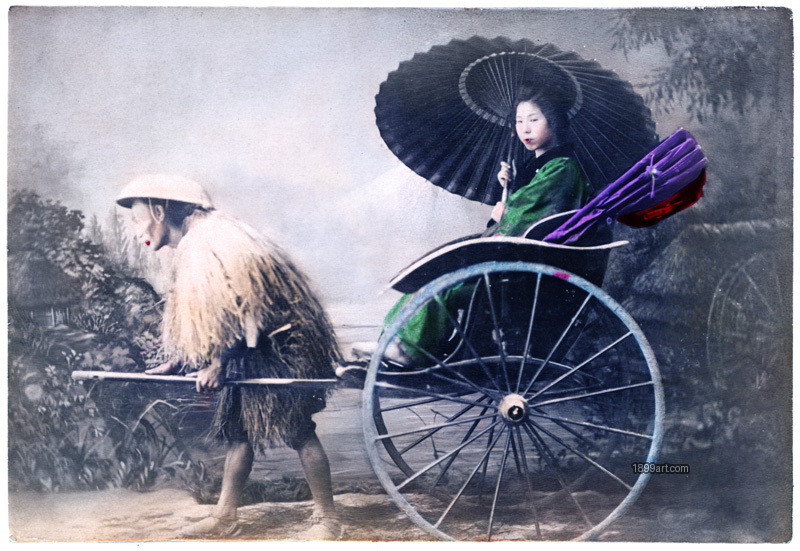
1899art Woman in a Jinrikisha with Parasol, Japan, Meiji Period (c. 1890s) Handcolored 1900s 1899art
From the 1899art Archive: This hand-colored Japanese photograph depicts a woman seated in a jinrikisha (rickshaw), holding a large paper parasol, while the puller moves forward along a rural path. The woman’s composed posture and elegant kimono contrast sharply with the bent stance and straw raincoat (mino) of the barefoot runner, emphasizing the social and physical divide inherent in this mode of transport. The large spoked wheel and the angled shaft of the rickshaw create a strong sense of motion within an otherwise carefully staged scene.
Rickshaw motifs were among the most popular subjects of Yokohama School photography, symbolizing mobility, modernity, and everyday life in late 19th-century Japan. The soft hand-coloring highlights garments, skin tones, and landscape details, lending the image a calm, idealized atmosphere despite its focus on labor and movement. The composition and catalog-style presentation are consistent with photographs distributed by studios associated with Kusakabe Kimbei, making this a representative yet increasingly rare example of Meiji-era export photography.
Japan · c. 1895–1910 · Hand-colored photograph
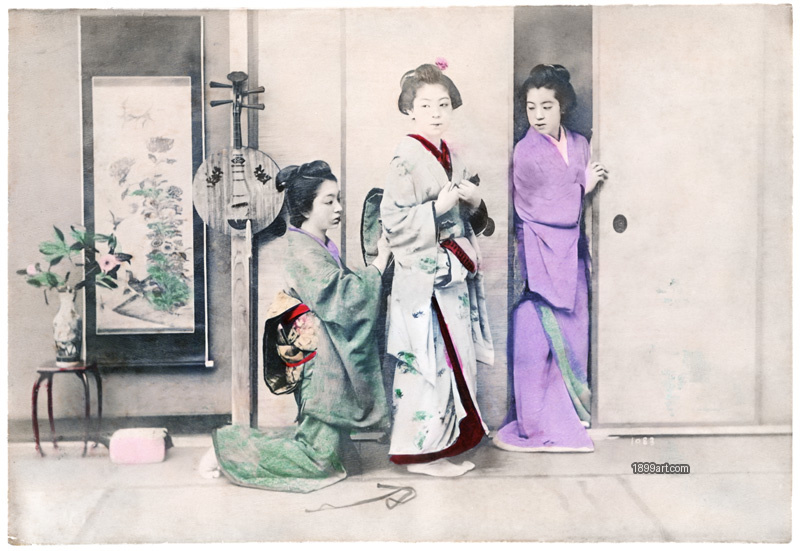
1899art Three Meiko in an Interior Scene with Shamisen, Japan, Meiji Period (c. 1890s) Handcolored 1900s 1899art
From the 1899art Archive: This hand-colored Japanese studio photograph depicts three meiko arranged in a carefully staged interior setting. One woman kneels in the foreground, attending to the garments of a standing figure dressed in a richly patterned kimono, while a third woman pauses at a sliding door, partially turned as if entering or leaving the room. The composition emphasizes layered interaction and controlled movement, guiding the viewer’s eye across the figures and the architectural elements of the space.
A shamisen rests against the wall beside a hanging scroll and a small decorative table, subtly introducing themes of music, refinement, and cultivated domestic life. Such scenes were characteristic of Yokohama School photography, blending theatrical staging with idealized representations of feminine elegance for foreign audiences. The catalogue-style presentation and visual language are consistent with photographs distributed by studios associated with Kusakabe Kimbei, making this image a refined example of late Meiji-era genre photography focused on interior life, gesture, and social presence.
Japan · c. 1895–1910 · Hand-colored photograph
1899art Two Maiko Seated in a Garden Setting, Japan, Meiji Period (c. 1890s) Handcolored 1900s 1899art
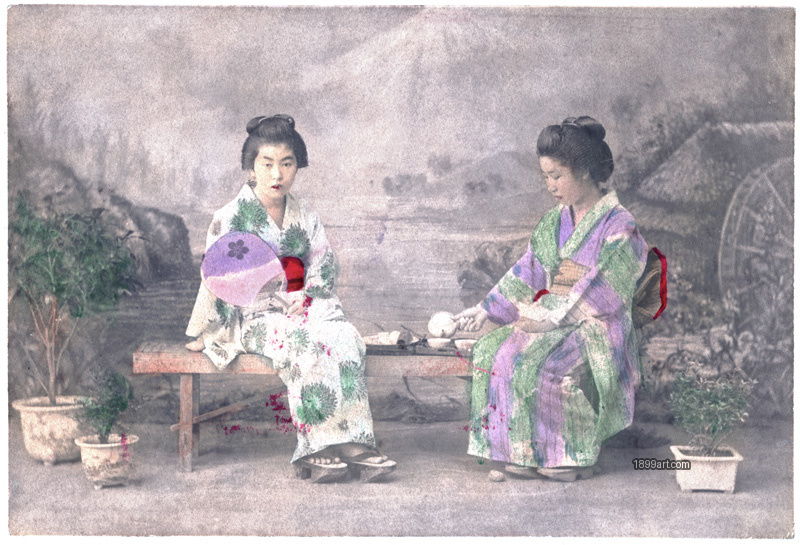
From the 1899art Archive: This hand-colored Japanese studio photograph depicts two young women clearly presented as maiko (apprentice geisha), seated side by side on a simple wooden bench. Their youthful appearance, brightly colored kimono, and distinctly red collars (eri) are characteristic markers of maiko status in the late Meiji period. One figure faces the viewer while holding a round fan, her composed gaze establishing a direct visual presence, while the other turns inward, engaged with small objects beside her, creating a quiet contrast between outward display and inward focus.
The setting is carefully staged to evoke a garden environment, with potted plants and a painted landscape backdrop framing the figures. Rather than depicting narrative action, the composition emphasizes elegance, balance, and controlled gesture—qualities closely associated with maiko as symbols of refinement, youth, and cultural cultivation.
Japan · c. 1895–1910 · Hand-colored photograph
1899art Two Maiko Reading a Letter, Japan, Meiji Period (c. 1890s) Handcolored 1900s 1899art
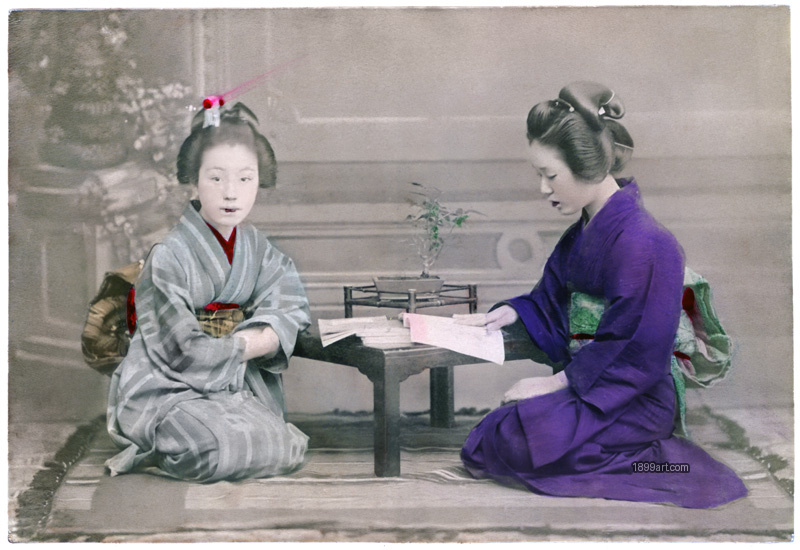
From the 1899art Archive: This hand-colored Japanese studio photograph depicts two young women presented as maiko (apprentice geisha), kneeling opposite one another at a low table. Their youthful faces, formal hairstyles, vividly colored kimono, and red collars (eri) clearly signal maiko status. One figure looks outward toward the viewer, while the other concentrates on a folded letter held in her hands, introducing a quiet narrative moment centered on reading and exchange.
The restrained interior setting—defined by a low table with a small plant and minimal furnishings—focuses attention on gesture, posture, and interaction rather than environment. The scene emphasizes composure, refinement, and cultivated literacy, qualities closely associated with maiko training.
Japan · c. 1895–1910 · Hand-colored photograph
1899art Portrait of a Maiko with Fan, Japan, Meiji Period (c. 1890s) Handcolored 1900s 1899art
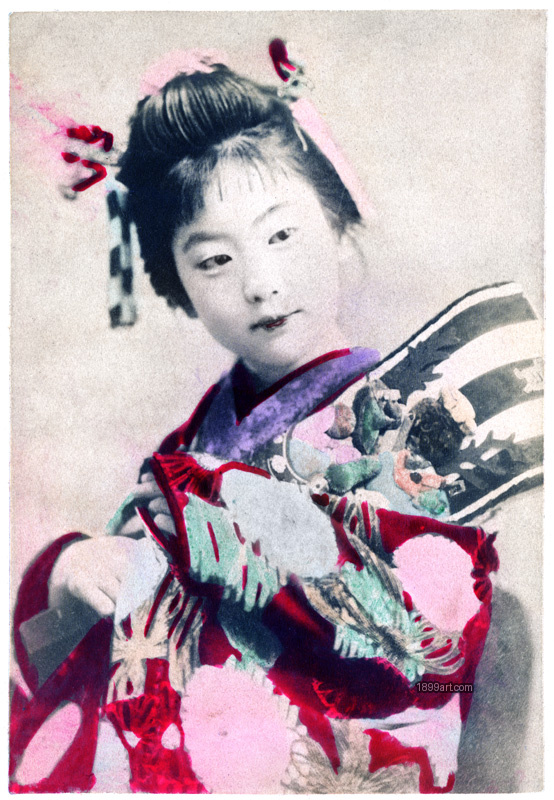
From the 1899art Archive: This hand-colored Japanese studio portrait depicts a young woman clearly presented as a maiko (apprentice geisha). Her youthful facial features, elaborate hairstyle adorned with hair ornaments, and the distinctly red collar (eri) are defining markers of maiko status in the late Meiji period. She holds an open folding fan decorated with a bold floral motif, which becomes a central visual element of the composition.
The close framing and neutral background focus attention on expression, costume, and gesture rather than setting. The slightly tilted head and soft, attentive gaze convey poise and cultivated elegance, qualities central to the visual representation of maiko for both domestic and foreign audiences. Such portraits were commonly produced within Yokohama School studio photography, where maiko embodied ideals of youth, artistry, and refined femininity. The image stands as a particularly intimate and finely composed example of late 19th-century Japanese studio portraiture.
Contact & Credits
Purpose of this site
YokohamaSchool.org is intended as a reference and context resource for the history and surviving works of the Yokohama School of hand-colored photography.
It does not claim to be complete and will be expanded over time.
Focus
Historical research, visual analysis, digital preservation and curated examples of original works from the period c. 1860–1920.
This website is currently in its early phase. Further sections on sources, studios and bibliography will follow.
YokohamaSchool.org is part of the wider 1899art project:
www.1899art.com.
Usage Rights & Legal Notice – 1899art Archive
All images published on 1899art.com originate from the 1899art Archive and are provided for cultural, educational, and historical reference purposes only.
Permitted use
Images may be linked, embedded, or shared on external websites and platforms exclusively in their original, unmanipulated form, provided that:
– the source is clearly credited as “1899art”, and
– a visible and clickable link to https://1899art.com accompanies the image.
Prohibited use
Any form of modification, including but not limited to cropping, retouching, recoloring, compositing, filtering, AI-based processing, or the creation of derivative works, is strictly prohibited without prior written permission.
Commercial use, resale, redistribution as standalone files, or inclusion in third-party archives or databases is also not permitted without explicit authorization.
Rights status
While the original photographs may be in the public domain due to age, the digital reproductions, curatorial selection, restoration decisions, metadata, and contextual presentation are the intellectual property of the 1899art Archive.
By using images from this website, you agree to respect these conditions. Automated downloading, scraping, or use of images for machine learning or AI training purposes is expressly prohibited.
EU / International Copyright Notice
All images published by the 1899art Archive are protected under European and international copyright law.
Any reproduction, redistribution, modification, AI-based processing, or commercial use beyond the explicitly permitted low-resolution web sharing is prohibited without prior written consent of the 1899art Archive.
This applies equally to high-resolution files obtained through unauthorized access, third-party leaks, or archival reproductions.
DMCA Copyright Notice & Protection
All images and digital files published by the 1899art Archive are protected by international copyright law and the Digital Millennium Copyright Act (DMCA).
Unauthorized reproduction, distribution, modification, AI processing, or commercial use of any image or high-resolution file from the 1899art Archive is strictly prohibited.
The unauthorized possession or dissemination of high-resolution files does not constitute a license and does not grant any rights of use.
Any infringement will result in DMCA takedown notices, platform removal requests, and, where applicable, legal action.